2491514 Search Results

FLO4613607: Common Tern. Sterna hirundo. Copper engraving by Edward Donovan (1768-1837), published in Histoire naturelle des oiseaux britanniques, London, 1794-1819., Donovan, Edward (1768-1837) / Bridgeman Images

LRI4610960: The Philosophers Wood (oil on canvas, 1645-1648), Rosa, Salvator (1615-73) / Bridgeman Images

FLO4611538: Base of the skull, human teeth, knee cap (after Clopton Havers), mucus gland, etc. Copperplate engraving by Robert Benard from Denis Diderot's Encyclopedia, Pellet, Geneva, 1779. / Bridgeman Images

FLO4614555: Mediterranean sand smelt or European atherine, Atherina hepsetus. Handcoloured copperplate drawn and engraved by Edward Donovan from his Natural History of British Fishes, Donovan and F.C. and J. Rivington, London, 1802-1808., Donovan, Edward (1768-1837) / Bridgeman Images

OMG4599629: Drugstore Publicis Saint Germain in Paris, launched in 1965 to ceder the place in 2002 to the fashion emperor Armani. / Bridgeman Images

OMG4596999: Musee Jacquemart Andre, boulevard Haussmann, Paris 8th arrondissement. Construction 1869-1875, architect Henri Parent (1819-1895). / Bridgeman Images

OMG4599685: Renovation of the glass court of the Palais des Etudes des Beaux-Arts in Paris. The courtyard is an extraordinary architectural ensemble designed by Felix Duban (1798-1870) during the 1830s. In 1867, in order to protect the carving castings from the Musee du Louvre, this courtyard was covered with a glass on a metal frame which then constituted all its wealth. At the death of Felix Duban, Ernest Coquart (1831-1903) took over the construction site by covering the facades of a polychrome decor from Italian inspiration. The Palais des Etudes is an exceptional testimony of 19th century architecture. With the Cour vitree, Felix Duban completed the formidable educational program. In 1970, most of the castings were transferred to the Petite stables of the Chateau de Versailles. For its reopening in April 2009, after two years of construction, the school welcomes Giuseppe Penone's sculpture “Matrix de Seve””. It is a tree of 24 meters cut in its length and whose hollow heart is covered with seve. Photography 03/06/09. / Bridgeman Images

OMG4599767: Renovation of the glass court of the Palais des Etudes des Beaux-Arts in Paris. The courtyard is an extraordinary architectural ensemble designed by Felix Duban (1798-1870) during the 1830s. In 1867, in order to protect the carving castings from the Musee du Louvre, this courtyard was covered with a glass on a metal frame which then constituted all its wealth. At the death of Felix Duban, Ernest Coquart (1831-1903) took over the construction site by covering the facades of a polychrome decor from Italian inspiration. The Palais des Etudes is an exceptional testimony of 19th century architecture. With the Cour vitree, Felix Duban completed the formidable educational program. In 1970, most of the castings were transferred to the Petite stables of the Chateau de Versailles.Photography 03/06/09. / Bridgeman Images

OMG4596991: Musee Jacquemart Andre, boulevard Haussmann, Paris 8th arrondissement. Construction 1869-1875, architect Henri Parent (1819-1895). / Bridgeman Images

MDA4599501: Le Cafe de Flore, 172 boulevard Saint Germain, Paris 6th arrondissement., Denance, Michel / Bridgeman Images

MDA4599572: Real estate in Paris. Photography 2005., Denance, Michel / Bridgeman Images

MDA4599617: Building facade, Real estate in Paris. 2005 photography., Denance, Michel / Bridgeman Images

OMG4599702: Renovation of the glass court of the Palais des Etudes des Beaux-Arts in Paris. The courtyard is an extraordinary architectural ensemble designed by Felix Duban (1798-1870) during the 1830s. In 1867, in order to protect the carving castings from the Musee du Louvre, this courtyard was covered with a glass on a metal frame which then constituted all its wealth. At the death of Felix Duban, Ernest Coquart (1831-1903) took over the construction site by covering the facades of a polychrome decor from Italian inspiration. The Palais des Etudes is an exceptional testimony of 19th century architecture. With the Cour vitree, Felix Duban completed the formidable educational program. In 1970, most of the castings were transferred to the Petite stables of the Chateau de Versailles.Photography 03/06/09. / Bridgeman Images

OMG4596996: Hotel Crillon, Place de la Concorde, Paris 8th arrondissement. The building on the right was purchased in 1788 by the Count of Crillon. And it was not until 1907 that the Societe des department stores du Louvre overhauled the hotel to bring it into one of the most beautiful Parisian palaces. Architect Jacques Ange Gabriel (1698-1782), construction 1766-1775. / Bridgeman Images

OMG4599716: Renovation of the glass court of the Palais des Etudes des Beaux-Arts in Paris. The courtyard is an extraordinary architectural ensemble designed by Felix Duban (1798-1870) during the 1830s. In 1867, in order to protect the carving castings from the Musee du Louvre, this courtyard was covered with a glass on a metal frame which then constituted all its wealth. At the death of Felix Duban, Ernest Coquart (1831-1903) took over the construction site by covering the facades of a polychrome decor from Italian inspiration. The Palais des Etudes is an exceptional testimony of 19th century architecture. With the Cour vitree, Felix Duban completed the formidable educational program. In 1970, most of the castings were transferred to the Petite stables of the Chateau de Versailles.Photography 03/06/09. / Bridgeman Images

OMG4597093: The Royal Village in Paris. / Bridgeman Images

OMG4599791: Renovation of the glass court of the Palais des Etudes des Beaux-Arts in Paris. The courtyard is an extraordinary architectural ensemble designed by Felix Duban (1798-1870) during the 1830s. In 1867, in order to protect the carving castings from the Musee du Louvre, this courtyard was covered with a glass on a metal frame which then constituted all its wealth. At the death of Felix Duban, Ernest Coquart (1831-1903) took over the construction site by covering the facades of a polychrome decor from Italian inspiration. The Palais des Etudes is an exceptional testimony of 19th century architecture. With the Cour vitree, Felix Duban completed the formidable educational program. In 1970, most of the castings were transferred to the Petite stables of the Chateau de Versailles.Photography 03/06/09. / Bridgeman Images

OMG4597048: The Alexandre III Bridge in Paris. Tsar Alexander III of Russia (1845-1894) laid the first stone of the bridge in 1886, which was to be completed for the 1900 World Expo. One of the most beautiful bridges in Paris has a single-flight metal structure. / Bridgeman Images

MDA4599549: Le Cafe de Flore, 172 boulevard Saint Germain, Paris 6th arrondissement., Denance, Michel / Bridgeman Images

MDA4596958: Detail of iron works of a window of the PeuPalais, Paris 8th arrondissement. The Peure Palais building was built by Charles Girault (1851-1932) for the 1900 World Exhibition. It is now home to the Musee des Beaux Arts of the City of Paris, which includes many works of Antiquite in the 19th century., Denance, Michel / Bridgeman Images

MDA4596947: Entreement grid of the PeuPalais, avenue Winston Churchill, Paris 8th arrondissement. The Peure Palais building was built by Charles Girault (1851-1932) for the 1900 World Exhibition. It is now home to the Musee des Beaux Arts of the City of Paris, which includes many works of Antiquite in the 19th century., Denance, Michel / Bridgeman Images

RCT4597220: Le Fouquet's, Avenue des Champs Elsyees in Paris., Castan, Remy / Bridgeman Images

PIX4597684: Apollo 16: The command module seen from the LEM - LM ascent stage approaching CSM - The command module of Apollo 16 seen from the LEM before its mooring. 23 April 1972. (23 April 1972) The Apollo Command and Service Modules (CSM) “” Casper”” approaches the Lunar Module (LM) Orion, from which this photograph was made. The two spacecraft are about to make their final rendezvous of the mission, on April 23, 1972. Astronauts John W. Young and Charles M. Duke Jr. aboard the LM, were returning to the CSM, in lunar orbit, after three successful days on the lunar surface. Astronaut Thomas K. (Ken) Mattingly II, command module pilot, remained with the CSM in lunar orbit, while Young and Duke descended in the LM to explore the Descartes region of the Moon / Bridgeman Images

PIX4598221: Apollo 17: E. Cernan in LEM - Apollo 17: E. Cernan inside the LM after EVA. Dec 13 1972 - Eugene Cernan in the LEM after his third extravehicular release. 13/12/1972. Astronaut Eugene A. Cernan, Apollo 17 commander, is photographed inside the lunar module on the lunar surface following the third extravehicular activity (EVA - 3) of his mission. Note lunar dust on his suit / Bridgeman Images

PIX4599254: Shooting Star - Meteor - A shooting star passes through the star sky. September 28, 2011. A meteor seen on September 28, 2011 / Bridgeman Images

PIX4595555: N. Armstrong en formation - Neil Armstrong during a training exercise - Mission Apollo 11: Neil Armstrong en scacphandre during a training exercise. 22/04/1969. Astronaut Neil A. Armstrong, wearing an Extravehicular Mobility Unit, participates in a simulation of deploying and using lunar tools on the surface of the moon during a training exercise in Building 9 on April 22, 1969. Armstrong is the commander of the Apollo 11 lunar landing mission. In the background is a Lunar Module mock - up / Bridgeman Images
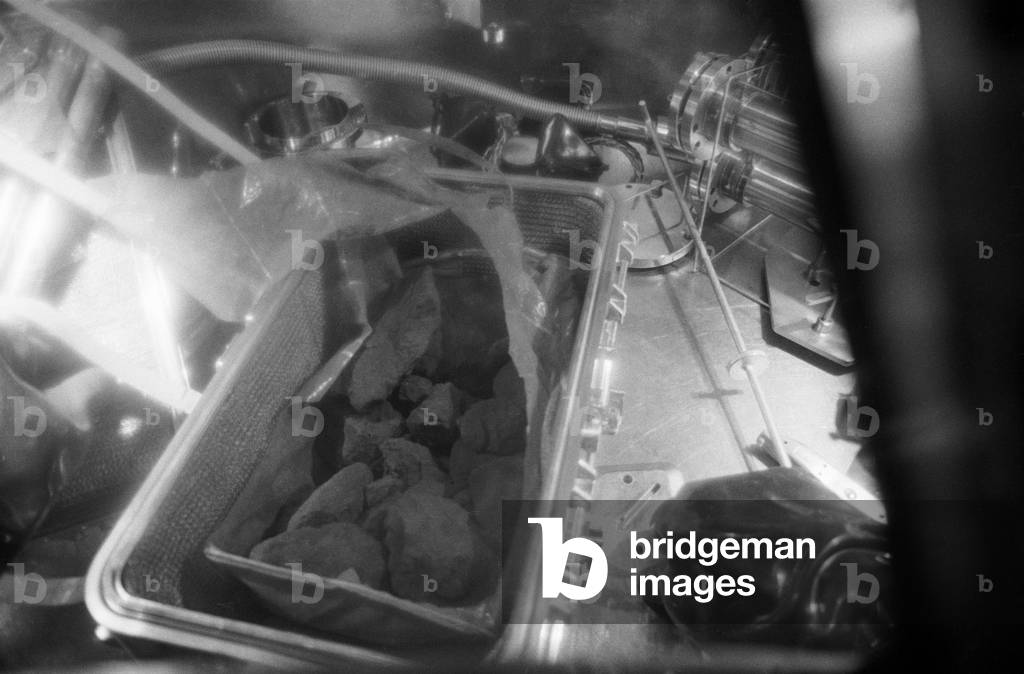
PIX4596351: Apollo 11: lunar rock - Apollo 11: lunar rock - Close up of lunar rocks contained in the first container of samples brought by astronauts from the Apollo 11 mission. 26 July 1969. A close - up view of the lunar rocks contained in the first Apollo 11 sample return container. The rock box was opened for the first time in the Vacuum Laboratory of the Manned Spacecraft Center's Lunar Receiving Laboratory, Building 37, at 3:55 p.m. (CDT), Saturday, July 26, 1969. The gloved hand gives an indication of size. This box also contained the Solar Wind Composition experiment (not shown) and two core tubes for subsurface samples (not shown). These lunar samples were collected by astronauts Neil A. Armstrong and Edwin E. Aldrin Jr. during their lunar surface extravehicular activity on July 20, 1969. 26 July 1969 / Bridgeman Images

PIX4595347: Crew Apollo 10 - Apollo 10 crew - The crew of Apollo 10, from left to right astronauts Eugene A. Cernan, Thomas P. Stafford and John W. Young. 03/04/1969. The prime crew of the Apollo 10 mission at the Kennedy Space Center. Left to right: Eugene A. Cernan, Lunar Module pilot; Thomas P. Stafford, Commander and John W. Young, Command Module pilot. Apr 03 1969 / Bridgeman Images

PIX4597382: Apollo 15: Roche de la Genese - Apollo 15: the Genesis Rock - Roche de la Genese, (Genesis Rock): 269 gram meteorite found on the Moon by the crew of the Apollo 15 mission. It would be 4.1 billion years old. Lunar Receiving Lab photo of sample 15415, a 269 gram piece of pure anorthosite - dubbed the 'Genesis Rock' by the press - that Apollo 15 astronauts collected at Spur Crater. This rock would be 4 billion years old / Bridgeman Images

PIX4598217: Apollo 17: E. Cernan on the Moon - Apollo 17: E. Cernan at the Lunar Rover Vehicle - E.Cernan and the lunar jeep near Lem. 13/12/1972. Cernan at the Rover prior to EVA - 3 geology traverse. Dec 13 1972 / Bridgeman Images
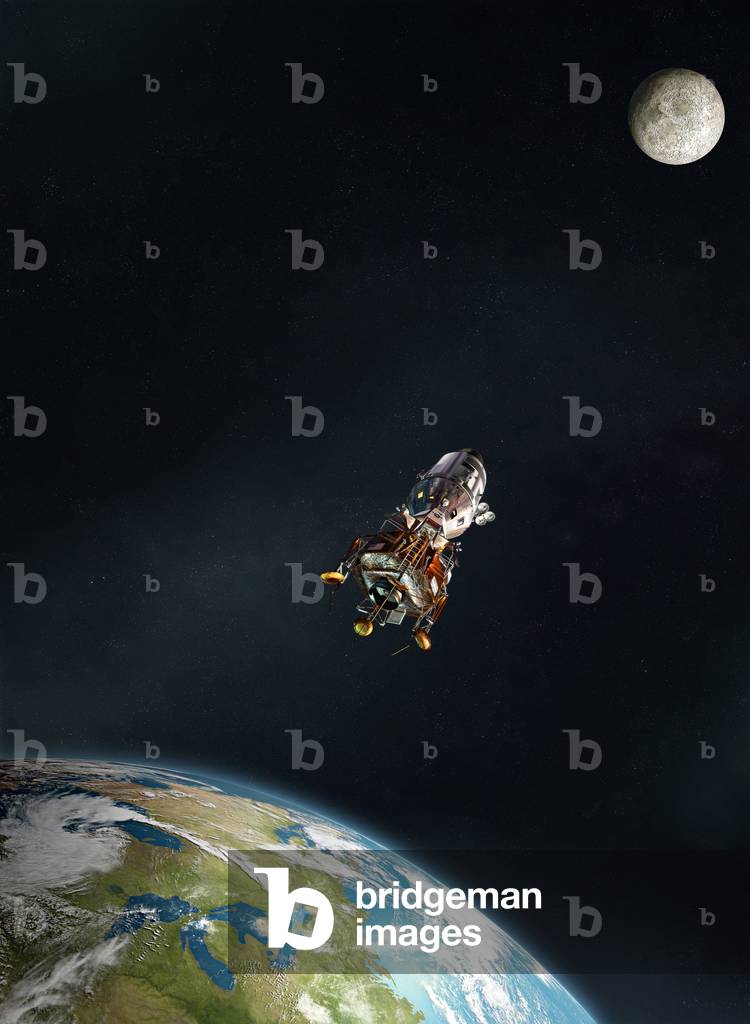
PIX4596442: Missions Apollo - Artist view - Apollo program - Artist view - The LEM and the control module en route to the Moon. The Lunar Excursion Module attached to the Command and Service Module in their journey to the Moon / Bridgeman Images

PIX4599822: ISS: modules Unity and Zarya 12/1998 - ISS: modules Unity and Zarya 12/1998 - Assembly of module Unity a Zarya. 15/12/1998 In December 1998, the crew of Space Shuttle Mission STS - 88 began construction of the International Space Station, joining the U.S. - built Unity node to the Russian - built Zarya module. The crew carried a large - format IMAX camera from which this picture was taken. With Unity in place, Astronaut Nancy Currie begins positioning Zarya for mating / Bridgeman Images

PIX4599929: ISS: Unity, Zarya and Zvezda modules. 09/2000 - ISS: Unity, Zarya and Zvezda modules. 09/2000 - Unity, Zarya and Zvezda modules photographs from the Atlantis shuttle. 18/09/2000 Backdropped against black space above Earth's horizon, the International Space Station (ISS) is seen following its undocking with the Space Shuttle Atlantis. After accomplishing all mission objectives in outfitting the station for the first resident crew, the seven astronauts and cosmonauts undocked at 3:46 GMT on Sept. 18 over Russia near the northeastern portion of the Ukraine. When Atlantis was at a safe distance from the station, about 450 feet, astronaut Scott D. Altman, pilot, performed a 90 - minute, double - loop fly around to enable the crew to document the station's exterior. He fired Atlantis' jets one final time to separate from the station at 5:35 (GMT) September 18 2000 / Bridgeman Images

PIX4597227: Crew Apollo 15 - Apollo 15 crew - From left to right: David R. Scott (commander), Alfred M. Worden (control module pilot) and James B. Irwin (lunar module pilot) in front of the emblem of Apollo 15. 28/06/1971. From left to right: David R. Scott, Commander, Alfred M. Worden, Command Module pilot and James B. Irwin, Lunar Module pilot in front of the Apollo 15 emblem. Jun 28 1971 / Bridgeman Images

PIX4597125: Apollo 14: E. Mitchell on the Moon - Apollo 14: E. Mitchell moonwalk - Extravehicular release of Edgar Mitchell with a map. 05/02/1971. Astronaut Edgar D. Mitchell, lunar module pilot, moves across the lunar surface as he looks over a traverse map during an extravehicular activity (EVA). Lunar dust can be seen clinging to the boots and legs of the space suit. Astronauts Alan B. Shepard Jr., commander, and Mitchell explored the lunar surface while astronaut Stuart A. Roosa, command module pilot, orbited the moon in the Command and Service Modules (CSM) / Bridgeman Images

PIX4597680: Apollo 16: the LEM en approche du module de commande - Apollo 16: LM ascent stage approaching CSM - Le LEM en approche du module de commande d'Apollo 16. 23/04/1972. (23 April 1972) The ascent stage of the Apollo 16 Lunar Module (LM) approaches the Command and Service Modules (CSM) during rendezvous, with a contrasting background of darkness and the Sea of Fertility (Mare Fecundatatis). Taken from the CSM, the photo shows the aft side of the LM during a yaw maneuver. Note the buckled thermal panels. Messier and Messier A (right center) are among the most readily identifiable features on the surface below / Bridgeman Images
