Print Friendly Version Page

2502127 Search Results

Residential building, Avenue des Cretes, Cannicio Quarter in Ajaccio, South Corsica. Photography 17/08/07.

TEC4582884: Residential building, Avenue des Cretes, Cannicio Quarter in Ajaccio, South Corsica. Photography 17/08/07. / Bridgeman Images

Remains of the supernova of the Sails - Detail - Vela supernova remnant. Detail - Detail of the rest of the supernova of the Sails. The supernova exploded 12,000 years ago. A supernova event marks the catastrophic end - point in the life of a massive star. The self - destruction of the star releases a huge amount of energy as radiation of all kinds, but a substantial fraction of the force of the explosion blasts the outer part of the supernova into an expanding shell of matter that travels through the almost empty space between the stars. As the rapidly moving blast wave encounters the relatively stationary interstellar medium it creates a very narrow, luminous shock front that appears as a faint nebula. Because the shock front is very convoluted the nebulosity appears to be highly structured and the various colours define different energy levels within the interaction. Although the star responsible for the Vela supernova remnant exploded 12,000 years ago, it is still affecting its environment

PIX4582885: Remains of the supernova of the Sails - Detail - Vela supernova remnant. Detail - Detail of the rest of the supernova of the Sails. The supernova exploded 12,000 years ago. A supernova event marks the catastrophic end - point in the life of a massive star. The self - destruction of the star releases a huge amount of energy as radiation of all kinds, but a substantial fraction of the force of the explosion blasts the outer part of the supernova into an expanding shell of matter that travels through the almost empty space between the stars. As the rapidly moving blast wave encounters the relatively stationary interstellar medium it creates a very narrow, luminous shock front that appears as a faint nebula. Because the shock front is very convoluted the nebulosity appears to be highly structured and the various colours define different energy levels within the interaction. Although the star responsible for the Vela supernova remnant exploded 12,000 years ago, it is still affecting its environment / Bridgeman Images

The Man of Hiroshima Detail. Series of ten panels constituting the tapestry 'Le Chant du Monde', 1956, 1961 (tapestry)

JLJ4582931: The Man of Hiroshima Detail. Series of ten panels constituting the tapestry 'Le Chant du Monde', 1956, 1961 (tapestry), Lurcat, Jean (1892-1966) / Bridgeman Images
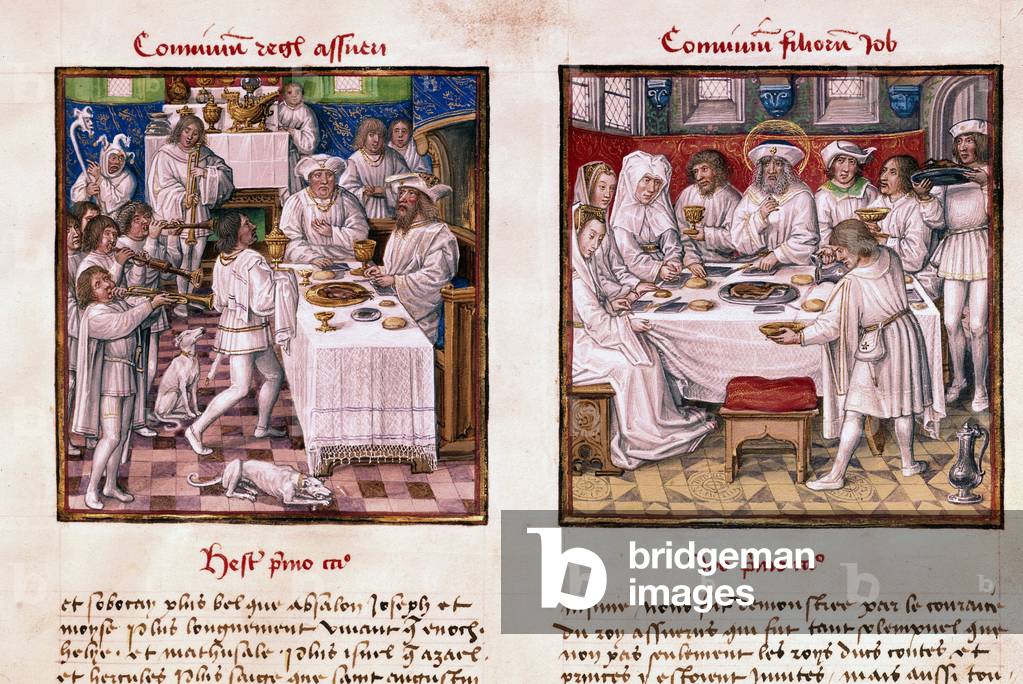
On the left the feast of Assuerus 1st . On the right, the feast of the children of Job, from the manuscript 'Le Miroir de l'humaine salvation' 15th centur (miniature)

JLJ4582963: On the left the feast of Assuerus 1st . On the right, the feast of the children of Job, from the manuscript 'Le Miroir de l'humaine salvation' 15th centur (miniature), Unknown Artist, (15th century) / Bridgeman Images

The Last Judgment Down Satan devore the souls of the damns - Detail of the mosaics,  ca1270

LRI4582984: The Last Judgment Down Satan devore the souls of the damns - Detail of the mosaics, ca1270, Coppo di Marcovaldo (fl.1225/30-after 1274) / Bridgeman Images

Les Dromonts in Avoriaz (Haute Savoie) Architect Jacques Labro 1967.

ITR4582285: Les Dromonts in Avoriaz (Haute Savoie) Architect Jacques Labro 1967. / Bridgeman Images
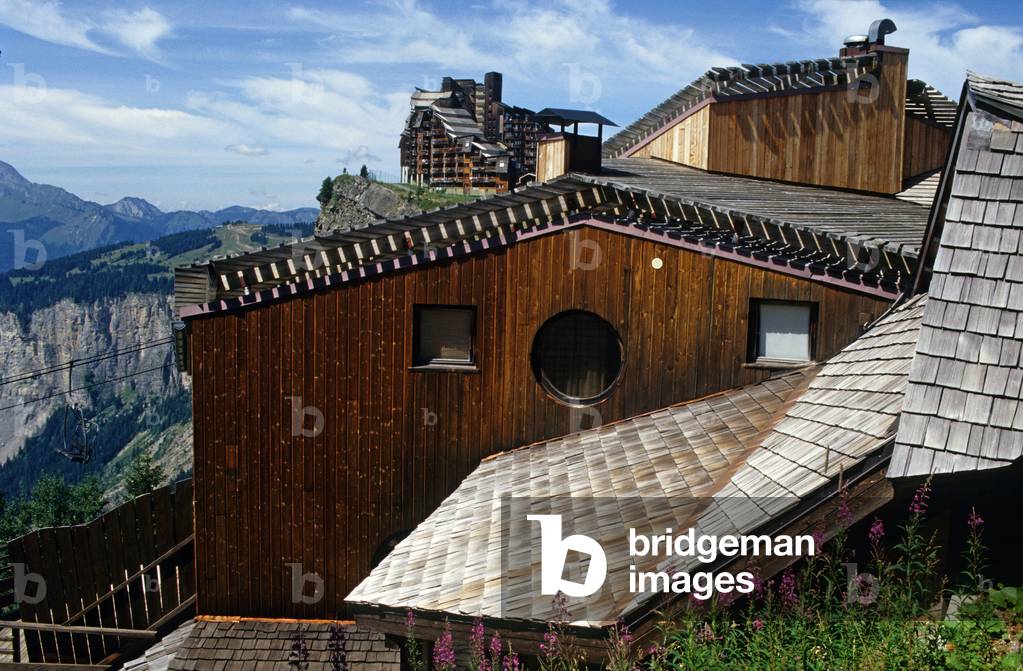
Avoriaz (Haute Savoie) Architects Jacques Labro and Jean Jacques Orzoni, 1966.

ITR4582295: Avoriaz (Haute Savoie) Architects Jacques Labro and Jean Jacques Orzoni, 1966., Labro, Jacques (b.1935) & Orzoni, Jean-Jacques (1935-2009) / Bridgeman Images

Residence La Cascade aux Arcs 1600 (Savoie). Architects Atelier d'architecture en montagne, 1968, Bernard Taillefer, Gaston Regairaz and Guy Rey Millet, Charlotte Perriand (furniture) Jean Prove (Ingenieur). The resort of Les Arcs was awarded the Heritage of the 20th century in 2006. Les Arcs are the full-scale illustration of the designs of the architect and designer Charlotte Perriand who coordinated all the teams of architects, engineers and graphic designers with the collaboration of Roger Godino, founder and promoter of the resort in 1968.

ITR4583255: Residence La Cascade aux Arcs 1600 (Savoie). Architects Atelier d'architecture en montagne, 1968, Bernard Taillefer, Gaston Regairaz and Guy Rey Millet, Charlotte Perriand (furniture) Jean Prove (Ingenieur). The resort of Les Arcs was awarded the Heritage of the 20th century in 2006. Les Arcs are the full-scale illustration of the designs of the architect and designer Charlotte Perriand who coordinated all the teams of architects, engineers and graphic designers with the collaboration of Roger Godino, founder and promoter of the resort in 1968., Perriand, Charlotte (1903-99) / Bridgeman Images
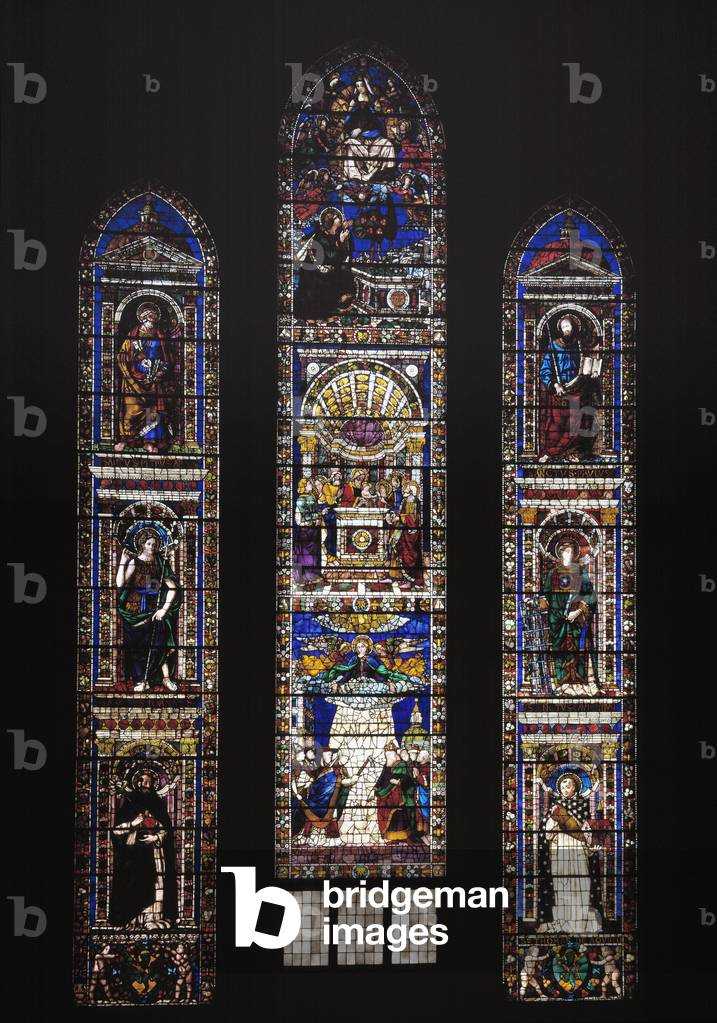
Presentation to the temple, triumph of the Virgin, St Peter, St John the Baptist, St Paul, St Lawrence, St Thomas Aquinas. Stained glass, 1492

LRI4583271: Presentation to the temple, triumph of the Virgin, St Peter, St John the Baptist, St Paul, St Lawrence, St Thomas Aquinas. Stained glass, 1492, Agolanti, Alessandro (15th century) / Bridgeman Images

Old man's head, 16th century (drawing)

JLJ4582614: Old man's head, 16th century (drawing), Titian (Tiziano Vecellio) (c.1488-1576) / Bridgeman Images

Representation of a new balloon, c.1785 (engraving)

JLJ4583319: Representation of a new balloon, c.1785 (engraving), Dighton, Robert (1752-1814) / Bridgeman Images

Feast given in honor of Maria Teresa, empress of Austria, the future emperor Joseph II and his wife, Isabella of Parma, on 10/10/1760. Detail, 1760 (painting)

LRI4582676: Feast given in honor of Maria Teresa, empress of Austria, the future emperor Joseph II and his wife, Isabella of Parma, on 10/10/1760. Detail, 1760 (painting), Mytens or Meytens, Martin van (1695-1770) / Bridgeman Images

Detail of the Swan Lace - NGC 6992 and NGC 6995 are the eastern part of the Swan lace, a remnant of supernova located in the constellation Swan

PIX4582723: Detail of the Swan Lace - NGC 6992 and NGC 6995 are the eastern part of the Swan lace, a remnant of supernova located in the constellation Swan / Bridgeman Images

Les Dentelles du Cygne - Detail - NGC 6960 - The Veil Nebula, NGC 6960 - Part of the rest of the supernova of the Dentelles du Swan lies about 1500 years - light from Earth. Ten thousand years ago a star exploded. The supernova remnant is called the Veil Nebula. Here is the west end of the Veil Nebula known as NGC 6960 or the Witch's Broom Nebula. The rampaging gas gains its colors by impacting and exciting existing nearby gas. The supernova remnant lies about 1,400 light - years away towards the constellation of Cygnus. The bright star 52 Cygnus is visible with the unaided eye from a dark location but unrelated to the ancient supernova. The filaments in the right upper portion of the image is commonly called Pickering's Triangle. It was discovered in 1904 by Williamina Fleming of the Harvard Observatory while examining photographic plates of the region. The object was named in honor of her boss, astronomer Edward Charles Pickering

PIX4582769: Les Dentelles du Cygne - Detail - NGC 6960 - The Veil Nebula, NGC 6960 - Part of the rest of the supernova of the Dentelles du Swan lies about 1500 years - light from Earth. Ten thousand years ago a star exploded. The supernova remnant is called the Veil Nebula. Here is the west end of the Veil Nebula known as NGC 6960 or the Witch's Broom Nebula. The rampaging gas gains its colors by impacting and exciting existing nearby gas. The supernova remnant lies about 1,400 light - years away towards the constellation of Cygnus. The bright star 52 Cygnus is visible with the unaided eye from a dark location but unrelated to the ancient supernova. The filaments in the right upper portion of the image is commonly called Pickering's Triangle. It was discovered in 1904 by Williamina Fleming of the Harvard Observatory while examining photographic plates of the region. The object was named in honor of her boss, astronomer Edward Charles Pickering / Bridgeman Images
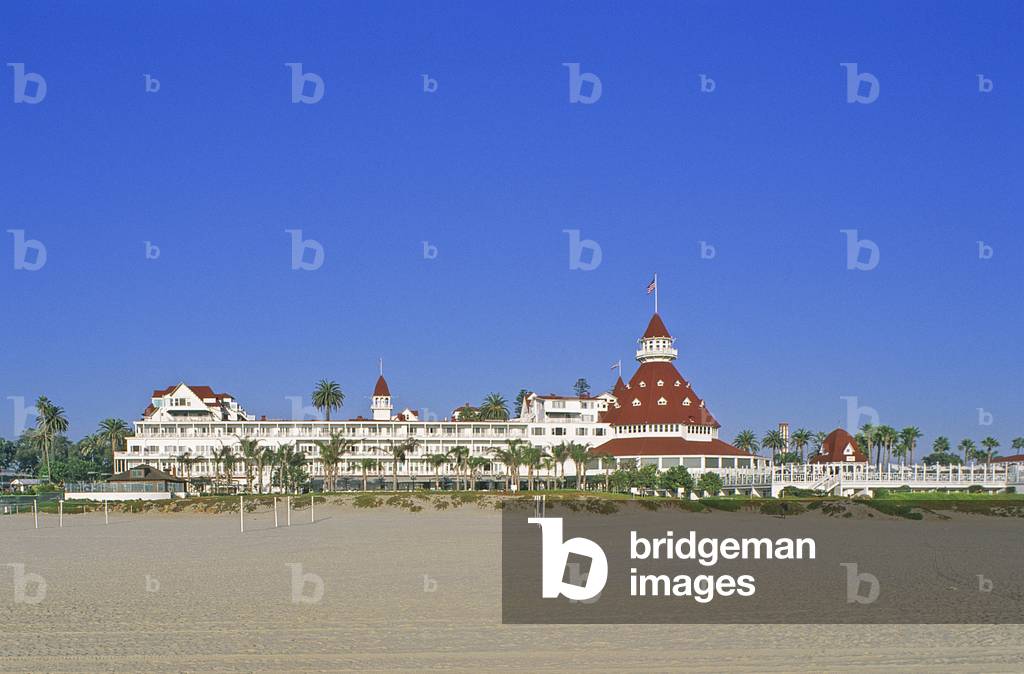
L'hotel del Coronado in San Diego (California, United States).

TEC4583722: L'hotel del Coronado in San Diego (California, United States). / Bridgeman Images

Bonifacio in Corsica. Photography 15/05/07.

TEC4582822: Bonifacio in Corsica. Photography 15/05/07. / Bridgeman Images

Portrait of children Calmady, 19th century (oil on canvas)

JLJ4582836: Portrait of children Calmady, 19th century (oil on canvas), Lawrence, Thomas (1769-1830) / Bridgeman Images

Grape harvest and transport page of illuminated manuscript from 'Book of Hours of the Duchess of Burgundy, Adelaide of Savoy', 1460-65 (illumination)

JLJ4583838: Grape harvest and transport page of illuminated manuscript from 'Book of Hours of the Duchess of Burgundy, Adelaide of Savoy', 1460-65 (illumination), Master of Jean Rolin II, (fl.1440-65) / Bridgeman Images

Hotel Charmettogger aux Arcs 1800 (Savoie). Architect Bernard Taillefer 1972. The resort of Les Arcs was awarded the Heritage of the 20th century in 2006. Les Arcs are the full-scale illustration of the designs of the architect and designer Charlotte Perriand who coordinated all the teams of architects, engineers and graphic designers with the collaboration of Roger Godino, founder and promoter of the resort in 1968.

ITR4583519: Hotel Charmettogger aux Arcs 1800 (Savoie). Architect Bernard Taillefer 1972. The resort of Les Arcs was awarded the Heritage of the 20th century in 2006. Les Arcs are the full-scale illustration of the designs of the architect and designer Charlotte Perriand who coordinated all the teams of architects, engineers and graphic designers with the collaboration of Roger Godino, founder and promoter of the resort in 1968., Perriand, Charlotte (1903-99) / Bridgeman Images
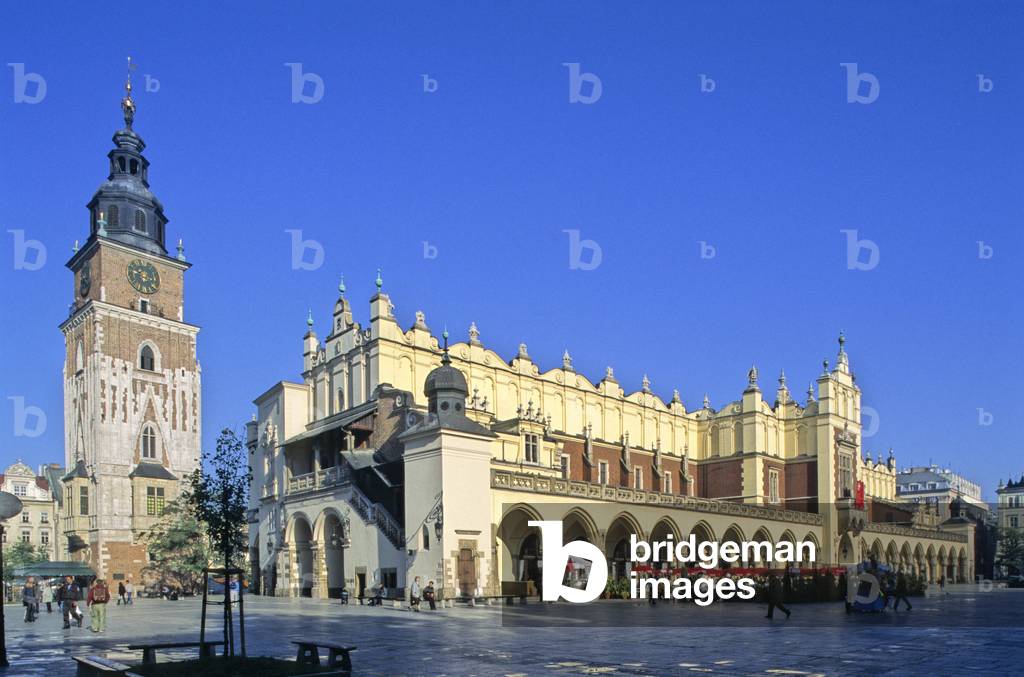
The Sheets Hall in Krakow, Poland.

MDA4583050: The Sheets Hall in Krakow, Poland. / Bridgeman Images

Remains of the Crab Supernova (M1) in the Taurus - Remains of the Crab Supernova (M1) in the Taurus - M1, the Crab Nebula, is the rest of a supernova that exploded in July or August 1054. It is located about 7000 light years from Earth in the constellation Taurus. At the heart of this nebula is a pulsar. In this photo we see a jet of material north of the nebula; this jet was discovered in 1970 but rarely appears in the images; it seems to follow the same rate of expansion as the whole nebula, but not on the same axis as the centre of the nebula, its presence remains a mystery. Image obtained with a 50 cm telescope, through various filters, total installation of almost 24 hours

PIX4583052: Remains of the Crab Supernova (M1) in the Taurus - Remains of the Crab Supernova (M1) in the Taurus - M1, the Crab Nebula, is the rest of a supernova that exploded in July or August 1054. It is located about 7000 light years from Earth in the constellation Taurus. At the heart of this nebula is a pulsar. In this photo we see a jet of material north of the nebula; this jet was discovered in 1970 but rarely appears in the images; it seems to follow the same rate of expansion as the whole nebula, but not on the same axis as the centre of the nebula, its presence remains a mystery. Image obtained with a 50 cm telescope, through various filters, total installation of almost 24 hours / Bridgeman Images

Chateau de Chambord (Loir et Cher). From 1519 and for more than thirty years, 1800 workers worked in the construction of Chambord. If the shadow of Leonard de Vinci (Leonardo di ser Piero da Vinci, 1452-1519) friend of the king and official architect hovers on the surprising double-revolution staircase, the author of this strange, yet uninhabitable residence is unknown.

LBY4583647: Chateau de Chambord (Loir et Cher). From 1519 and for more than thirty years, 1800 workers worked in the construction of Chambord. If the shadow of Leonard de Vinci (Leonardo di ser Piero da Vinci, 1452-1519) friend of the king and official architect hovers on the surprising double-revolution staircase, the author of this strange, yet uninhabitable residence is unknown., Boegly, Luc / Bridgeman Images

Star Line - Star trail

PIX4580402: Star Line - Star trail / Bridgeman Images

Caius Mucius Scaevola in front of Porsenna Caius Mucius Scaevola, plunges his hand into the fire. (Painting, 1545)

LRI4580512: Caius Mucius Scaevola in front of Porsenna Caius Mucius Scaevola, plunges his hand into the fire. (Painting, 1545), Tintoretto, Jacopo Robusti (1518-94) / Bridgeman Images

At the cafe, 1914 (oil on canvas)

JLJ4580528: At the cafe, 1914 (oil on canvas), Gris, Juan (1887-1927) / Bridgeman Images

Residential building (1984) on Unrinii Boulevard in Bucharest, Romania. The Boulevard of the Victory of Socialism (Boulevard Unrinii) was inaugurated by Nicolas Ceaucescu on 25 June 1984. Photography 10/10/05.

OMG4580544: Residential building (1984) on Unrinii Boulevard in Bucharest, Romania. The Boulevard of the Victory of Socialism (Boulevard Unrinii) was inaugurated by Nicolas Ceaucescu on 25 June 1984. Photography 10/10/05. / Bridgeman Images

Portrait of Justine Dieuhl - oil on cardboard, 1891

LRI4580573: Portrait of Justine Dieuhl - oil on cardboard, 1891, Toulouse-Lautrec, Henri de (1864-1901) / Bridgeman Images

Star Trails - Star Trails - Star Stars on Celestial Ecuador. Near the horizon, a shooting star. 13 August 2007. Star trails on the celestial equator. A meteor is visible near horizon. August 13 2007

PIX4580415: Star Trails - Star Trails - Star Stars on Celestial Ecuador. Near the horizon, a shooting star. 13 August 2007. Star trails on the celestial equator. A meteor is visible near horizon. August 13 2007 / Bridgeman Images

The interior of the Palace of Parliament (1984) (formerly the House of the People) in Bucharest, Romania. The House of the People and the Boulevard of the Victory of the Socialist was inaugurated by Nicolas Ceaucescu on 25 June 1984. This pharaonic project is the second largest building in the world after the Pentagon - 45,000 m2 of floor area, 400,000 m2 of living space. To build this palace, one fifth of the city was razed. The palace is now the palace of the parliament now serves as a chamber of deputes and senators. Photography 10/10/05.

OMG4580723: The interior of the Palace of Parliament (1984) (formerly the House of the People) in Bucharest, Romania. The House of the People and the Boulevard of the Victory of the Socialist was inaugurated by Nicolas Ceaucescu on 25 June 1984. This pharaonic project is the second largest building in the world after the Pentagon - 45,000 m2 of floor area, 400,000 m2 of living space. To build this palace, one fifth of the city was razed. The palace is now the palace of the parliament now serves as a chamber of deputes and senators. Photography 10/10/05., Petrescu, Anca (1949-2013) / Bridgeman Images
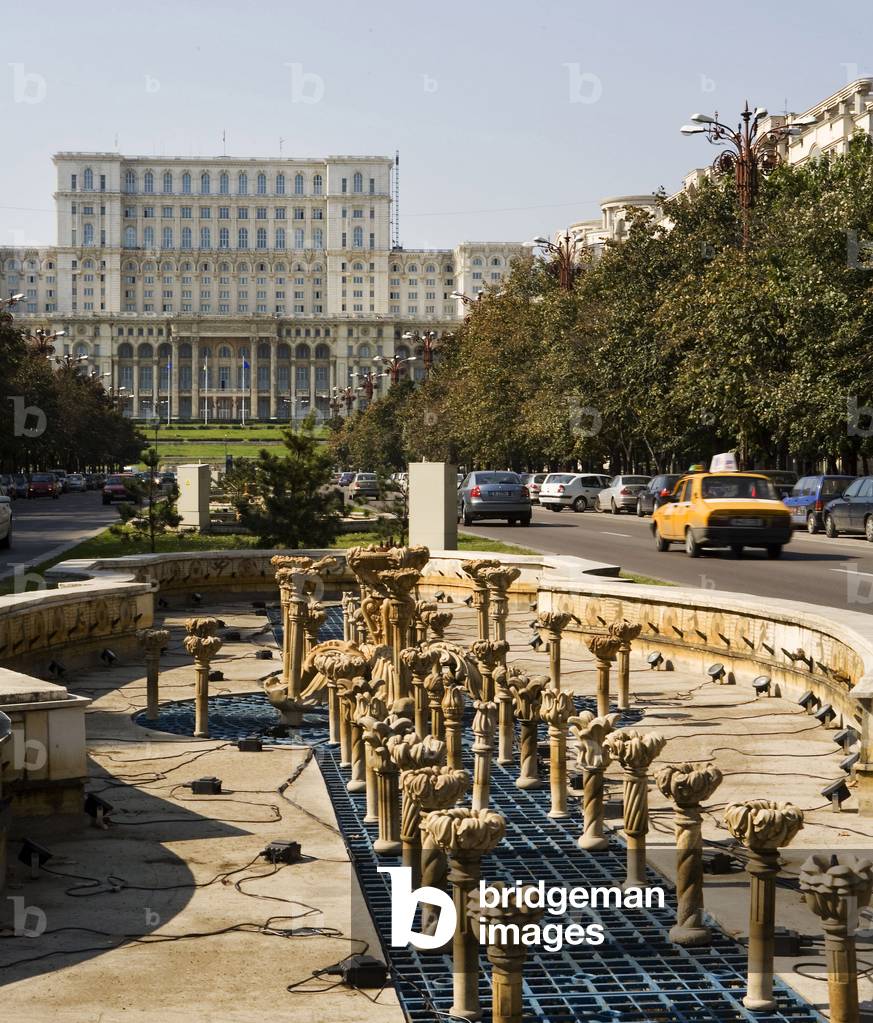
Public fountain on Boulevard Unirii in Bucharest, Romania, with the Parliament Palace in the background. Photography 10/10/05.

OMG4580776: Public fountain on Boulevard Unirii in Bucharest, Romania, with the Parliament Palace in the background. Photography 10/10/05., Petrescu, Anca (1949-2013) / Bridgeman Images

Synthesis (Painting, 1927-1929)

LRI4580854: Synthesis (Painting, 1927-1929), Kupka, Frantisek (1871-1957) / Bridgeman Images

Orion's belt rising over the lights of Coonabarabran - Photographic pose of several hours on the constellation Orion. From Siding Spring Mountain, Australia, there is a clear view to the eastern horizon, directly over the small town of Coonabarabran about 26 km from the telescopes. Here we see the three distinctive trails of Orion's belt rising above the town. The rightmost star of the line of three is Minkata, and it is within a degree of the celestial equator. The point on the horizon where it rises is very close to due east and similarly its setting point is almost exactly due west. Minkata has long been an important navigation star. and its trail is a straight line, while either side of Orion's belt, towards the celestial poles, the star trails become increasingly curved.

PIX4581099: Orion's belt rising over the lights of Coonabarabran - Photographic pose of several hours on the constellation Orion. From Siding Spring Mountain, Australia, there is a clear view to the eastern horizon, directly over the small town of Coonabarabran about 26 km from the telescopes. Here we see the three distinctive trails of Orion's belt rising above the town. The rightmost star of the line of three is Minkata, and it is within a degree of the celestial equator. The point on the horizon where it rises is very close to due east and similarly its setting point is almost exactly due west. Minkata has long been an important navigation star. and its trail is a straight line, while either side of Orion's belt, towards the celestial poles, the star trails become increasingly curved. / Bridgeman Images

Stars - The view to the north from Siding Spring - Photographic pose of several hours made in Australia; the northern Celestial pole is here 30 degrees below the horizon. As the Earth rotates beneath them the stars appear to drift across the sky from east to west. From a dark site, a camera with its shutter left open will record the apparent movement of the stars. This is the view from Siding Spring Mountain, the site of the telescopes of Anglo - Australian Observatory. It is located about 30 degrees south of the equator, so the north celestial pole is 30 degrees below the northern horizon. Behind the camera the south celestial pole is about 30 degrees above the horizon

PIX4581104: Stars - The view to the north from Siding Spring - Photographic pose of several hours made in Australia; the northern Celestial pole is here 30 degrees below the horizon. As the Earth rotates beneath them the stars appear to drift across the sky from east to west. From a dark site, a camera with its shutter left open will record the apparent movement of the stars. This is the view from Siding Spring Mountain, the site of the telescopes of Anglo - Australian Observatory. It is located about 30 degrees south of the equator, so the north celestial pole is 30 degrees below the northern horizon. Behind the camera the south celestial pole is about 30 degrees above the horizon / Bridgeman Images

Former crossing point between the Federal Republic of Germany and the GDR in Berlin (Germany).

TEC4581162: Former crossing point between the Federal Republic of Germany and the GDR in Berlin (Germany). / Bridgeman Images

Chinese art: bronze knocker, Period of the Fighting Kingdoms 475-211 BC (bronze)

JLJ4581156: Chinese art: bronze knocker, Period of the Fighting Kingdoms 475-211 BC (bronze), Chinese School, (5th century BC) / Bridgeman Images
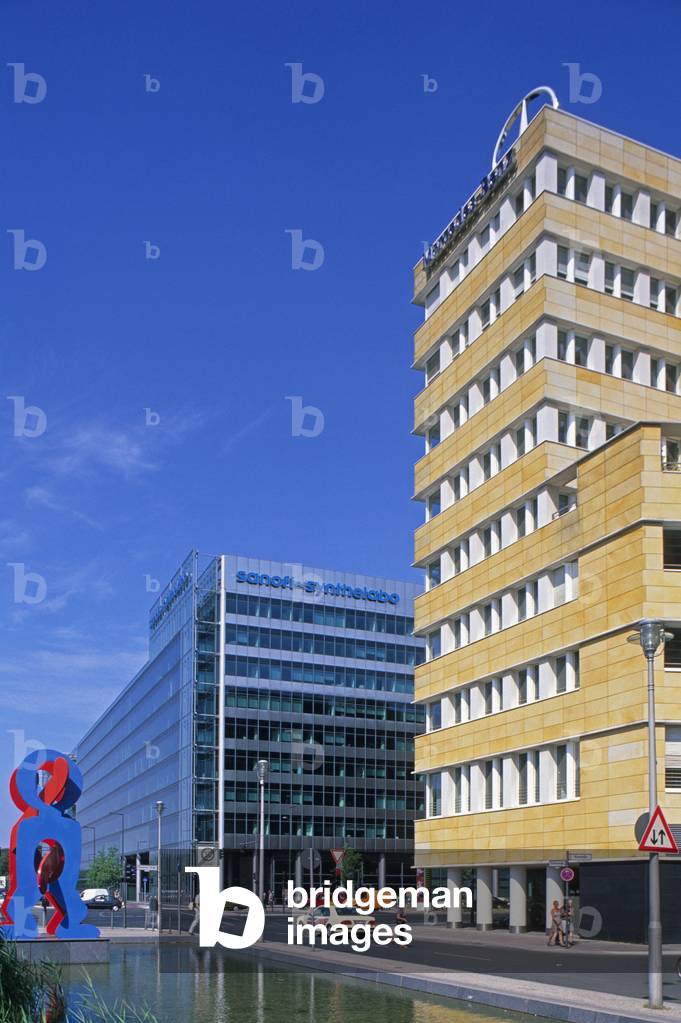
Headquarters of Mercedes Benz AG, Potsdamerstrasse 7 in Berlin (Germany). Architect Jose Rafael Moneo, 1995-1998. Photography 15/08/03.

TEC4581223: Headquarters of Mercedes Benz AG, Potsdamerstrasse 7 in Berlin (Germany). Architect Jose Rafael Moneo, 1995-1998. Photography 15/08/03., Moneo, Jose Rafael (b.1937) / Bridgeman Images


Back to top