2490020 Search Results

FLO4661882: Hygrometric (Geastrum hygrometricum) and blackish bovist (Bovista nigrescens), edible. Chromolithography of C.Krause, based on an illustration by Fritz Leuba (1848-1910), in Les champignons edibles et les especes veneneuses with which they could be confused, published by Delachaux and Niestle, in Neuchatel, Switzerland, in 1890. / Bridgeman Images

FLO4662124: English dandies at the home of a bankrupt friend as he is evicted for debt. Tom and Jerry taking the hint at Logic's beling blown up at Point Nonplus or long wanted by John Doe and Richard Roe and must come. Handcoloured copperplate engraving by Isaac Robert Cruikshank and George Cruikshank from Pierce EGAN's Life in London, Sherwood, Jones, London, 1823. / Bridgeman Images

FLO4662181: Datil yucca or banana yucca, Yucca baccata. Chromolithograph by L. Stroobant after an illustration by P. de Pannemaeker from Jean Linden's l'Illustration Horticole, Brussels, 1873. / Bridgeman Images

FLO4662214: Camellia hybrid, Don Carlos Ferdinando, Camellia japonica. Chromolithograph by L. Stroobant after an illustration from life by P. de Pannemaeker from Jean Linden's l'Illustration Horticole, Brussels, 1873. / Bridgeman Images

FLO4662338: Little flag orchid, Masdevallia coccinea (Masdevallia lindeni var. harryana). Drawn and chromolithographed by P. de Pannemaeker from Jean Linden's l'Illustration Horticole, Brussels, 1873. / Bridgeman Images

FLO4676631: Mathilde of Tuscany (ca. 1046-1145), called Countess Mathilde, Mathilde de Briey or Mathilde de Canossa - Matilda of Tuscany, 1046-1115 - She wears a conical hat decorated with gemstones, pink veil, red chlamys edged with gold tied at the left shoulder, blue robe edged with gold on the sleeves She sits on a throne, with cushion and footrest - Illustration taken from a manuscript of Donizo's “” Vita Mathildis -”” Handcoloured illustration drawn and lithographed by Paul Mercuri with text by Camille Bonnard from “” Historical Costumes from the 12th to 15th Centuries,”” Levy Fils, Paris, 1860, Mercuri, Paolo (1804-84) / Bridgeman Images

FLO4676721: Costume d'un medecin italian, 14th century - Italian doctor or physician, 14th century - He wears a velvet cap trimmed with fur, a black cape lined in white, scarlet robe, green sleeves, red shoes - He carries a gold box and pincers - From a painting by an unknown artist in the Academy of Fine Arts, Siena - Handcoloured illustration drawn and lithographed by Paul Mercuri with text by Camille Bonnard from “” Historical Costumes from the 12th to 15th Centuries,”” Levy Fils, Paris, 1860, Mercuri, Paolo (1804-84) / Bridgeman Images

FLO4676803: Cimabue (Cenni di Pepo) (1272-1302), Italian painter, headdress of a liripion - Cimabue, Florentine artist, 14th century - He wears a short white cape embroidered in gold, a hood with a long tail, tunic, stockings and garters in white and gold - From a painting by Simone Martini in the church of Santa Maria Novella, Florence - (Massard, this is Jean by Joinville, French chronicler, 1224-1317) - Handcoloured illustration drawn and lithographed by Paul Mercuri with text by Camille Bonnard from “” Historical Costumes from the 12th to 15th Centuries,”” Levy Fils, Paris, 1860, Mercuri, Paolo (1804-84) / Bridgeman Images

LRI4676849: The popular game of the bucket in Naples Anonymous painting. 19th century Naples Museo Nazionale di San Martino, Unknown Artist, (19th century) / Bridgeman Images

FLO4676887: Costume d'une jeune femme de Florence (Italy), 14th century - Noble woman of Florence, 14th century - She wears her hair tied with black laces, blue simar embroidered in gold, yellow lining, scarlet robe, leather belt - From a painting to illustrate Boccaccio's Decameron by an artist of the Florentine school - Handcoloured illustration drawn and lithographed by Paul Mercuri with text by Camille Bonnard from “” Historical Costumes from the 12th to 15th Centuries,”” Levy Fils, Paris, 1860, Mercuri, Paolo (1804-84) / Bridgeman Images

TEC4676964: Accommodation in Emerainville (Marne la Vallee). Realisation 1986, architect Lucien Kroll. Photography 1986., Kroll, Lucien (b. 1927) / Bridgeman Images

FLO4677051: Costume d'une jeune femme francaise, 14th century - Costume of a young French woman, 14th century, from the Titius Livius manuscript - She wears her hair tied with black laces, a white dress embroidered with gold, and long bizarre cracows (shoes “” a la poulaine”””””) - Handcoloured illustration drawn and lithographed by Paul Mercuri with text by Camille Bonnard from “” Historical Costumes from the 12th to 15th Centuries,”” Levy Fils, Paris, 1861, Mercuri, Paolo (1804-84) / Bridgeman Images

FLO4677070: Costume d'un valet, 14th century - Costume of a valet, 14th century - He wears a red hood with white border, tabard of the same fabric, lead-coloured stockings and silver spurs - He carries a dagger in a red scabbard - From a manuscript of “” Lancelot of the Lake”” in the Imperiale Library, 6964 - Handcoloured illustration drawn and lithographed Paul Mercuri with text by Camille Bonnard from “” Historical Costumes from the 12th to 15th Centuries,”” Levy Fils, Paris, 1861, Mercuri, Paolo (1804-84) / Bridgeman Images

FLO4677154: Costume d'un jeune homme italien, 14eme century - Costume of a young Italian man, 14th century - He wears a tabard with a blue-and-white striped right side, and beige left side with hood over the shoulder - From a miniature in the Titus Livius manuscript in the Biblioteca Ambrosiana, Milan - Handcoloured illustration drawn and lithographed by Paul Mercuri with text by Camille Bonnard from “” Historical Costumes from the 12th to 15th Centuries,”” Levy Fils, Paris, 1861, Mercuri, Paolo (1804-84) / Bridgeman Images

FLO4677278: The informal umbrella. A gentleman grabs the hand of a young lady and kisses her, while using his umbrella to prevent her aunt and chaperone from seeing it. Handcoloured engraving from Pierre de la Mesanger's Le Bon Genre, Paris, 1817. / Bridgeman Images
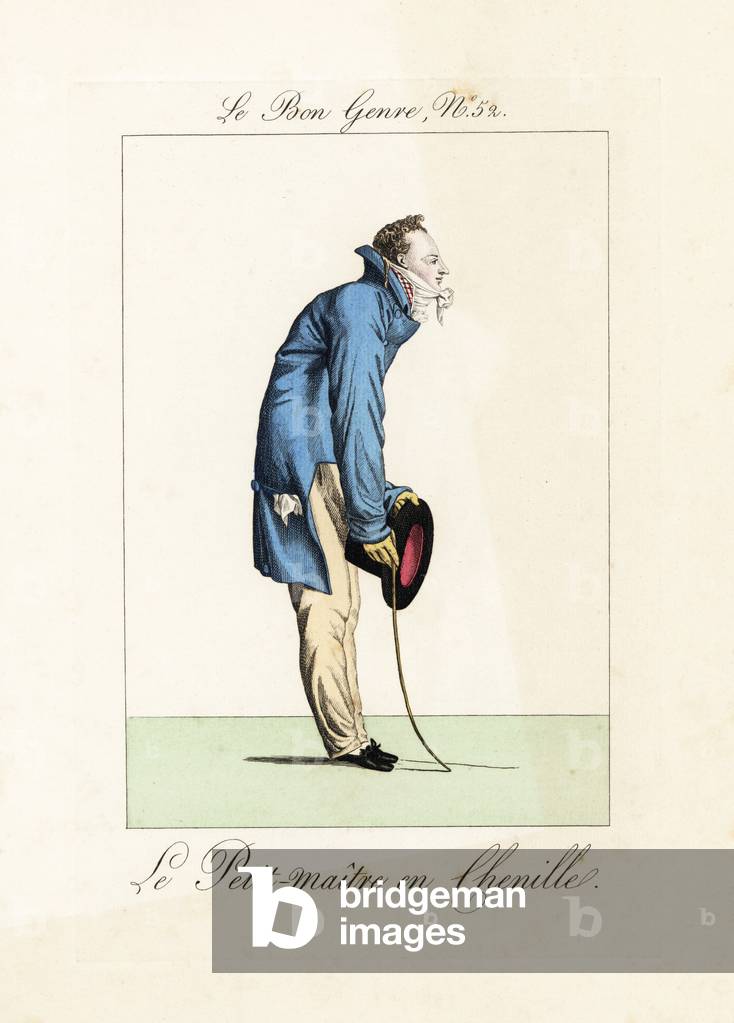
FLO4677328: Young man in chenille yarn jacket, tie, gloves, trousers, top hat and stick. When fashions appear strange or embarrassing, I recall the hammer wigs, wide-sleeve coats, arabesque embroidery, wooden heels, huge sneakers, that were found majestic or convenient by our fathers.” Handcoloured engraving from Pierre de la Mesanger's Le Bon Genre, Paris, 1817. / Bridgeman Images

FLO4677351: A young fashionable man shows a girl how to play with a Diabolo (Chinese yo-yo). “Expertise on the Diabolo is now indispensable. A father who wants to raise his children properly has to engage tutors in drawing, music and dance, and a professor of Diabolo.” Handcoloured engraving by Gatine from Pierre de la Mesanger's Le Bon Genre, Paris, 1817. / Bridgeman Images

FLO4677534: The old young man. Old dandy in jacket with high collar, bicorn, tight breeches and hose, has a tie ties by a young shopgirl. Handcoloured engraving from Pierre de la Mesanger's Le Bon Genre, Paris, 1817. / Bridgeman Images

FLO4677558: English fashions and military uniforms, 1815. One woman on the right wears English-influenced fashions, while talking with a hussar and dragoon. Handcoloured engraving from Pierre de la Mesanger's Le Bon Genre, Paris, 1817. / Bridgeman Images

FLO4677559: Fashionable women in decollete dresses playing the game of hide and seek in a garden. Handcoloured engraving from Pierre de la Mesanger's Le Bon Genre, Paris, 1817. / Bridgeman Images

FLO4677632: Street entertainer using a baton to remove a coin from a woman's nose without touching her nose. Audience of fashionable women in bonnets, shawls and dresses with frills. Handcoloured engraving from Pierre de la Mesanger's Le Bon Genre, Paris, 1817. / Bridgeman Images

FLO4677718: Breakfast. Gentlemen in coat tails and breeches and ladies in veils and dresses share a breakfast of coffee and bread. Great familiarity reigns in the morning, one has no time to become ceremonial, breakfast is the honest meal.” Handcoloured engraving from Pierre de la Mesanger's Le Bon Genre, Paris, 1817. / Bridgeman Images

FLO4677735: A woman is pampered by her seamstress, her clothes seller, her hairdresser and two chambermaids. As Montesquieu said, “” For one man to live deliciously, one hundred others must work tirelessly.”” Handcoloured engraving from Pierre de la Mesanger's Le Bon Genre, Paris, 1817. / Bridgeman Images

FLO4677157: Barnabe Visconti (1323-1385), seigneur of Milan - Bernabo Visconti, Lord of Milan, Italian soldier and statesman, 14th century - He wears a gold diadem, black armour, a white tabard embroidered in gold, gold spurs, iron gauntlets, and carries a sword and baton - From the monument to him in the church of Saint-Jean in Concha - Handcoloured illustration and lithographed by Paul Mercuri with text by Camille Bonnard from “” Historical Costumes from the 12th to 15th Centuries,”” Levy Fils, Paris, 1861 / Bridgeman Images

FLO4677184: A young woman dressed in a medievale dress and headdress, sitting on a Gothic seat plays the play of twine, observed by a thoughtful young man - Lithograph based on an illustration by J.E. Rogers, from Passe temps actuels de l'Engleterre heureuse, by Francis Cowley Burnand (1836-1917), 1873 - Medieval woman seated in a gothic chair playing cat's cradle with a pensive youth - Handcoloured lithograph after an illustration by J. E. Rogers from Francis Cowley Burnand's “” Present Pastimes of Merrie England, Cassell, London, 1873 / Bridgeman Images

FLO4677209: A man of the Middle Ages drives a wooden bicycle, in a pave street, in front of frightened spectators (this type of bicycle did not appear until the end of the 19th century) - Lithography based on an illustration by J.E. Rogers, from Francis Cowley Burnand's Passe temps actuels de l'Englance (1836-1917), 1873 - Medieval man riding a wooden velocipede on a cobbled street in front of startled bystanders. (This early bicycle was invented in the late 19th century) Handcoloured lithograph after an illustration by J. E. Rogers from Francis Cowley Burnand's “” Present Pastimes of Merrie England, Cassell, London, 1873 / Bridgeman Images
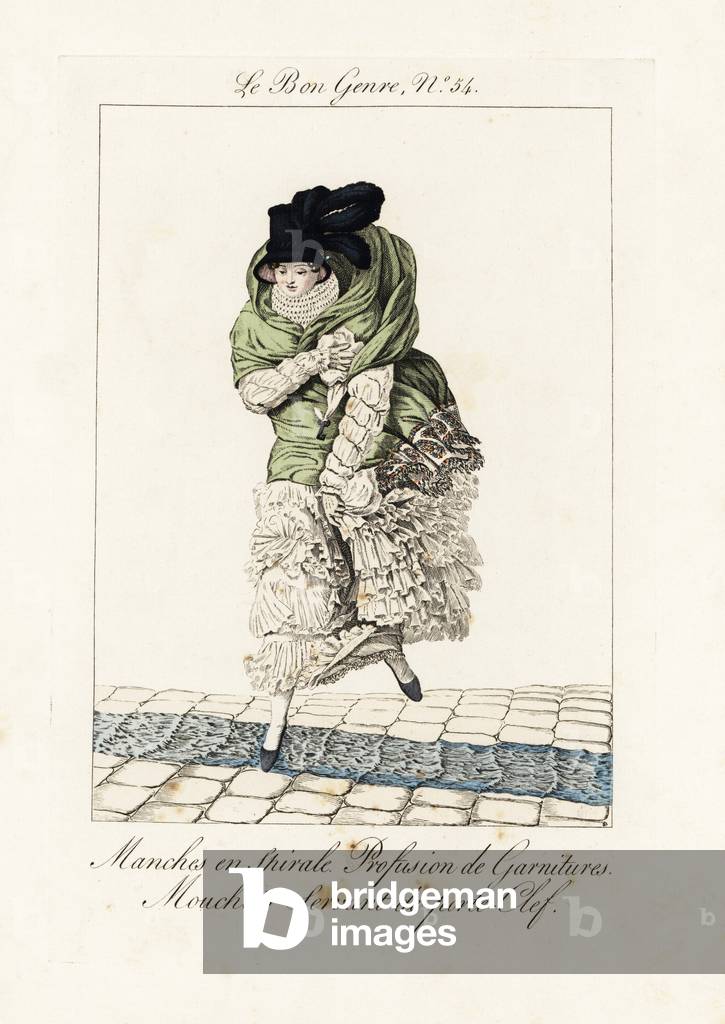
FLO4677354: Woman with spiral sleeves, profuse ruffs and flounces, kerchief key-holder. When one talks of flounces, refer back to the reign of Louis XV, and look at the portrait of your grandmother. Have patience, miss. That which causes such disdain today will excite you in a little while, and it won't be one falbala but many that you want to wear.”” Illustration by Jean-Baptiste Isabey. Handcoloured engraving from Pierre de la Mesanger's Le Bon Genre, Paris, 1817. / Bridgeman Images

FLO4677385: Woman from the Chaussee-d'Antin in the Chinese fashion. She wears a tall bonnet with flowers and ribbons over her piled up hairstyle a la Chinoque, ruff collar, tunic with bells, shawl tied in a bow, and shoes with bows. Illustration by Louis-Philibert Debucourt. Handcoloured engraving from Pierre de la Mesanger's Le Bon Genre, Paris, 1817. / Bridgeman Images

FLO4677482: Cartoon of English fashions in Paris, 1814. Man in flowerpot hat, women in bottom-shaped gowns. Handcoloured engraving from Pierre de la Mesanger's Le Bon Genre, Paris, 1817. / Bridgeman Images

FLO4677876: Evening party at Coblenz (between rue Taitbout and rue Neuve-Lepelletier, Paris). A group of women and children (including a black woman) sit listening to music from a hurdygurdy man and woman with tambourine. “” In 1791-1792, the previously unfashionable Boulevard des Italians became the favorite promenade for the royalist partisans. To be seen there was a public profession of aristocracy, an enlistment in the army of the princes, an espousal of the interests and opinions of the French refugees in Koblentz. After 1795, it became the fashionable place for incredible, wonderful, and muscadins. At night from 6 til midnight, up to 4,000 people jostled, elbowed and bumped along this street.”” Handcoloured engraving from Pierre de la Mesanger's Le Bon Genre, Paris, 1817. / Bridgeman Images
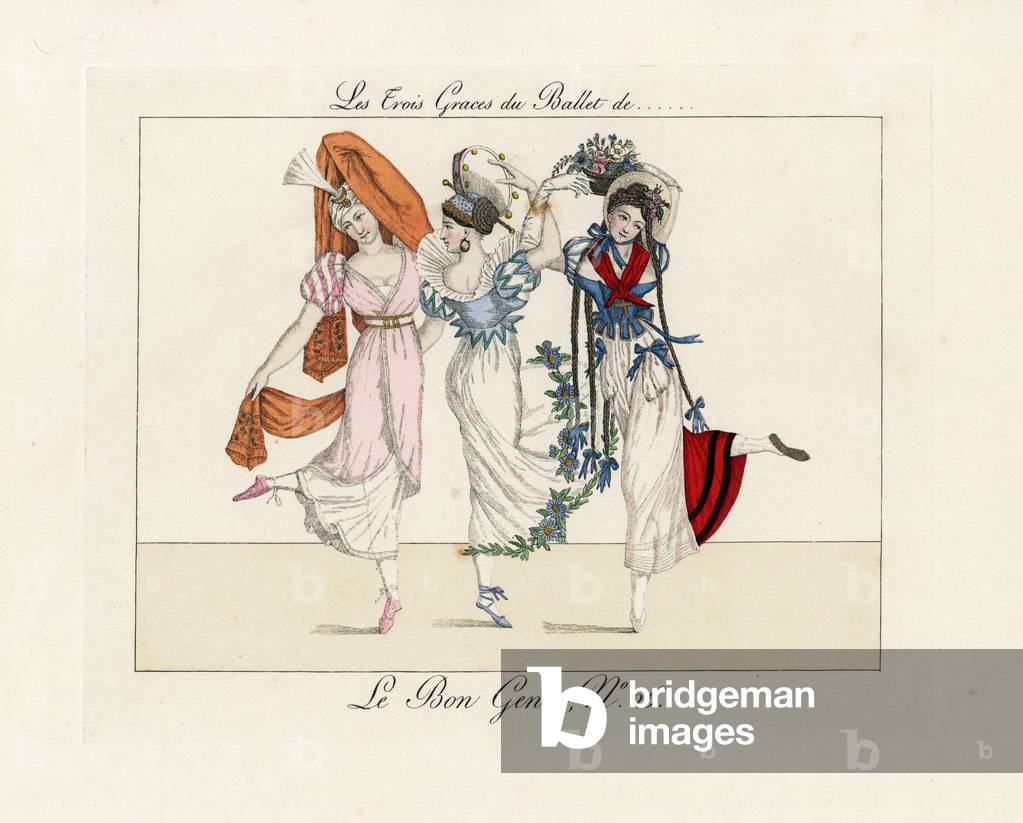
FLO4677921: Three graces of the Ballet of**. Elegant ballet dancers in costume (one in turban and shawl, one with tambourine and dress decorated with flowers, and one with a basket and long plaits tied with ribbons). “” Each movement betrays a form: arms, shoulders, throat, legs, feet all are naked or appear so.”” Handcoloured engraving from Pierre de la Mesanger's Le Bon Genre, Paris, 1817. / Bridgeman Images
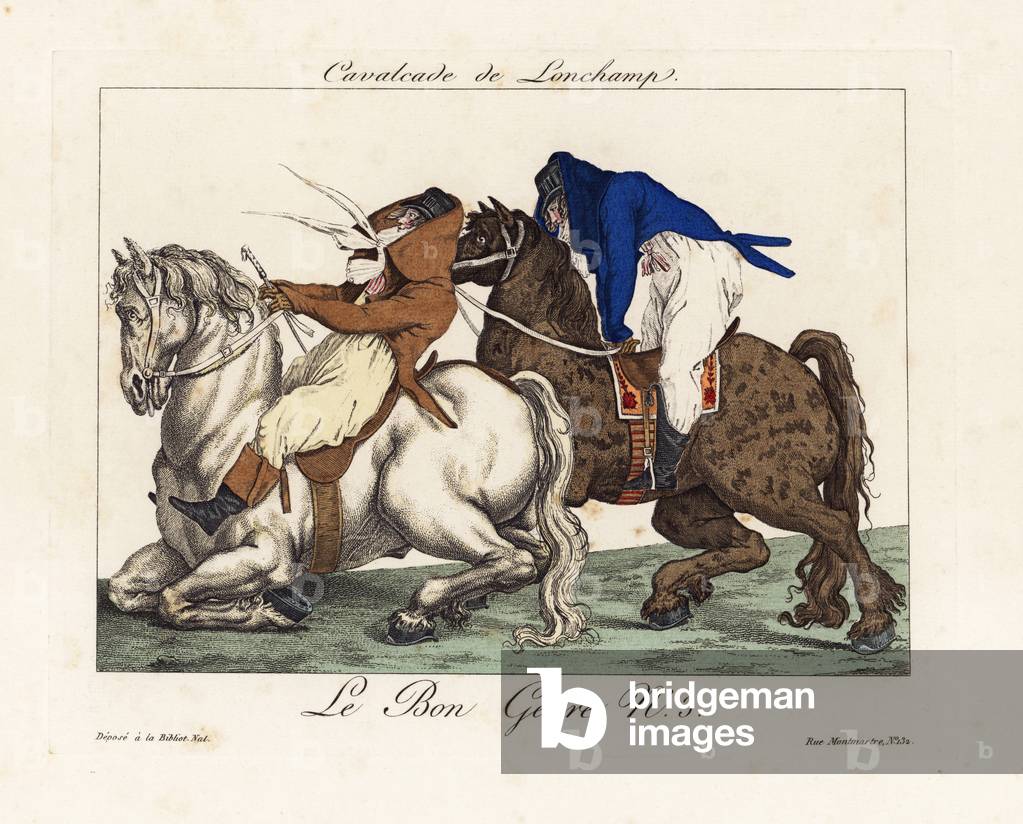
FLO4677969: Longchamp Cavalcade. Two incredible (fops) mounted on heavy dray horses instead of thoroughbreds at Longchamp racetrack. Handcoloured engraving from Pierre de la Mesanger's Le Bon Genre, Paris, 1817. / Bridgeman Images

FLO4678203: Sir Guy de Bryan, First Baron Bryan, English military commander and admiral, 1319-1390, and Bernarbo Visconti, Lord of Milan, Italian soldier and statesman, 1354-1385. Guy de Bryan wears mixed armour of chainmail and plate, short hauberk, brasselbow vandykes, gauntlets, chausses, and bassinet with camail. Visconti wears mixed armour, with chainmail hauberk and thighs, knee pads, jambs or steel boots and spurs. Handcoloured lithograph after an illustration by S.R. Meyrick from Sir Samuel Rush Meyrick's A Critical Inquiry into Antient Armour. / Bridgeman Images

FLO4678208: Sir John Harsich, 1384. He wears his tilting helmet with turkey-feather crest and cointisse over his bassinet. The wreath below the crest is two pieces of silk in his armorial colours twisted together by a lady. Handcoloured lithograph by Maddocks after an illustration by S.R. Meyrick from Sir Samuel Rush Meyrick's A Critical Inquiry into Antient Armour. / Bridgeman Images

FLO4677834: Wonderful playing the game of blind man's buff. A blindfolded woman runs in a garden as one woman strokes her hand and another grabs her muslin dress. Another woman crouches near a chair and covers her head with a shawl. It can be played inside, or in a defined exterior. The blindfolded person has to guess the name of the person who touches her.” Illustration by Dominique Bosio. Handcoloured engraving from Pierre de la Mesanger's Le Bon Genre, Paris, 1817. / Bridgeman Images

FLO4677958: Millinery shop workers. Women in lowcut muslin dresses trying on hats, holding a hat box, fixing feathers to a headdress and reading a notebook at the counter. Handcoloured engraving from Pierre de la Mesanger's Le Bon Genre, Paris, 1817. / Bridgeman Images
