2491514 Search Results

FLO4687486: Cabiai or capybara (Hydrochoerus hydrochaeris, Cavia capybara), the largest rodent in the world, lives in South America. Its meat is eaten and tastes like a bad fish. Lithographie in The Naturalist Pocket Magazine or Cabinet complete des Curiosites et Beautes de la Nature, published between 1798 and 1802, by Harrison, London, England. / Bridgeman Images

FLO4685247: Foot avocet, Recurvirostra avosetta, and ruff, Philomachus pugnax. Handcoloured engraving by widow Fournier after an illustration by Edouard Travies from Charles d'Orbigny's Dictionnaire Universale d'Histoire Naturelle (Dictionary of Natural History), Paris, 1849. / Bridgeman Images

FLO4685841: Shepherdess, reign of Charles VIII, 1491. Handcoloured steel engraving by Polidor Pauquet after a contemporary work from the Pauquet Brothers' “” Modes et Costumes Historique”” (Historical Fashions and Costumes), Paris, 1865. Hippolyte (b. 1797) and Polydor Pauquet (b. 1799) ran a successful publishing house in Paris in the 19th century, specializing in illustrated books on costume, birds, butterflies, anatomy and natural history. / Bridgeman Images

FLO4688622: Councellor or lawyer in the court of law, with black robes and wig, holding legal briefs on a table. Handcoloured copperplate engraving from William Henry Pyne's The World in Miniature: England, Scotland and Ireland, Ackermann, 1827. / Bridgeman Images

FLO4687249: Flying fish (Exocoetus), living in warm seas, where it is hunted by sea bream, its very developed pectoral fins allow it to jump out of the water and soar for a few moments, or it becomes prey to the albatrosses. Illustration by George Edwards (1694-1773). Lithographie in The Naturalist Pocket Magazine or Cabinet complete des Curiosites et Beautes de la Nature, published between 1798 and 1802, by Harrison, London, England. / Bridgeman Images

FLO4688567: The Four Bears, Mah-to-Toh-pa, second chief of the Mandan or Numakiki nation. In undress, being in mourning, with a few locks of hair cut off. His hair put up in plaits or slabs, with glue and red paint, a custom of the tribe. Handcoloured lithograph by J. Harris after a painting by George Catlin from James Cowles Prichard's Natural History of Man, Balliere, London, 1855., Catlin, George (1796-1872) / Bridgeman Images

FLO4685834: Women of the environs of Paris, reign of Charles VII, 1443. Handcoloured steel engraving by Hippolyte Pauquet after Gaignieres from the Pauquet Brothers' “” Modes et Costumes Historique” (Historical Fashions and Costumes), Paris, 1865. Hippolyte (b. 1797) and Polydor Pauquet (b. 1799) ran a successful publishing house in Paris in the 19th century, specializing in illustrated books on costume, birds, butterflies, anatomy and natural history. / Bridgeman Images

FLO4685389: Squid (squid) and octopus. Squid (Histioteuthis bonnellii) and octopus (Octopus vulgaris). Handcolored engraving by Pretre from Charles d'Orbigny's “Universal Dictionary of Natural History” 1849. / Bridgeman Images

FLO4685505: Ichnography of the Chapel of the Trinity, Stratford upon Avon, Warwickshire. Etching by Thomas Fisher from his Paintings on the Walls of the Chapel of the Trinity. / Bridgeman Images

FLO4689127: Medallion portrait of Joseph Priestley, clergy and physical scientist. Chromolithograph by W. Griggs from Frederick Rathone's Old Wedgwood, the Decorative or Artistic Ceramic Work Produced by Josiah Wedgwood, Quaritch, London, 1898. / Bridgeman Images

FLO4689205: Vase with reliefs of Achilles (L), vase with Hercules in the garden of the Hesperides (C), and vase with reliefs designed by Lady Templeton (R). Chromolithograph by W. Griggs from Frederick Rathone's Old Wedgwood, the Decorative or Artistic Ceramic Work Produced by Josiah Wedgwood, Quaritch, London, 1898. / Bridgeman Images

FLO4687111: Cast of a dead dog from the House of Vesonius Primus, a fuller. Chromolithograph by Victor Steeger after an illustration by Geremia Discanno from Emile Presuhn (1844-1878) The Most Beautiful Paintings of Pompeii, Leipzig, 1881. / Bridgeman Images

FLO4689062: John Flaxman's wine vase decorated with grape foliage, and a satyr grasping a ram's head. Chromolithograph W. Griggs from Frederick Rathone's Old Wedgwood, the Decorative or Artistic Ceramic Work Produced by Josiah Wedgwood, Quaritch, London, 1898. / Bridgeman Images

FLO4685210: Common ostrich, Struthio camelus. Handcoloured engraving by Fournier after an illustration by Edouard Travies from Charles d'Orbigny's Dictionnaire Universale d'Histoire Naturelle (Dictionary of Natural History), Paris, 1849. / Bridgeman Images

FLO4685710: Dog and Wolf - Shepherd dog, Canis familiaris, and wolf, Canis lupus. Handcoloured copperplate engraving after Sydenham Edwards from John Mason Good's Pantologia, a New Encyclopedia, G. Kearsley, London, 1813., Edwards, Sydenham Teast (c.1768-1819) / Bridgeman Images

JLJ4687756: A Karib chef from the island of Saint Vincent in the West Indies with his five women, 19th century (engraving), French School, (19th century) / Bridgeman Images

JLJ4686519: Flowers And Fruits, 1885 (oil on canvas), Vernay, Francois (1821-1896) / Bridgeman Images

JLJ4689618: Self-Portrait. Portrait Of The Artist As A Hunter, 17th century (oil on canvas), Desportes, Alexandre-Francois (1661-1743) / Bridgeman Images
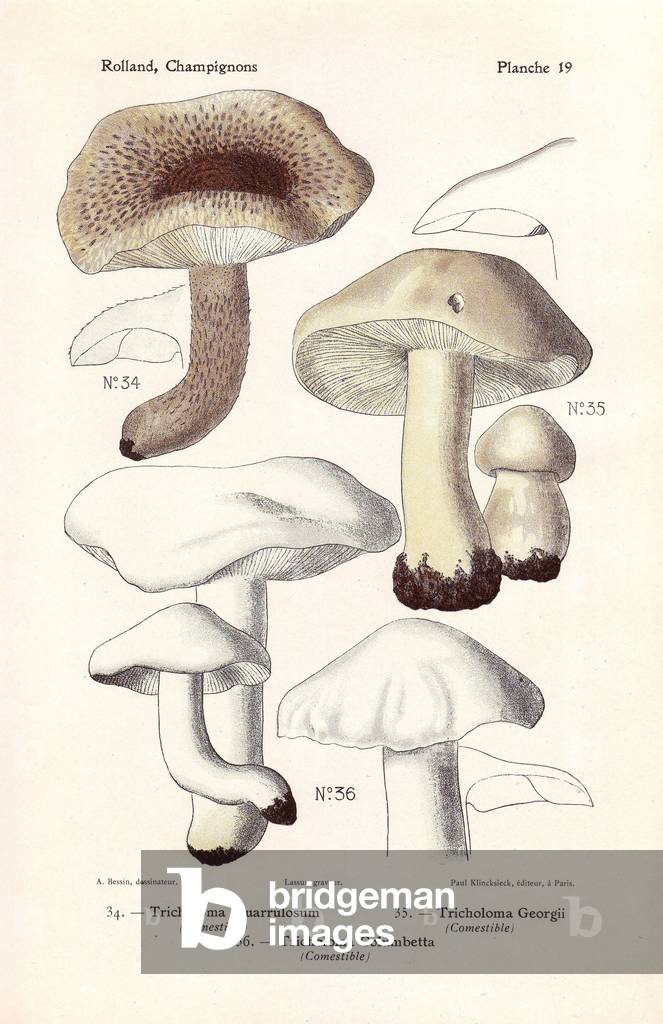
FLO4689695: Edible mushrooms, Tricholoma squarrulosum, do-coloured tricholoma, Tricholoma columbetta and St. George's mushroom, Tricholoma georgii, Calocybe gambosa. Chromolithograph drawn by Bessin for Leon Rolland's “Atlas of Mushrooms”” 1911. / Bridgeman Images

FLO4685867: Page with horn, reign of Louis XII, 1500. Handcoloured steel engraving by Hippolyte Pauquet after Xavier Willemin (1763-1833), French antiquarian and engraver, from the Pauquet Brothers' “” Modes et Costumes Historique”” (Historical Fashions and Costumes), Paris, 1865. Hippolyte (b. 1797) and Polydor Pauquet (b. 1799) ran a successful publishing house in Paris in the 19th century, specializing in illustrated books on costume, birds, butterflies, anatomy and natural history. / Bridgeman Images

FLO4685769: Orders of flowers: Siliculosa, Seliquosa, Polygamia, Monogamia, Filicus, Fungi, etc. Handcoloured copperplate engraving after Sydenham Edwards from John Mason Good's Pantologia, a New Encyclopedia, G. Kearsley, London, 1813., Edwards, Sydenham Teast (c.1768-1819) / Bridgeman Images
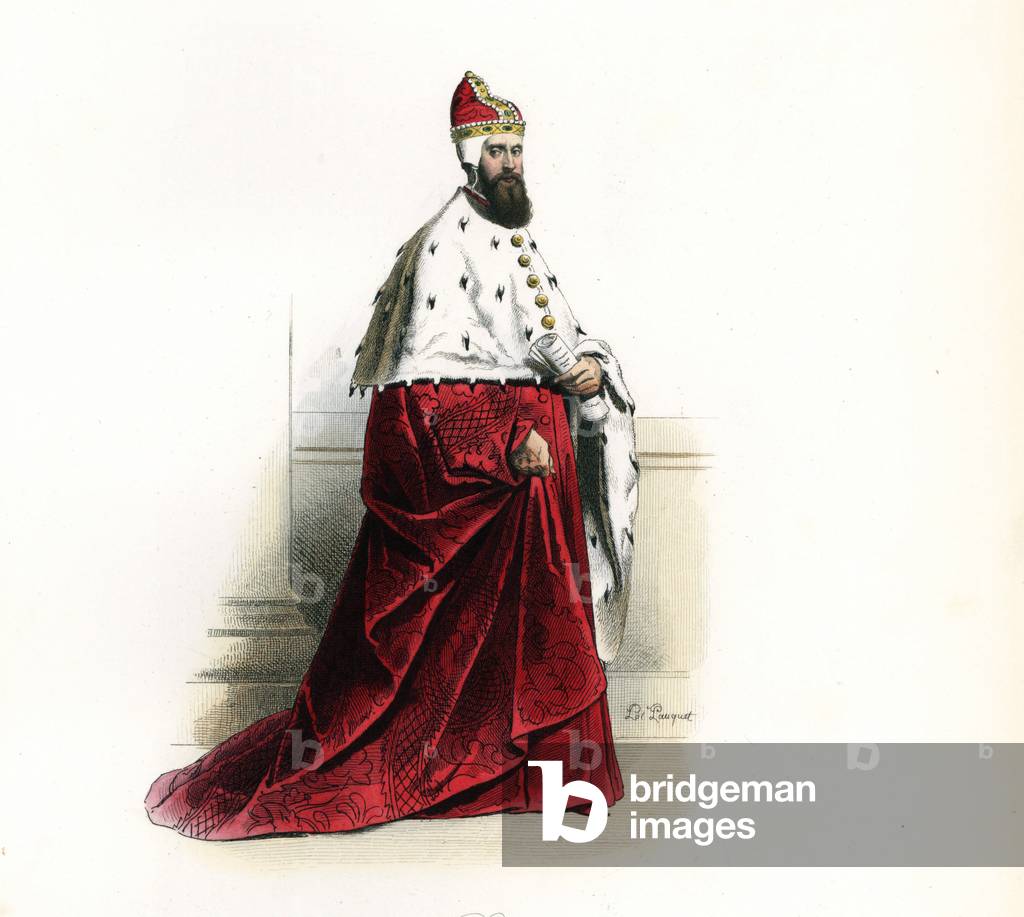
FLO4686356: Doge of Venice, after Abraham de Bruyn, 1580 - Handcoloured steel engraving by Polydor Pauquet from the Pauquet Brothers' “” Foreign Fashions and Costumes Ancient and Modern”, Paris, 1865 / Bridgeman Images

FLO4688689: Parish Beadle, a petty officer of the police, in uniform with mace, bicorn and cape. Handcoloured copperplate engraving from William Henry Pyne's The World in Miniature: England, Scotland and Ireland, Ackermann, 1827. / Bridgeman Images
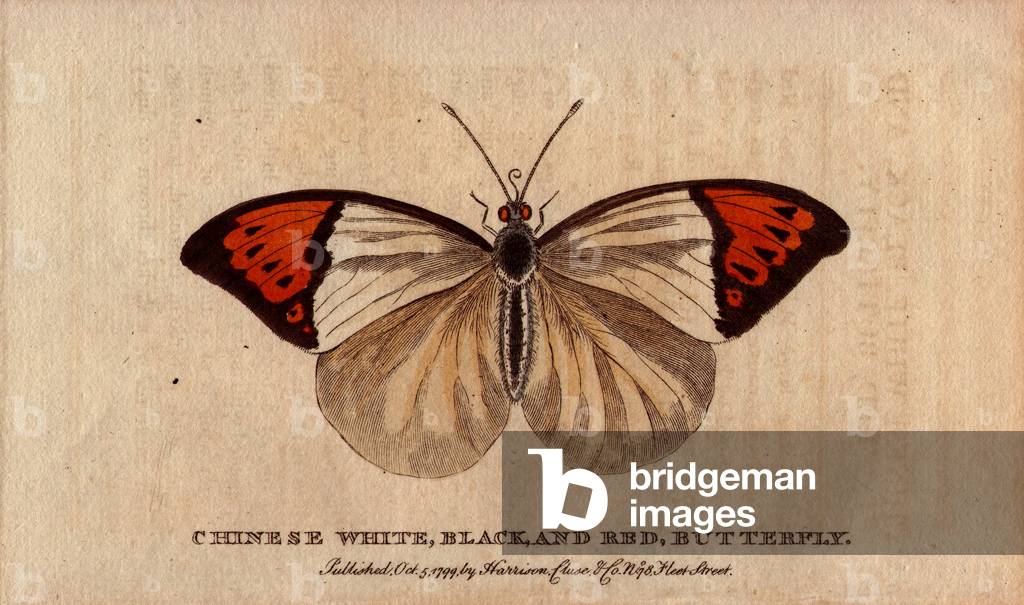
FLO4687398: Chinese butterfly with black and red white wings. Identified by George Edwards (1694-1773) in Natural History Gleanings. Lithographie in The Naturalist Pocket Magazine or Cabinet complete des Curiosites et Beautes de la Nature, published between 1798 and 1802, by Harrison, London, England. / Bridgeman Images

FLO4687844: Red apple ingestrie (domestic apple tree). Lithograph after the illustration of Augusta Withers (1793-1877), published in the “Pomology Magazine” (1828-1830) by John Lindley (1795-1865). Red Ingestrie apple, Malus domestica, hybrid of an Orange Pippin and Old Golden Pippin raised at Wormsley Grange. Illustration by Mrs. Withers. Handcoloured copperplate engraved by S. Watts from J. Lindley's “” Pomological Magazine,” London, 1828-1930. / Bridgeman Images

JLJ4687622: Our Lady has the child, 15th century (painting on wood), Bouts, Dirck (c.1415-75) / Bridgeman Images

JLJ4686841: A Young Gentleman, 17th century (oil on canvas), Jonge, Jan Martszen de (1609/10-47/67) / Bridgeman Images

JLJ4688488: Skaters, 19th century (oil on canvas), Verwee, Louis (1807-1877) / Bridgeman Images

JLJ4688047: Departing From Bayard De Brescia, 1512, 1821 (oil on canvas), Bidault, Jean Joseph (1758-1846) / Bridgeman Images

FLO4688655: Skulls of an ancient Cimbrian, an Estonian Finn, and a Lapp. Lithograph by J. Bull from James Cowles Prichard's Natural History of Man (Balliere, London, 1855). / Bridgeman Images

FLO4688307: Cafeier, cafe - Branch, leaf, fruit and flower of the coffee tree, Coffea arabica. Copperplate engraving from Abbe Antoine Francois Prevost's Histoire generale des voyages, Paris, 1746. / Bridgeman Images

FLO4685762: Guinea pig and capybara - Guinea pig, Cavia porcellus, and capybara, Hydrochoerus hydrochaeris. Handcoloured copperplate engraving after Sydenham Edwards from John Mason Good's Pantologia, a New Encyclopedia, G. Kearsley, London, 1813., Edwards, Sydenham Teast (c.1768-1819) / Bridgeman Images

LRI4687499: Sign of the Zodiac: The Pisces. Scene of fishing, c.1520 (fresco), Falconetto, Giovanni Maria (1468-1535) / Bridgeman Images

JLJ4689996: Christ leaving the priest, 1872 (oil on canvas), Dore, Gustave (1832-83) / Bridgeman Images

JLJ4685217: Full-length portrait of Hortense de Beauharnais, Queen of Holland (1783-1837), 1807 (oil on canvas), Gerard, Francois Pascal Simon, Baron (1770-1837) / Bridgeman Images

JLJ4687419: Scipio's continence. After his victory in the Punic War Scipio the African (235-183 BC), 16th century (oil on canvas), Abate, Nicolo dell' (c.1512-71) / Bridgeman Images
