2491557 Search Results

FLO4705622: Woman of Bayern, 1581, and a German army captain, 1588. Handcolored copperplate engraving from Robert von Spalart's “” Historical Picture of the Costumes of the Principal People of Antiquity and of the Middle Ages,”” Vienna, 1811. Illustration based on Thomas Jefferys Collection of Dresses of Different Nations, Antient and Modern. After the Designs of Holbein, Van Dyke, Hollar, and others, London, 1757. / Bridgeman Images

MME4705723: Jazz pianist McCoy Tiner in concert in 1995., Mencarini, Marcello / Bridgeman Images

MME4707147: Portrait of Argentine writer Jorge Luis Borges in Rome, 1981., Mencarini, Marcello / Bridgeman Images

FLO4707247: Title page of volume 2 Book 1 of the series. Title in German, with a vignette: two naked boys decorating a bust with a laurel wreath. Hand-coloured copper engraving, in “Images historiques des costumes des principaux peuples de l'Antiquite et du Middle Ages” by Robert Von Spalart, published in 1796. / Bridgeman Images

FLO4707290: A Saxon king in ceremonial costume. The great mantle is worn only by members of the realm or aristocracy and seems to have and reserve for divine or Celestial beings. Her hair and beard seem to have been dyed blue, as can be seen in paintings from the 8th century onwards. The saxons introduced the royal diademe, a circle of gold carries like a crown. Hand-coloured copper engraving, in “Images historiques des costumes des principaux peuples de l'Antiquite et du Middle Ages” by Robert Von Spalart, published in 1796. / Bridgeman Images

MME4707303: Portrait of Argentine writer Jorge Luis Borges in Rome, 1981., Mencarini, Marcello / Bridgeman Images

FLO4707314: Anglo-Saxon women: wearing tunic, veil, coat and shoe with open toe (36), wearing tunic and veil (37) and wearing a veil of a different colour from that of her coat. The sails were dyed in various colours and woven in more or less precious materials. Hand-coloured copper engraving, in “Images historiques des costumes des principaux peuples de l'Antiquite et du Middle Ages” by Robert Von Spalart, published in 1796. / Bridgeman Images

MME4705077: Portrait of the German composer Karlheinz Stockhausen, 1989., Mencarini, Marcello / Bridgeman Images

MME4705161: Portrait of Italian director Giorgio Strehler in 1979., Mencarini, Marcello / Bridgeman Images

FLO4705236: A young woman of Friesland. Handcolored copperplate engraving from Robert von Spalart's “” Historical Picture of the Costumes of the Peoples of Antiquity, the Middle Ages and the New Era,”” written by Leopold Ziegelhauser, Vienna, 1837 / Bridgeman Images

FLO4705539: Young French woman, 1581. Handcolored copperplate engraving from Robert von Spalart's “” Historical Picture of the Costumes of the Principal People of Antiquity and of the Middle Ages,”” Vienna, 1811. Illustration based on Thomas Jefferys Collection of Dresses of Different Nations, Antient and Modern. After the Designs of Holbein, Van Dyke, Hollar, and others, London, 1757. / Bridgeman Images

MME4707939: Portrait of writer William Burroughs around 1980, Mencarini, Marcello / Bridgeman Images

FLO4707975: Costumes of Norman women in the 12th century. The sleeves are always very wide and end in a kind of pocket, on two of the figures represented. The figure on the right, has sleeves of different colors, which seem to be separate parts of his dress. The cuff of the middle one falls very low, on the left of his head, while on the right it is thrown on the shoulder. The head of the left figure is wrapped around his neck on one side and falls back on his right breast on the other side. The figure on the left presents a headdress, one end of which is thrown on the chest and the other on the left shoulder, both completely covering, the folds are gathered at the top of the head and held by a diademe or a circle of gold. Hand-coloured copper engraving, in “Images historiques des costumes des principaux peuples de l'Antiquite et du Middle Ages” by Robert Von Spalart, published in 1796. / Bridgeman Images
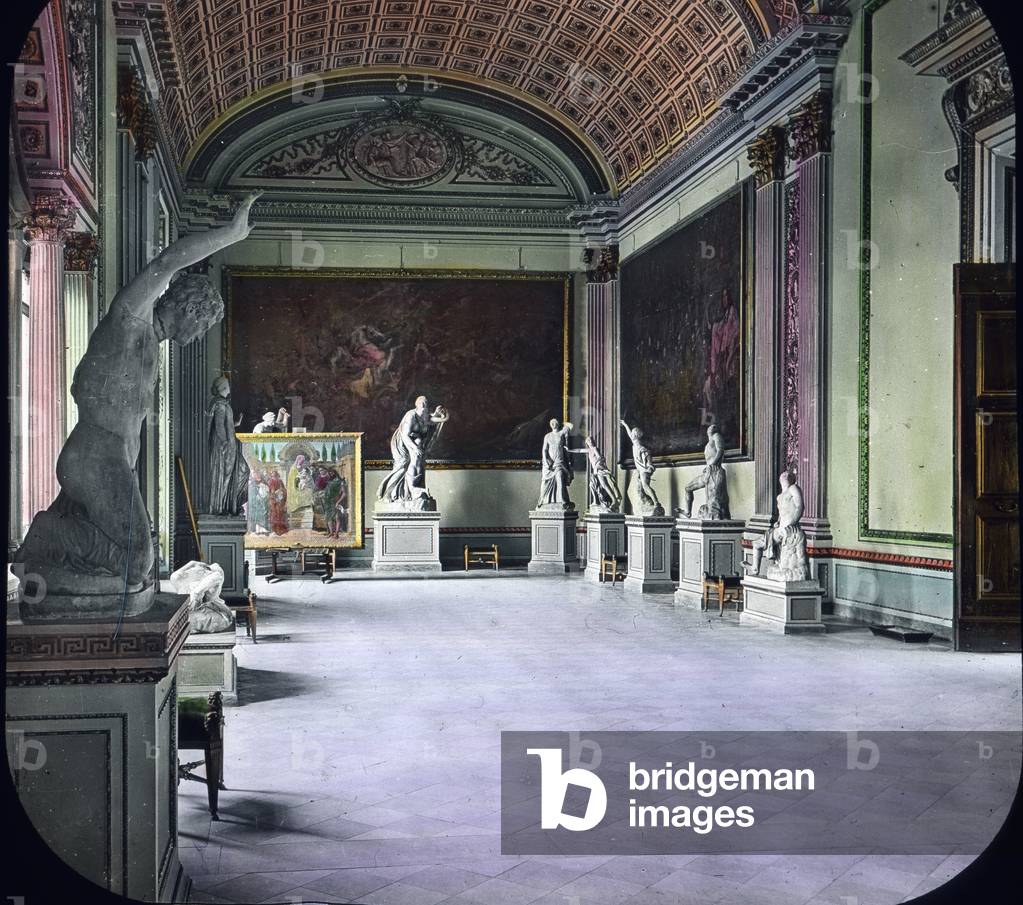
UTD4705845: Italy, Florence, Uffizi Gallery, Niobiden hall, image date: circa 1910. Carl Simon Archive, Simon, Carl (1873-1952) / Bridgeman Images

FLO4708158: Norman soldiers: archer with chest, bow and arrow, infantryman with spear, shield and armor and infantryman in mesh armor, helm and especially military. Hand-coloured copper engraving, in “Images historiques des costumes des principaux peuples de l'Antiquite et du Middle Ages” by Robert Von Spalart, published in 1796. / Bridgeman Images

FLO4705868: A girl of Padua, Italy. Handcolored copperplate engraving from Robert von Spalart's “” Historical Picture of the Costumes of the Principal People of Antiquity and of the Middle Ages,”” Vienna, 1811. Illustration based on Thomas Jefferys Collection of Dresses of Different Nations, Antient and Modern. After the Designs of Holbein, Van Dyke, Hollar, and others, London, 1757. / Bridgeman Images

MME4706008: Portrait of psychologist Armando Verdiglione in 1980., Mencarini, Marcello / Bridgeman Images

FLO4706013: Woman of Alsace, with her purse hanging from her belt. Handcolored copperplate engraving from Robert von Spalart's “” Historical Picture of the Costumes of the Principal People of Antiquity and of the Middle Ages,”” Vienna, 1811. Illustration based on Cesare Vecellio's Habiti Antichi e moderni, Venice, 1590 / Bridgeman Images

MME4706122: Czech realizer Jiri Weiss in 1990., Mencarini, Marcello / Bridgeman Images

MME4706139: Czech realizer Jiri Weiss in 1990., Mencarini, Marcello / Bridgeman Images

MME4706213: Portrait of writer Elie Wiesel in 1995., Mencarini, Marcello / Bridgeman Images

MME4702622: Portrait of Polish pianist Krystian Zimerman in 1994., Mencarini, Marcello / Bridgeman Images

FLO4702669: Inscription on the tomb of King Dagobert I (ca. 602-638) in St. Denis 180, Frankish pillars and arch 181-184, and a Frankish church 185. Handcoloured copperplate engraving from Robert von Spalart's Historical Picture of the Costumes of the Principal People of Antiquity and of the Middle Ages. / Bridgeman Images

FLO4702845: Norman furniture: a royal bed 276 and a common bed 277. Handcoloured copperplate engraving from Robert von Spalart's Historical Picture of the Costumes of the Principal People of Antiquity and of the Middle Ages. / Bridgeman Images

FLO4700338: Wood sanicle, Sanicula europaea. Handcoloured copperplate engraving after an illustration by James Sowerby from James Smith's English Botany, London, 1793., Sowerby, James (1757-1822) / Bridgeman Images

MME4700345: Portrait of jazz trumpeter Art Farmer around 1980., Mencarini, Marcello / Bridgeman Images

FLO4700405: Common chervil (Anthriscus cerefolium). Coloured copper prints from a drawing by James Sowerby for the book “English Botanical” by James Smith (1804). Sowerby was an illustrator of natural history books and illustrious books on botany, mycology, shellfish and geology. / Bridgeman Images

MME4704368: Violinist Isaac Stern, pianist Emanuel Ax, cellist Yo Yo Ma and viola player Jaime Eduardo Laredo in 1995., Mencarini, Marcello / Bridgeman Images

FLO4704404: Indian man and woman from a monument. Handcolored copperplate engraving from Robert von Spalart's “” Historical Picture of the Costumes of the Principal People of Antiquity and of the Middle Ages”” (1797). / Bridgeman Images

GIA4700631: Piotr or Petr Ilyich Tchaikovsky (or Tchaikovsky or Ciajkovskij or Tchaikowsky, 1840 - 1893). Decor by Alexandre Benois (1870-1960).Museo della scala de Milan, Benois, Alexander Nikolaivich (1870-1960) / Bridgeman Images

FLO4700693: Lily of the valley of May (Convallaria majalis) - Lithography based on a drawing by James Sowerby for Smith's English Botanical, published in London, England, 1792 / Bridgeman Images

MME4700701: Portrait of the Italian director Marco Ferreri. Venice 1981, Mencarini, Marcello / Bridgeman Images

MME4700707: Portrait of the Italian director Marco Ferreri. Venice 1981, Mencarini, Marcello / Bridgeman Images

MME4700873: Soul singer Eddie Floyd on stage around 1980., Mencarini, Marcello / Bridgeman Images

FLO4709374: Gentlemen's watch in 18-carat gold case. Chromolithograph from Edwin Street's Gems Catalog, Bond Street, London, circa 1895. / Bridgeman Images

FLO4712428: Bomarea dulcis (Sweet collania, Collania dulcis). Handcoloured copperplate engraving by G. Barclay after Miss Sarah Drake from John Lindley and Robert Sweet's Ornamental Flower Garden and Shrubbery, G. Willis, London, 1854. / Bridgeman Images
