2491557 Search Results

FLO4712416: Pink bomarea, Bomarea edulis (Hairy-leaved bomarea, Bomarea hirtella). Handcoloured copperplate engraving by Weddell after Edwin Dalton Smith from John Lindley and Robert Sweet's Ornamental Flower Garden and Shrubbery, G. Willis, London, 1854. / Bridgeman Images

MME4709639: Portrait of American comedian Matt Dillon, 1984, Mencarini, Marcello / Bridgeman Images

FLO4713899: Seringat - Mexican syringa or mock orange, Philadelphus mexicanus. Handcoloured copperplate engraving by G. Barclay after Miss Sarah Drake from John Lindley and Robert Sweet's Ornamental Flower Garden and Shrubbery, G. Willis, London, 1854. / Bridgeman Images

MME4714053: English composer PIERRE BOULEZ/PIERRE BOULEZ, composer and orchestra direttore, Mencarini, Marcello / Bridgeman Images

FLO4712627: Crocus variets - Crocuses, Croci. Crocus gargargaricus, reticulatus v. albicans, vallicola, cancellatus v. margaritaceus, cancellatus v. mazziaricus, striatus, hadriaticus v. saundersianus, hadriatcus v. chrysovelonicus, boryanus. Handcoloured copperplate engraving by G. Barclay after W. Herbert from John Lindley and Robert Sweet's Ornamental Flower Garden and Shrubbery, G. Willis, London, 1854. / Bridgeman Images

MME4710021: Austrian conductor Carlos Kleiber at a concert in Pompei in 1987., Mencarini, Marcello / Bridgeman Images

FLO4712673: Crocus variets - Crocuses, Croci. Crocus damascenus, C. byzanticus, C. tournefortianus, C. cambessedianus, C. medius, C. cartwrightianus, C. cartwrightianus v. creticus, C. clusianus. Handcoloured copperplate engraving after W. Herbert from John Lindley and Robert Sweet's Ornamental Flower Garden and Shrubbery, G. Willis, London, 1854. / Bridgeman Images

MME4710111: Portrait of Latvian conductor and violinist Gidon Kremer., Mencarini, Marcello / Bridgeman Images

FLO4710190: Sigesbeckia jorullensis (Sundew-involucred siegesbeckia, Siegesbeckia droseroides). Handcoloured copperplate engraving by Weddell after a botanical illustration by Edward Dalton Smith from Robert Sweet's The British Flower Garden, Ridgeway, London, 1827. / Bridgeman Images

MME4709052: Panoramic view of the column of Marc Aurele (Marc-Aurele or Marco Aurelio) on Piazza Colonna, Rome, Mencarini, Marcello / Bridgeman Images

FLO4709279: Diamond combs and head ornaments, wings, sword hilts, etc. Chromolithograph from Edwin Street's Gems Catalog, Bond Street, London, circa 1895. / Bridgeman Images

MME4707678: David Bowie, c.1999-93 (photo), Mencarini, Marcello / Bridgeman Images

FLO4707931: Three Norman cavalry soldiers, wearing armor of stitches and their helm, with spear and sword. Copper engraving hand-coloured, in “Images historique des costumes des principaux peuples de l'Antiquite et du Middle Ages” by Robert Von Spalart, published in 1796. Three Norman cavalry in chainmail suits of armor and helmets, carrying lances and swords.Handcolored copperplate engraving from Robert von Spalart's “” Historical Picture of the Costumes of the Principal People of Antiquity and of the Middle Ages”” (1796). / Bridgeman Images
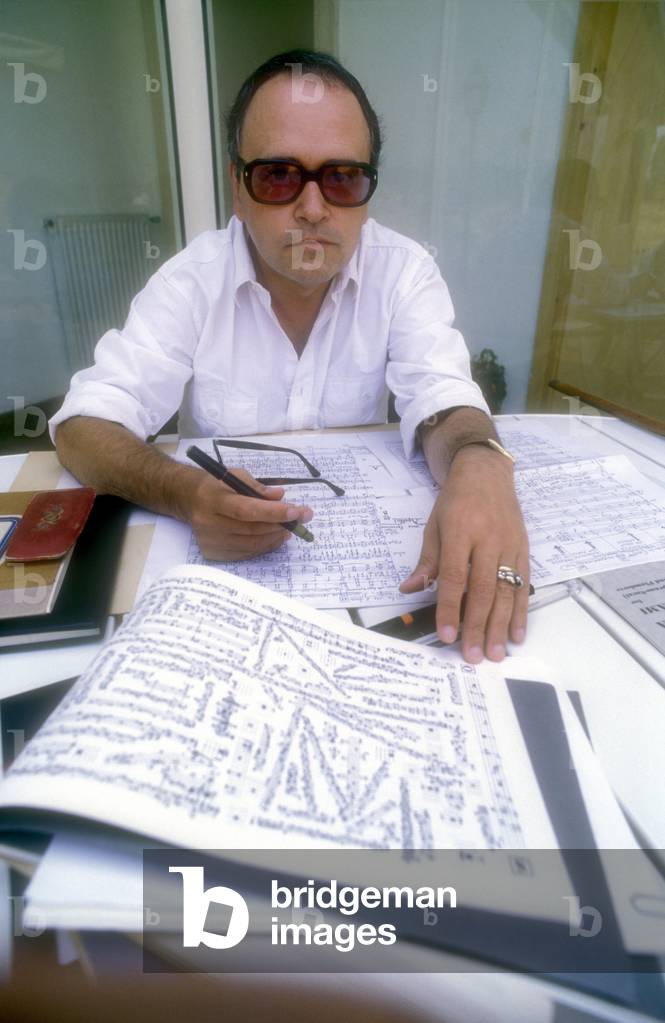
MME4707998: Portrait of the Italian composer Sylvano Bussotti, circa 1980, Mencarini, Marcello / Bridgeman Images

FLO4709749: Fashionable men in three-piece suits with wide lapels exchanging business cards. Color printed fashion plate by W. A. Richards from the winter catalogue of Superchic, London, 1929. / Bridgeman Images

FLO4708168: Norman infantry: infantry with spear and shield, saddler and two crossbaletriers carrying armor or chest. Hand-coloured copper engraving, in “Images historiques des costumes des principaux peuples de l'Antiquite et du Middle Ages” by Robert Von Spalart, published in 1796. / Bridgeman Images

MME4708195: Portrait of composer and poet John Cage, 1982., Mencarini, Marcello / Bridgeman Images

FLO4710011: Scarlet pimpernel, Anagallis arvensis (Indian pimpernel, Anagallis indica). Handcoloured copperplate engraving by Bailey after a botanical illustration by Edward Dalton Smith from Robert Sweet's The British Flower Garden, Ridgeway, London, 1825. / Bridgeman Images

FLO4710178: Carolina springbeauty or spatula-leaved claytonia, Claytonia caroliniana. Handcoloured copperplate engraving by Weddell after a botanical illustration by Edward Dalton Smith from Robert Sweet's The British Flower Garden, Ridgeway, London, 1827. / Bridgeman Images

FLO4708503: Knight of the Order of Aviz, in ceremonial dress. A Portuguese military religious order, after the conquest of Aviz (Portugal), a military fortress was built and became the mother house of the order, who first called themselves the Knights of St. Benedict d'Aviz until they adopted the Benedictine rule in 1162. They were subject to the rules and the Cistercian costume, wearing a white coat and a green lysee flower cross, although this illustration clearly shows a red Cistercian cross on the chest of his coat. Hand-coloured copper engraving, in “Images historiques des costumes des principaux peuples de l'Antiquite et du Middle Ages” by Robert Von Spalart, published in 1796. / Bridgeman Images

FLO4708528: Knight of the Order of St. Catherine and Knight of the Order of the Sword. The Order of St. Catherine was founded by the Christian princes to protect the pelerins of Mount Sinai, who came to venerate the relics of St. Catherine, but also to protect them from desecration from the 11th to the 15th centuries. However, according to the Catholic encyclopedia, the knights of St. Catherine were not an order, nor secular, nor regal. The order of the Sword, or the sword-bearers, was a military order in order to prepare the crusade against the Prussian peers in the 13th century (uncarried out crusade). / Bridgeman Images

MME4708564: Portrait of American comedian and director John Cassavetes in 1984., Mencarini, Marcello / Bridgeman Images

MME4708591: Portrait of the writer Carlo Cassola in 1979., Mencarini, Marcello / Bridgeman Images

MME4708744: Panoramic view of the archeological site of Ostia antica (Ostia), ancient port of ancient Rome. Italy, Mencarini, Marcello / Bridgeman Images

MME4708899: Panoramic view of the forum of Trajan (foro traiano), Rome Italy, Mencarini, Marcello / Bridgeman Images

MME4710581: Portrait of Italian composers Riccardo Malipiero and Luigi Dalla Piccola., Mencarini, Marcello / Bridgeman Images

FLO4710628: False indigo-bush, Amorpha fruticosa (Fragrant bastarts indigo, Amorpha fragrans). Handcoloured copperplate engraving by Weddell after a botanical illustration by Edward Dalton Smith from Robert Sweet's The British Flower Garden, Ridgeway, London, 1828. / Bridgeman Images

MME4710749: Portrait of the Italian composer Giacomo Manzoni in 1995, Mencarini, Marcello / Bridgeman Images

MME4710803: Portrait of the Italian composer Giacomo Manzoni in 1995, Mencarini, Marcello / Bridgeman Images
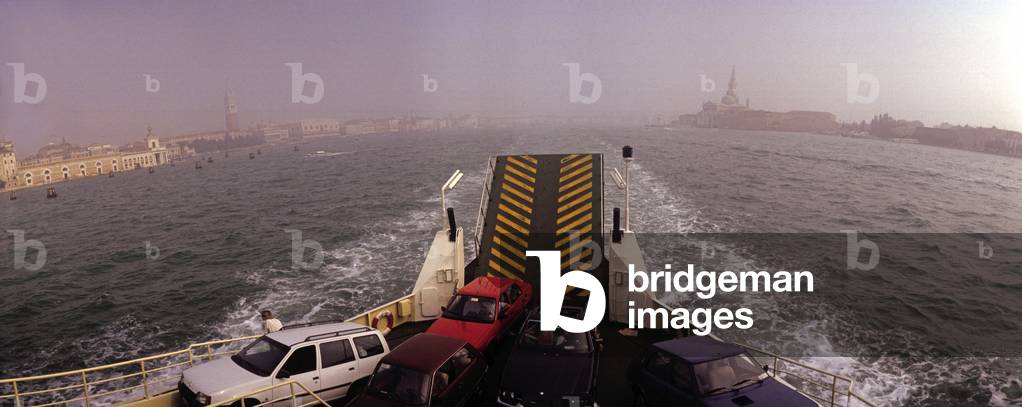
MME4709186: View of the basin of St. Mark (San Marco) from the traghetto (ferry), Venice. Italy Panoramic Photo, Mencarini, Marcello / Bridgeman Images

FLO4709231: Aquamarine crystal, quartz, amethyst, garnet, tourmaline and peridot. Chromolithography, in Precious Stones and Gems by Edwin Streeter, published in London, England, by George Bell and Sons, 1892. / Bridgeman Images

FLO4710918: Conanthera campanulata (Hyacinth-flowered cummingia, Cummingia campanulata). Handcoloured copperplate engraving by Weddell after a botanical illustration by Edward Dalton Smith from Robert Sweet's The British Flower Garden, Ridgeway, London, 1828. / Bridgeman Images

MME4710940: Portrait of the Italian composer Giacomo Manzoni in 1995, Mencarini, Marcello / Bridgeman Images

FLO4709467: Cape yellow diamond crystal (South Africa). Chromolithography, in Precious Stones and Gems by Edwin Streeter, published in London, England, by George Bell and Sons, 1892. / Bridgeman Images

MME4709654: Portrait of American comedian Matt Dillon, 1984, Mencarini, Marcello / Bridgeman Images

FLO4709707: Sapphires in their gangue. Chromolithography, in Precious Stones and Gems by Edwin Streeter, published in London, England, by George Bell and Sons, 1892. / Bridgeman Images
