2491632 Search Results

PFR210106: Famille Rose covered bowl with pheasants and beetles in a garden, Qianlong period (1736-95) (porcelain) c.1745 (see also 210107), Chinese School, (18th century) / Bridgeman Images

PFR210142: Crown leaf (gilt wood and pigment), Tibetan School (13th century) / Bridgeman Images
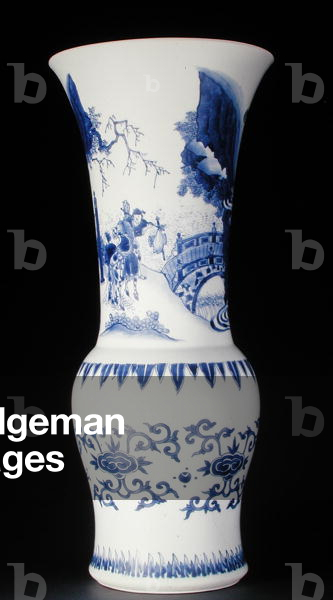
PFR210148: Vase decorated in underglaze blue with a horseman and a bridge c.1640 (porcelain) (see also 210147), Chinese School, (17th century) / Bridgeman Images
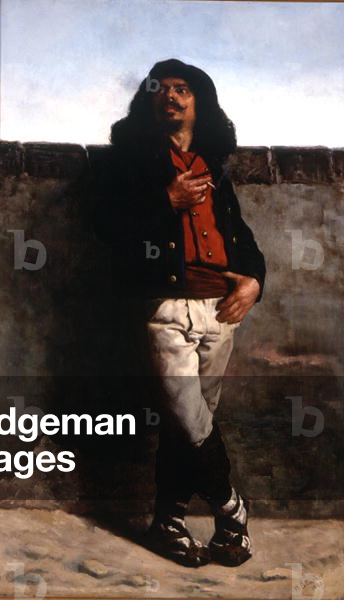
PFR210154: A Mexican, 1885 (oil on canvas), Turner, William Brint (fl.1885) / Bridgeman Images

PFR210157: Pair of 'iron paintings' (iron), Chinese School, (18th century) / Bridgeman Images

PFR210160: Sperm whale tooth mounted in silver as a snuff box, 1882 (ivory), Chinese School, (19th century) / Bridgeman Images
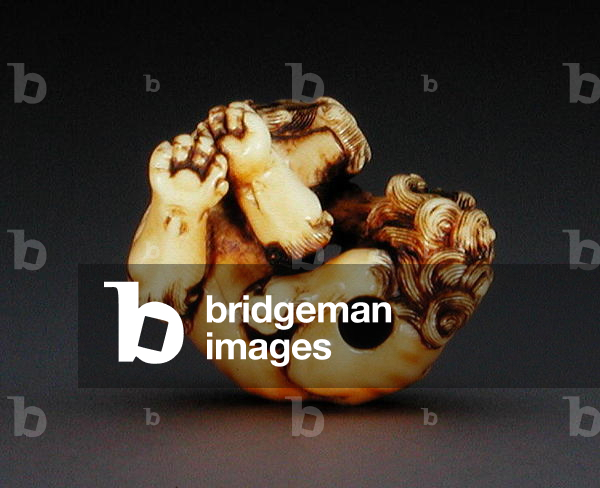
PFR210191: Netsuke depicting a shishi, c.1780-1800 (ivory) (base of 193826), Japanese School, (18th century) / Bridgeman Images

PFA156038: Costume design for 'Ephebes' from 'Phaedre', 1923 (w/c, gouache and silver paint on paper), Bakst, Leon (1866-1924) / Bridgeman Images

STC156080: The Arrival of King Louis-Philippe, (1773-1850) Duc de Montpensier, St George's Hall, Windsor Castle, 1838 (colour litho), Pyne, James Baker (1800-70) / Bridgeman Images

BMT156128: Napoleon (1769-1821) Pays Homage to the Courage of the Wounded, 1806 (oil on canvas), Debret, Jean Baptiste (1768-1848) / Bridgeman Images

STC156414: Sideboard, from 'Examples of Ancient and Modern Furniture', by Bruce Talbert, lithograph by S. Ayling (litho), Talbert, Bruce James (1838-81) (after) / Bridgeman Images

STC156420: Interior decoration of houses represented in manuscripts of the 15th century, from 'Monuments Francais', printed by Amedee Peree, 1839 (litho), Willemin, Gabrielle (19th century) (after) / Bridgeman Images

STC156442: Medieval panel designs from 'The Practical Decorator and Ornamentalist', by George Ashdown Audsley, 1892 (colour litho), Audsley, G.A. and M.A. (19th century) (after) / Bridgeman Images

STC203627: Billiards, engraved by G. Hunt, published 1827 (etching), Lambert, E.F. (fl.1823-46) (after) / Bridgeman Images

LST203742: Portrait of Rachel Russell (1674-1725) Duchess of Devonshire (oil on canvas), Dahl, Michael (1656-1743) / Bridgeman Images

CH203842: Boy with a Torn Jacket, 1890 (oil on board), Walker, William Aiken (1838-1921) / Bridgeman Images

CH203876: The Hours and the Freedom of the Fields (oil on canvas), Davies, Arthur Bowen (1862-1928) / Bridgeman Images

CH204209: Mending the Net, 1882 (w/c on paper), Eakins, Thomas Cowperthwait (1844-1916) / Bridgeman Images

NUM204365: Construction of an emergency airfield for the American army by Chinese workers (b/w photo), Unknown photographer, (20th century) / Bridgeman Images

XIR210493: A Mass in Spain to celebrate the birth of a baby, 1872 (oil on canvas), Melida, Enrique (1834-92) / Bridgeman Images

SAL210648: The Life of St. Benedict (fresco) (detail), Signorelli, L. (c.1441-1523) & Sodoma, G. (1477-1549) / Bridgeman Images

XJL210680: On to the Scaffold Quickly Lead Me, 1883 (litho) (b/w photo), American School, (19th century) / Bridgeman Images

BBC210794: A Young Couple Making Music, c.1665-70 (oil on panel), Schalken or Schalcken, Godfried (1643-1706) / Bridgeman Images

BRM156508: The Windmill, 1907 (oil on canvas), Luce, Maximilien (1858-1941) / Bridgeman Images

LRS156535: Fernand Piestre (1845-1924) (b/w photo), Dornac (Paul Francois Arnold Cardon) (1859-1941) / Bridgeman Images

XIR156571: Funeral stele depicting a banker and his daughter (mosaic), Paleo-Christian, (5th century) / Bridgeman Images

XKH156601: Stream with a Bridge, c.1799 (pencil, pen and ink on paper), Friedrich, Caspar David (1774-1840) / Bridgeman Images

XKH156604: Design for a Commemorative Column (pen, pencil and sepia on paper), Friedrich, Caspar David (1774-1840) / Bridgeman Images

XKH156616: Torso of a Young Man on round plinth, 1800 (black and white chalk on grey paper), Runge, Philipp Otto (1777-1810) / Bridgeman Images

BI156652: A Music Party (pen and brown wash over black chalk on paper), Novelli, Pietro Antonio (1729-1804) / Bridgeman Images

XJF156773: Unloading Gold at a Bank in the City (b/w photo), English Photographer, (20th century) / Bridgeman Images

XKH156790: Summer Wind, 1904-06 (drypoint), Kayser, Jean Paul (1869-1942) / Bridgeman Images

GG156930: St. Tropez (oil on canvas), Glehn, Wilfred Gabriel de (1870-1951) / Bridgeman Images

FIT156937: Windsor Castle from Eton Town, 1800 (w/c on paper), Rowlandson, Thomas (1756-1827) / Bridgeman Images

STC204396: Expedition doubling Cape Barrow, July 25 1821, from 'Narrative of a Journey to the Shores of the Polar Sea in the Years 1819-22' by Sir John Franklin (1786-1847) engraved by Edward Finden (1791-1857) published 1823-28 (colour engraving), Back, George (1796-1878) (after) / Bridgeman Images

XIR204599: Museum Ephrussi-de-Rothschild, France: facade & gardens, built in 1905-12 (photo), French School, (20th century) / Bridgeman Images
