2497476 Search Results

PIX4590228: Constellation of the Southern Cross - The Southern cross - Image obtained from Kangaroo Island, Australia. The Southern Cross and Carina from Kangaroo Island, Australia / Bridgeman Images

JLJ4590319: Egyptian Antiquity: View of the Pyramid of Sakkarah, Construction of Imhotep for King Djeser, c.2.700 BC, Saqqarah, Egypt (photo), Egyptian 3rd Dynasty (2700-2620 BC) / Bridgeman Images

PIX4590393: Part of the constellation Swan - Part of constellation of Cygnus - Above, the brightest star in the constellation Swan, Deneb. On top of the image is Deneb, the brighest star of the constellation Cygnu / Bridgeman Images

JLJ4590395: Spitritual song: prayer to Saint John the Baptist, 19th century (engraving), French School, (19th century) / Bridgeman Images

JLJ4590407: Egyptian antiquite: colonnade of the temple of Isis in Philae, Egypt (photo), Egyptian / Bridgeman Images

PIX4590420: Constellation du Cygne - Cygnus constellation - Celeste Atlas by John Flamsteed published in 1776 by J. Fortin Troieme edition, reviewed, corrected and augmented by Messrs. Delalande and Megain. Recolorise by us Celestial Atlas of John Flamsteed published in 1776. Recolored / Bridgeman Images

JLJ4590462: Egyptian antiquite: view of the entrance to the temple of Edfu, Temple of Horus, Edfu, Egypt (photo), Egyptian Ptolemaic Period (332-30 BC) / Bridgeman Images

FLO4590485: Chinese mountebank riding a boat on land accompanied by a musician playing a recorder, Qing Dynasty. Handcoloured copperplate engraving by Andrea Freschi after Antoine Cardon from Henri-Leonard-Jean-Baptiste Bertin and Jean Baptiste Joseph Breton's China, Its Costumes, Arts, Manufactures, etc., Howlett and Brimmer, London, 1824. / Bridgeman Images

CUB4495319: Countryside, Umbria, Italy / Bridgeman Images

CUB4495351: Countryside, San Pietro island, Sardinia, Italy / Bridgeman Images

CUB4495393: Mosaic, Noli, Ligury, Italy / Bridgeman Images

CUB4495414: Lagoon, Redentore feast, Venice, Veneto, Italy / Bridgeman Images

CUB4495429: Landscape, Redentore feast, Venice, Veneto, Italy / Bridgeman Images

CUB4495464: Lagoon, Venice, Veneto, Italy / Bridgeman Images

CUB4495481: Fireworks, Redentore feast, Venice, Veneto, Italy / Bridgeman Images

CUB4495508: Syusy Blady and Patrizio Roversi, Redentore feast, Venice, Veneto, Italy / Bridgeman Images

CUB4495572: Fireworks, Redentore feast, Venice, Veneto, Italy / Bridgeman Images

CUB4495585: Regatta, Redentore feast, Venice, Veneto, Italy / Bridgeman Images

CUB4495637: Procession of boats, Redentore feast, Venice, Veneto, Italy / Bridgeman Images

PIX4590553: Constellation of Sobieski's ECU - Constellation of Scutum - Scutum (The Shield) was originally Scutum Sobiescianum, Sobieski's Shield, and was introduced in 1690 by the astronomer/cartographer Johannes Hevelius, one - time mayor of Gdansk (Danzig), in honour of Polish warrior - King John Sobieski. King John distiguished himself in defending his land against the Turks in 1683, turning them back at the gates of Vienna. For this he was hailed by the Pope and others as the savior of Vienna and Western European Civilization. Scutum was created in honor of this victory, and alpha Scuti named Ioannina (Greek for John) in his honor. Scutum is small, 84th in size out of the 88 modern constellation. It contains no bright stars, and seems to have been carved out of adjoining Aquila and Serpens simply embrace a fine piece of the Milky Way. However, the open clusters M11 and M26 can be found here / Bridgeman Images

PIX4590674: Constellations of Gemels and Little Dog - Constellations of Gemini and Canis Minor - Constellation of Gemels with bright stars Castor and Pollux. Below is the small constellation of the Little Dog, with the bright star Procyon. Canis Minor (the Lesser Dog) is sometimes regarded as the smaller of the two dogs of Orion the hunter. It is minor indeed, just 185 degrees square, and 71st in size of the 88 modern constellations. The most obvious and interesting object Canis Minor is its main star, the pale yellow Procyon. Its name is from the Greek, meaning 'before the dog', since it rises before the Sirius, the Dog Star. Gemini (the Twins) is a much more interesting collection of stars, easily visualised as two figures holding hands, their heads represented by the stars Castor and Pollux. The constellation is an ancient zodiacal construction, with a rich mythology vanishing in the mists of time. It is from the direction of Gemini (near Castor) that annual Geminid meteor showers radiate, around December 14 / Bridgeman Images

PIX4590756: Constellations of the Giraffe and the Coach - Constellations of Camelopardalis and Auriga - Below, the constellation of the Coach with the brilliant star Capella, in the center, the Giraffe, at the top, towards the middle of the image, the brightest star is the Polar Star. Camelopardalis (the Giraffe, sometimes given as Camelopardis) is aptly named, both for the stick figure outlined above, which hints the outline of a giraffe's legs and sloping back, and for huge extent of constellation as it wanders over the North Celestial Pole, covering over 70 degrees. This meandering construction is probably the work of the Dutch astronomer Petrus Plancius in about 1613 and for its size (757 square degrees) it contains remarkably few bright stars / Bridgeman Images
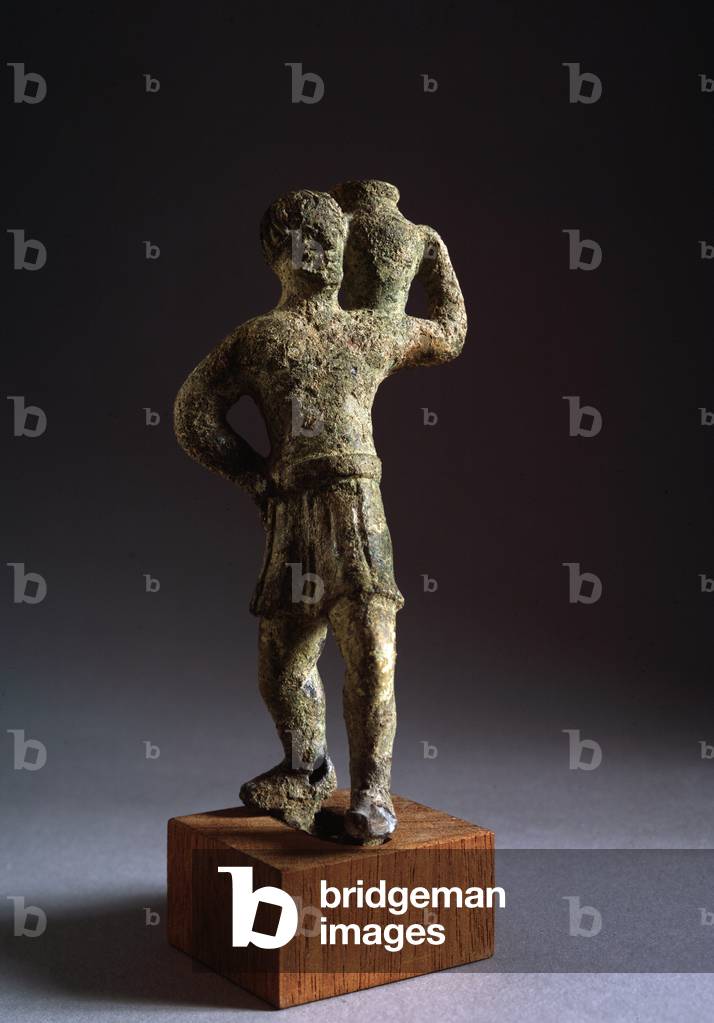
LRI4590765: Etruscan Civilization: Offering - Bronze Sculpture, 3rd - 2nd Century BC Sun 12.3 cm Coming from Brolio, Italy (Etruscan art, offering man, bronze sculpture, from Brolio, Italy, 3rd-2nd century BC, Sun 12.3 cm) Volterra Museo Guarnacci, Etruscan (3rd century BC) / Bridgeman Images

FLO4590774: Cross-sections and plans of blast furnaces, early 19th century. Copperplate engraving by Wilson Lowry from Abraham Rees' Cyclopedia or Universal Dictionary of Arts, Sciences and Literature, Longman, Hurst, Rees, Orme and Brown, London, 1804. / Bridgeman Images

LRI4590787: Greek art: music contest between Apollo and Marsyas (playing aulos and lyre). Low relief carved in marble, 320 BC, Greek antiquity. National Archaeological Museum, Athens (Greece), Greek school, (4th century BC) / Bridgeman Images

JLJ4590809: Saint Francois Xavier, Spanish Jesuit missionary one of the founders of the odre of Jesus' company, evangelizing the Chinese under the protection of Christ in China, 19th century (engraving), Unknown Artist, (19th century) / Bridgeman Images

FLO4590850: Plan, elevation and section of an air vault, early 19th century. Copperplate engraving by Wilson Lowry after a drawing by David Mushet from Abraham Rees' Cyclopedia or Universal Dictionary of Arts, Sciences and Literature, Longman, Hurst, Rees, Orme and Brown, London, 1805. / Bridgeman Images

JLJ4590925: Scene of the life of Charles de Valois, Duke of Angouleme, Party scene given on the occasion of the marriage of Charles de Valois with his second wife, 1644 (painting), Bosse, Abraham (1602-76) (after) / Bridgeman Images

FLO4590969: Dial work and striking part of an eight-day clock. Copperplate engraving by Wilson Lowry after a drawing by John Farey Jr. from Abraham Rees' Cyclopedia or Universal Dictionary of Arts, Sciences and Literature, Longman, Hurst, Rees, Orme and Brown, London, 1808. / Bridgeman Images

FLO4590988: Anatomy of human musculature, 1820 (copperplate engraving) / Bridgeman Images

CUB4496277: Chanel shop, Babuino street, Rome, Lazio, Italy / Bridgeman Images

CUB4496308: Gucci shop, Condotti street, Rome, Lazio, Italy / Bridgeman Images

CUB4496325: Salvatore Ferragamo shop, Condotti street, Rome, Lazio, Italy / Bridgeman Images

CUB4496353: Ferrari store, Tomacelli street, Rome, Lazio, Italy / Bridgeman Images

CUB4496370: Sign, Le Pain Quotidien café, Tomacelli street, Rome, Lazio, Italy / Bridgeman Images

CUB4496396: Crowd in Piazza del Comune, La Corsa dei Ceri feast on 15th of May, Gubbio, Umbria, Italy / Bridgeman Images
