2491528 Search Results

FLO4564388: Rhubarb, Rheum rhabarbarum (Rheum undulatum). Handcoloured copperplate engraving from Dr. Willibald Artus' Hand-Atlas sammtlicher mediinisch-pharmaceutischer Gewachse, (Handbook of all medical-pharmaceutical plants), Jena, 1876. / Bridgeman Images

FLO4564428: Calumba, Jateorhiza palmata (Menispermum palmatum). Handcoloured copperplate engraving from Dr. Willibald Artus' Hand-Atlas sammtlicher mediinisch-pharmaceutischer Gewachse, (Handbook of all medical-pharmaceutical plants), Jena, 1876. / Bridgeman Images

LRI4564548: Portrait of Giovanni Pacini (engraving, 19th century) / Bridgeman Images

FLO4564553: Coriander or cilantro, Coriandrum sativum. Handcoloured copperplate engraving from Dr. Willibald Artus' Hand-Atlas sammtlicher mediinisch-pharmaceutischer Gewachse, (Handbook of all medical-pharmaceutical plants), Jena, 1876. / Bridgeman Images

FLO4564315: Fine-leaved water-dropwort, Oenanthe aquatica (Phellandrium aquatica). Handcoloured copperplate engraving from Dr. Willibald Artus' Hand-Atlas sammtlicher mediinisch-pharmaceutischer Gewachse, (Handbook of all medical-pharmaceutical plants), Jena, 1876. / Bridgeman Images

FLO4564790: Saffron crocus, Crocus sativa. Handcoloured copperplate engraving from Dr. Willibald Artus' Hand-Atlas sammtlicher mediinisch-pharmaceutischer Gewachse, (Handbook of all medical-pharmaceutical plants), Jena, 1876. / Bridgeman Images

FLO4564764: Green cardamom, Elettaria cardamomum (Alpinia cardamom). Handcoloured copperplate engraving from Dr. Willibald Artus' Hand-Atlas sammtlicher mediinisch-pharmaceutischer Gewachse, (Handbook of all medical-pharmaceutical plants), Jena, 1876. / Bridgeman Images

FLO4564862: Russian noblewoman, 19th century. Handcoloured lithograph after a design by Leon Sault from “” L'Art du Travestissement” (The Art of Fancy Dress), Paris, c.1880. Sault was a theatre and opera designer and luxury fashion magazine publisher. / Bridgeman Images

LRI4564957: Portrait of Michele Rapetti (engraving, 19th century), Unknown Artist, (19th century) / Bridgeman Images

FLO4565008: Fancy dress costume of a hummingbird, with winged dress, bodice decorated with flowers. Handcoloured lithograph after a design by Leon Sault from “” L'Art du Travestissement” (The Art of Fancy Dress), Paris, c.1880. Sault was a theatre and opera designer and luxury fashion magazine publisher. / Bridgeman Images

FLO4565016: Allegorical costume as the element fire, with skirt and shawl decorated with flame pattern, bellows, flip-flops and brush on her belt. Handcoloured lithograph after a design by Leon Sault from “” L'Art du Travestissement” (The Art of Fancy Dress), Paris, c.1880. Sault was a theatre and opera designer and luxury fashion magazine publisher. / Bridgeman Images
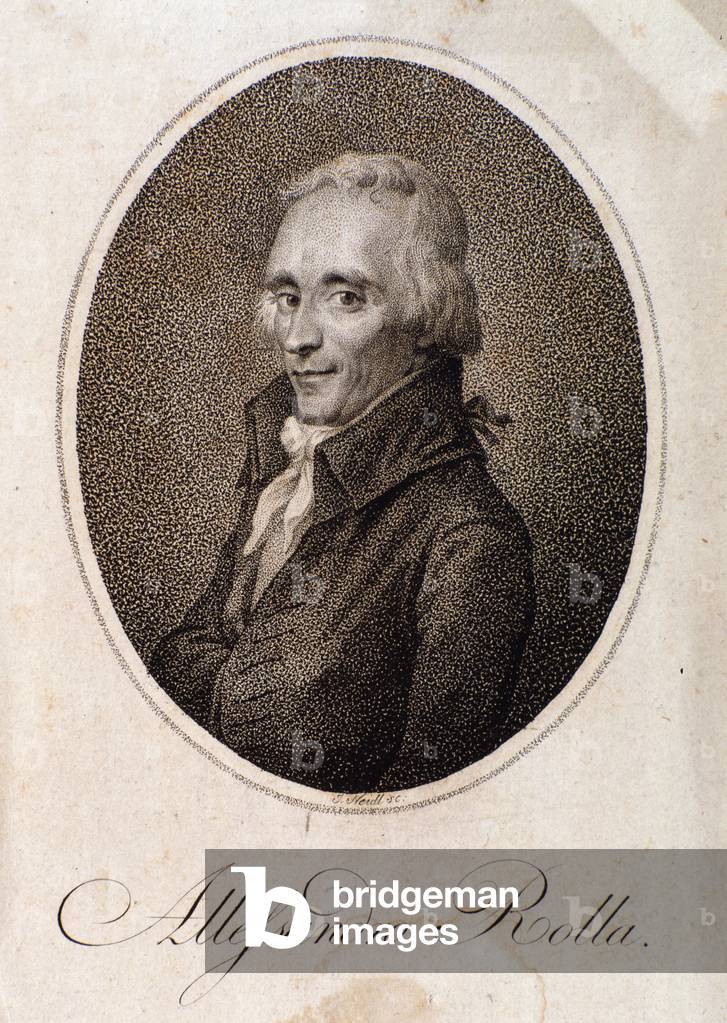
LRI4565044: Portrait of Alessandro Rolla (engraving, 19th century) / Bridgeman Images

EPA4561284: Artwork by Dan Flavin. The exhibition “” Passage du temps””, Collection Francois Pinault Fondation, at the Tri Postal de Lille (Nord, Pas de Calais), 2007-2008., Flavin, Dan (1933-96) / Bridgeman Images
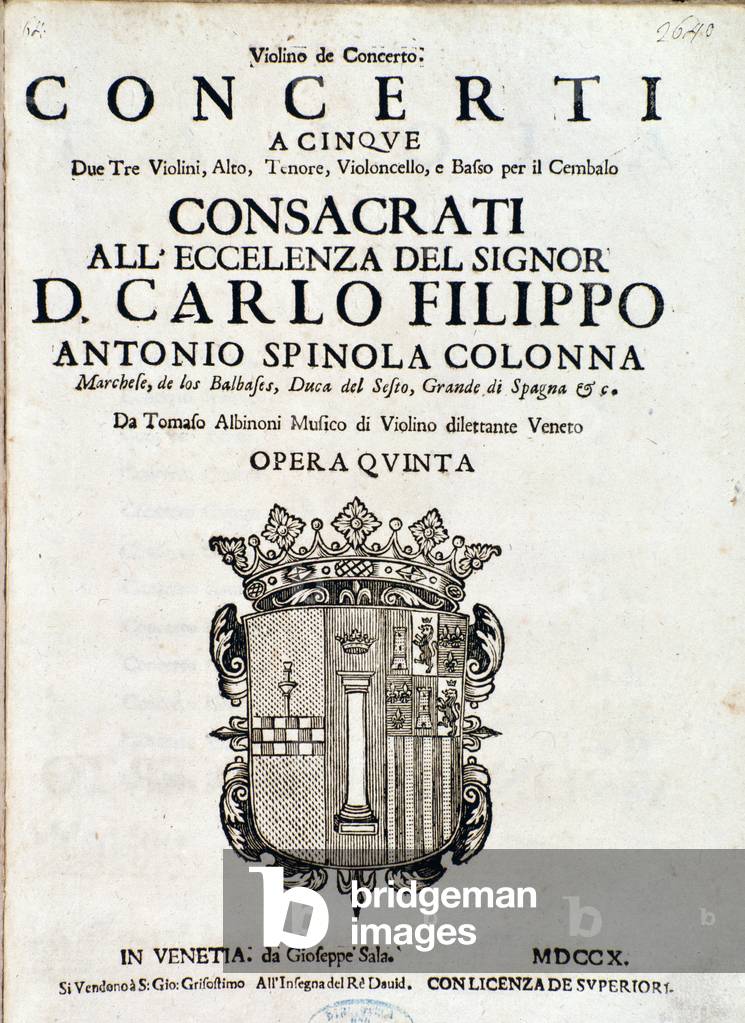
LRI4562747: Frontispiece of musical score of “Concerti a cinque, opera 5” by Tomaso Albinoni, 1710 (litho), Italian School, (18th century) / Bridgeman Images

FLO4562458: Bombyx of the bramble and coarse on a common bramble plant (wood or hedge bramble, hedge murier, wild murier or woody bramble) - Fox moth, Macrothylacia rubi, and Autumn green carpet, Chloroclysta miata, on blackberry bush, Rubus fruticosus. Handcoloured copperplate engraving drawn and etched by Jacob l'Admiral in Naauwkeurige Waarneemingen omtrent de veranderingen van veele Insekten (Accurate Descriptions of the Metamorphoses of Insects), J. Sluyter, Amsterdam, 1774. For this second edition, M. Houttuyn added another eight plates to the original 25. / Bridgeman Images

FLO4562504: Woman sitting under a tree reading a book wearing a coral pink dress with neck scarf - Lithograph with stencil (stencil) handcolour from the luxury French fashion magazine “” Art, Gout, Beaute,”” 1926, Illustration signed Dory. / Bridgeman Images
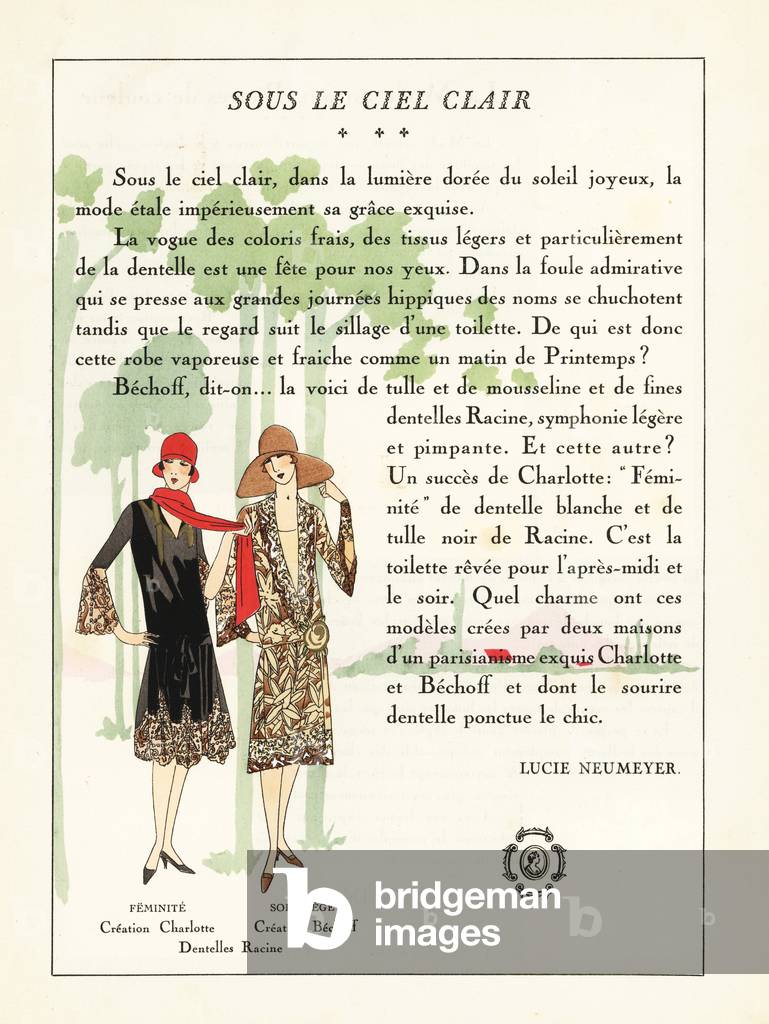
FLO4562513: Elegant Women in Tulle, Chiffon and Lace Afternoon Dresses, 1926 - Women in afternoon dresses of tulle, muslin and lace - Lithograph with stencil handcolour from the luxury French fashion magazine “” Art, Gout, Beaute,”” 1926 / Bridgeman Images
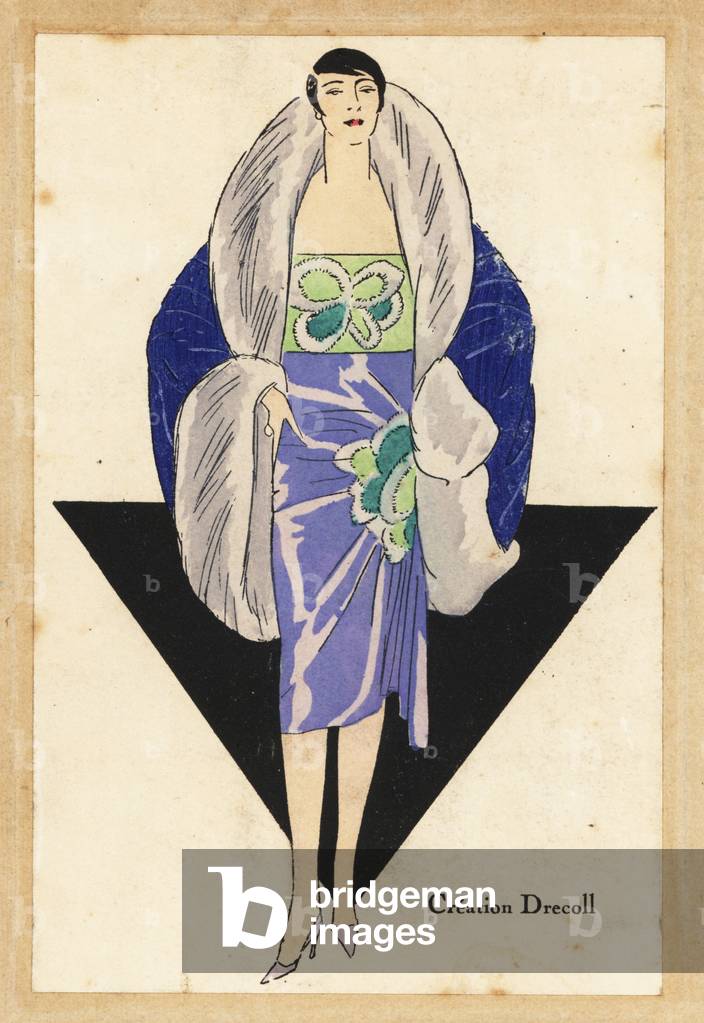
FLO4562527: Woman in silk wrap dress and fur coat, creation Drecoll, 1926 - Woman in silk wrap dress and fur coat from Creation Drecoll - Lithograph with stencil handcolour from the luxury French fashion magazine “” Art, Gout, Beaute,”” 1926 / Bridgeman Images

FLO4562614: Women in afternoon dresses in satin crepe with cloche hats in a restaurant - Lithograph with stencil handcolour from the luxury French fashion magazine “” Art, Gout, Beaute,”” 1926 / Bridgeman Images

FLO4562627: Dancer Miss Riviere and Lucette in La jolie fiancee by Charles-Gaspard Delestre-Poirson at the Theatre du Vaudeville, Paris. Handcoloured copperplate engraving from Charles Malo's Almanach des Spectacles by K. and Z, Chez Janet, Paris, 1818. / Bridgeman Images
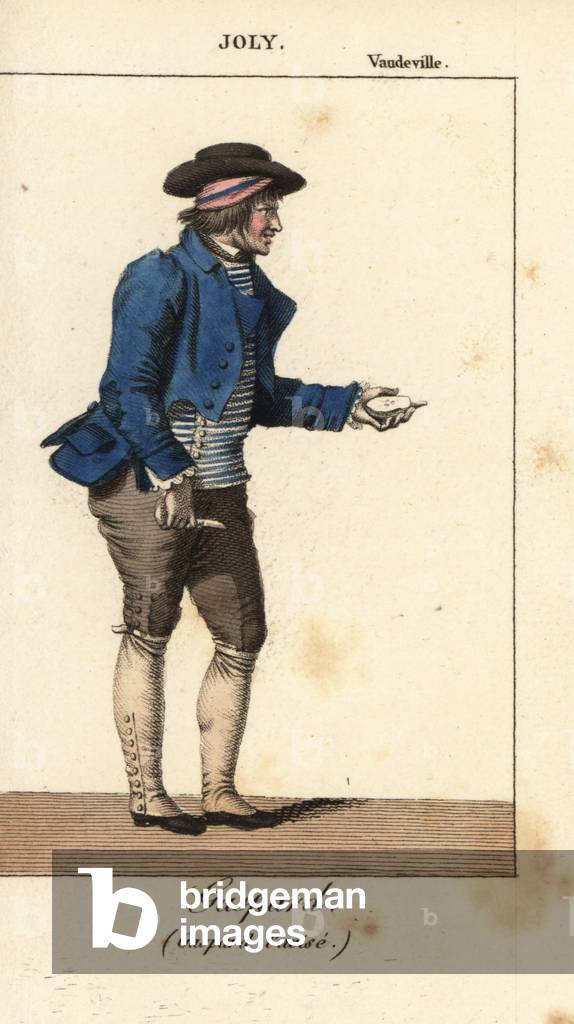
FLO4562638: Actor Joly or Adrien Jean Baptiste Mussat (1776-1839) as Gaspard in Gaspard l'avise by Jean-Baptiste Radet at the Theatre du Vaudeville. Handcoloured copperplate engraving from Almanach des Spectacles by K. and Z, attributed to Charles Malo, Chez Janet, Paris, 1818. / Bridgeman Images

FLO4562752: English opera singer Simon Chenard 1758-1832 as Prince de Catane in the opera Prince de Catane by Rene Richard Castel after Voltaire at the Opera Comique, Paris, 1818. Handcoloured copperplate engraving from Charles Malo's Almanach des Spectacles by K. Y. Z, Chez Louis Janet, Paris, 1819. / Bridgeman Images
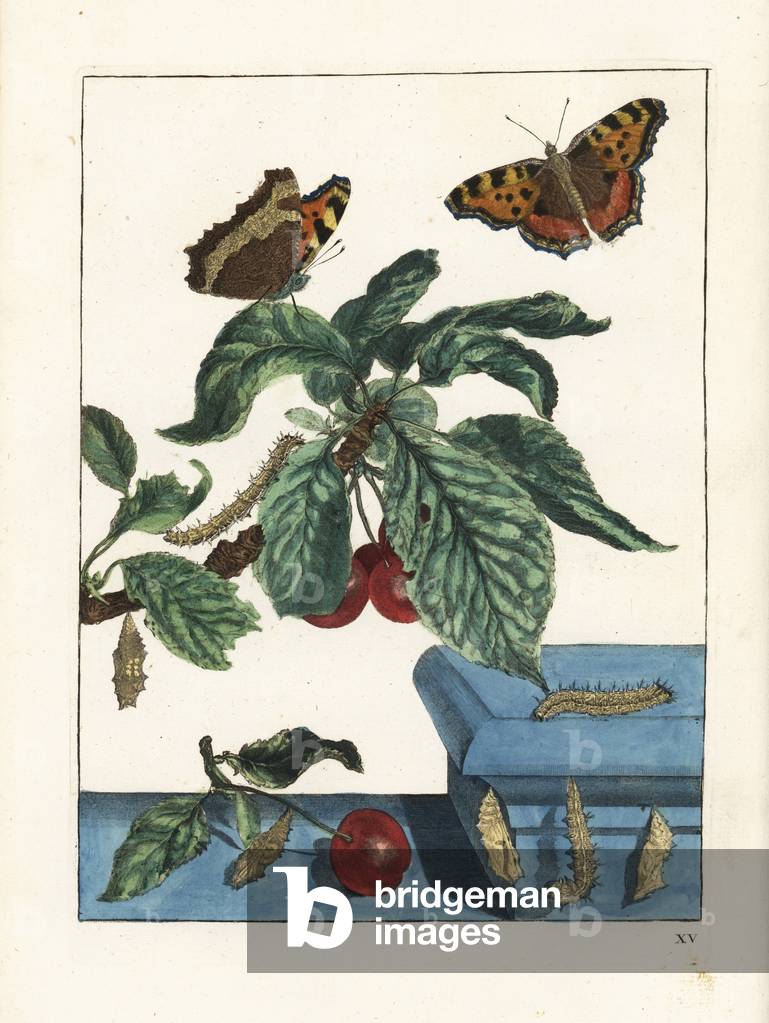
FLO4562382: Large tortoiseshell butterfly, Nymphalis polychloros, on a cherry tree, Prunus avium. Handcoloured copperplate engraving drawn and etched by Jacob l'Admiral in Naauwkeurige Waarneemingen omtrent de veranderingen van veele Insekten (Accurate Descriptions of the Metamorphoses of Insects), J. Sluyter, Amsterdam, 1774. For this second edition, M. Houttuyn added another eight plates to the original 25. / Bridgeman Images

FLO4562416: Cucubale Moth - Campion moth, Sideridis rivularis, on a flower. Handcoloured copperplate engraving drawn and etched by Jacob l'Admiral in Naauwkeurige Waarneemingen omtrent de veranderingen van veele Insekten (Accurate Descriptions of the Metamorphoses of Insects), J. Sluyter, Amsterdam, 1774. For this second edition, M. Houttuyn added another eight plates to the original 25. / Bridgeman Images

FLO4562459: Oak bombyx (or minimal with yellow bands) on a plant of callune - Oak eggar moth, Lasiocampa quercus, long bastard wasp, on heather, Calluna vulgaris. Handcoloured copperplate engraving drawn and etched by Jacob l'Admiral in Naauwkeurige Waarneemingen omtrent de veranderingen van veele Insekten (Accurate Descriptions of the Metamorphoses of Insects), J. Sluyter, Amsterdam, 1774. For this second edition, M. Houttuyn added another eight plates to the original 25. / Bridgeman Images

FLO4562483: Two women with their luggage in front of a train, one with a green wool sports suit, the other with a skirt suit lined with velvet, 1926 - Two women with travel bags in front of a train. One wears a sports ensemble in green wool and a visiting suit with velvet trim - Lithograph with stencil handcolour from the luxury French fashion magazine “” Art, Gout, Beaute,”” 1926 / Bridgeman Images

FLO4562514: Title page of the fashion magazine Art, Gout, Beaute, with two elegantly young women walking in a park, one wears a three-piece set printed in alpaca and the other a multicolored silk dress and an umbrella, 1926 - Title page of Art, Gout, Beaute, May, 1926, showing two chic women on a walk in the park. One wears a three-piece suit of black and white printed alpaca wool, and one in a multicoloured silk afternoon dress with parasol - Lithograph with stencil handcolour from the luxury French fashion magazine “” Art, Gout, Beaute,”” 1926 / Bridgeman Images

FLO4562700: Jacques Nicolas Tiercelin (1764-1837) as Bonneau in Les Auvergnats by Marc-Antoine Desaugiers and Gentil de Chavagnac at the Theatre des Varietes, Paris. Handcoloured copperplate engraving from Charles Malo's Almanach des Spectacles by K. Y. Z, Chez Louis Janet, Paris, 1819. / Bridgeman Images
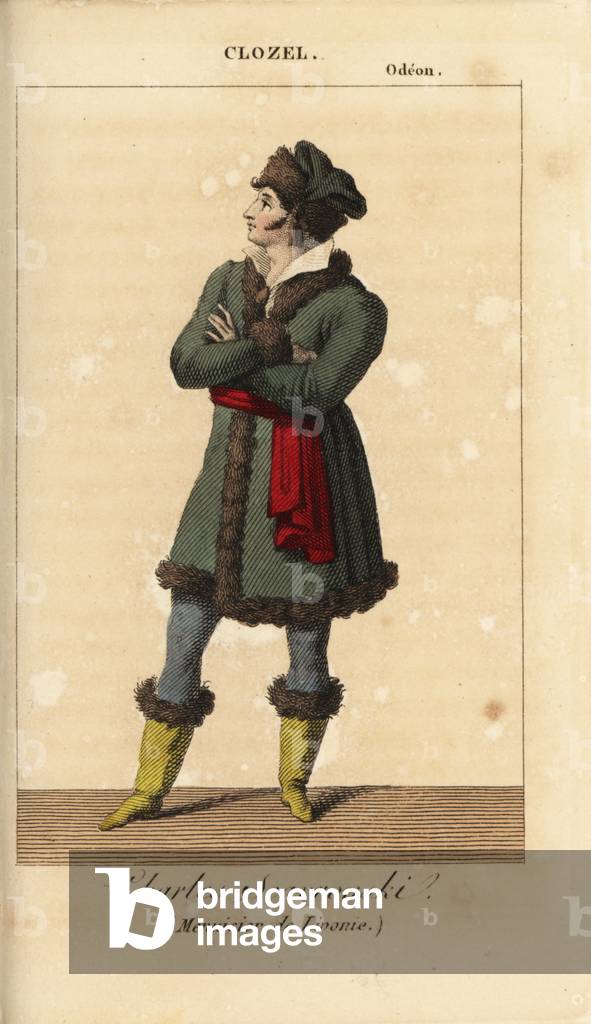
FLO4562728: French actor Pierre Clozel (1772-1840) as Charles Scavronski in Menuisier de Livonie by Alexandre Duval at the Odeon Theatre, Paris. Handcoloured copperplate engraving after Joly from Charles Malo's Almanach des Spectacles by K. Y. Z, Chez Louis Janet, Paris, 1820. / Bridgeman Images

LBY4559409: Graphic art studio at the Georges Pompidou center in Paris. Architect Peripheriques, Emmanuelle Marin and David Trottin, 2002., Rogers, Richard (b.1933) and Piano, Renzo (b.1937) / Bridgeman Images

FLO4565149: Fancy dress costume of a flower bouquet seller in the Watteau style. Silk toque hat, lace fichu, silk dress embroidered with flowers, petticoats and apron. Handcoloured lithograph after a design by Leon Sault from “” L'Art du Travestissement” (The Art of Fancy Dress), Paris, c.1880. Sault was a theatre and opera designer and luxury fashion magazine publisher. / Bridgeman Images

FLO4565167: Fancy dress costume of an Arab man, in chachia, long shawl over vest waistcoat, sash, panties, boots, dagger and sabre. Handcoloured lithograph after a design by Leon Sault from “” L'Art du Travestissement” (The Art of Fancy Dress), Paris, c.1880. Sault was a theatre and opera designer and luxury fashion magazine publisher. / Bridgeman Images

FLO4565444: Indian nobleman on a palanquin on an elephant in embroidered silk drapery. Handcoloured copperplate engraving by an unknown artist from “” Asiatic Costumes,”” Ackermann, London, 1828. / Bridgeman Images

FLO4565449: Moonshee, pundit or interpreter, in muslin vest, trousers, tunic and turban. Handcoloured copperplate engraving by an unknown artist from “” Asiatic Costumes,”” Ackermann, London, 1828. / Bridgeman Images

LRI4565624: Portrait of Giuseppe Verdi (b/w photo), Unknown photographer, (19th century) / Bridgeman Images

FLO4565137: Fancy dress costume of a shepherdess in the Watteau style. Straw hat, silk dress embroidered with flowers, petticoats and ribbons. Handcoloured lithograph after a design by Leon Sault from “” L'Art du Travestissement” (The Art of Fancy Dress), Paris, c.1880. Sault was a theatre and opera designer and luxury fashion magazine publisher. / Bridgeman Images
