Search options

Orientation
Colour

Display options

View

Print

To print search results, use print friendly version of this page.

2490880 Search Results

Palazzo Ducale, Parma, Emilia Romagna, Italy

CUB4515897: Palazzo Ducale, Parma, Emilia Romagna, Italy / Bridgeman Images

Villa Panza di Biumo garden, Varese, Lombardy, Italy

CUB4515914: Villa Panza di Biumo garden, Varese, Lombardy, Italy / Bridgeman Images

Garden of Nelson Castle, Maniace di Bronte, Sicily, Italy

CUB4515931: Garden of Nelson Castle, Maniace di Bronte, Sicily, Italy / Bridgeman Images

Mediterranean maquis, Sardinia, Italy

CUB4515944: Mediterranean maquis, Sardinia, Italy / Bridgeman Images

View of Tavolara island, Sardinia, Italy

CUB4515960: View of Tavolara island, Sardinia, Italy / Bridgeman Images

Cala Luna, Sardinia, Italy

CUB4516012: Cala Luna, Sardinia, Italy / Bridgeman Images

The kitchen of witches (painting, 16th century)

LRI4572264: The kitchen of witches (painting, 16th century), Francken, Hieronymus (1540-1610) / Bridgeman Images

Athena called 'Collar Minerve'm 5th century BC (marble)

JLJ4572325: Athena called 'Collar Minerve'm 5th century BC (marble), Phidias (c.500-c.432 BC) (after) / Bridgeman Images

Portrait of Yvette Guilbert singer. Portrait of a woman with red hair on a gold background, 1895 (oil on canvas)

JLJ4572349: Portrait of Yvette Guilbert singer. Portrait of a woman with red hair on a gold background, 1895 (oil on canvas), Granie, Joseph (1866-1915) / Bridgeman Images

Portrait in foot of the sister of Marechal Berthier, 1830 (oil on canvas)

JLJ4572373: Portrait in foot of the sister of Marechal Berthier, 1830 (oil on canvas), Winterhalter, Franz Xaver (1805-73) / Bridgeman Images

Brown dwarf with asteroid ring - Artist's view of a brown dwarf star surrounded by an asteroid belt. In the foreground, a primitive exoplanet illuminated by the star. This brown dwarf is host to a disk composed primarily of asteroids and boulders. The light from this dwarf is barely enough to illuminate the surface of this primitive planet. At a distance of about 1.5 million miles, the orbit of this planet is aligned to the plane of the rings with the result that they appear as a fuzzy line occulting the glowing face of this brown dwarf

PIX4572527: Brown dwarf with asteroid ring - Artist's view of a brown dwarf star surrounded by an asteroid belt. In the foreground, a primitive exoplanet illuminated by the star. This brown dwarf is host to a disk composed primarily of asteroids and boulders. The light from this dwarf is barely enough to illuminate the surface of this primitive planet. At a distance of about 1.5 million miles, the orbit of this planet is aligned to the plane of the rings with the result that they appear as a fuzzy line occulting the glowing face of this brown dwarf / Bridgeman Images

Brown dwarf with a large debris ring - Artist's view of a brown dwarf star surrounded by a disc of dust and rocks. In the foreground, a primitive exoplanet illuminated by the star. This imaginary high - mass brown dwarf has a larger disk than the previous renderings. The perspective is from the equator of an airless planet, orbiting the brown dwarf at a distance of about 4 million miles. This planet's orbit is very nearly aligned to the plane of the rings, hence the debris appears as a sword - like straight line

PIX4572539: Brown dwarf with a large debris ring - Artist's view of a brown dwarf star surrounded by a disc of dust and rocks. In the foreground, a primitive exoplanet illuminated by the star. This imaginary high - mass brown dwarf has a larger disk than the previous renderings. The perspective is from the equator of an airless planet, orbiting the brown dwarf at a distance of about 4 million miles. This planet's orbit is very nearly aligned to the plane of the rings, hence the debris appears as a sword - like straight line / Bridgeman Images

Nova de l'Eagle - Nova Aquilae. Artwork - Artist's view of a nova, a white dwarf star that attracts the material of a companion star at the end of life, a red giant, and compresses these gases and then unleash a nuclear fusion reaction releasing a huge amount of energy in the form of a brief, extremely bright light. Here the artist showed the binary system just before the explosion of the nova. The artist's illustration depicts a classical nova binary system just before an explosion on the surface of the white dwarf. Classical novas occur in a system where a white dwarf closely orbits a normal, companion star. In this illustration, gas is flowing from the large red, companion star into a disk and then onto the white dwarf that is hidden inside the white area. As the gas flows ever closer to the white dwarf, it gets increasingly hotter, as indicated by the change in colors from yellow to white. When the explosion occurs, it engulfs the disk of gas and the red companion star

PIX4572591: Nova de l'Eagle - Nova Aquilae. Artwork - Artist's view of a nova, a white dwarf star that attracts the material of a companion star at the end of life, a red giant, and compresses these gases and then unleash a nuclear fusion reaction releasing a huge amount of energy in the form of a brief, extremely bright light. Here the artist showed the binary system just before the explosion of the nova. The artist's illustration depicts a classical nova binary system just before an explosion on the surface of the white dwarf. Classical novas occur in a system where a white dwarf closely orbits a normal, companion star. In this illustration, gas is flowing from the large red, companion star into a disk and then onto the white dwarf that is hidden inside the white area. As the gas flows ever closer to the white dwarf, it gets increasingly hotter, as indicated by the change in colors from yellow to white. When the explosion occurs, it engulfs the disk of gas and the red companion star / Bridgeman Images

Artist's view of a fugitive star - A runaway star in the Large Magellanic cloud - The star HE0457 - 5439 is a massive star in the Grand Cloud of Magellan; it is a star escaping from this galaxy at a speed of 2.6 Million km/h Background image obtained at the observatory of La Silla in Chile; the star fleeing has been added on the image. The star HE0457 - 5439 is a massive star wich lies closer to one of the Milky Way satellite galaxies, the Large Magellanic Cloud, located 160,000 light - years away from us. This is a runaway star, moving at more than 2.6 million kilometers per hour. Astronomers find it likely for the star to have reached its present position had it been ejected from the centre of the LMC. The background image has been obtained at La Silla observatory, the star moving has been added

PIX4572713: Artist's view of a fugitive star - A runaway star in the Large Magellanic cloud - The star HE0457 - 5439 is a massive star in the Grand Cloud of Magellan; it is a star escaping from this galaxy at a speed of 2.6 Million km/h Background image obtained at the observatory of La Silla in Chile; the star fleeing has been added on the image. The star HE0457 - 5439 is a massive star wich lies closer to one of the Milky Way satellite galaxies, the Large Magellanic Cloud, located 160,000 light - years away from us. This is a runaway star, moving at more than 2.6 million kilometers per hour. Astronomers find it likely for the star to have reached its present position had it been ejected from the centre of the LMC. The background image has been obtained at La Silla observatory, the star moving has been added / Bridgeman Images

The punishment of love (oil on canvas, 1706-1707)

LRI4610769: The punishment of love (oil on canvas, 1706-1707), Ricci, Sebastiano (1658-1734) / Bridgeman Images

The four elements. The Earth (Detail on the right), 1641 (oil on canvas)

JLJ4610801: The four elements. The Earth (Detail on the right), 1641 (oil on canvas), Deruet, Claude (1588-1660) / Bridgeman Images

Saint Peter released from prison (oil on canvas, circa 1710)

LRI4610810: Saint Peter released from prison (oil on canvas, circa 1710), Ricci, Sebastiano (1658-1734) / Bridgeman Images
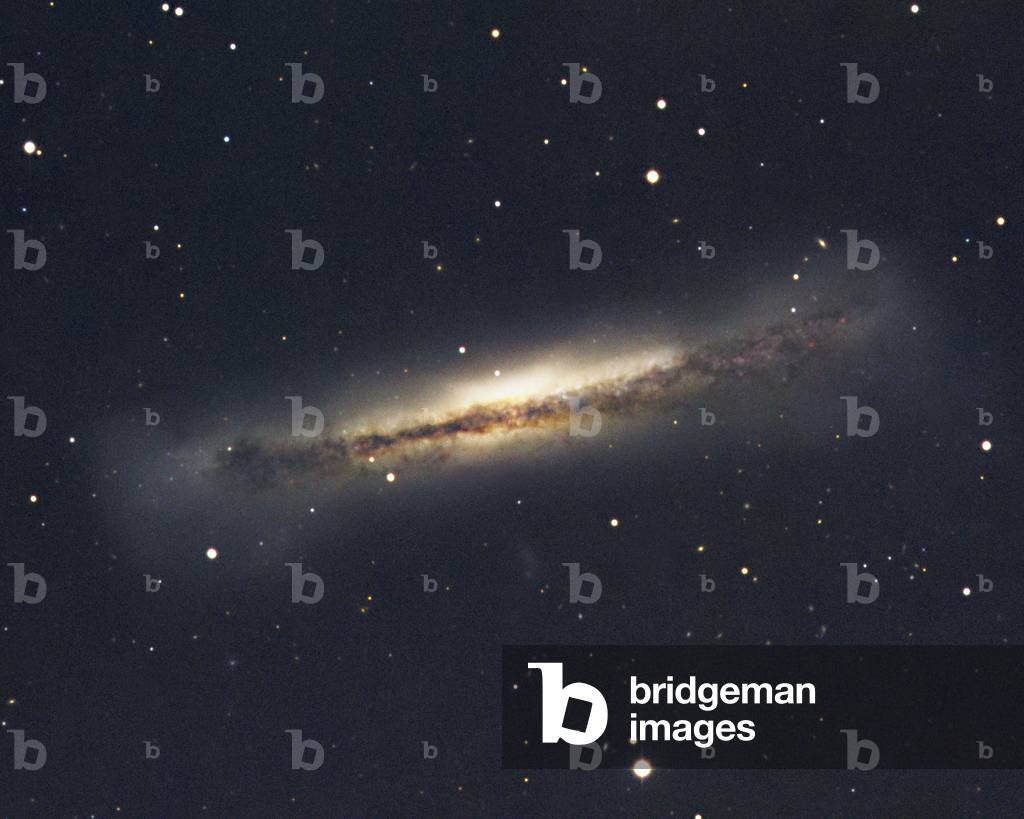
Spiral Galaxy NGC 3628 in the Lion - Spiral galaxy NGC 3628 in Leo - NGC 3628 is a spiral galaxy seen by the slice located at a distance of about 35 million years - light. With its neighbors M65 and M66, it forms a remarkable triplet of galaxies, called the Lion Triplet or the M66 Group. Image obtained with Siding Spring's 3.9m telescope. This picture has been specially enhanced to reveal NGC 3628, which is seen as an edge - on spiral galaxy, crossed by a dust lane. Galaxies seen edge - on are rare, but this example has other peculiarities. The dust lane is distinctly askew and the ends of the spiral arms are obviously puffed out, with evidence of star formation. The bright bulge of the galaxy also has an unusual 'peanut' shape. This suggests that the galaxies of the Leo group are interacting, gradually pulling each other apart as they orbit each other. Image obtained with the 3.9m telescope of Siding Spring

PIX4610870: Spiral Galaxy NGC 3628 in the Lion - Spiral galaxy NGC 3628 in Leo - NGC 3628 is a spiral galaxy seen by the slice located at a distance of about 35 million years - light. With its neighbors M65 and M66, it forms a remarkable triplet of galaxies, called the Lion Triplet or the M66 Group. Image obtained with Siding Spring's 3.9m telescope. This picture has been specially enhanced to reveal NGC 3628, which is seen as an edge - on spiral galaxy, crossed by a dust lane. Galaxies seen edge - on are rare, but this example has other peculiarities. The dust lane is distinctly askew and the ends of the spiral arms are obviously puffed out, with evidence of star formation. The bright bulge of the galaxy also has an unusual 'peanut' shape. This suggests that the galaxies of the Leo group are interacting, gradually pulling each other apart as they orbit each other. Image obtained with the 3.9m telescope of Siding Spring / Bridgeman Images

Corniglia, Cinque Terre, Ligury, Italy

CUB4516209: Corniglia, Cinque Terre, Ligury, Italy / Bridgeman Images

Fisherman, Cinque Terre, Ligury, Italy

CUB4516248: Fisherman, Cinque Terre, Ligury, Italy / Bridgeman Images

Thermal waters, Fosso Bianco, Bagni San Filippo, Tuscany, Italy

CUB4516273: Thermal waters, Fosso Bianco, Bagni San Filippo, Tuscany, Italy / Bridgeman Images

Basin and arcade, S. Caterina da Siena sanctuary, Bagni Vignoni, Tuscany, Italy

CUB4516279: Basin and arcade, S. Caterina da Siena sanctuary, Bagni Vignoni, Tuscany, Italy / Bridgeman Images

Spiral galaxy NGC 3982 in the Great Bear - Spiral galaxy NGC 3982 in Ursa Major - The spiral galaxy NGC 3982 is located about 68 million years ago - light from Earth. It extends over about 30,000 light years. It is a spiral galaxy that houses a black hole in its heart and large zones of star formation in its arms. This image was taken by the Hubble Space Telescope (HST). This face - on spiral galaxy, called NGC 3982, is striking for its rich tapestry of star birth, along with its winding arms. The arms are lined with pink star - forming regions of glowing hydrogen, newborn blue star clusters, and obscuring dust lanes that provide the raw material for future generations of stars. The bright nucleus is home to an older population of stars, which grow ever more densely packed towards the center. NGC 3982 is located about 68 million light - years away in the constellation Ursa Major. The galaxy spans about 30,000 light - years, one - third of the size of our Milky Way galaxy. This color image is composed of exposures taken by the Hubble Space Telescope's Wide Field Camera 3 (WFC3), the Advanced Camera for Surveys (ACS), and the Wide Field Planetary Camera 2 (WFPC2). The observations were taken between March 2000 and August 2009

PIX4610993: Spiral galaxy NGC 3982 in the Great Bear - Spiral galaxy NGC 3982 in Ursa Major - The spiral galaxy NGC 3982 is located about 68 million years ago - light from Earth. It extends over about 30,000 light years. It is a spiral galaxy that houses a black hole in its heart and large zones of star formation in its arms. This image was taken by the Hubble Space Telescope (HST). This face - on spiral galaxy, called NGC 3982, is striking for its rich tapestry of star birth, along with its winding arms. The arms are lined with pink star - forming regions of glowing hydrogen, newborn blue star clusters, and obscuring dust lanes that provide the raw material for future generations of stars. The bright nucleus is home to an older population of stars, which grow ever more densely packed towards the center. NGC 3982 is located about 68 million light - years away in the constellation Ursa Major. The galaxy spans about 30,000 light - years, one - third of the size of our Milky Way galaxy. This color image is composed of exposures taken by the Hubble Space Telescope's Wide Field Camera 3 (WFC3), the Advanced Camera for Surveys (ACS), and the Wide Field Planetary Camera 2 (WFPC2). The observations were taken between March 2000 and August 2009 / Bridgeman Images

Fodder plants, Emilia Romagna, Italy

CUB4516497: Fodder plants, Emilia Romagna, Italy / Bridgeman Images

Interacting galaxies NGC 4038 - 4039 in the Raven - NGC 4038 - 39, the interacting galaxies of the Antennae - Image of the galaxy NGC 4038 - 39 (antenna galaxy), located about 45 million years ago - light from Earth. These two galaxies are interacting. The collision started at least 100 million years ago causes intense star formation. NGC 4038 and 4039 are the well - known pair of interacting galaxies that show two broadly curved tails of stars, the 'antenna', extending a considerable distance from the action, as seen here. The colour picture reveals the burst of star formation triggered by the encounter, the large numbers of pink emission nebulae in the inter - galaxy region and the location of the numerous dark, brownish - yellow clouds of dust. The yellow nuclei of the two galaxies are also still visible in the colour picture as separate entities

PIX4611114: Interacting galaxies NGC 4038 - 4039 in the Raven - NGC 4038 - 39, the interacting galaxies of the Antennae - Image of the galaxy NGC 4038 - 39 (antenna galaxy), located about 45 million years ago - light from Earth. These two galaxies are interacting. The collision started at least 100 million years ago causes intense star formation. NGC 4038 and 4039 are the well - known pair of interacting galaxies that show two broadly curved tails of stars, the 'antenna', extending a considerable distance from the action, as seen here. The colour picture reveals the burst of star formation triggered by the encounter, the large numbers of pink emission nebulae in the inter - galaxy region and the location of the numerous dark, brownish - yellow clouds of dust. The yellow nuclei of the two galaxies are also still visible in the colour picture as separate entities / Bridgeman Images

Snowfall, Italy
Snowfall, Italy

CUB4516582: Snowfall, Italy / Bridgeman Images

Alder with frost, Italy

CUB4516597: Alder with frost, Italy / Bridgeman Images

Frost on ivy, Italy
Frost on ivy, Italy

CUB4516651: Frost on ivy, Italy / Bridgeman Images
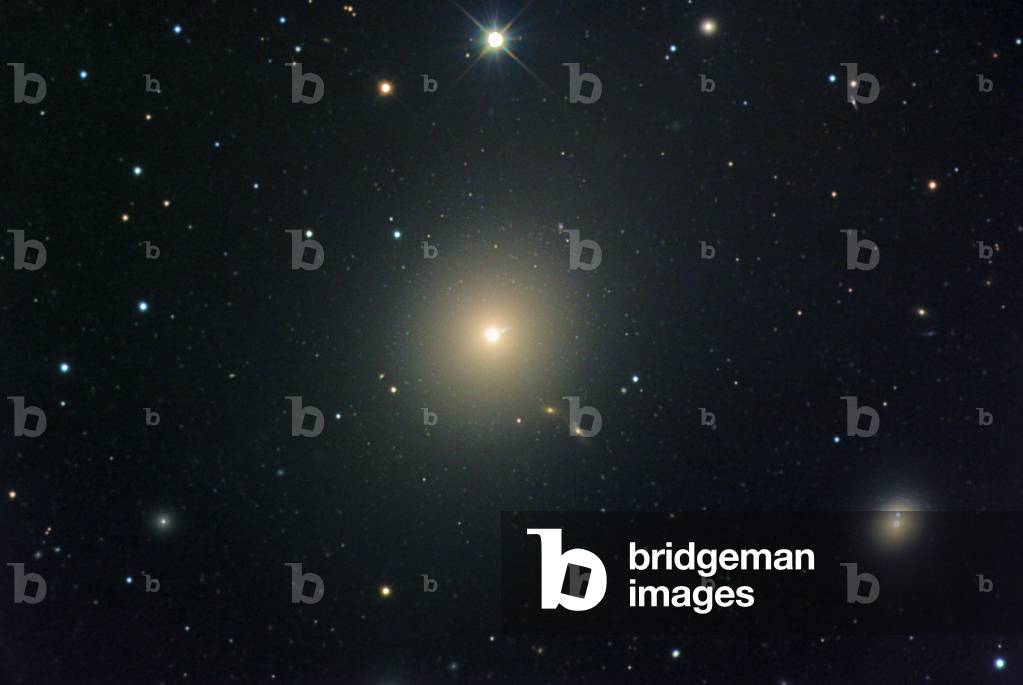
M87 elliptical galaxy in Virgo - M87 elliptical galaxy in Virgo - The M87 galaxy (NGC 4486) is located about 52 million years away - light from Earth, in the heart of the Virgin's cluster. M87 is the brightest radio source in the constellation, it is also called Virgo A. Gigantic elliptical galaxy M87 is located at the heart of the Virgo Cluster of galaxies. Also known as radio source Virgo A, M87 is located about 60 million light years away. It appears to have a linear size of 120,000 light years and a mass estimated at 2.7 trillion solar masses, and an extreme luminosity, with an absolute magnitude of about - 22

PIX4611436: M87 elliptical galaxy in Virgo - M87 elliptical galaxy in Virgo - The M87 galaxy (NGC 4486) is located about 52 million years away - light from Earth, in the heart of the Virgin's cluster. M87 is the brightest radio source in the constellation, it is also called Virgo A. Gigantic elliptical galaxy M87 is located at the heart of the Virgo Cluster of galaxies. Also known as radio source Virgo A, M87 is located about 60 million light years away. It appears to have a linear size of 120,000 light years and a mass estimated at 2.7 trillion solar masses, and an extreme luminosity, with an absolute magnitude of about - 22 / Bridgeman Images

Galaxy M88 in the Hair of Berenice - Spiral galaxy M88 in Coma Berenices - M88 is a spiral galaxy located in the cluster of the Virgin. Spiral galaxy located in the Virgo cluster of galaxies

PIX4611465: Galaxy M88 in the Hair of Berenice - Spiral galaxy M88 in Coma Berenices - M88 is a spiral galaxy located in the cluster of the Virgin. Spiral galaxy located in the Virgo cluster of galaxies / Bridgeman Images

Campaign (Expedition) of Egypt (1798-1801):

JLJ4611576: Campaign (Expedition) of Egypt (1798-1801): "The Battle of the Pyramids, July 21, 1798" Detail, 1798 (oil on canvas), Lejeune, Louis (1775-1848) / Bridgeman Images

Saint Mary the Egyptian, 1583-1587 (painting)

LRI4611631: Saint Mary the Egyptian, 1583-1587 (painting), Tintoretto, Domenico Robusti (1560-1635) / Bridgeman Images

Spring, plum blossoms in Pontoise - oil on canvas, 1877

LRI4573904: Spring, plum blossoms in Pontoise - oil on canvas, 1877, Pissarro, Camille (1830-1903) / Bridgeman Images

The speech of Alfonso de Avalos, Italian condottiere, 1540-1541 (painting)

LRI4611782: The speech of Alfonso de Avalos, Italian condottiere, 1540-1541 (painting), Titian (Tiziano Vecellio) (c.1488-1576) / Bridgeman Images

Exoplanete HD 85512b - The rocky super - Earth HD 85512 b - HD 85512 b is an exoplanet orbiting around the star HD 85512, located about 36 years ago - light from Earth in the constellation of Sails. It is one of the smallest exoplanets in habitable areas discovered to date; this super Earth was detected with the help of the HARPS program at the La Silla Observatory in Chile in August 2011. This artist's impression shows the planet orbiting the Sun - like star HD 85512 in the southern constellation of Vela (The Sail). This planet is one of sixteen super - Earths discovered by the HARPS instrument on the 3.6 - metre telescope at Eso's La Silla Observatory. This planet, HD 85512b, is about 3.6 times as massive as the Earth and lies at the edge of the habitable zone around the star, where liquid water, and perhaps even life, could potentially exist

PIX4573980: Exoplanete HD 85512b - The rocky super - Earth HD 85512 b - HD 85512 b is an exoplanet orbiting around the star HD 85512, located about 36 years ago - light from Earth in the constellation of Sails. It is one of the smallest exoplanets in habitable areas discovered to date; this super Earth was detected with the help of the HARPS program at the La Silla Observatory in Chile in August 2011. This artist's impression shows the planet orbiting the Sun - like star HD 85512 in the southern constellation of Vela (The Sail). This planet is one of sixteen super - Earths discovered by the HARPS instrument on the 3.6 - metre telescope at Eso's La Silla Observatory. This planet, HD 85512b, is about 3.6 times as massive as the Earth and lies at the edge of the habitable zone around the star, where liquid water, and perhaps even life, could potentially exist / Bridgeman Images

Landscape, 1870 (oil on canvas)

JLJ4574089: Landscape, 1870 (oil on canvas), Sisley, Alfred (1839-99) / Bridgeman Images


Back to top