2490904 Search Results

CUB4505562: Chaplain's dining room, Castle, Campo Tures, Trentino Alto Adige, Italy / Bridgeman Images

CUB4505578: Coira castle, Sluderno, Trentino Alto Adige, Italy / Bridgeman Images

CUB4505586: Trento Carli villa, Costozza, Veneto, Italy / Bridgeman Images

CUB4505616: Ostrich-breeding, Fontanelle, Veneto, Italy / Bridgeman Images

PIX4602846: The International Space Station (ISS) 02/2010 - The International Space Station (ISS) 02/2010 - View of the International Space Station from Space Shuttle Endeavour at the end of the STS mission - 130 on 19 February 2010. The International Space Station is featured in this image photographed by an STS - 130 crew member on space shuttle Endeavour after the station and shuttle began their post - undocking relative separation. Undocking of the two spacecraft occurred at 7:54 p.m. (EST) on Feb. 19, 2010 / Bridgeman Images

CUB4505716: Canoe, Brenta river, Valstagna, Veneto, Italy / Bridgeman Images

CUB4505742: World War One's trench, Grappa mountain, Veneto, Italy / Bridgeman Images

PIX4602885: Astronauts in the International Space Station - Astronauts in ISS - Astronauts in the STS-131 mission (in light blue jerseys) and Expedition 23 pose for a group photo in the Kibo module of the International Space Station (ISS). The astronauts of the STS-131 mission are Alan Poindexter, James P. Dutton Jr., Clayton Anderson, Rick Mastracchio, Dorothy Metcalf-Lindenburger, Stephanie Wilson and Naoko Yamazaki. The members of Expedition 23 are Oleg Kotov, Mikhail Kornienko, Alexander Skvortsov, Soichi Noguchi, T.J. Creamer and Tracy Caldwell Dyson. April 14, 2010. STS-131 and Expedition 23 crew members gather for a group portrait in the Kibo laboratory of the International Space Station while space shuttle Discovery remains docked with the station. STS - 131 crew members pictured (light blue shirts) are NASA astronauts Alan Poindexter, commander; James P. Dutton Jr., pilot; Clayton Anderson, Rick Mastracchio, Dorothy Metcalf - Lindenburger, Stephanie Wilson and Japan Aerospace Exploration Agency astronaut Naoko Yamazaki, all mission specialists. Expedition 23 crew members pictured are Russian cosmonauts Oleg Kotov, commander; Mikhail Kornienko and Alexander Skvortsov; Japan Aerospace Exploration Agency astronaut Soichi Noguchi, and NASA astronauts T.J. Creamer and Tracy Caldwell Dyson, all flight engineers. 14 April 2010 / Bridgeman Images

CUB4505864: San Martino cathedral, Lucca, Tuscany, Italy / Bridgeman Images

CUB4505872: Santissimi Giovanni e Reparata church, Lucca, Tuscany, Italy / Bridgeman Images

CUB4505937: Villa Reale, Marlia, Tuscany, Italy / Bridgeman Images

CUB4505962: Mansi villa, Segromigno In Monte, Tuscany, Italy / Bridgeman Images

CUB4505997: Villa Gherardi, Barga, Tuscany, Italy / Bridgeman Images

CUB4506007: Bridge, Fabbriche di Vallico, Tuscany, Italy / Bridgeman Images

CUB4506030: Gate, Montecarlo, Tuscany, Italy / Bridgeman Images

CUB4506038: Church, Altopascio, Tuscany, Italy / Bridgeman Images

CUB4506105: Maria Santissima della Stella Sanctuary, Fosciandora, Lucca, Tuscany, Italy / Bridgeman Images

CUB4506120: Royal palace, Turin, Piedmont, Italy / Bridgeman Images

CUB4500547: Pieve Romanico, San Dalmazio, Val di Cecina, Toscana, Italy / Bridgeman Images

CUB4500594: Libbiano, Val di Cecina, Toscana, Italy / Bridgeman Images

JLJ4599013: The baptism of Constantine (Constantine I the Great, 270-337), 17th century (painting), Puget, Pierre (1620-94) / Bridgeman Images
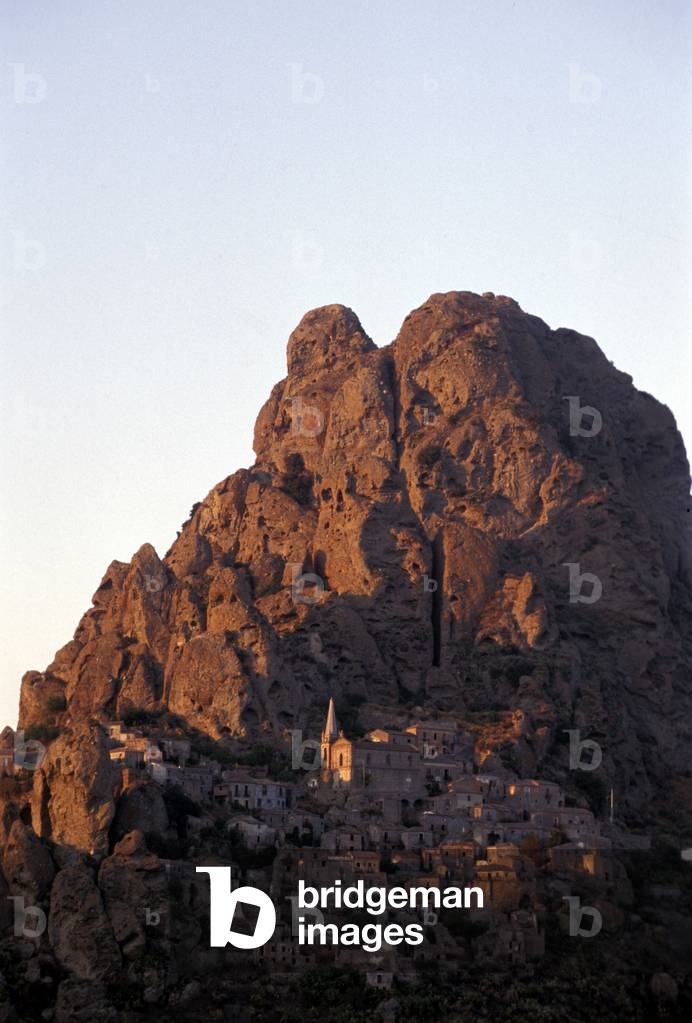
CUB4500677: Village hand shaped, Pentidattilo, from greek language “” five fingers””, Aspromonte, Calabria, Italy / Bridgeman Images

CUB4538310: Preparation of boiled meat and vegetables, Carrù, Piedmont, Italy / Bridgeman Images

JLJ4599045: Colonialism: poster for the colonial national exhibition in Marseille. Poster, 1922 (oil on canvas), Dellepiane, David (1866-1932) / Bridgeman Images

CUB4538335: Prada Veteran Boat Rally, Porto Cervo, Sardegna, Italy. / Bridgeman Images

CUB4538348: Rope, Prada Veteran Boat Rally, Porto Cervo, Sardegna, Italy. / Bridgeman Images

CUB4538472: Typical porch, Porto Cervo, Sardegna, Italy. / Bridgeman Images

CUB4501091: La Thuile, towards Chavanne Hill, Chavanne Valley, Valle d'Aosta, Italy / Bridgeman Images

CUB4500396: Sirenuse hotel, Positano, Campania, Italy / Bridgeman Images

CUB4500449: View of Capri, Sorrento, Campania, Italy / Bridgeman Images

JLJ4609604: View of the Sedan Dragon Barracks in the Ardennes, 1904 (photo) / Bridgeman Images

PIX4609683: Galaxy NGC 1232 in Eridan - Spiral galaxy NGC 1232 in Eridanus - The large spiral galaxy NGC 1232 is located about 100 million years ago - light. She's accompanied by a dwarf galaxy at the end of one of her arms. Image obtained from the 1.5m Danish telescope of La Silla in Chile. NGC 1232 is located 20 degrees south of the celestial equator, in the constellation Eridanus (The River). The distance is about 100 million light - years. Note the distorted companion galaxy on the top of the image. This image was made at the danish 1.5 meter telescope in La Silla, Chile / Bridgeman Images

PIX4609732: Elliptical galaxy NGC 1275 in Persee - Elliptical galaxy NGC 1275 in Perseus - View of the giant elliptical galaxy NGC 1275 located 230 million years ago - light in the center of the cluster of Persee galaxies. This image obtained by the Hubble Space Telescope in 2006 reveals filamentary structures surrounding the galaxy. These gas filaments would come from the interaction between the cold gas of the center of the galaxy or resides a supermassive black hole and the warmer gas present in the galaxy cluster. This Hubble Space Telescope image of galaxy NGC 1275 reveals the fine, thread - like filamentary structures in the gas surrounding the galaxy. The red filaments are composed of cool gas being suspended by a magnetic field, and are surrounded by the 100 - million - degree Fahrenheit hot gas in the center of the Perseus galaxy cluster. The filaments are dramatic markers of the feedback process through which energy is transferred from the central massive black hole to the surrounding gas. The filaments originate when cool gas is transported from the center of the galaxy by radio bubbles that rise in the hot interstellar gas. At a distance of 230 million light - years, NGC 1275 is one of the closest giant elliptical galaxies and lies at the center of the Perseus cluster of galaxies. The galaxy was photographed in July and August 2006 with the Advanced Camera for Surveys in three color filters / Bridgeman Images

JLJ4609740: View of a Gate of the City of Pekin, China Photograph of 1906 (photo), Anonymous / Bridgeman Images

JLJ4609818: Passing a baccalaureate in China, early 20th century (photo), Anonymous / Bridgeman Images
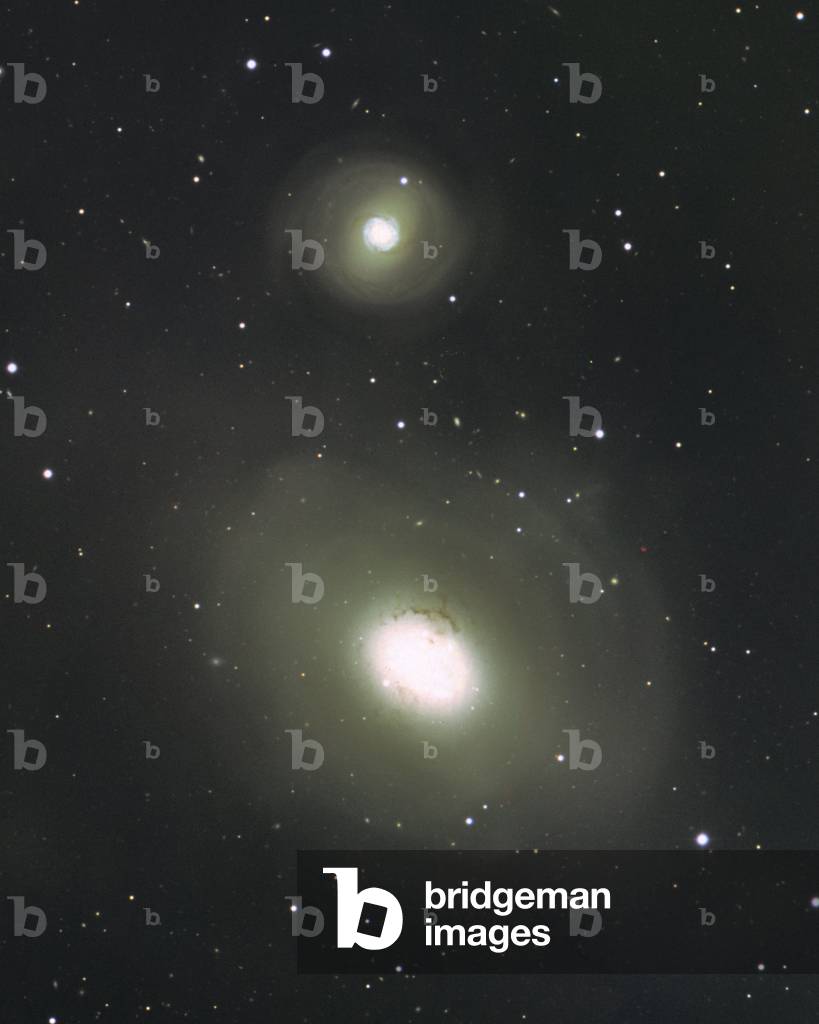
PIX4609824: Galaxies NGC 1316 and 1317 in the Furnace - Galaxies NGC 1316 and NGC 1317 in Fornax - The giant elliptical galaxy NGC 1316 (below) absorbed a spiral galaxy a few billion years ago. A few bands of dust visible in the centre are the traces of this feast. A spiral galaxy, NGC 1317, is visible just above it. These galaxies resident more than 60 million years ago - light in the array of galaxies of the Furnace. Also called Fornax A, NGC 1316 is one of the strongest radio sources in the sky. Image made with Siding Spring's 3.9m telescope. NGC 1316 - 17 are on the outskirts of a nearby cluster of galaxies in the southern constellation of Fornax, at a distance of about 60 million light years. At first glance, the optical image of these galaxies does not seem to be very unusual. However, closer inspection shows that the larger galaxy, the elliptical NGC 1316, has distinct dust lanes in its inner regions, and NGC 1317 is a strangely distorted spiral. The dust lanes strongly suggest that NGC 1316 has recently absorbed a dusty spiral galaxy, and that the merger is not yet complete. The colour picture also hints at faint arcs or shells of stars in the outer parts of the galaxy, another strong indication of recent merger activity. A much deeper picture reveals enormous loops and shell - like structures extending far beyond this photograph, again supporting the merger hypothesis. If any more evidence were needed, it is provided by radio astronomers, who see Fornax A as one of the strongest and largest sources in the sky, with radio lobes extending over several degrees of sky. However, unlike the faint optical extensions, the radio lobes extend roughly E - W across the sky. There is another southern galaxy with many of these characteristics - - dusty elliptical, faint outer shells and somewhat detached from a cluster of galaxies. This is NGC 5128, Centaurus A, a confimed merger remnant / Bridgeman Images
