Search options

Orientation
Colour

Display options

View

Print

To print search results, use print friendly version of this page.

2491566 Search Results

Apple Bedfordshire Foundling. Lithograph by Benjamin Maund (1790-1863) published in The Fruitist, London, England, 1850. Bedfordshire Foundling apple, Malus domestica, within a Della Robbia ornamental frame with text below. Handcoloured glyphograph from Benjamin Maund's “” The Fruitist,”” London, 1850, Groombridge and Sons.

FLO4675126: Apple Bedfordshire Foundling. Lithograph by Benjamin Maund (1790-1863) published in The Fruitist, London, England, 1850. Bedfordshire Foundling apple, Malus domestica, within a Della Robbia ornamental frame with text below. Handcoloured glyphograph from Benjamin Maund's “” The Fruitist,”” London, 1850, Groombridge and Sons. / Bridgeman Images

Apple Woodville Matchless. Lithograph by Benjamin Maund (1790-1863) published in The Fruitist, London, England, 1850. Woodville's Matchless apple, Malus domestica, within a Della Robbia ornamental frame with text below. Handcoloured glyphograph from Benjamin Maund's “” The Fruitist,”” London, 1850, Groombridge and Sons.

FLO4675203: Apple Woodville Matchless. Lithograph by Benjamin Maund (1790-1863) published in The Fruitist, London, England, 1850. Woodville's Matchless apple, Malus domestica, within a Della Robbia ornamental frame with text below. Handcoloured glyphograph from Benjamin Maund's “” The Fruitist,”” London, 1850, Groombridge and Sons. / Bridgeman Images

Apple pippin Lucombe. Lithograph by Benjamin Maund (1790-1863) published in The Fruitist, London, England, 1850. Lucombe's Pine-Apple Pippin apple, Malus domestica, within a Della Robbia ornamental frame with text below. Handcoloured glyphograph from Benjamin Maund's “” The Fruitist,”” London, 1850, Groombridge and Sons.

FLO4675396: Apple pippin Lucombe. Lithograph by Benjamin Maund (1790-1863) published in The Fruitist, London, England, 1850. Lucombe's Pine-Apple Pippin apple, Malus domestica, within a Della Robbia ornamental frame with text below. Handcoloured glyphograph from Benjamin Maund's “” The Fruitist,”” London, 1850, Groombridge and Sons. / Bridgeman Images

Apple-shaped pear, a variety of Pearmain d'lamb abbey. Lithograph by Benjamin Maund (1790-1863) published in The Fruitist, London, England, 1850. Lamb Abbey Pearmain apple, Malus domestica. Handcoloured glyphograph from Benjamin Maund's “” The Fruitist,”” London, 1850, Groombridge and Sons.

FLO4675418: Apple-shaped pear, a variety of Pearmain d'lamb abbey. Lithograph by Benjamin Maund (1790-1863) published in The Fruitist, London, England, 1850. Lamb Abbey Pearmain apple, Malus domestica. Handcoloured glyphograph from Benjamin Maund's “” The Fruitist,”” London, 1850, Groombridge and Sons. / Bridgeman Images

Common pear, Bergamot variety of Esperen. Lithograph by Benjamin Maund (1790-1863) published in The Fruitist, London, England, 1850. Bergamotte d'Esperen pear, Pyrus communis. Handcoloured glyphograph from Benjamin Maund's “” The Fruitist,”” London, 1850, Groombridge and Sons.

FLO4675457: Common pear, Bergamot variety of Esperen. Lithograph by Benjamin Maund (1790-1863) published in The Fruitist, London, England, 1850. Bergamotte d'Esperen pear, Pyrus communis. Handcoloured glyphograph from Benjamin Maund's “” The Fruitist,”” London, 1850, Groombridge and Sons. / Bridgeman Images

Ribstone reinette apple. Lithograph by Benjamin Maund (1790-1863) published in The Fruitist, London, England, 1850. Ribstone Pippin apple, Malus domestica. Handcoloured glyphograph from Benjamin Maund's “” The Fruitist,”” London, 1850, Groombridge and Sons.

FLO4675514: Ribstone reinette apple. Lithograph by Benjamin Maund (1790-1863) published in The Fruitist, London, England, 1850. Ribstone Pippin apple, Malus domestica. Handcoloured glyphograph from Benjamin Maund's “” The Fruitist,”” London, 1850, Groombridge and Sons. / Bridgeman Images

Stingy. Death broke into the vault, where the Stingy sits among his coffers and bags of gold. Death on a stool, deliberately collects in a large dish the money on the table that the Mad had counted. In an agony of terror and despair, the poor man seems to beg indulgence from his undesirable visitor. Hand-coloured engraving by Christian Von Mechel (or Chretien de Mechel, 1737-1817) in “The Triumph of Death”” based on original drawings by Hans Holbein the Young (1497-1543), 1860.

FLO4675742: Stingy. Death broke into the vault, where the Stingy sits among his coffers and bags of gold. Death on a stool, deliberately collects in a large dish the money on the table that the Mad had counted. In an agony of terror and despair, the poor man seems to beg indulgence from his undesirable visitor. Hand-coloured engraving by Christian Von Mechel (or Chretien de Mechel, 1737-1817) in “The Triumph of Death”” based on original drawings by Hans Holbein the Young (1497-1543), 1860. / Bridgeman Images

The drinkers. On the right, La Mort festive holds an ebriete head and poured a bottle of red wine into its throat. His companions watch and applaud. In front, a drunk character vomits on the floor and a third drunk on the left looks deep into his mug. Hand-coloured engraving by Christian Von Mechel (or Chretien de Mechel, 1737-1817) in “The Triumph of Death”” based on original drawings by Hans Holbein the Young (1497-1543), 1860.

FLO4675769: The drinkers. On the right, La Mort festive holds an ebriete head and poured a bottle of red wine into its throat. His companions watch and applaud. In front, a drunk character vomits on the floor and a third drunk on the left looks deep into his mug. Hand-coloured engraving by Christian Von Mechel (or Chretien de Mechel, 1737-1817) in “The Triumph of Death”” based on original drawings by Hans Holbein the Young (1497-1543), 1860. / Bridgeman Images

The curse: Adam digs in the ground, assists by death. Deep down, Eve breastfed her newborn by holding a cattail. Hand-coloured engraving by Christian Von Mechel (or Chretien de Mechel, 1737-1817) in “The Triumph of Death”” based on original drawings by Hans Holbein the Young (1497-1543), 1860.

FLO4675787: The curse: Adam digs in the ground, assists by death. Deep down, Eve breastfed her newborn by holding a cattail. Hand-coloured engraving by Christian Von Mechel (or Chretien de Mechel, 1737-1817) in “The Triumph of Death”” based on original drawings by Hans Holbein the Young (1497-1543), 1860. / Bridgeman Images

The Child. A cottage owner's wife prepares a family meal when death arrives and takes away the youngest of her children. Hand-coloured engraving by Christian Von Mechel (or Chretien de Mechel, 1737-1817) in “The Triumph of Death”” based on original drawings by Hans Holbein the Young (1497-1543), 1860.

FLO4675821: The Child. A cottage owner's wife prepares a family meal when death arrives and takes away the youngest of her children. Hand-coloured engraving by Christian Von Mechel (or Chretien de Mechel, 1737-1817) in “The Triumph of Death”” based on original drawings by Hans Holbein the Young (1497-1543), 1860. / Bridgeman Images

The madman. Death plays a bagpipe and performs a dance while lifting the madman's green dress to expose his limbs. The Mad is about to hit Death with his rattle, a kind of pocket with a bell hanging from her. Hand-coloured engraving by Christian Von Mechel (or Chretien de Mechel, 1737-1817) in “The Triumph of Death”” based on original drawings by Hans Holbein the Young (1497-1543), 1860.

FLO4675825: The madman. Death plays a bagpipe and performs a dance while lifting the madman's green dress to expose his limbs. The Mad is about to hit Death with his rattle, a kind of pocket with a bell hanging from her. Hand-coloured engraving by Christian Von Mechel (or Chretien de Mechel, 1737-1817) in “The Triumph of Death”” based on original drawings by Hans Holbein the Young (1497-1543), 1860. / Bridgeman Images

Design for a dagger sheath designed by Holbein. The characters are a young woman, a monk and a child who involuntarily accompany Death in the dance. The king's despair, the downfall of the queen accompanied by her little dog, the terror of the soldier who hears the drum of death, are portrayed with veracity and spirit of equality. Hand-coloured engraving by Christian Von Mechel (or Chretien de Mechel, 1737-1817) in “The Triumph of Death”” based on original drawings by Hans Holbein the Young (1497-1543), 1860.

FLO4675844: Design for a dagger sheath designed by Holbein. The characters are a young woman, a monk and a child who involuntarily accompany Death in the dance. The king's despair, the downfall of the queen accompanied by her little dog, the terror of the soldier who hears the drum of death, are portrayed with veracity and spirit of equality. Hand-coloured engraving by Christian Von Mechel (or Chretien de Mechel, 1737-1817) in “The Triumph of Death”” based on original drawings by Hans Holbein the Young (1497-1543), 1860. / Bridgeman Images

Propaganda policy poster of the national union for the French legislative elections of 1902, 20th century (engraving)

JLJ4675847: Propaganda policy poster of the national union for the French legislative elections of 1902, 20th century (engraving), Galland, Andre (1886-1965) / Bridgeman Images

Knight of the short-lived Order of the Knot, an order of chivalry founded in 1352 by Louis of Taranto, King of Naples - He wears a brown tabard, steel helm, suit of armour, gauntlets and spurs - The helm edges of the shield are decorated with knots - From a sepulchral stone in the church of Saint Catherine, Pisa - Handcoloured illustration drawn and lithographed by Paul Mercuri with text by Camille Bonnard from “” Historical Costumes from the 12th to 15th Centuries,”” Levy Fils, Paris, 1861

FLO4675970: Knight of the short-lived Order of the Knot, an order of chivalry founded in 1352 by Louis of Taranto, King of Naples - He wears a brown tabard, steel helm, suit of armour, gauntlets and spurs - The helm edges of the shield are decorated with knots - From a sepulchral stone in the church of Saint Catherine, Pisa - Handcoloured illustration drawn and lithographed by Paul Mercuri with text by Camille Bonnard from “” Historical Costumes from the 12th to 15th Centuries,”” Levy Fils, Paris, 1861, Mercuri, Paolo (1804-84) / Bridgeman Images

Oldrado da Tresseno (d. 1233), podestat (mayor) of Milan (Italy), 13th century - Oldrado da Tresseno, Podesta or Mayor of Milan, 13th century - He wears a blue cape with gold clasp at the shoulder, pink tunic, yellow stockings, gold spurs - From an equestrian statue - Handcoloured illustration drawn and lithographed by Paul Mercuri with text by Camille Bonnard from “” Historical Costumes from the 12th to 15th Centuries,”” Levy Fils, Paris, 1860

FLO4675983: Oldrado da Tresseno (d. 1233), podestat (mayor) of Milan (Italy), 13th century - Oldrado da Tresseno, Podesta or Mayor of Milan, 13th century - He wears a blue cape with gold clasp at the shoulder, pink tunic, yellow stockings, gold spurs - From an equestrian statue - Handcoloured illustration drawn and lithographed by Paul Mercuri with text by Camille Bonnard from “” Historical Costumes from the 12th to 15th Centuries,”” Levy Fils, Paris, 1860, Mercuri, Paolo (1804-84) / Bridgeman Images

Costume d'un homme de la noblesse venitienne, 15eme century - Costume of a Venetian noble man, 15th century - He wears a red toque, scarlet cape lined with white silk, a lined hood, black stockings and leather shoes - It was rarely permitted to wear a sword in Venice at the time - From a painting by Gentile Bellini - Handcoloured illustration drawn and lithographed by Paul Mercuri with text by Camille Bonnard from “” Historical Costumes from the 12th to 15th Centuries,”” Levy Fils, Paris, 1861

FLO4676058: Costume d'un homme de la noblesse venitienne, 15eme century - Costume of a Venetian noble man, 15th century - He wears a red toque, scarlet cape lined with white silk, a lined hood, black stockings and leather shoes - It was rarely permitted to wear a sword in Venice at the time - From a painting by Gentile Bellini - Handcoloured illustration drawn and lithographed by Paul Mercuri with text by Camille Bonnard from “” Historical Costumes from the 12th to 15th Centuries,”” Levy Fils, Paris, 1861, Mercuri, Paolo (1804-84) / Bridgeman Images

Common or domestic apple. Lithograph by Benjamin Maund (1790-1863) published in The Fruitist, London, England, 1850. Short Hanging Flat Apple, Malus domestica. Handcoloured glyphograph from Benjamin Maund's “” The Fruitist,”” London, 1850, Groombridge and Sons.

FLO4675439: Common or domestic apple. Lithograph by Benjamin Maund (1790-1863) published in The Fruitist, London, England, 1850. Short Hanging Flat Apple, Malus domestica. Handcoloured glyphograph from Benjamin Maund's “” The Fruitist,”” London, 1850, Groombridge and Sons. / Bridgeman Images

The Monk. The beggar monk returning to his convent with his money bank and purse. Death grabbed him by the hood, and strained him away. Plate 10. Hand-coloured engraving by Christian Von Mechel (or Chretien de Mechel, 1737-1817) in “The Triumph of Death”” based on original drawings by Hans Holbein the Young (1497-1543), 1860.

FLO4675506: The Monk. The beggar monk returning to his convent with his money bank and purse. Death grabbed him by the hood, and strained him away. Plate 10. Hand-coloured engraving by Christian Von Mechel (or Chretien de Mechel, 1737-1817) in “The Triumph of Death”” based on original drawings by Hans Holbein the Young (1497-1543), 1860. / Bridgeman Images

Hignell's Inequalable Apple. Lithograph by Benjamin Maund (1790-1863) published in The Fruitist, London, England, 1850. Hignell's Matchless apple, Malus domestica. Handcoloured glyphograph from Benjamin Maund's “” The Fruitist,”” London, 1850, Groombridge and Sons.

FLO4675502: Hignell's Inequalable Apple. Lithograph by Benjamin Maund (1790-1863) published in The Fruitist, London, England, 1850. Hignell's Matchless apple, Malus domestica. Handcoloured glyphograph from Benjamin Maund's “” The Fruitist,”” London, 1850, Groombridge and Sons. / Bridgeman Images

Gaston de Foix, Duke of Nemours or Gaston de Foix Nemours (1489-1512), Count of Etampes, General of the Armees of the King of France - Gaston de Foix (1489-1512), French military commander famous for his campaign during the War of the League of Cambrai - He wears a laurel wreath, a blue tunic over a suit of armour, and rests his hand a sword - From a sculpture by Agostino Busti preserved in the Pinacoteca di Brera, Milan (now in Sforza Castle) - Handcoloured illustration drawn and lithographed by Paul Mercuri with text by Camille Bonnard from “” Historical Costumes from the 12th to 15th Centuries,”” Levy Fils, Paris, 1861

FLO4676156: Gaston de Foix, Duke of Nemours or Gaston de Foix Nemours (1489-1512), Count of Etampes, General of the Armees of the King of France - Gaston de Foix (1489-1512), French military commander famous for his campaign during the War of the League of Cambrai - He wears a laurel wreath, a blue tunic over a suit of armour, and rests his hand a sword - From a sculpture by Agostino Busti preserved in the Pinacoteca di Brera, Milan (now in Sforza Castle) - Handcoloured illustration drawn and lithographed by Paul Mercuri with text by Camille Bonnard from “” Historical Costumes from the 12th to 15th Centuries,”” Levy Fils, Paris, 1861, Mercuri, Paolo (1804-84) / Bridgeman Images

Military suit: Victor (Vettore) Pisani (1324-1380), venitian admiral (Italy) - Vettore Pisani, Venetian admiral, 14th century - He wears a red toque, ted tunic buckled up the front, suit of steel plate armour, thighs, greaves, gauntlets, and shoes, edged with gold - His arms include two-handed sword and dagger - From the statue in Venice arsenal - Handcoloured illustration drawn and lithographed by Paul Mercuri with text by Camille Bonnard from “” Historical Costumes from the 12th to 15th Centuries,”” Levy Fils, Paris, 1860

FLO4676769: Military suit: Victor (Vettore) Pisani (1324-1380), venitian admiral (Italy) - Vettore Pisani, Venetian admiral, 14th century - He wears a red toque, ted tunic buckled up the front, suit of steel plate armour, thighs, greaves, gauntlets, and shoes, edged with gold - His arms include two-handed sword and dagger - From the statue in Venice arsenal - Handcoloured illustration drawn and lithographed by Paul Mercuri with text by Camille Bonnard from “” Historical Costumes from the 12th to 15th Centuries,”” Levy Fils, Paris, 1860, Mercuri, Paolo (1804-84) / Bridgeman Images

Costume d'une femme de la nobility italian, 15th century - Italian noblewoman, 15th century - She wears a black ribbon in her hair and over her white blouse, full crimson cape, yellow robe with black hem - Blue gloves and petticoat - From a miniature painting in a manuscript in Barberini library, Rome - Handcoloured illustration drawn and lithographed by Paul Mercuri with text by Camille Bonnard from “” Historical Costumes from the 12th to 15th Centuries,”” Levy Fils, Paris, 1861

FLO4676258: Costume d'une femme de la nobility italian, 15th century - Italian noblewoman, 15th century - She wears a black ribbon in her hair and over her white blouse, full crimson cape, yellow robe with black hem - Blue gloves and petticoat - From a miniature painting in a manuscript in Barberini library, Rome - Handcoloured illustration drawn and lithographed by Paul Mercuri with text by Camille Bonnard from “” Historical Costumes from the 12th to 15th Centuries,”” Levy Fils, Paris, 1861, Mercuri, Paolo (1804-84) / Bridgeman Images

Costume d'un seigneur de Rimini, prince de la famille Malatesta (ou Malatesti), 15th century - Costume of a lord of Rimini, one of the Malatesta princes, 15th century - He wears a red toque, damask doublet edged in fur, multicoloured stockings - He carries a gold stick, symbol of authority - From a manuscript of poetry by Petrarch in Barberini library, Rome Handcoloured illustration drawn and lithographed by Paul Mercuri with text by Camille Bonnard from “” Historical Costumes from the 12th to 15th Centuries,”” Levy Fils, Paris, 1861

FLO4676328: Costume d'un seigneur de Rimini, prince de la famille Malatesta (ou Malatesti), 15th century - Costume of a lord of Rimini, one of the Malatesta princes, 15th century - He wears a red toque, damask doublet edged in fur, multicoloured stockings - He carries a gold stick, symbol of authority - From a manuscript of poetry by Petrarch in Barberini library, Rome Handcoloured illustration drawn and lithographed by Paul Mercuri with text by Camille Bonnard from “” Historical Costumes from the 12th to 15th Centuries,”” Levy Fils, Paris, 1861, Mercuri, Paolo (1804-84) / Bridgeman Images

Military costume: un soldat de Verona (Italy), 15th century - Costume of a soldier of Verona, 15th century - He wears a white cap, woolen coat with black velvet collar, brown breeches and black boots - A sabre in black scabbard hangs from his belt - From the painting “” Crucifixion””” by Michele de Verona, dated 1501 - Handcoloured illustration drawn and lithographed by Paul Mercuri with text by Camille Bonnard from “” Historical Costumes from the 12th to 15th Centuries,”” Levy Fils, Paris, 1861

FLO4676545: Military costume: un soldat de Verona (Italy), 15th century - Costume of a soldier of Verona, 15th century - He wears a white cap, woolen coat with black velvet collar, brown breeches and black boots - A sabre in black scabbard hangs from his belt - From the painting “” Crucifixion””” by Michele de Verona, dated 1501 - Handcoloured illustration drawn and lithographed by Paul Mercuri with text by Camille Bonnard from “” Historical Costumes from the 12th to 15th Centuries,”” Levy Fils, Paris, 1861, Mercuri, Paolo (1804-84) / Bridgeman Images

Costume of a young Italian man, lifting his hat as a sign of salvation, 15th century - Young Italian man doffing his hat in salute, 15th century - He wears a violet peaked cap, a crimson velvet doublet, green damask tunic with fur trim, crimson stockings and leather boots - From a miniature in the Duke of Urbino's Bible in the Vatican library - Handcoloured illustration drawn and lithographed by Paul Mercuri with text by Camille Bonnard from “” Historical Costumes from the 12th to 15th Centuries,”” Levy Fils, Paris, 1861

FLO4676589: Costume of a young Italian man, lifting his hat as a sign of salvation, 15th century - Young Italian man doffing his hat in salute, 15th century - He wears a violet peaked cap, a crimson velvet doublet, green damask tunic with fur trim, crimson stockings and leather boots - From a miniature in the Duke of Urbino's Bible in the Vatican library - Handcoloured illustration drawn and lithographed by Paul Mercuri with text by Camille Bonnard from “” Historical Costumes from the 12th to 15th Centuries,”” Levy Fils, Paris, 1861, Mercuri, Paolo (1804-84) / Bridgeman Images

Military costume: un gentilhomme Tuscan (Italy), 15th century - Military costume of a Tuscan gentleman, 15th century - He wears a scarlet cape lined in black, white doublet, red stockings and yellow leather boots - He holds a sword and dagger with gold handles - From a painting by Matteo di Giovanni in the Academy of Fine Arts, Siena - Handcoloured illustration drawn and lithographed by Paul Mercuri with text by Camille Bonnard from “” Historical Costumes from the 12th to 15th Centuries,”” Levy Fils, Paris, 1861

FLO4676469: Military costume: un gentilhomme Tuscan (Italy), 15th century - Military costume of a Tuscan gentleman, 15th century - He wears a scarlet cape lined in black, white doublet, red stockings and yellow leather boots - He holds a sword and dagger with gold handles - From a painting by Matteo di Giovanni in the Academy of Fine Arts, Siena - Handcoloured illustration drawn and lithographed by Paul Mercuri with text by Camille Bonnard from “” Historical Costumes from the 12th to 15th Centuries,”” Levy Fils, Paris, 1861, Mercuri, Paolo (1804-84) / Bridgeman Images

Costume d'un medecin italian, 14th century - Italian doctor or physician, 14th century - He wears a velvet cap trimmed with fur, a black cape lined in white, scarlet robe, green sleeves, red shoes - He carries a gold box and pincers - From a painting by an unknown artist in the Academy of Fine Arts, Siena - Handcoloured illustration drawn and lithographed by Paul Mercuri with text by Camille Bonnard from “” Historical Costumes from the 12th to 15th Centuries,”” Levy Fils, Paris, 1860

FLO4676721: Costume d'un medecin italian, 14th century - Italian doctor or physician, 14th century - He wears a velvet cap trimmed with fur, a black cape lined in white, scarlet robe, green sleeves, red shoes - He carries a gold box and pincers - From a painting by an unknown artist in the Academy of Fine Arts, Siena - Handcoloured illustration drawn and lithographed by Paul Mercuri with text by Camille Bonnard from “” Historical Costumes from the 12th to 15th Centuries,”” Levy Fils, Paris, 1860, Mercuri, Paolo (1804-84) / Bridgeman Images

Alberto I Canfrancesco della Scala (1291-1329), war name Cangrande della Scala, lord of Verona and mecene of Dante Alighieri (1265-1321) - Cangrande della Scala, lord of Verona, 14th center- He wears a blue cap, pink cape with hanging sleeves lined with fur, belted scarlet robe, gauntlets and holds a blue two-handed sword in scabbard - From his sarcophagus in the church of Santa Maria Antica, Verona - Handcoloured illustration drawn and lithographed by Paul Mercuri with text by Camille Bonnard from “” Historical Costumes from the 12th to 15th Centuries,”” Levy Fils, Paris, 1860

FLO4676799: Alberto I Canfrancesco della Scala (1291-1329), war name Cangrande della Scala, lord of Verona and mecene of Dante Alighieri (1265-1321) - Cangrande della Scala, lord of Verona, 14th center- He wears a blue cap, pink cape with hanging sleeves lined with fur, belted scarlet robe, gauntlets and holds a blue two-handed sword in scabbard - From his sarcophagus in the church of Santa Maria Antica, Verona - Handcoloured illustration drawn and lithographed by Paul Mercuri with text by Camille Bonnard from “” Historical Costumes from the 12th to 15th Centuries,”” Levy Fils, Paris, 1860, Mercuri, Paolo (1804-84) / Bridgeman Images

Suit d'un homme jeif, 14eme century - Jewish man, 14th century - He wears a white hood, yellow cape with gold embroidery, green robe, red belt and shoes - From a painting by Sano di Pietro in the Academy of Fine Arts, Siena - Handcoloured illustration drawn and lithographed by Paul Mercuri with text by Camille Bonnard from “” Historical Costumes from the 12th to 15th Centuries,”” Levy Fils, Paris, 1860

FLO4676850: Suit d'un homme jeif, 14eme century - Jewish man, 14th century - He wears a white hood, yellow cape with gold embroidery, green robe, red belt and shoes - From a painting by Sano di Pietro in the Academy of Fine Arts, Siena - Handcoloured illustration drawn and lithographed by Paul Mercuri with text by Camille Bonnard from “” Historical Costumes from the 12th to 15th Centuries,”” Levy Fils, Paris, 1860, Mercuri, Paolo (1804-84) / Bridgeman Images

A man of the Middle Ages drives a wooden bicycle, in a pave street, in front of frightened spectators (this type of bicycle did not appear until the end of the 19th century) - Lithography based on an illustration by J.E. Rogers, from Francis Cowley Burnand's Passe temps actuels de l'Englance (1836-1917), 1873 - Medieval man riding a wooden velocipede on a cobbled street in front of startled bystanders. (This early bicycle was invented in the late 19th century) Handcoloured lithograph after an illustration by J. E. Rogers from Francis Cowley Burnand's “” Present Pastimes of Merrie England, Cassell, London, 1873

FLO4677209: A man of the Middle Ages drives a wooden bicycle, in a pave street, in front of frightened spectators (this type of bicycle did not appear until the end of the 19th century) - Lithography based on an illustration by J.E. Rogers, from Francis Cowley Burnand's Passe temps actuels de l'Englance (1836-1917), 1873 - Medieval man riding a wooden velocipede on a cobbled street in front of startled bystanders. (This early bicycle was invented in the late 19th century) Handcoloured lithograph after an illustration by J. E. Rogers from Francis Cowley Burnand's “” Present Pastimes of Merrie England, Cassell, London, 1873 / Bridgeman Images
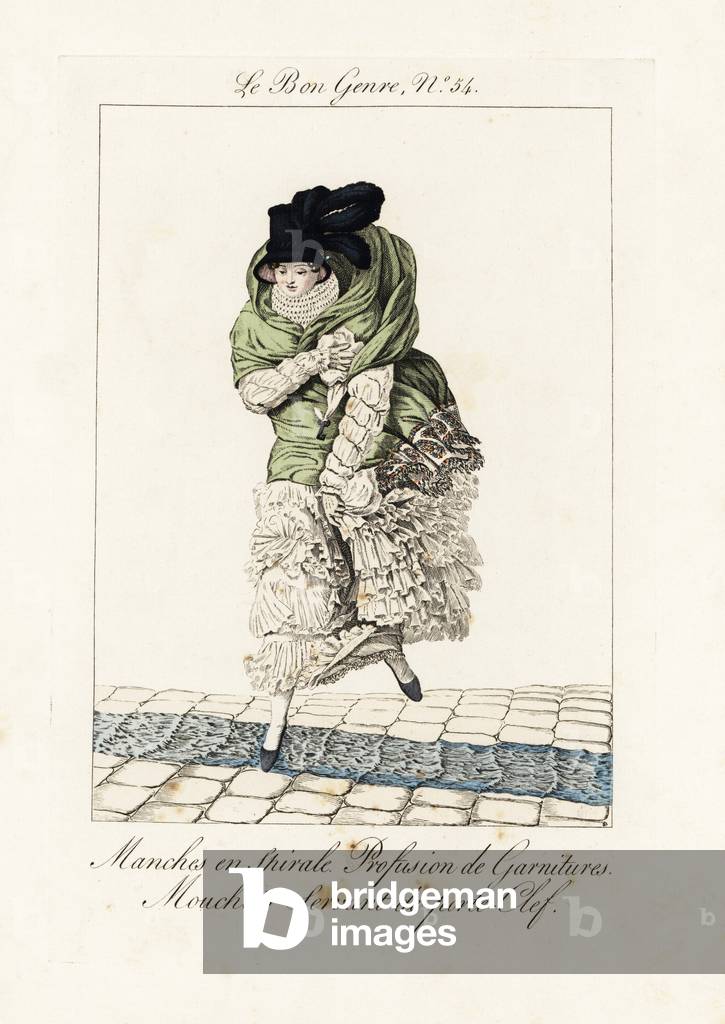
Woman with spiral sleeves, profuse ruffs and flounces, kerchief key-holder. When one talks of flounces, refer back to the reign of Louis XV, and look at the portrait of your grandmother. Have patience, miss. That which causes such disdain today will excite you in a little while, and it won't be one falbala but many that you want to wear.”” Illustration by Jean-Baptiste Isabey. Handcoloured engraving from Pierre de la Mesanger's Le Bon Genre, Paris, 1817.

FLO4677354: Woman with spiral sleeves, profuse ruffs and flounces, kerchief key-holder. When one talks of flounces, refer back to the reign of Louis XV, and look at the portrait of your grandmother. Have patience, miss. That which causes such disdain today will excite you in a little while, and it won't be one falbala but many that you want to wear.”” Illustration by Jean-Baptiste Isabey. Handcoloured engraving from Pierre de la Mesanger's Le Bon Genre, Paris, 1817. / Bridgeman Images

Woman from the Chaussee-d'Antin in the Chinese fashion. She wears a tall bonnet with flowers and ribbons over her piled up hairstyle a la Chinoque, ruff collar, tunic with bells, shawl tied in a bow, and shoes with bows. Illustration by Louis-Philibert Debucourt. Handcoloured engraving from Pierre de la Mesanger's Le Bon Genre, Paris, 1817.

FLO4677385: Woman from the Chaussee-d'Antin in the Chinese fashion. She wears a tall bonnet with flowers and ribbons over her piled up hairstyle a la Chinoque, ruff collar, tunic with bells, shawl tied in a bow, and shoes with bows. Illustration by Louis-Philibert Debucourt. Handcoloured engraving from Pierre de la Mesanger's Le Bon Genre, Paris, 1817. / Bridgeman Images

Cimabue (Cenni di Pepo) (1272-1302), Italian painter, headdress of a liripion - Cimabue, Florentine artist, 14th century - He wears a short white cape embroidered in gold, a hood with a long tail, tunic, stockings and garters in white and gold - From a painting by Simone Martini in the church of Santa Maria Novella, Florence - (Massard, this is Jean by Joinville, French chronicler, 1224-1317) - Handcoloured illustration drawn and lithographed by Paul Mercuri with text by Camille Bonnard from “” Historical Costumes from the 12th to 15th Centuries,”” Levy Fils, Paris, 1860

FLO4676803: Cimabue (Cenni di Pepo) (1272-1302), Italian painter, headdress of a liripion - Cimabue, Florentine artist, 14th century - He wears a short white cape embroidered in gold, a hood with a long tail, tunic, stockings and garters in white and gold - From a painting by Simone Martini in the church of Santa Maria Novella, Florence - (Massard, this is Jean by Joinville, French chronicler, 1224-1317) - Handcoloured illustration drawn and lithographed by Paul Mercuri with text by Camille Bonnard from “” Historical Costumes from the 12th to 15th Centuries,”” Levy Fils, Paris, 1860, Mercuri, Paolo (1804-84) / Bridgeman Images

The popular game of the bucket in Naples Anonymous painting. 19th century Naples Museo Nazionale di San Martino

LRI4676849: The popular game of the bucket in Naples Anonymous painting. 19th century Naples Museo Nazionale di San Martino, Unknown Artist, (19th century) / Bridgeman Images

Costume d'une jeune femme de Florence (Italy), 14th century - Noble woman of Florence, 14th century - She wears her hair tied with black laces, blue simar embroidered in gold, yellow lining, scarlet robe, leather belt - From a painting to illustrate Boccaccio's Decameron by an artist of the Florentine school - Handcoloured illustration drawn and lithographed by Paul Mercuri with text by Camille Bonnard from “” Historical Costumes from the 12th to 15th Centuries,”” Levy Fils, Paris, 1860

FLO4676887: Costume d'une jeune femme de Florence (Italy), 14th century - Noble woman of Florence, 14th century - She wears her hair tied with black laces, blue simar embroidered in gold, yellow lining, scarlet robe, leather belt - From a painting to illustrate Boccaccio's Decameron by an artist of the Florentine school - Handcoloured illustration drawn and lithographed by Paul Mercuri with text by Camille Bonnard from “” Historical Costumes from the 12th to 15th Centuries,”” Levy Fils, Paris, 1860, Mercuri, Paolo (1804-84) / Bridgeman Images

Accommodation in Emerainville (Marne la Vallee). Realisation 1986, architect Lucien Kroll. Photography 1986.

TEC4676964: Accommodation in Emerainville (Marne la Vallee). Realisation 1986, architect Lucien Kroll. Photography 1986., Kroll, Lucien (b. 1927) / Bridgeman Images


Back to top