2491557 Search Results

FLO4678336: A soldier and knight, 1295. Knight in bacinet helmet, gamboised coat hauberk and chausses, elbow plates, with shield, lance and sword. The soldier wears a hood and chainmail suit, multicoloured leather corium and trellised chausses with metal studs and leather bandages. Handcoloured lithograph by Maddocks after an illustration by S.R. Meyrick from Sir Samuel Rush Meyrick's A Critical Inquiry into Antient Armour. / Bridgeman Images

FLO4677632: Street entertainer using a baton to remove a coin from a woman's nose without touching her nose. Audience of fashionable women in bonnets, shawls and dresses with frills. Handcoloured engraving from Pierre de la Mesanger's Le Bon Genre, Paris, 1817. / Bridgeman Images

FLO4678553: A suit of a Genoese demi-launcers' armour in the possession of Llewelyn Meyrick, 1543. Black armour with raised foliage; pauldrons, elbow-pieces and knee-pieces with raised lion's heads. Sword-breaking weapon. Handcoloured lithograph by Maddocks after an illustration by S.R. Meyrick from Sir Samuel Rush Meyrick's A Critical Inquiry into Antient Armour. / Bridgeman Images

FLO4677735: A woman is pampered by her seamstress, her clothes seller, her hairdresser and two chambermaids. As Montesquieu said, “” For one man to live deliciously, one hundred others must work tirelessly.”” Handcoloured engraving from Pierre de la Mesanger's Le Bon Genre, Paris, 1817. / Bridgeman Images

FLO4677876: Evening party at Coblenz (between rue Taitbout and rue Neuve-Lepelletier, Paris). A group of women and children (including a black woman) sit listening to music from a hurdygurdy man and woman with tambourine. “” In 1791-1792, the previously unfashionable Boulevard des Italians became the favorite promenade for the royalist partisans. To be seen there was a public profession of aristocracy, an enlistment in the army of the princes, an espousal of the interests and opinions of the French refugees in Koblentz. After 1795, it became the fashionable place for incredible, wonderful, and muscadins. At night from 6 til midnight, up to 4,000 people jostled, elbowed and bumped along this street.”” Handcoloured engraving from Pierre de la Mesanger's Le Bon Genre, Paris, 1817. / Bridgeman Images
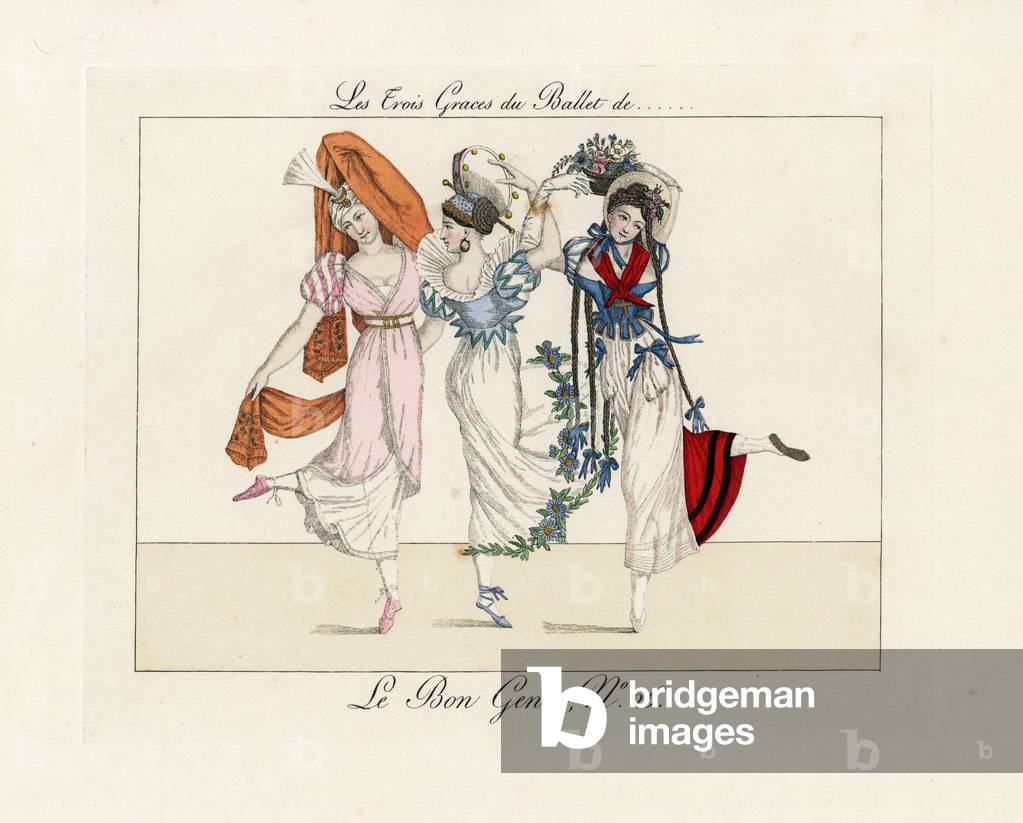
FLO4677921: Three graces of the Ballet of**. Elegant ballet dancers in costume (one in turban and shawl, one with tambourine and dress decorated with flowers, and one with a basket and long plaits tied with ribbons). “” Each movement betrays a form: arms, shoulders, throat, legs, feet all are naked or appear so.”” Handcoloured engraving from Pierre de la Mesanger's Le Bon Genre, Paris, 1817. / Bridgeman Images

FLO4677958: Millinery shop workers. Women in lowcut muslin dresses trying on hats, holding a hat box, fixing feathers to a headdress and reading a notebook at the counter. Handcoloured engraving from Pierre de la Mesanger's Le Bon Genre, Paris, 1817. / Bridgeman Images

FLO4678217: A knight of the Blanchfront Family, 1397. He wears a suit of armour with a visored bassinet, silk camail, ornamented mamillieres, round cuffed gauntlets, hauberk, belts ornamented with rosettes, shoulders and elbows with roundels. After a monument in Alvechurch. Handcoloured lithograph after an illustration by S.R. Meyrick from Sir Samuel Rush Meyrick's A Critical Inquiry into Antient Armour. / Bridgeman Images

FLO4678322: Alexander I King of Scotland - Alexander I, King of Scotland, 1107. Alexander the Fierce, 1078-1124. He wears a helmet, hauberk tunic with hood, rides a horse and carries a lance with pennant and targe shield. Handcoloured lithograph after an illustration by S.R. Meyrick from Sir Samuel Rush Meyrick's A Critical Inquiry into Antient Armour. / Bridgeman Images

FLO4678731: Amelanchier with alder leaves or flowered aronie - Plate engraved by S.Watts, from an illustration by Sarah Anne Drake (1803-1857), from the Botanical Register of Sydenham Edwards (1768-1819), England, 1833 - Florida serviceberry, Amelanchier alnifolia subsp. florida (Many-flowered amelanchier florier, Amelanchier (ida) - Engraving by S. Watts after an illustration by Miss Drake from Sydenham Edwards' “” The Botanical Register,”” London, Ridgway, 1833, Edwards, Sydenham Teast (c.1768-1819) / Bridgeman Images

FLO4681672: Spanish hogfish, Bodianus rufus (Boar-tusked sparus, Sparus glasses). Illustration drawn and engraved by Richard Polydore Nodder. Handcoloured copperplate engraving from George Shaw and Frederick Nodder's The Naturalist's Miscellany, London, 1806. / Bridgeman Images
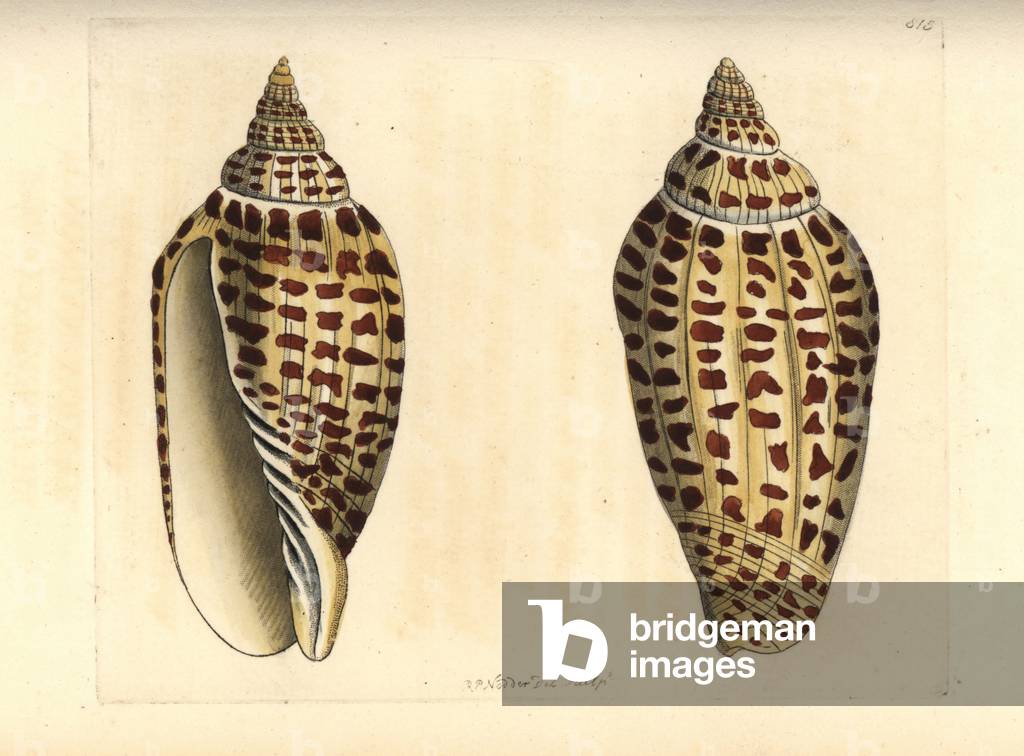
FLO4681685: Junonia or Juno's volute, Scaphella junonia (Junonian volute, Voluta junonia). Illustration drawn and engraved by Richard Polydore Nodder. Handcoloured copperplate engraving from George Shaw and Frederick Nodder's The Naturalist's Miscellany, London, 1806. / Bridgeman Images
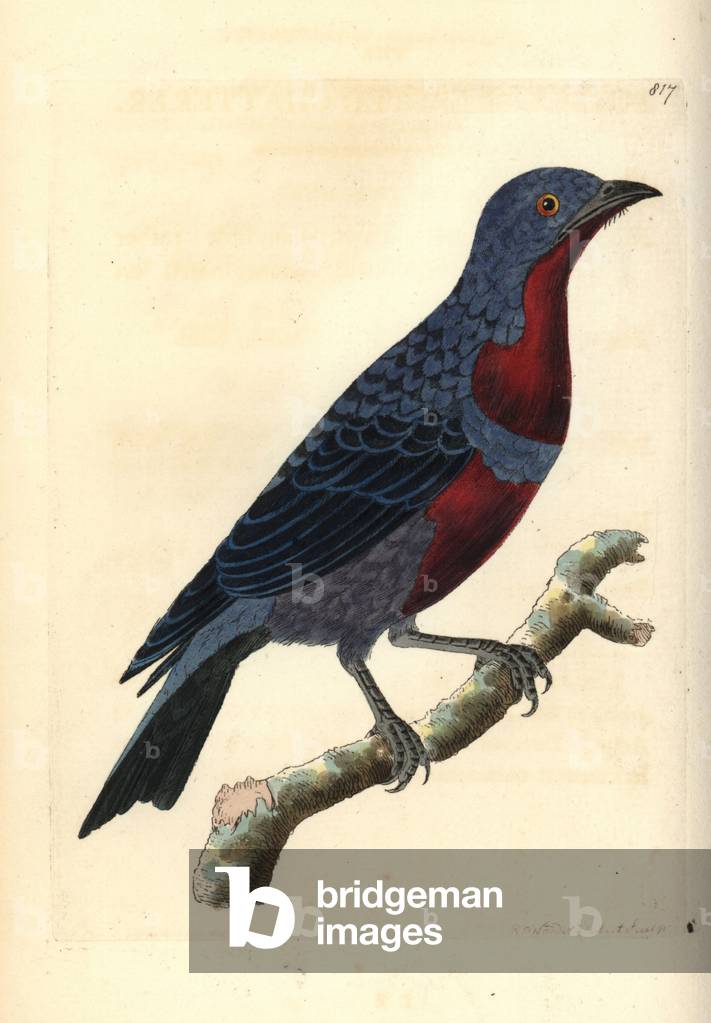
FLO4681699: Purple-breasted cotinga, Cotinga cotinga (Purple-breasted chatterer, Ampelis cotinga). Illustration drawn and engraved by Richard Polydore Nodder. Handcoloured copperplate engraving from George Shaw and Frederick Nodder's The Naturalist's Miscellany, London, 1806. / Bridgeman Images
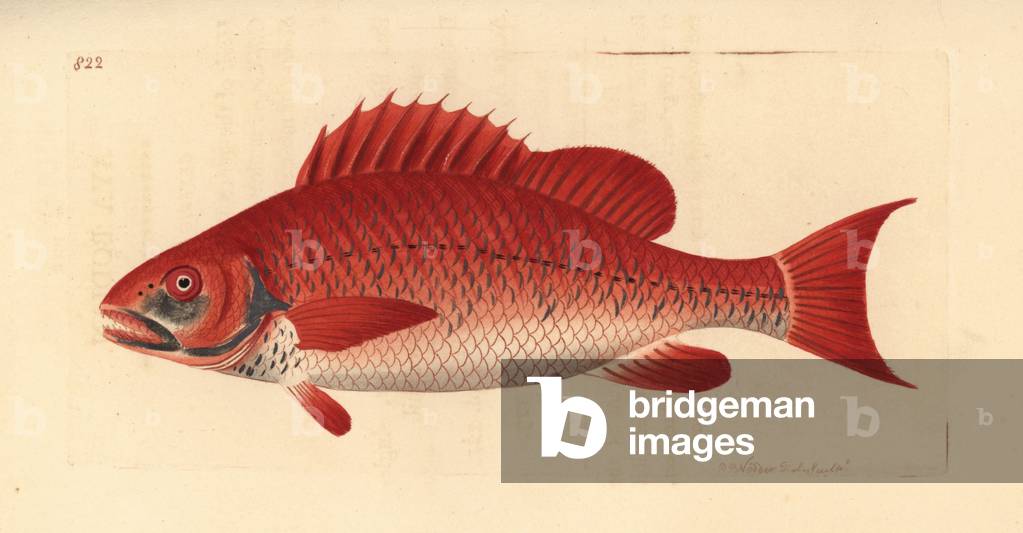
FLO4681751: Red snapper species, Lutjanus campechanus? (Aya bodian, Bodianus aya). Illustration drawn and engraved by Richard Polydore Nodder. Handcoloured copperplate engraving from George Shaw and Frederick Nodder's The Naturalist's Miscellany, London, 1806. / Bridgeman Images

FLO4681990: Least valley coral, Leptoria phrygia (Lace madrepore, Madrepora phrygia). Illustration drawn and engraved by Richard Polydore Nodder. Handcoloured copperplate engraving from George Shaw and Frederick Nodder's The Naturalist's Miscellany, London, 1806. / Bridgeman Images

FLO4682005: White amphisbene. Copper engraving by Frederick Polydor Nodder (1751-1801), signed illustration S, by George Shaw for the naturalist collection, published in 1790 by George Shaw. / Bridgeman Images

FLO4682038: Amazonian motmot, Momotus momota (Brasilian momot, Momota brasiliensis). Illustration drawn and engraved by Richard Polydore Nodder. Handcoloured copperplate engraving from George Shaw and Frederick Nodder's The Naturalist's Miscellany, London, 1806. / Bridgeman Images

FLO4682104: Cape starling, Lamprotornis nitens (Shining stare, Sturnus nitens). Illustration drawn and engraved by Richard Polydore Nodder. Handcoloured copperplate engraving from George Shaw and Frederick Nodder's The Naturalist's Miscellany, London, 1806. / Bridgeman Images

FLO4682118: Red underwing moth, Catocala nupta (Phalaena nupta). Illustration drawn and engraved by Richard Polydore Nodder. Handcoloured copperplate engraving from George Shaw and Frederick Nodder's The Naturalist's Miscellany, London, 1806. / Bridgeman Images

FLO4682163: Mant leaf. Copper engraving by Frederick Polydor Nodder (1751-1801), signed illustration SN, by Frederick Noder and George Shaw for the naturalist collection, published in 1790 by George Shaw. / Bridgeman Images

FLO4682183: Portrait of Nicolas Culpeper (1616-1654), botanist, herbalist doctor and English astrologer. It is described wearing a cape with a large lace collar, inscribed in an oval frame with the signs of the zodiac, topped by a ribbon. Engraving in “” Culpeper's Complete Herbal and English Physician”” Burslem, Tregortha, 1814. / Bridgeman Images

FLO4682299: Portrait of John Evelyn (1620-1706), English writer, gardener and horticulturist. Engraving by W.H. Lizars, in “” The Naturalist Library”” by Sir William Jardine, Edinburgh, Scotland, 1833. / Bridgeman Images

FLO4682419: Purple and orange lilies - Lithography attributed to Paul Theodor van Brussel (1754-1795), author of the cover bouquet, or A.Bres., influenced by Nicolas Robert (1614-1685), published in “Nederlandsch Bloemwerk” (Dutch Floral Compositions), Amsterdam, J.B. Elwe, 1794 / Bridgeman Images

FLO4682492: Hyacinth (or hyacinth), variete Augustus rex, with a scarabee - Lithography attributed to Paul Theodor van Brussel (1754-1795), author of the cover bouquet, or A.Bres., influenced by Nicolas Robert (1614-1685), published in “Nederlandsch Bloemwerk” (Dutch Floral Compositions), Amsterdam, J.B. Elwe, 1794 / Bridgeman Images

FLO4682803: Mollusk, sea snail tulip, Fasciolaria tulipa - Lithography by Richard Polydore Nodder (1774-1823) published in The Naturalist Miscellany, 1812 / Bridgeman Images

FLO4682791: Charonia lampas - Lithography by Richard Polydore Nodder (1774-1823) published in The Naturalist Miscellany, 1812 / Bridgeman Images

FLO4682855: Red Partridge, Alectoris rufa - Lithography by Richard Polydore Nodder (1774-1823) published in The Naturalist Miscellany, 1812 / Bridgeman Images

FLO4683461: Unknown species of bushbaby or mouse lemur (Minute lemur, Lemur minutus). Illustration drawn and engraved by Richard Polydore Nodder. Handcoloured copperplate engraving from George Shaw and Frederick Nodder's The Naturalist's Miscellany, London, 1802. / Bridgeman Images

FLO4683727: Red naped lorikeet, Psittacus nuchalis. Illustration drawn and engraved by Richard Polydore Nodder. Handcoloured copperplate engraving from George Shaw and Frederick Nodder's “” The Naturalist's Miscellany,”” London, 1810. / Bridgeman Images

FLO4683775: Diana conch, Euprotomus aurisdianae (Ear strombus shell, Strombus auris dianae). Illustration drawn and engraved by Richard Polydore Nodder. Handcoloured copperplate engraving from George Shaw and Frederick Nodder's “” The Naturalist's Miscellany,”” London, 1810. / Bridgeman Images

FLO4683877: Boulder star coral, Montastrea annularis. Endangered. (Annular madrepore, Madrepora annularis). Illustration drawn and engraved by Richard Polydore Nodder. Handcoloured copperplate engraving from George Shaw and Frederick Nodder's “” The Naturalist's Miscellany,”” London, 1810. / Bridgeman Images

FLO4683906: Xyleukes hyphinoe moth (Hyphinoe, Phalaena hyphinoe), native to Australia. Illustration drawn and engraved by Richard Polydore Nodder. Handcoloured copperplate engraving from George Shaw and Frederick Nodder's “” The Naturalist's Miscellany,”” London, 1810. / Bridgeman Images

FLO4684194: Sea anemone, branch of the cnidaires. Copper engraving by Frederick Polydor Nodder (1751-1801), George Shaw's illustration for the naturalist collection, published in 1790 by George Shaw. Sea anemone or anemone actinia. Actinia anemone. Scarlet sea anemone shown in contracted (1) and expanded state (3), “” displaying a triple row of circular tentacula of an oblong form, with obtuse points, of a yellow color and varied with red.” Handcolored copperplate engraving, illustration signed S (George Shaw) from George Shaw's “” Naturalist's Miscellany”” (1790). / Bridgeman Images

FLO4684605: Woman in long veil over a pink dress in La Voilette costume. Lithograph by unknown artist with stencil handcolouring from “” Nos Travestis”” (Our Fancy Dress Costumes), Paris, 1928. / Bridgeman Images

FLO4684308: Blue morpho butterfly. Copper engraving by Frederick Polydor Nodder (1751-1801), George Shaw's illustration for the naturalist collection, published in 1790 by George Shaw. Menelaus Blue Morpho butterfly. Morpho menelaus (Papilio menelaus). Iridescent blue tropical butterfly native to Central and South America. Handcolored copperplate engraving, illustration signed S (George Shaw) from George Shaw's “” Naturalist's Miscellany”” (1790). / Bridgeman Images

FLO4684452: Woman in wireless telephone (the TSF) costume, with speaker hat, receiver and gold dress. Lithograph by unknown artist with stencil handcolouring from “” Nos Travestis”” (Our Fancy Dress Costumes), Paris, 1928. / Bridgeman Images
