2491476 Search Results

FLO4647892: Bronze-tailed thornbill, Chalcostigma heteropogon (Ramphomicron heteropogon). Handcoloured steel engraving from W.C.L. Martin's A General History of Humming-birds or the Trochilidae. / Bridgeman Images

PIX4647909: C. Nicollier and JF. Clervoy in the shuttle Discovery STS-103 - 1999 - C. Nicollier and JF. Clervoy in weightlessness 12/1999 - (19 - 27 December 1999) - - - Astronauts Claude Nicollier (left) and Jean - Francois Clervoy, mission specialists representing the European Space Agency (ESA), move about on Discovery's mid deck in a manner they could not duplicate in Earth - bound training. A photography / Bridgeman Images

FLO4648025: Handcoloured print by Kono Bairei for 'One Hundred Varieties of Flowers', Tokyo, Yamada, 1901 / Bridgeman Images

FLO4648097: Handcoloured print by Kono Bairei for 'One Hundred Varieties of Flowers', Tokyo, Yamada, 1901 / Bridgeman Images

FLO4648181: Handcoloured print by Kono Bairei for 'One Hundred Varieties of Flowers', Tokyo, Yamada, 1901 / Bridgeman Images

FLO4648215: Handcoloured print by Kono Bairei for 'One Hundred Varieties of Flowers', Tokyo, Yamada, 1901 / Bridgeman Images

FLO4648455: Amadokoro or Solomon's seal, Polygonatum odoratum. Handcoloured woodblock print by Kono Bairei from Kusa Bana Hyakushu (One Hundred Varieties of Flowers), Tokyo, Yamada, 1901. / Bridgeman Images

FLO4648474: Kanran orchid, Cymbidium kanran Makino. Handcoloured woodblock print by Kono Bairei from Kusa Bana Hyakushu (One Hundred Varieties of Flowers), Tokyo, Yamada, 1901. / Bridgeman Images

FLO4648498: Handcoloured print by Kono Bairei for 'One Hundred Varieties of Flowers', Tokyo, Yamada, 1901 / Bridgeman Images

FLO4648505: Handcoloured print by Kono Bairei for 'One Hundred Varieties of Flowers', Tokyo, Yamada, 1901 / Bridgeman Images
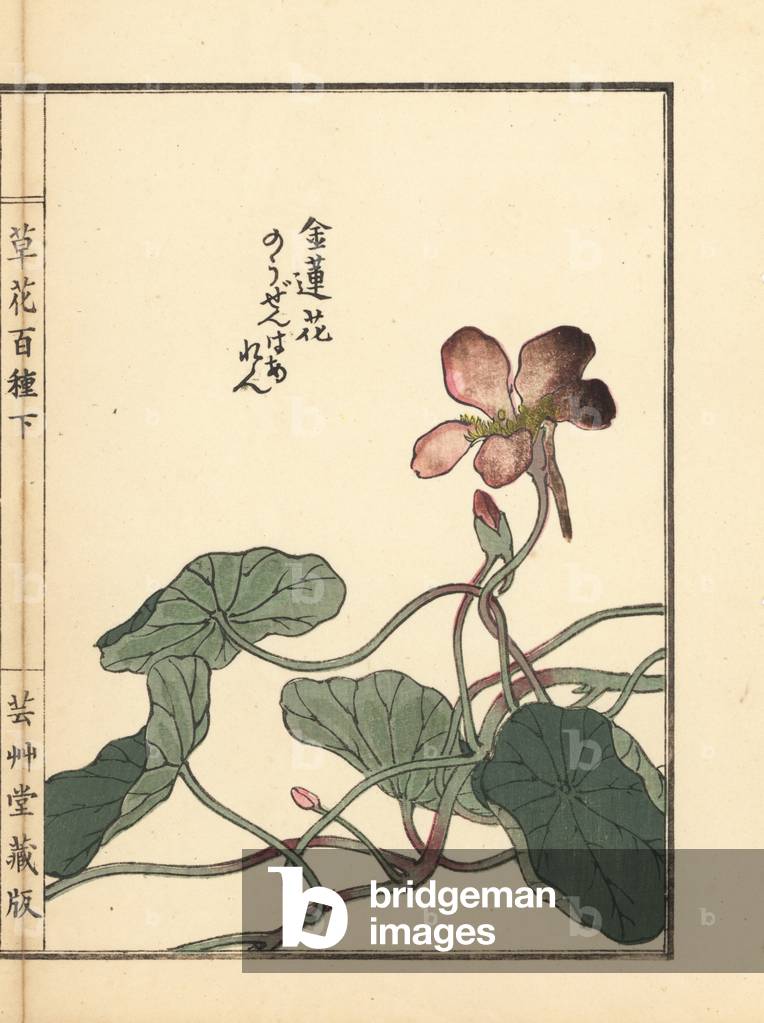
FLO4648595: Nouzenharen or garden nasturtium, Tropaeolum majus. Handcoloured woodblock print by Kono Bairei from Kusa Bana Hyakushu (One Hundred Varieties of Flowers), Tokyo, Yamada, 1901. / Bridgeman Images

FLO4648681: Handcoloured print by Kono Bairei for 'One Hundred Varieties of Flowers', Tokyo, Yamada, 1901 / Bridgeman Images

FLO4648695: Habusou or coffee senna, Senna occidentalis. Handcoloured woodblock print by Kono Bairei from Kusa Bana Hyakushu (One Hundred Varieties of Flowers), Tokyo, Yamada, 1901. / Bridgeman Images

FLO4648879: Handcoloured print by Kono Bairei for 'One Hundred Varieties of Flowers', Tokyo, Yamada, 1901 / Bridgeman Images

FLO4648884: Hybrid white rose, Imperatrice Eugenie, Empress Eugenie. Chromolithograph drawn and lithographed by L. Stroobant for “L'Illustration Horticole,”” Ghent, 1860. Ambroise Verschaffelt (1825 € ¿1886) was a distinguished Belgian horticulturist and author. He founded the L'Illustration Horticole at Ghent in 1854. / Bridgeman Images

FLO4648364: Handcoloured print by Kono Bairei for 'One Hundred Varieties of Flowers', Tokyo, Yamada, 1901 / Bridgeman Images

FLO4648735: Handcoloured print by Kono Bairei for 'One Hundred Varieties of Flowers', Tokyo, Yamada, 1901 / Bridgeman Images

FLO4648780: Handcoloured print by Kono Bairei for 'One Hundred Varieties of Flowers', Tokyo, Yamada, 1901 / Bridgeman Images

PIX4648810: Astronauts leave for departure. STS - 120 - 10 - 2007 - STS - 120 crew on departure - Oct 2007 - In front of the right, Pamela Melroy (commander), on his left, driver George Zamka, behind him, hide, Stephanie Wilson (mission specialist), in the middle left, Daniel Tani (mission specialist), middle right, Doug Wheelock (mission specialist), Paolo Nespoli (centre), from ESA, and Scott Parazynski (mission specialist). The launch of the STS-120 mission took place on 23 October 2007. STS-120 will bring the Italian module Node 2 to the International Space Station. ESA astronaut Paolo Nespoli during the walkout of the STS - 120 crew at Nasa's Kennedy Space Center, Florida, 23 October 2007. The crew boarded the Astrovan which takes them to the launch pad where they board Space Shuttle Discovery. On the right, is Commander Pamela Melroy, with Pilot George Zamka (front left), hidden behind Mission Specialist Stephanie Wilson, Mission Specialist Daniel Tani (middle left), Mission Specialist Doug Wheelock (middle right), Paolo Nespoli (center), who represents the European Space Agency and Mission Specialist Scott Parazynski. Tani will remain on the International Space Station to join the Expedition 16 crew after the mission is complete. Launch of STS - 120 to the International Space Station is scheduled for 23 October 2007. STS - 120 will deliver the Italian - built Node 2 module to the International Space Station / Bridgeman Images

FLO4648845: The hyssop officinale (Hyssopus officinalis) Coloured copper prints from a drawing by B. Thanner by Johannes Zorn “Afbeeldingen der Artseny-Gewassen”” (Icons de plantes medicinales) published by Jan Christiaan Sepp in 1796. Zorn (1739-1799) was a German pharmacist and botanist who travelled all over Europe looking for medicinal plants. / Bridgeman Images

PIX4648937: Astronaut Lisa Nowak - mission STS-121 - Astronaut Lisa Nowak floats weightlessly in space shuttle Discovery. Mission STS-121 - 4 to 17 July 2006 / Bridgeman Images

FLO4648665: Handcoloured print by Kono Bairei for 'One Hundred Varieties of Flowers', Tokyo, Yamada, 1901 / Bridgeman Images

FLO4648808: Handcoloured print by Kono Bairei for 'One Hundred Varieties of Flowers', Tokyo, Yamada, 1901 / Bridgeman Images

FLO4648836: Benkeisou or garden stonecrop, Hylotelephium erythrostictum. Handcoloured woodblock print by Kono Bairei from Kusa Bana Hyakushu (One Hundred Varieties of Flowers), Tokyo, Yamada, 1901. / Bridgeman Images

FLO4649048: Baroness Prevost rose, hybrid raised by Monsieur Desprez at Yebles near Melun in 1843. Chromolithograph drawn and lithographed after nature by F. Grobon from Hippolyte Jamain and Eugene Forney's “” Les Roses,” Paris, J. Rothschild, 1873. Jamain was a rose grower and Forney a professor of arboriculture. Francois Frederic GROBON (1815-1901) ran his own atelier and illustrated “” Fleurs” after Redoute with his brother Anthelme as the Grobon freres. / Bridgeman Images

FLO4649082: Jules Margottin rose, hybrid raised by Monsieur Margottin of Bourg-la-Reine in 1853. Chromolithograph drawn and lithographed after nature by F. Grobon from Hippolyte Jamain and Eugene Forney's “” Les Roses,” Paris, J. Rothschild, 1873. Jamain was a rose grower and Forney a professor of arboriculture. Francois Frederic GROBON (1815-1901) ran his own atelier and illustrated “” Fleurs” after Redoute with his brother Anthelme as the Grobon freres. / Bridgeman Images

FLO4649156: La Biche rose, variety of white noisette, raised by Monsieur Toullier of Reuil in 1832. Chromolithograph drawn and lithographed after nature by F. Grobon from Hippolyte Jamain and Eugene Forney's “” Les Roses,” Paris, J. Rothschild, 1873. Jamain was a rose grower and Forney a professor of arboriculture. Francois Frederic GROBON (1815-1901) ran his own atelier and illustrated “” Fleurs” after Redoute with his brother Anthelme as the Grobon freres. / Bridgeman Images

FLO4649309: Madame Edouard Ory rose, hybrid of the moss rose, Rosa muscosa, raised by Monsieur Robert of Angers in 1854. Chromolithograph drawn and lithographed after nature by F. Grobon from Hippolyte Jamain and Eugene Forney's “” Les Roses,” Paris, J. Rothschild, 1873. Jamain was a rose grower and Forney a professor of arboriculture. Francois Frederic GROBON (1815-1901) ran his own atelier and illustrated “” Fleurs” after Redoute with his brother Anthelme as the Grobon freres. / Bridgeman Images

FLO4649476: The dhole, Asian cuon or Asian wild dog, Cuon alpinus - Lithograph by Colonel Charles Hamilton Smith to illustrate Naturalist's Library: Dogs by Sir William Jardine, edition W. H Lizars, Edinburgh, Scotland, 1839 / Bridgeman Images

FLO4649193: Elisa Boelle rose, hybrid rose raised by Monsieur Guillot Jr. of Lyon in 1869. Chromolithograph drawn and lithographed after nature by F. Grobon from Hippolyte Jamain and Eugene Forney's “” Les Roses,” Paris, J. Rothschild, 1873. Jamain was a rose grower and Forney a professor of arboriculture. Francois Frederic GROBON (1815-1901) ran his own atelier and illustrated “” Fleurs” after Redoute with his brother Anthelme as the Grobon freres. / Bridgeman Images

LRI4649246: Prehistory: flint scrapers. Neolithic era. From Umbria. Perugia, Museo Archeologico Nazionale dell'Umbria, Prehistoric / Bridgeman Images

FLO4649556: Fox or Wood Dog, Extirpated Species, Thous acmon - Lithograph by Colonel Charles Hamilton Smith to illustrate Naturalist's Library: Dogs by Sir William Jardine, W. H Lizars Edition, Edinburgh, Scotland, 1839 / Bridgeman Images

FLO4649697: Cape lion. Lithograph of William Lizars, based on a drawing by Charles Hamilton Smith, for “” Bibliotheque naturaliste, mammals, les felins”, by Sir William Jardine, published in 1834 in Edinburgh (Scotland). / Bridgeman Images

LRI4650006: Deer of Iglesias, 8th-7th century BC (bronze statuette), Nuragic Civilization, Sardinia (1800-1200 BC) / Bridgeman Images

FLO4650111: Festive coquette, Lophornis chalybeus (Audenet's hummingbird, Trochilus audenetii). Handcoloured steel engraving by William Lizars from Sir William Jardine's Naturalist's Library: Ornithology: Hummingbirds, Edinburgh, W.H. Lizars, 1834. / Bridgeman Images

FLO4650146: Fiery-tailed awlbill, Avocadettula recurvirostris, juvenile (Avocent-billed hummingbird, Trochilus avocetta). Handcoloured steel engraving by William Lizars from Sir William Jardine's Naturalist's Library: Ornithology: Hummingbirds, Edinburgh, W.H. Lizars, 1834. / Bridgeman Images
