Search options

Orientation
Colour

Display options

View

Print

To print search results, use print friendly version of this page.

2491476 Search Results

Charles V, the Wise, King of France, 1338-1380. He wears a crown, blue simar with gold fleurs de liys, lined with ermine, and red shoes. From a miniature in a manuscript of Froissart's Chronicles. Handcoloured copperplate drawn and engraved by Leopold Massard from “” French Costumes from KingClovis to Our Days,”” Massard, Mifliez, Paris, 1834.

FLO4673580: Charles V, the Wise, King of France, 1338-1380. He wears a crown, blue simar with gold fleurs de liys, lined with ermine, and red shoes. From a miniature in a manuscript of Froissart's Chronicles. Handcoloured copperplate drawn and engraved by Leopold Massard from “” French Costumes from KingClovis to Our Days,”” Massard, Mifliez, Paris, 1834., Massard, Leopold (1812-1889) / Bridgeman Images

Jean de Vaudetar, chamberlain to King Charles V, 14th century. He wears a simple white buttoned tunic and stockings, with dagger and keys hanging from his belt. From the Gaignieres collection. Handcoloured copperplate drawn and engraved by Leopold Massard from “” French Costumes from KingClovis to Our Days,”” Massard, Mifliez, Paris, 1834.

FLO4673612: Jean de Vaudetar, chamberlain to King Charles V, 14th century. He wears a simple white buttoned tunic and stockings, with dagger and keys hanging from his belt. From the Gaignieres collection. Handcoloured copperplate drawn and engraved by Leopold Massard from “” French Costumes from KingClovis to Our Days,”” Massard, Mifliez, Paris, 1834., Massard, Leopold (1812-1889) / Bridgeman Images

Executioner, 9th century. He wears a sleeveless tunic with belt, laced sandals up to the calf, and holds an axe. From a manuscript in the king's library. Handcoloured copperplate drawn and engraved by Leopold Massard from “” French Costumes from KingClovis to Our Days,”” Massard, Mifliez, Paris, 1834.

FLO4673840: Executioner, 9th century. He wears a sleeveless tunic with belt, laced sandals up to the calf, and holds an axe. From a manuscript in the king's library. Handcoloured copperplate drawn and engraved by Leopold Massard from “” French Costumes from KingClovis to Our Days,”” Massard, Mifliez, Paris, 1834., Massard, Leopold (1812-1889) / Bridgeman Images

French soldier, 9th century. He wears a Phrygian cap, chlamys, short chainmail armour over a tunic, stockings and shoes laced to the calf. He carries a lance and buckler (shield). Handcoloured copperplate drawn and engraved by Leopold Massard from “” French Costumes from KingClovis to Our Days,”” Massard, Mifliez, Paris, 1834.

FLO4673873: French soldier, 9th century. He wears a Phrygian cap, chlamys, short chainmail armour over a tunic, stockings and shoes laced to the calf. He carries a lance and buckler (shield). Handcoloured copperplate drawn and engraved by Leopold Massard from “” French Costumes from KingClovis to Our Days,”” Massard, Mifliez, Paris, 1834., Massard, Leopold (1812-1889) / Bridgeman Images

Bertha, daughter of King Lothair II and his concubine Waldrada, 863-925. She wears a veil tied at the throat, and two tunics, the top one with gold cuffs. Handcoloured copperplate drawn and engraved by Leopold Massard from “” French Costumes from KingClovis to Our Days,”” Massard, Mifliez, Paris, 1834.

FLO4673967: Bertha, daughter of King Lothair II and his concubine Waldrada, 863-925. She wears a veil tied at the throat, and two tunics, the top one with gold cuffs. Handcoloured copperplate drawn and engraved by Leopold Massard from “” French Costumes from KingClovis to Our Days,”” Massard, Mifliez, Paris, 1834., Massard, Leopold (1812-1889) / Bridgeman Images

Louis II the German, King of Bavaria, 806. Handcoloured copperplate drawn and engraved by Leopold Massard from “” French Costumes from KingClovis to Our Days,”” Massard, Mifliez, Paris, 1834.

FLO4673775: Louis II the German, King of Bavaria, 806. Handcoloured copperplate drawn and engraved by Leopold Massard from “” French Costumes from KingClovis to Our Days,”” Massard, Mifliez, Paris, 1834., Massard, Leopold (1812-1889) / Bridgeman Images

Lothair I, Emperor of the Romans, 795-855. He carries a sceptre and orb, wears a mitre and crown, long cope or pluviale over several tunics. Handcoloured copperplate drawn and engraved by Leopold Massard from “” French Costumes from KingClovis to Our Days,”” Massard, Mifliez, Paris, 1834.

FLO4673820: Lothair I, Emperor of the Romans, 795-855. He carries a sceptre and orb, wears a mitre and crown, long cope or pluviale over several tunics. Handcoloured copperplate drawn and engraved by Leopold Massard from “” French Costumes from KingClovis to Our Days,”” Massard, Mifliez, Paris, 1834., Massard, Leopold (1812-1889) / Bridgeman Images

Raymond V, Count of Toulouse, (Raymond V de Toulouse) 1134-1194. He wears a skullcap, short sayon (jacket), doublet, and stockings and gauntlets. He wears a dagger or misericorde from his belt. Handcoloured copperplate drawn and engraved by Leopold Massard from “” French Costumes from KingClovis to Our Days,”” Massard, Mifliez, Paris, 1834.

FLO4674295: Raymond V, Count of Toulouse, (Raymond V de Toulouse) 1134-1194. He wears a skullcap, short sayon (jacket), doublet, and stockings and gauntlets. He wears a dagger or misericorde from his belt. Handcoloured copperplate drawn and engraved by Leopold Massard from “” French Costumes from KingClovis to Our Days,”” Massard, Mifliez, Paris, 1834., Massard, Leopold (1812-1889) / Bridgeman Images

Hugh Capet, King of the Franks, Capetian dynasty, c.941. Handcoloured copperplate drawn and engraved by Leopold Massard from “” French Costumes from KingClovis to Our Days,”” Massard, Mifliez, Paris, 1834.

FLO4673885: Hugh Capet, King of the Franks, Capetian dynasty, c.941. Handcoloured copperplate drawn and engraved by Leopold Massard from “” French Costumes from KingClovis to Our Days,”” Massard, Mifliez, Paris, 1834., Massard, Leopold (1812-1889) / Bridgeman Images

Suger, Abbot of Saint-Denis (Suger de Saint Denis, 1080-1151), 12th century. He wears the tonsure, a hooded robe and holds a crosier. From a portrait in a stainless-glass window in Saint-Denis. Handcoloured copperplate drawn and engraved by Leopold Massard from “” French Costumes from KingClovis to Our Days,”” Massard, Mifliez, Paris, 1834.

FLO4674023: Suger, Abbot of Saint-Denis (Suger de Saint Denis, 1080-1151), 12th century. He wears the tonsure, a hooded robe and holds a crosier. From a portrait in a stainless-glass window in Saint-Denis. Handcoloured copperplate drawn and engraved by Leopold Massard from “” French Costumes from KingClovis to Our Days,”” Massard, Mifliez, Paris, 1834., Massard, Leopold (1812-1889) / Bridgeman Images

Renaud or Bernard, son of William II (William II) Count of Tonnerre, died 1148 on a crusade in Latakia, Syria. He wears a suit of chainmail under a tunic, and holds a lance with banderole, sword, and buckler (shield) without heraldic coat of arms. From a statue. Handcoloured copperplate drawn and engraved by Leopold Massard from “” French Costumes from KingClovis to Our Days,”” Massard, Mifliez, Paris, 1834.

FLO4674026: Renaud or Bernard, son of William II (William II) Count of Tonnerre, died 1148 on a crusade in Latakia, Syria. He wears a suit of chainmail under a tunic, and holds a lance with banderole, sword, and buckler (shield) without heraldic coat of arms. From a statue. Handcoloured copperplate drawn and engraved by Leopold Massard from “” French Costumes from KingClovis to Our Days,”” Massard, Mifliez, Paris, 1834., Massard, Leopold (1812-1889) / Bridgeman Images

Holy communion ceremony, 12th century. A priest and altar boy with tonsure giving holy communion to the kneeling congregation in a church. From a manuscript in the Royal Library. Handcoloured copperplate drawn and engraved by Leopold Massard from “” French Costumes from KingClovis to Our Days,”” Massard, Mifliez, Paris, 1834.

FLO4674054: Holy communion ceremony, 12th century. A priest and altar boy with tonsure giving holy communion to the kneeling congregation in a church. From a manuscript in the Royal Library. Handcoloured copperplate drawn and engraved by Leopold Massard from “” French Costumes from KingClovis to Our Days,”” Massard, Mifliez, Paris, 1834., Massard, Leopold (1812-1889) / Bridgeman Images

Cross (Detail of mosaics, 6th century)

LRI4674082: Cross (Detail of mosaics, 6th century), Byzantine School, (6th century) / Bridgeman Images

Mahaut or Matilda II, (Mathilde d'Artois or Mahaut d'Artois, 1268-1329) Countess of Burgundy, 13th century. She wears a crown decorated with gems, veil over her hair, a blue coat-of-arms tunic with gold fleurs de liys, and tunic with pink sleeves. Handcoloured copperplate drawn and engraved by Leopold Massard from “” French Costumes from KingClovis to Our Days,”” Massard, Mifliez, Paris, 1834.

FLO4674190: Mahaut or Matilda II, (Mathilde d'Artois or Mahaut d'Artois, 1268-1329) Countess of Burgundy, 13th century. She wears a crown decorated with gems, veil over her hair, a blue coat-of-arms tunic with gold fleurs de liys, and tunic with pink sleeves. Handcoloured copperplate drawn and engraved by Leopold Massard from “” French Costumes from KingClovis to Our Days,”” Massard, Mifliez, Paris, 1834., Massard, Leopold (1812-1889) / Bridgeman Images

Knight Templar in combat uniform, 12th century. He wears a steel helm, white tunic and stockings, carries a sword and buckler. Handcoloured copperplate drawn and engraved by Leopold Massard from “” French Costumes from KingClovis to Our Days,”” Massard, Mifliez, Paris, 1834.

FLO4674226: Knight Templar in combat uniform, 12th century. He wears a steel helm, white tunic and stockings, carries a sword and buckler. Handcoloured copperplate drawn and engraved by Leopold Massard from “” French Costumes from KingClovis to Our Days,”” Massard, Mifliez, Paris, 1834., Massard, Leopold (1812-1889) / Bridgeman Images
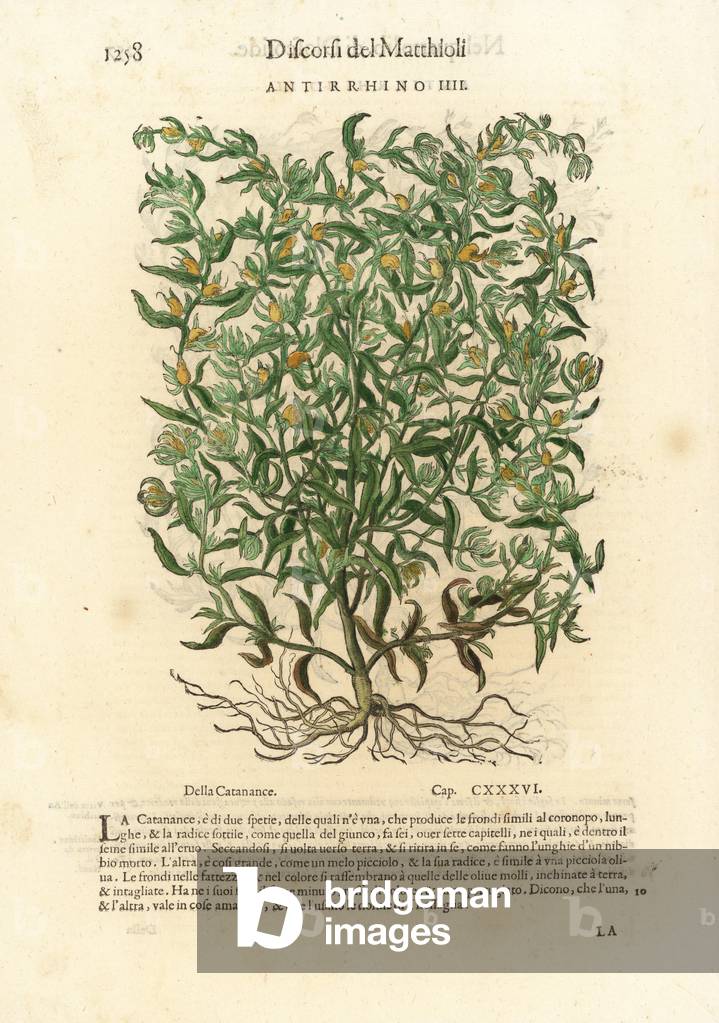
Snapdragon variety, Antirrhinum species, ANTIRRHINO IIIII. Handcoloured woodblock print by Wolfgang Meyerpick after an illustration by Giorgio Liberale from Pietro Andrea Mattioli's Discorsi di P.A. Matthioli ne i sei libri della Materia Medicinale di Pedacio Dioscoride Anazarbeo (Commentary on the Materia Medica of Dioscorides), Vincenzo Valgrisi, Venice, 1568.

FLO4674423: Snapdragon variety, Antirrhinum species, ANTIRRHINO IIIII. Handcoloured woodblock print by Wolfgang Meyerpick after an illustration by Giorgio Liberale from Pietro Andrea Mattioli's Discorsi di P.A. Matthioli ne i sei libri della Materia Medicinale di Pedacio Dioscoride Anazarbeo (Commentary on the Materia Medica of Dioscorides), Vincenzo Valgrisi, Venice, 1568., Liberale, Giorgio (1527-1579) (after) / Bridgeman Images

Housing building, Avenue Jean Jaures in Paris 75019. Architect Aldo Rossi, realisation 1991. Photography 1991.

MDA4674358: Housing building, Avenue Jean Jaures in Paris 75019. Architect Aldo Rossi, realisation 1991. Photography 1991., Rossi, Aldo (1931-1997) / Bridgeman Images

Cornelian cherry, Cornus mas (Corniolo). Handcoloured woodblock print by Wolfgang Meyerpick after an illustration by Giorgio Liberale from Pietro Andrea Mattioli's Discorsi di P.A. Matthioli ne i sei libri della Materia Medicinale di Pedacio Dioscoride Anazarbeo (Commentary on the Materia Medica of Dioscorides), Vincenzo Valgrisi, Venice, 1568.

FLO4674506: Cornelian cherry, Cornus mas (Corniolo). Handcoloured woodblock print by Wolfgang Meyerpick after an illustration by Giorgio Liberale from Pietro Andrea Mattioli's Discorsi di P.A. Matthioli ne i sei libri della Materia Medicinale di Pedacio Dioscoride Anazarbeo (Commentary on the Materia Medica of Dioscorides), Vincenzo Valgrisi, Venice, 1568., Liberale, Giorgio (1527-1579) (after) / Bridgeman Images

Spring crocus, Crocus vernus (Croco fiorito). Handcoloured woodblock print by Wolfgang Meyerpick after an illustration by Giorgio Liberale from Pietro Andrea Mattioli's Discorsi di P.A. Matthioli ne i sei libri della Materia Medicinale di Pedacio Dioscoride Anazarbeo (Commentary on the Materia Medica of Dioscorides), Vincenzo Valgrisi, Venice, 1568.

FLO4674650: Spring crocus, Crocus vernus (Croco fiorito). Handcoloured woodblock print by Wolfgang Meyerpick after an illustration by Giorgio Liberale from Pietro Andrea Mattioli's Discorsi di P.A. Matthioli ne i sei libri della Materia Medicinale di Pedacio Dioscoride Anazarbeo (Commentary on the Materia Medica of Dioscorides), Vincenzo Valgrisi, Venice, 1568., Liberale, Giorgio (1527-1579) (after) / Bridgeman Images
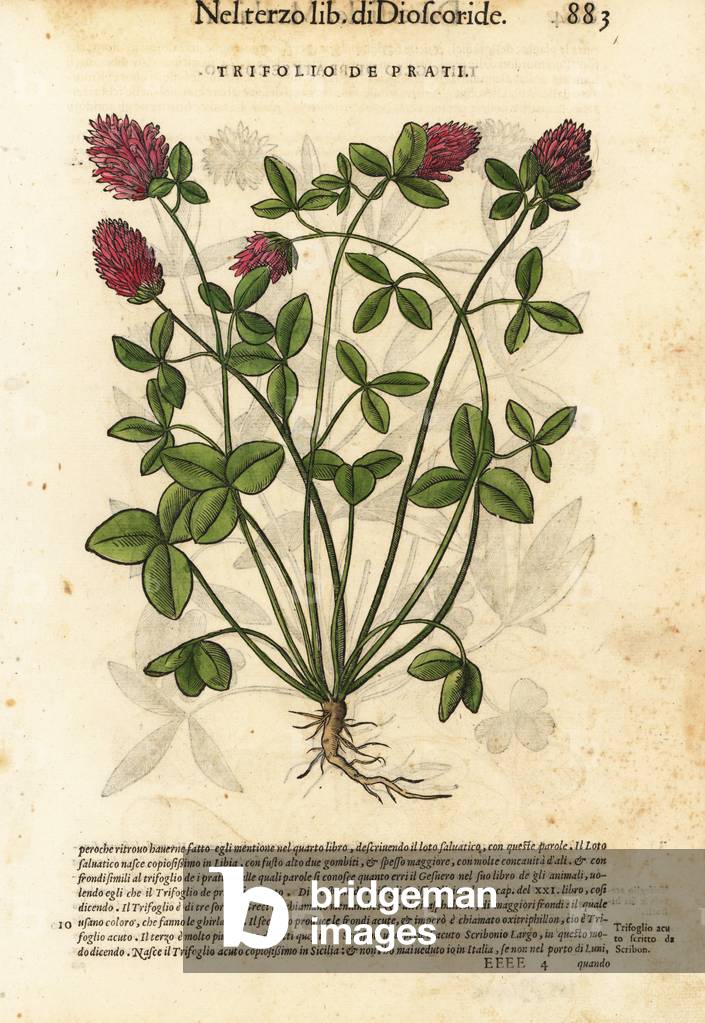
Red clover, Trifolium pratense. Prati trifolio. Handcoloured woodblock print by Wolfgang Meyerpick after an illustration by Giorgio Liberale from Pietro Andrea Mattioli's Discorsi di P.A. Matthioli ne i sei libri della Materia Medicinale di Pedacio Dioscoride Anazarbeo (Commentary on the Materia Medica of Dioscorides), Vincenzo Valgrisi, Venice, 1568.

FLO4674676: Red clover, Trifolium pratense. Prati trifolio. Handcoloured woodblock print by Wolfgang Meyerpick after an illustration by Giorgio Liberale from Pietro Andrea Mattioli's Discorsi di P.A. Matthioli ne i sei libri della Materia Medicinale di Pedacio Dioscoride Anazarbeo (Commentary on the Materia Medica of Dioscorides), Vincenzo Valgrisi, Venice, 1568., Liberale, Giorgio (1527-1579) (after) / Bridgeman Images

Hibiscus variete (H. roseus). This species has elegantly pink flowers is native to France, Italy and the coasts of North Africa.

FLO4674724: Hibiscus variete (H. roseus). This species has elegantly pink flowers is native to France, Italy and the coasts of North Africa. / Bridgeman Images

Crimson red flowers of Gilia coronopifolia. Illustration by Augusta Innes Withers (1793-1877), in The Botanist, series by Benjamin Maund in five volumes, published between 1836 and 1842. This work is renowned for its finely detailed engravings.

FLO4674797: Crimson red flowers of Gilia coronopifolia. Illustration by Augusta Innes Withers (1793-1877), in The Botanist, series by Benjamin Maund in five volumes, published between 1836 and 1842. This work is renowned for its finely detailed engravings. / Bridgeman Images
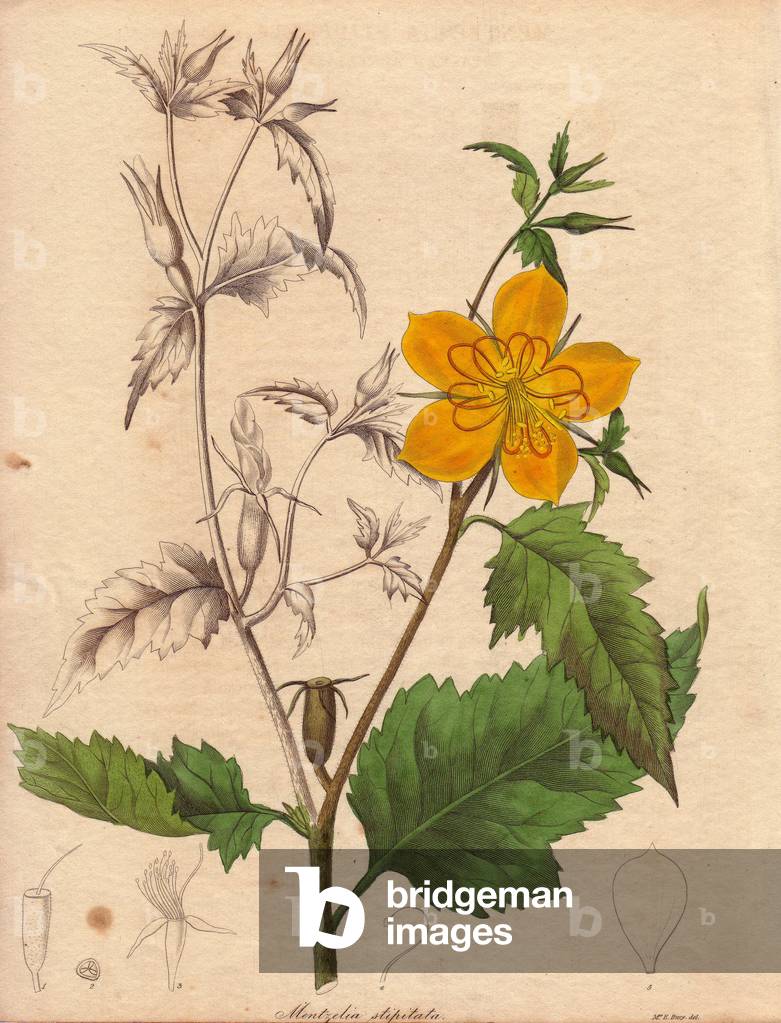
Specimen of Mentzelia stipitata 34. Illustration by Priscilla Bury, in The Botanist, series by Benjamin Maund in five volumes, published between 1836 and 1842. This work is renowned for its finely detailed engravings.

FLO4674803: Specimen of Mentzelia stipitata 34. Illustration by Priscilla Bury, in The Botanist, series by Benjamin Maund in five volumes, published between 1836 and 1842. This work is renowned for its finely detailed engravings. / Bridgeman Images

Orchid variete, Paphinia (Maxillaria) cristata, endemic species in northern South America. A pendant inflorescence with a star-shaped flower, crimson red colour with white stripes. Illustration by Augusta Innes Withers (1793-1877), in The Botanist, series by Benjamin Maund in five volumes, published between 1836 and 1842. This work is renowned for its finely detailed engravings.

FLO4674851: Orchid variete, Paphinia (Maxillaria) cristata, endemic species in northern South America. A pendant inflorescence with a star-shaped flower, crimson red colour with white stripes. Illustration by Augusta Innes Withers (1793-1877), in The Botanist, series by Benjamin Maund in five volumes, published between 1836 and 1842. This work is renowned for its finely detailed engravings. / Bridgeman Images

Costume d'un jeune homme francais, 14eme century - Costume of a young French man, blue tunic with large sleeves, black belt, stockings in red and white, and bizarre long cracows (pointed shoes a la poulaine), 14th century - From a miniature in a French manuscript titled Roman de la Rose, Imperiale Paris Library - Handcolored illustration drawn and lithographed by Paul Mercuri with text by Camille Bonnard from “” Historical Costumes from the 12th to 15th Centuries,”” Levy Fils, Paris, 1861

FLO4677027: Costume d'un jeune homme francais, 14eme century - Costume of a young French man, blue tunic with large sleeves, black belt, stockings in red and white, and bizarre long cracows (pointed shoes a la poulaine), 14th century - From a miniature in a French manuscript titled Roman de la Rose, Imperiale Paris Library - Handcolored illustration drawn and lithographed by Paul Mercuri with text by Camille Bonnard from “” Historical Costumes from the 12th to 15th Centuries,”” Levy Fils, Paris, 1861 / Bridgeman Images

Barnabe Visconti (1323-1385), seigneur of Milan - Bernabo Visconti, Lord of Milan, Italian soldier and statesman, 14th century - He wears a gold diadem, black armour, a white tabard embroidered in gold, gold spurs, iron gauntlets, and carries a sword and baton - From the monument to him in the church of Saint-Jean in Concha - Handcoloured illustration and lithographed by Paul Mercuri with text by Camille Bonnard from “” Historical Costumes from the 12th to 15th Centuries,”” Levy Fils, Paris, 1861

FLO4677157: Barnabe Visconti (1323-1385), seigneur of Milan - Bernabo Visconti, Lord of Milan, Italian soldier and statesman, 14th century - He wears a gold diadem, black armour, a white tabard embroidered in gold, gold spurs, iron gauntlets, and carries a sword and baton - From the monument to him in the church of Saint-Jean in Concha - Handcoloured illustration and lithographed by Paul Mercuri with text by Camille Bonnard from “” Historical Costumes from the 12th to 15th Centuries,”” Levy Fils, Paris, 1861 / Bridgeman Images

A young woman dressed in a medievale dress and headdress, sitting on a Gothic seat plays the play of twine, observed by a thoughtful young man - Lithograph based on an illustration by J.E. Rogers, from Passe temps actuels de l'Engleterre heureuse, by Francis Cowley Burnand (1836-1917), 1873 - Medieval woman seated in a gothic chair playing cat's cradle with a pensive youth - Handcoloured lithograph after an illustration by J. E. Rogers from Francis Cowley Burnand's “” Present Pastimes of Merrie England, Cassell, London, 1873

FLO4677184: A young woman dressed in a medievale dress and headdress, sitting on a Gothic seat plays the play of twine, observed by a thoughtful young man - Lithograph based on an illustration by J.E. Rogers, from Passe temps actuels de l'Engleterre heureuse, by Francis Cowley Burnand (1836-1917), 1873 - Medieval woman seated in a gothic chair playing cat's cradle with a pensive youth - Handcoloured lithograph after an illustration by J. E. Rogers from Francis Cowley Burnand's “” Present Pastimes of Merrie England, Cassell, London, 1873 / Bridgeman Images

A man of the Middle Ages drives a wooden bicycle, in a pave street, in front of frightened spectators (this type of bicycle did not appear until the end of the 19th century) - Lithography based on an illustration by J.E. Rogers, from Francis Cowley Burnand's Passe temps actuels de l'Englance (1836-1917), 1873 - Medieval man riding a wooden velocipede on a cobbled street in front of startled bystanders. (This early bicycle was invented in the late 19th century) Handcoloured lithograph after an illustration by J. E. Rogers from Francis Cowley Burnand's “” Present Pastimes of Merrie England, Cassell, London, 1873

FLO4677209: A man of the Middle Ages drives a wooden bicycle, in a pave street, in front of frightened spectators (this type of bicycle did not appear until the end of the 19th century) - Lithography based on an illustration by J.E. Rogers, from Francis Cowley Burnand's Passe temps actuels de l'Englance (1836-1917), 1873 - Medieval man riding a wooden velocipede on a cobbled street in front of startled bystanders. (This early bicycle was invented in the late 19th century) Handcoloured lithograph after an illustration by J. E. Rogers from Francis Cowley Burnand's “” Present Pastimes of Merrie England, Cassell, London, 1873 / Bridgeman Images
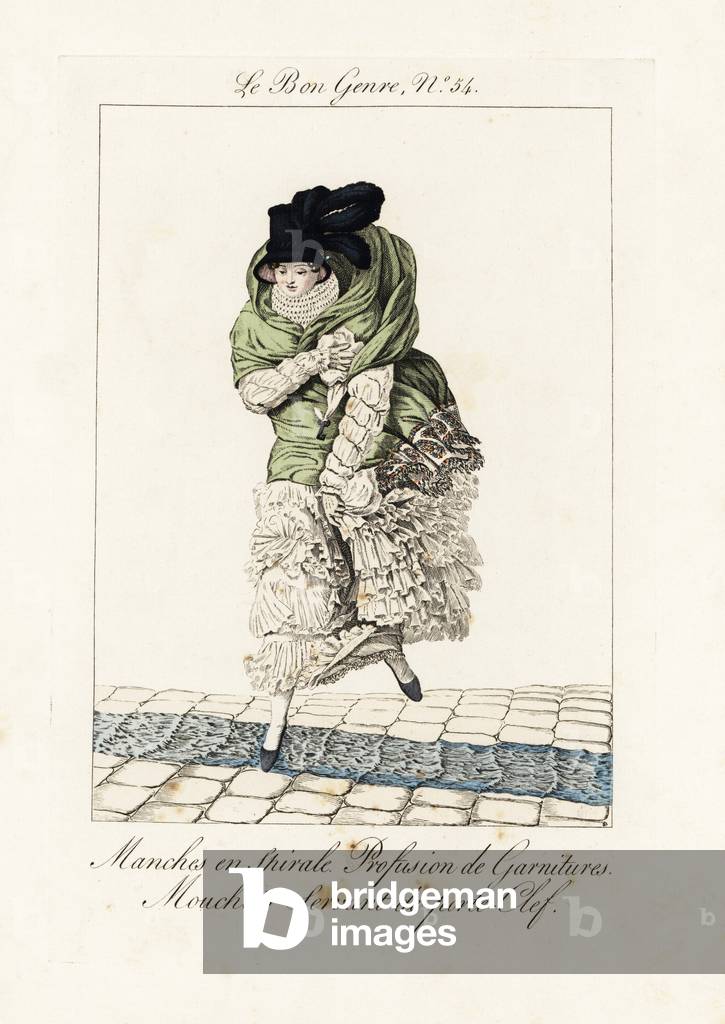
Woman with spiral sleeves, profuse ruffs and flounces, kerchief key-holder. When one talks of flounces, refer back to the reign of Louis XV, and look at the portrait of your grandmother. Have patience, miss. That which causes such disdain today will excite you in a little while, and it won't be one falbala but many that you want to wear.”” Illustration by Jean-Baptiste Isabey. Handcoloured engraving from Pierre de la Mesanger's Le Bon Genre, Paris, 1817.

FLO4677354: Woman with spiral sleeves, profuse ruffs and flounces, kerchief key-holder. When one talks of flounces, refer back to the reign of Louis XV, and look at the portrait of your grandmother. Have patience, miss. That which causes such disdain today will excite you in a little while, and it won't be one falbala but many that you want to wear.”” Illustration by Jean-Baptiste Isabey. Handcoloured engraving from Pierre de la Mesanger's Le Bon Genre, Paris, 1817. / Bridgeman Images

Woman from the Chaussee-d'Antin in the Chinese fashion. She wears a tall bonnet with flowers and ribbons over her piled up hairstyle a la Chinoque, ruff collar, tunic with bells, shawl tied in a bow, and shoes with bows. Illustration by Louis-Philibert Debucourt. Handcoloured engraving from Pierre de la Mesanger's Le Bon Genre, Paris, 1817.

FLO4677385: Woman from the Chaussee-d'Antin in the Chinese fashion. She wears a tall bonnet with flowers and ribbons over her piled up hairstyle a la Chinoque, ruff collar, tunic with bells, shawl tied in a bow, and shoes with bows. Illustration by Louis-Philibert Debucourt. Handcoloured engraving from Pierre de la Mesanger's Le Bon Genre, Paris, 1817. / Bridgeman Images

Cartoon of English fashions in Paris, 1814. Man in flowerpot hat, women in bottom-shaped gowns. Handcoloured engraving from Pierre de la Mesanger's Le Bon Genre, Paris, 1817.

FLO4677482: Cartoon of English fashions in Paris, 1814. Man in flowerpot hat, women in bottom-shaped gowns. Handcoloured engraving from Pierre de la Mesanger's Le Bon Genre, Paris, 1817. / Bridgeman Images

Costume d'une femme de la nobility Siennoise (Italy), 14th century - Noble woman of Siena, in luxurious crown of gold, silver necklace and fringed violet dress, from a painting by Domenico Bartoli, 14th century - Handcoloured illustration drawn and lithographed by Paul Mercuri with text by Camille Bonnard from “” Historical Costumes from the 12th to 15th Centuries,”” Levy Fils, Paris, 1861

FLO4676980: Costume d'une femme de la nobility Siennoise (Italy), 14th century - Noble woman of Siena, in luxurious crown of gold, silver necklace and fringed violet dress, from a painting by Domenico Bartoli, 14th century - Handcoloured illustration drawn and lithographed by Paul Mercuri with text by Camille Bonnard from “” Historical Costumes from the 12th to 15th Centuries,”” Levy Fils, Paris, 1861, Mercuri, Paolo (1804-84) / Bridgeman Images

Accommodation in Emerainville (Marne la Vallee). Realisation 1986, architect Lucien Kroll. Photography 1986.

TEC4676964: Accommodation in Emerainville (Marne la Vallee). Realisation 1986, architect Lucien Kroll. Photography 1986., Kroll, Lucien (b. 1927) / Bridgeman Images
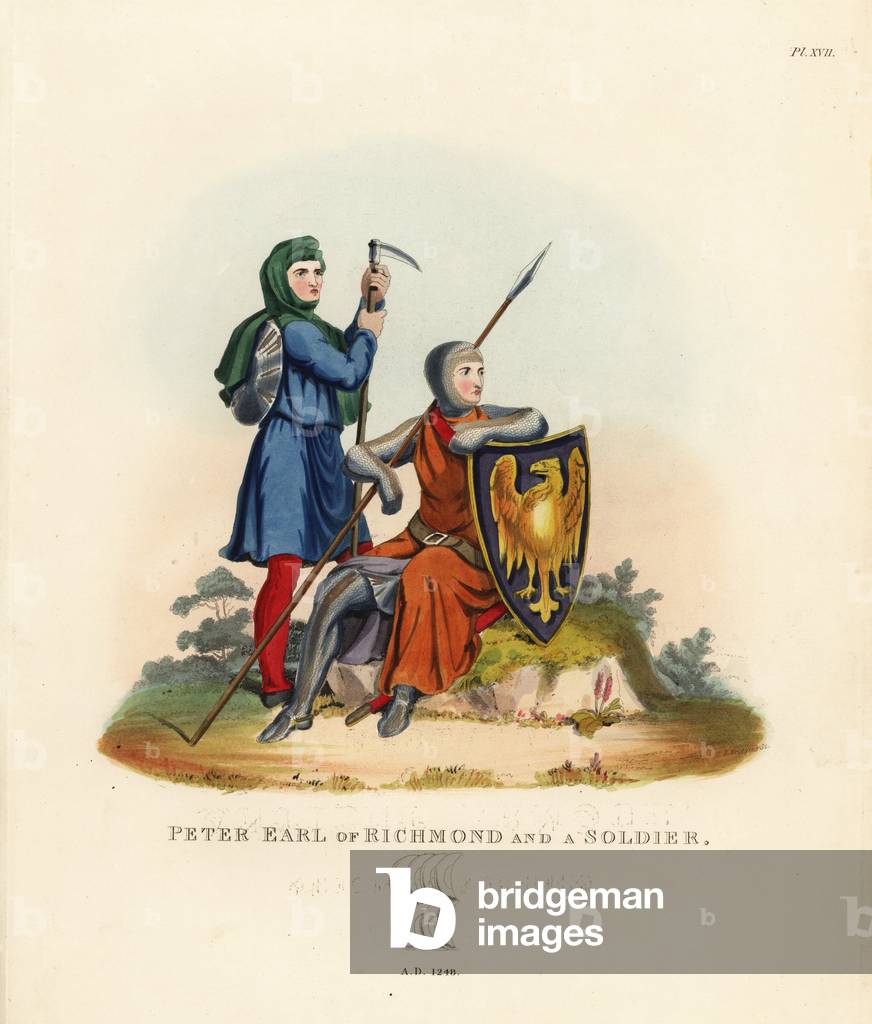
Peter II, Count of Savoy, Earl of Richmond, and a soldier. 1248. The Earl wears a chainmail hauberk and chausses, tunic, and carries a lance and shield with coat of arms. The footsoldier wears a cargan hood, carries an oucin and round shield. Handcoloured lithograph after an illustration by S.R. Meyrick from Sir Samuel Rush Meyrick's A Critical Inquiry into Antient Armour.

FLO4678629: Peter II, Count of Savoy, Earl of Richmond, and a soldier. 1248. The Earl wears a chainmail hauberk and chausses, tunic, and carries a lance and shield with coat of arms. The footsoldier wears a cargan hood, carries an oucin and round shield. Handcoloured lithograph after an illustration by S.R. Meyrick from Sir Samuel Rush Meyrick's A Critical Inquiry into Antient Armour. / Bridgeman Images

Pimelea sylvestris, native of Australia - Engraved by S.Watts, from an illustration by Sarah Anne Drake (1803-1857), from the Botanical Register of Sydenham Edwards (1768-1819), England, 1833 - Forest riceflower, Pimelea sylvestris - Engraving by S. Watts after an illustration by Miss Drake from Sydenham Edwards' “The Botanical Register,” London, Ridgway, 1833

FLO4678740: Pimelea sylvestris, native of Australia - Engraved by S.Watts, from an illustration by Sarah Anne Drake (1803-1857), from the Botanical Register of Sydenham Edwards (1768-1819), England, 1833 - Forest riceflower, Pimelea sylvestris - Engraving by S. Watts after an illustration by Miss Drake from Sydenham Edwards' “The Botanical Register,” London, Ridgway, 1833, Edwards, Sydenham Teast (c.1768-1819) / Bridgeman Images

A soldier and knight, 1295. Knight in bacinet helmet, gamboised coat hauberk and chausses, elbow plates, with shield, lance and sword. The soldier wears a hood and chainmail suit, multicoloured leather corium and trellised chausses with metal studs and leather bandages. Handcoloured lithograph by Maddocks after an illustration by S.R. Meyrick from Sir Samuel Rush Meyrick's A Critical Inquiry into Antient Armour.

FLO4678336: A soldier and knight, 1295. Knight in bacinet helmet, gamboised coat hauberk and chausses, elbow plates, with shield, lance and sword. The soldier wears a hood and chainmail suit, multicoloured leather corium and trellised chausses with metal studs and leather bandages. Handcoloured lithograph by Maddocks after an illustration by S.R. Meyrick from Sir Samuel Rush Meyrick's A Critical Inquiry into Antient Armour. / Bridgeman Images


Back to top