2497532 Search Results

LRI4669652: Portrait of Jean Calvin (engraving) / Bridgeman Images

PIX4669687: Southern Aurora Observed from Space Station - Southern Aurora Observed from Space Station - Southern Aurora Observed from International Space Station April 30, 2003 / Bridgeman Images

LBY4669851: Pavilion Finca Guell, Avenida Pedralbes 7-15 in Barcelona (Spain), realized by Antoni Gaudi (1852-1926) in 1884-1887. / Bridgeman Images

PIX4669995: Aurora boreale observed in Alaska 09 - 2003 - Aurora borealis - Alaska. Sept 18 2003 - Aurora Boreale observed September 18, 2003 in Alaska / Bridgeman Images

PIX4670111: Aurora boreale and Jupiter - Aurora with Jupiter in Norway - A character shows the planet Jupiter surrounded by a boreal aurora. Norway. 1 December 2011. A man showing planet Jupiter surrounded by an aurora borealis. Norway, December 1st 2011 / Bridgeman Images

TEC4690245: Extension of the German Historical Museum in Berlin (Germany). Realisation 2001, architect Ieoh Ming Pei. Photography 10/08/02. / Bridgeman Images

TEC4690278: Extension of the German Historical Museum in Berlin (Germany). Realisation 2001, architect Ieoh Ming Pei. Photography 10/08/02. / Bridgeman Images

PIX4647762: Marsha Ivins' hair in weightlessness - Marsha Ivins' hair in the space shuttle Atlantis: Astronaut Marsha Ivins weightless in space shuttle Atlantis. February 2001. Mission Specialist Marsha Ivins, her hair loose and free floating in microgravity, smiles for the camera on Atlantis' Aft Flight Deck / Bridgeman Images

PIX4647778: Shuttle Endeavour in orbit 02/2000 - Space shuttle Endeavour orbits Earth Feb 200 / Bridgeman Images

TEC4647952: The construction site of the Postdamer Platz in Berlin (Germany). / Bridgeman Images

PIX4647958: Extra - vehicle exit by D. Barry STS - 105 08/2001 - Extravehicular activity 08/2001 - Astronaut Daniel Barry takes extra - vehicle exit along the shuttle Discovery. 16 - 08 - 2001. Astronaut Daniel Barry, mission specialist, traverses along the Space Shuttle Discovery's payload bay, during one of two days of extravehicular activity (EVA). Aug 16 2001 / Bridgeman Images

PIX4648019: Shuttle Columbia STS - 107 on its fire pad 01/2003 - Shuttle Columbia on launch pad - 01/2003 - Shuttle Columbia after rollback of the Rotating Service Structure on Launch Pad 39A / Bridgeman Images

PIX4648047: Launch of the shuttle Atlantis STS - 106 09/2000 - Launch of STS - 106 Atlantis - 09/2000 - Launch of STS - 106 Atlantis. The crew will perform support tasks on orbit, transfer supplies and prepare the living quarters in the newly arrived Zvezda Service Module. Sep 09 2000 / Bridgeman Images

PIX4648099: Shuttle clearance Columbia STS - 107 01/2003 - Launch of STS - 107 Shuttle Columbia - Launch of STS - 107 Shuttle Columbia from Launch Pad 39A. Jan 16 2003 / Bridgeman Images

PIX4648164: Shuttle Endeavour STS - 108 view from ISS 07/12/2001 - Space shuttle Endeavour is approaching ISS. 12/2001 - Controlled by the flight crew of STS - 108, the shuttle is approaching the International Space Station (ISS). The Raffaello logistics module that is being brought up to the orbiting outpost is clearly visible in Endeavour's cargo bay. Among other activities the Endeavour's mission will include the change out of the station crews. Dec 07 2001 / Bridgeman Images

PIX4648321: Shuttle Atlantis STS - 112 view of ISS 10/2002 - Shuttle Atlantis approaches the International Space Station 10/2002 - Atlantis photographed by an Expedition Five crewmember onboard the International Space Station (ISS) during rendezvous and docking operations. Oct 09 2002 / Bridgeman Images

TEC4648343: Development in Lognes in Seine Marn. / Bridgeman Images

TEC4648431: La Promenade des Anglais, Hotel Negresco, 37 Promenade des Anglais in Nice (Alpes Maritimes). Architect Edouard Niermans, 1912. Photography 27/01/07. / Bridgeman Images

PIX4648436: Shuttle Discovery STS - 114 view of ISS 07/2005 - Discovery approaches ISS 07/2005 - Discovery approaches the international space station; Raffaello (Multi-Purpose Logistics Module (MPLM)) is visible in the cargo bay of the shuttle. 28 July 2005. Discovery taken from aboard the International Space Station during rendezvous and docking operations. The Italian - built Raffaello Multi - Purpose Logistics Module (MPLM) is in the Shuttle's cargo bay. Earth, dotted with popcorn - like clouds, provides the backdrop for this image / Bridgeman Images

PIX4670267: Aurora boreale - Finland - 10/2003 - Aurora borealis in Finland 10/2003 - Aurora boreale observed in Lapland, Kittilae (Finland), October 2003. Aurora borealis seen in Lapland, in Kittilae (Finland). October 2003 / Bridgeman Images

PIX4670336: Aurora boreale - Finland - 10/2003 - Aurora borealis in Finland 10/2003 - Aurora boreale observed in Lapland, Kittilae (Finland), October 2003. Aurora borealis seen in Lapland, in Kittilae, Aakenus fell, (Finland). October 2003 / Bridgeman Images

PIX4670419: Aurora boreale - Finland - 11/1998 - Aurora borealis in Finland 11/1998 - Aurora boreale observed in Lapland, Kittilae, Finland, November 2008. Aurora borealis seen in Lapland, Kittilae (Finland). November 2008 / Bridgeman Images

PIX4670642: Aurora boreale in Iceland - Jokulsarlon - Northern light above Lake Jokulsarlon in Iceland - Aurora boreale on the glacial lake of Jokulsarlon, located south of the Vatnajokull glacier in Iceland. April 2016 / Bridgeman Images

PIX4670836: Storm on Los Angeles - Storm on Los Angele / Bridgeman Images

PIX4670923: Halo around the Sun - Sun Halo - Halos are due to the light of the Sun reflected by high-altitude clouds, cirrostratus, composed of ice crystals. They bend the light and cause a perfect circle around the Sun. Here we can see: - around the Sun, the halo of 22* radius, rather little contrast. - at the top of the halo of 22* radius, the upper arc tangent in the shape of a U evase. - above, “” parallele”” to the halo of 22* radius, the arc of Parry. - near the zenith, the arc cirucmzenithal, very colourful. Quimper Halos are caused by sunlight being refracted by cirro-stratus clouds. These are thin clouds, very high in the atmosphere, and are composed of ice crystals. They bend light at a 22 degree angle, which creates a halo around the sun that is 44 degrees in diameter. In brief: - around the Sun, the 22* halo, not very contrasted. - atop the 22* halo, the upper tangent arc (a splayed U shape). - above it, “” parallel”” to the 22* halo, the Parry arc. - near the zenith, the cirucmzenithal arc, very colorful. October 28, 2006 Quimper (France) / Bridgeman Images

PIX4670961: Halo around the Sun and condensation train - Sun Halo and contrail. - Halos are due to the light of the Sun reflected by high-altitude clouds, cirrostratus, composed of ice crystals. They bend the light and thus cause a perfect circle around the Sun. 14 May 2006, Finistere. Halos are caused by sunlight being refracted by cirro - stratus clouds. These are thin clouds, very high in the atmosphere, and are composed of ice crystals. They bend light at a 22 degree angle, which creates a halo around the sun that is 44 degrees in diameter. May 14, 2006 / Bridgeman Images

TEC4671183: Saint Louis Hospital in Paris 75010. / Bridgeman Images

LBY4692662: Le Musée de la Chasse et de la Nature, Paris, France, 2007 (photo) / Bridgeman Images

PIX4671730: Lunar Halo - Lunar Halo - Lunar Halo. The ice crystals in the cirrus decompose the lunar light (in fact, the solar light reflected by the lunar surface) as small prisms and can give rise to a large coloured circle. Lunar halos are caused by moonlight being refracted by cirro - stratus clouds. These thin clouds are located very high in the atmosphere, and are composed of ice crystals. They bend light at a 22 degree angle, which creates a halo that is 44 degrees in diameter / Bridgeman Images

PIX4671739: Lunar crown - Lunar corona - A lunar crown is due to the diffraction of the light of the Moon by drops of water in medium-altitude clouds. Lunar corona is caused by the diffraction of the moonlight by water droplets / Bridgeman Images

PIX4672071: Lower Mirage - Inferior mirage - Lower Mirage which gives the illusion that the rocks (on the left and at the entrance of the port) float above the horizon, not far from the Eckmuehl lighthouse (Penmarc'h, South Finistere). Inferior mirage (at left) near lighthouse in Penmarc'h, Brittany, France. Inferior mirages are caused by the differences of temperature between sea and air / Bridgeman Images

TEC4672100: Les sculptures habitacles d'Andre Bloc (1896-1966) à Meudon (Hauts de Seine). Plastic intervention 1964-1966. Photography 10/06/95. / Bridgeman Images

PIX4672293: The Moon, Venus and a train left by a rocket - The Moon, Venus and a train left by a rocket - Cloud left by a missile or rocket over the Moon and Venus / Bridgeman Images

PIX4649669: Shuttle Endeavour landing 06/2011 - Space Shuttle Endeavour landing 06/2011 - Shuttle Endeavour landing at Kennedy Space Center. Mission STS-134, 1 June 2011. Space shuttle Endeavour approaches Runway 15 on the Shuttle Landing Facility at Nasa's Kennedy Space Center in Florida for the final time. Main gear touchdown was at 2:34:51 a.m. (EDT) on June 1, 2011, followed by nose gear touchdown at 2:35:04 a.m., and wheelstop at 2:35:36 a.m. Onboard are NASA astronauts Mark Kelly, STS - 134 commander; Greg H. Johnson, pilot; Michael Fincke, Andrew Feustel, Greg Chamitoff and European Space Agency astronaut Roberto Vittori, all mission specialists. STS-134 delivered the Alpha Magnetic Spectrometer - 2 (AMS) and the Express Logistics Carrier - 3 (ELC-3) to the International Space Station. AMS will help researchers understand the origin of the universe and search for evidence of dark matter, strange matter and antimatter from the station. ELC - 3 carried spare parts that will sustain station operations once the shuttles are retired from service. STS - 134 was the 25th and final flight for Endeavour, which has spent 299 days in space, orbited Earth 4,671 times and traveled 122,883,151 miles / Bridgeman Images
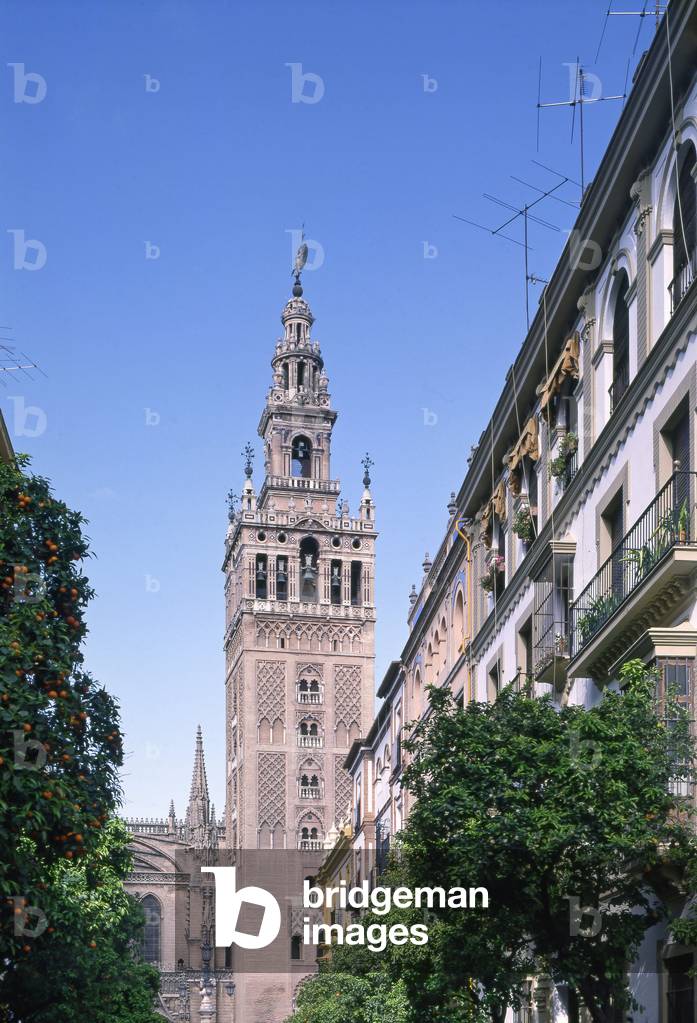
TEC4649694: La Giralda, Cathedrale de Seville (Spain). / Bridgeman Images

PIX4649758: Shuttle Atlantis - Last Shuttle Flight - July 2011 - Liftoff of Space Shuttle Atlantis - Final mission of Space Shuttle Program. July 2011 - Launch of the Atlantis space shuttle on July 8, 2011. Mission STS-135, last flight of American space shuttles. Smoke and steam billow outward as space shuttle Atlantis lifts off on twin columns of flame from Launch Pad 39A at Nasa's Kennedy Space Center in Florida as it begins its STS - 135 mission to the International Space Station. Atlantis with its crew of four; Commander Chris Ferguson, Pilot Doug Hurley, Mission Specialists Sandy Magnus and Rex Walheim, lifted off at 11:29 a.m. EDT on July 8, 2011 to deliver the Raffaello multi - purpose logistics module packed with supplies and spare parts for the station. Atlantis also will fly the Robotic Refueling Mission experiment that will investigate the potential for robotically refueling existing satellites in orbit. In addition, Atlantis will return with a failed ammonia pump module to help NASA better understand the failure mechanism and improve pump designs for future systems. STS - 135 is the 33rd flight of Atlantis, the 37th shuttle mission to the space station, and the 135th and final mission of NASA's Space Shuttle Program / Bridgeman Images
