2491383 Search Results

TEC4579588: Beausoleil (Alpes Maritimes). / Bridgeman Images

PIX4579594: Total Eclipse of Moon 20/02/2008 - February 20, 2008 Total Lunar Eclipse. - The Moon eclipse in the constellation Lion. To the left of the Moon, the Planet Saturn, to the right of the Moon, the star Regulus. 20 February 2008. February 20, 2008 Total Lunar Eclipse. The eclipsed Moon is seen below the Sickle in Leo, near Saturn and Regulus / Bridgeman Images

JLJ4573183: Le jeune homme et l'entremeteuse, 17th century (oil on canvas), Sweerts, Michael (1618-64) / Bridgeman Images

PIX4573195: Exoplanete - Artist's View / Bridgeman Images

PIX4573201: Planetary system around the star HD 69830 - Planetary System Around HD 69830 - Artist's view of three planets orbiting around the star HD 69830. This planetary system is the first detects around a star similar to the Sun that contains several planets whose mass is less than that of Jupiter. It seems that this system also has an asteroid belt. Using the ultra - precise HARPS spectrograph on Eso's 3.6 - m telescope at La Silla (Chile), a team of European astronomers have discovered that a nearby star is host to three Neptune - mass planets. The innermost planet is most likely rocky, while the outermost is the first known Neptune - mass planet to reside in the habitable zone. This unique system is likely further enriched by an asteroid belt. This view portaits a point of view inside the asteroid belt, which is assumed here to lie between the two outermost planets / Bridgeman Images

PIX4573237: Gas exoplanete - Gas exoplanet - Artist's view of an extrasolar gas planet in the sky of one of its satellites. Recent discoveries of what appear to be giant planets orbiting very close to distant stars inspired this image. Due to the close proximity to its own sun, this gas planet would shine brilliantly in this moon's sky / Bridgeman Images

TEC4573270: Double lines indeterminate by Bernar Venet (born in 1941) in the Michelet district, a la Defense (Hauts de Seine).Painted steel sculpture of twelve meters high., Venet, Bernar (b.1941) / Bridgeman Images

TEC4573297: La Defense (Hauts de Seine). / Bridgeman Images

LRI4569736: Aerial view on vineyards in the east of Mendoza (photography, 1983) / Bridgeman Images

PIX4618434: Rosette nebula (NGC 2237) in the Unicorn - The Rosette nebula in Monoceros - The Rosette nebula is a vast cloud of dust and gas. In its center, the cluster of stars NGC 2244. Image obtained by the Oschin telescope of Mount Palomar through several filters and composed. The north is at top. Discovered by John Flamsteed about 1690, the Rosetta Nebula is a vast cloud of dust and gas, extending over an area of more than 1 degree across, or about 5 times the area covered by the full moon. Within the nebula, open star cluster NGC 2244 is situated, consisted of the young stars which recently formed from the nebula's material, and the brightest of which make the nebula shine by exciting its atoms to emit radiation. Star formation is still in progress in this vast cloud of interstellar matter. Although various values for its distance occur in the literature, an avarage value of about 5,500 light - years is generally accepted. This image is based on data acquired by the Oschin Telescope at the Mount Palomar Observatory / Bridgeman Images

JLJ4618455: French Revolution: Battle of Nerwinden on March 18, 1793 between the Austrian army and the French army, 1793 (engraving and drawing), Levachez, Charles Francois Gabriel (fl.1760-1820) / Bridgeman Images

LRI4618512: Pauline Bonaparte, Princess Borghese as Victorious Venus. Detail of the woman's face. 18th-19th century (Plaster sculpture), Canova, Antonio (1757-1822) (after) / Bridgeman Images

TEC4608881: Facade of buildings in Chandigarh, India. Photography 17/01/06. / Bridgeman Images

LRI4608899: Presentation in the temple. Right panel of the Triptych of Adoration of the Magi (Detrempe on wood, c.1470), Memling, Hans (c.1433-94) / Bridgeman Images

PIX4608932: Andromede Galaxy - Detail - The Andromede galaxy is located about 2.3 million years ago - light from Earth. On this composite image obtained by the Hubble Space Telescope (HST), one hundred million stars are visible. M31, the Great galaxy in Andromeda, is a gigantic collection of more than 300 billion stars and is located about 2 million light years from Earth. This image, captured with the NASA/ESA Hubble Space Telescope, is the largest and sharpest image ever taken of the Andromeda galaxy - - otherwise known as M31. It is the biggest Hubble image ever released and shows over 100 million stars and thousands of star clusters embedded in a section of the galaxy's pancake - shaped disc stretching across over 40,000 light - years / Bridgeman Images

OMG4618629: The Musee de la Vie Romantique, 16 rue Chaptal in Paris 9e. Private hotel rented by brothers painters Ary (1795-1858) and Henri (1798-1862) Scheffer. Acquired in 1987 by the City of Paris, the Musee de la Vie Romantique presents collections of souvenirs and objects of art legues in the city, recalling two great figures of the 19th century: writer George Sand (Amantine Aurore Lucile Dupin, Baroness Dudevant, 1804-1876) and Ary Scheffer. / Bridgeman Images

JLJ4618701: Cecile Renaud arrested after trying to kill Robespierre, 22 May 1794 (engraving), French School / Bridgeman Images

JLJ4618704: War of the French Revolution and Movement against Revolutionary: Victory of the Battle of Fleurus won (engraving), French School / Bridgeman Images

PIX4613160: Spiral galaxy NGC 7424 in the Crane - Galaxy NGC 7424 in Grus - The barree spiral galaxy NGC 7424 is located about 40 million years away from Earth. NGC 7424 extends over nearly 100,000 light years, like our galaxy. Numerous bright blue clusters of massive young stars are visible along the spiral arms. Image obtained by the telescope MELIPAL of the VLT on October 9, 2004 Composite colour - coded image of spiral galaxy, NGC 7424, at a distance of 40 million light - years. This galaxy is classified as “” SAB (rs) cd””, meaning that it is intermediate between normal spirals (SA) and strongly barred galaxies (SB) and that it has rather open arms with a small central region. It also shows many ionised regions as well as clusters of young and massive stars. Ten young massive star clusters can be identified whose size span the range from 1 to 200 light - years. The galaxy itself is roughly 100,000 light - years across, that is, quite similar in size to our own Milky Way galaxy. Images obtained with the multi - mode VIMOS instrument on the ESO Very Large Telescope (VLT) / Bridgeman Images

JLJ4613236: Knights Combat Miniature from Master Charles of Maine's Manuscript "The Novel of Tristan", 1450-1460 (miniature), French School, (15th century) / Bridgeman Images

JLJ4613251: Hunting in honor of Charles V at Torgau Castle in Germany The emperor is representative on the left probably, 16th century (oil on canvas), Cranach, Lucas the Elder (1472-1553) / Bridgeman Images

PIX4618722: Nebula of the cone NGC 2264 and S star Monocerotis - NGC 2264 and S Monocerotis - Region H II located about 2600 years - light from Earth. The bright star is S Monocerotis, a star of magnitude 4.7. Image obtained by Siding Spring's 3.9m telescope. The region around the 4.7 magnitude star S Mon is a fascinating mixture of red fluorescent hydrogen and dark, obscuring dust lanes. Some dust patches are close enough to bright stars to reflect light from them; these appear blue for the same reason that the day - time sky is blue - because some of the interstellar particles preferentially scatter blue light. Some of the wispy tendrils of nebulosity are Herbig - Haro objects, jets of matter ejected from newly - formed stars still hidden within the nebula. About 250 stars have been recognised as members of NGC 2264 which is at a distance of about 2700 light years / Bridgeman Images

PIX4618776: Nebula NGC 2359 in the Big Dog - NGC 2359 nebula in Canis Major - NGC 2359 is a nebula in the Big Dog that houses a star Wolf - Rayet, HD 56925. NGC 2359 (Thor's Helmet) is a prototypical wind blown bubble powered by the extremely massive and unstable Wolf - Rayet star HD 56925. These types of stars (only about 300 are known presently) represent a late evolutionary phase of massive O - type blue giants which have become unstable in the late stages of their short stellar life / Bridgeman Images

JLJ4618785: Executive Board hears charges against Political Regime's executive power, 30 Brumaire An IV (21 Nov 1795) (engraving), French School / Bridgeman Images

PIX4613348: The Small Magellanic Cloud (NGC 292) - The Small Magellanic Cloud (NGC 292) - The Small Magellanic Cloud galaxy is about 240,000 years from Earth in the southern constellation of Toucan. It's one of the closest galaxies of the Lactee Way. Two globular clusters are visible in this image, on the right the Toucan cluster, at the top of the galaxy the NGC 362 cluster. The Small Magellanic Cloud is about 210,000 light years in the constellation of Tucana. It is one of the Milky Way's nearest neighbors. The globular clusters 47 Tucana (on the right) and NGC 362 (on the upper left corner) are also visible on this image / Bridgeman Images

LRI4618878: Outrider (biker) (Mixed technique with fabric strips, 1970), Scarpitta, Salvatore (1919-2007) / Bridgeman Images

JLJ4613384: View of the Theatre des Funambules on the boulevard du Crime, 19th century (watercolour), Martial, A.P. (Adolphe Martial Potemont called) (1828-1883) / Bridgeman Images

JLJ4613387: Jesse's Tree. Page of the mansucrit " Lectiaire de Citeaux" ", 12th century (miniature), Unknown Artist, (12th century) / Bridgeman Images

PIX4618914: Nebula NGC 3372 and cluster of stars in the Carene - The nebula of the Carene is located about 7000 years from the Earth. It houses many hot stars, including the star Eta Carinae. On its right, the cluster of stars NGC 3532 / Bridgeman Images

JLJ4613468: Aragonese by Anso Detail, 1872 (painting), Antigna, Alexandre (1817-78) / Bridgeman Images

LRI4618968: Clothesline (Mixed media with fabric, belt and wood, 1959), Scarpitta, Salvatore (1919-2007) / Bridgeman Images

PIX4619010: Nebula NGC 3372 in the Carene in fake colors - NGC 3372 Carina nebula in narrow band - The nebula of the Carene is located about 8000 years - light from Earth. It is home to many hot stars, including the massive star Eta Carinae in the centre of the nebula. Image obtained by the 1.2m Schmidt UK Telescope of Siding Spring through 3 different filters that highlight oxygen, hydrogen, and sulfur. Although no bright naked - eye stars are associated with the Carina nebula now, 150 years ago there blazed forth here one of the most unusual and peculiar stars ever seen. The star is known as Eta Carinae and for a few months in 1843 it was the second or third brightest star in the sky. Since then it has faded and is today about 1000 times fainter than it was at its brightest as the nebula it created during its outburst has cooled and become opaque. The whole region around Eta Carinae is rich in hot stars of which Eta is an extreme example and it is their combined radiation that produces the spectacular Carina nebula that dominates this picture. The nebula and its peculiar star are about 8000 light years away / Bridgeman Images

JLJ4613489: Aragonese by Anso, 1872 (painting), Antigna, Alexandre (1817-78) / Bridgeman Images
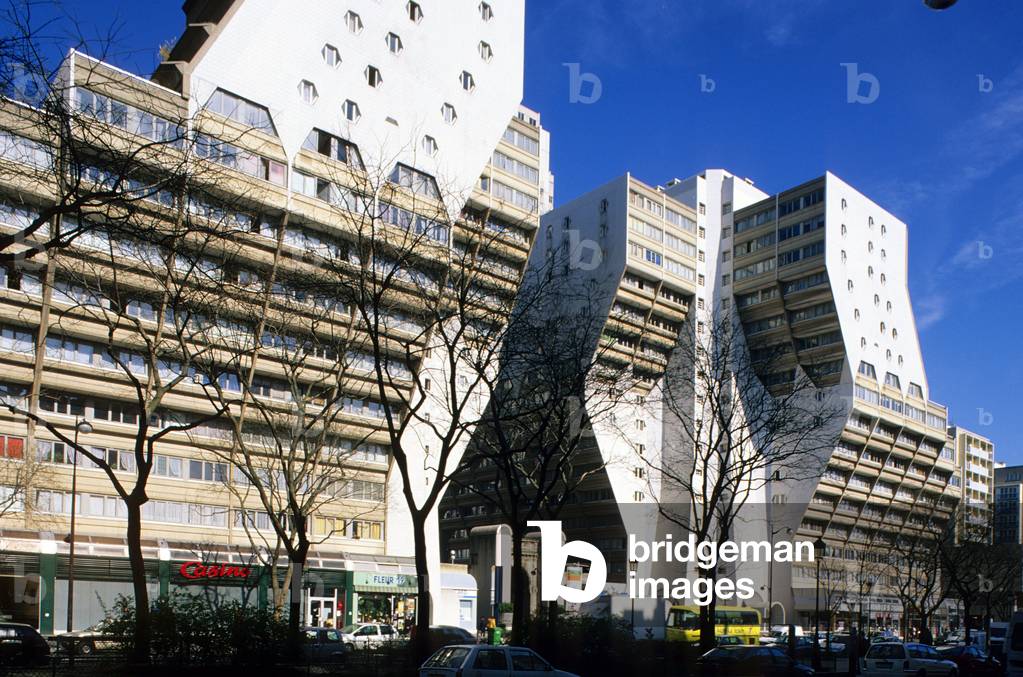
TEC4613597: The organs of Flanders in Paris. Construction 1972-1977, architect Martin S. van Treck., Treeck, Martin S. van (1926-1999) / Bridgeman Images

PIX4613612: Barree spiral galaxy UGC 12158 - Galaxy UGC 12158 - The galaxy UGC 12158, is about 400 million light years away from Earth in the constellation Pegase. In this image obtained by the Hubble space telescope, a blue star is visible near the center of the galaxy (lower left), it is a supernova, SN 2004ef. The galaxy captured in this image, called UGC 12158, certainly isn't camera - shy: this spiral stunner is posing face - on to the NASA/ESA Hubble Space Telescope's Advanced Camera for Surveys, revealing its structure in fine detail. UGC 12158 is an excellent example of a barred spiral galaxy in the Hubble sequence - - a scheme used to categorise galaxies based on their shapes. Barred spirals, as the name suggest, feature spectacular swirling arms of stars that emanate from a bar - shaped centre. Such bar structures are common, being found in about two thirds of spiral galaxies, and are thought to act as funnels, guiding gas to their galactic centres where it accumulates to form newborn stars. These aren't permanent structures: astronomers think that they slowly disperse over time, so that the galaxies eventually evolve into regular spirals. The appearance of a galaxy changes little over millions of years, but this image also contains a short - lived and brilliant interloper - - the bright blue star just to the lower left of the centre of the galaxy is very different from the several foreground stars seen in the image. It is in fact a supernova inside UGC 12158 and much further away than the Milky Way stars in the field - - at a distance of about 400 million light - years! This stellar explosion, called SN 2004ef, was first spotted by two British amateur astronomers in September 2004 and the Hubble data shown here form part of the follow - up observations. This picture was created from images taken with the Wide Field Channel of Hubble's Advanced Camera for Surveys. Images through blue (F475W, colored blue), yellow (F606W, c / Bridgeman Images

JLJ4609106: Africa: the main street in Saint Louis, Senegal, early 20th century (postcard) / Bridgeman Images
