Print Friendly Version Page

2501742 Search Results

Plans and views of lock gates in operation on canals, 18th century, England. Copperplate engraving by Mutlow from John Mason Good's Pantologia, a New Encyclopedia, G. Kearsley, London, 1813.

FLO4685683: Plans and views of lock gates in operation on canals, 18th century, England. Copperplate engraving by Mutlow from John Mason Good's Pantologia, a New Encyclopedia, G. Kearsley, London, 1813. / Bridgeman Images

Blowing engine at the Carron Iron Works designed by John Smeaton (1724-1792). Copperplate engraving by Mutlow after an illustration by J. Farey Jr. from John Mason Good's Pantologia, a New Encyclopedia, G. Kearsley, London, 1813.

FLO4685695: Blowing engine at the Carron Iron Works designed by John Smeaton (1724-1792). Copperplate engraving by Mutlow after an illustration by J. Farey Jr. from John Mason Good's Pantologia, a New Encyclopedia, G. Kearsley, London, 1813. / Bridgeman Images

Broker, reign of Charles IX, 1579. Handcoloured steel engraving by Polidor Pauquet after Gaignieres from the Pauquet Brothers' “” Modes et Costumes Historique” (Historical Fashions and Costumes), Paris, 1865. Hippolyte (b. 1797) and Polydor Pauquet (b. 1799) ran a successful publishing house in Paris in the 19th century, specializing in illustrated books on costume, birds, butterflies, anatomy and natural history.

FLO4685943: Broker, reign of Charles IX, 1579. Handcoloured steel engraving by Polidor Pauquet after Gaignieres from the Pauquet Brothers' “” Modes et Costumes Historique” (Historical Fashions and Costumes), Paris, 1865. Hippolyte (b. 1797) and Polydor Pauquet (b. 1799) ran a successful publishing house in Paris in the 19th century, specializing in illustrated books on costume, birds, butterflies, anatomy and natural history. / Bridgeman Images

Silver italian coin (half ecu) from Sardinia kingdom: reign of Carlo Emanuele III di Savoia (1701-1773) (Charles Emmanuel III of Sardinia). 1756. Diam. 3.7 cm Naples, museo archeologico

LRI4685378: Silver italian coin (half ecu) from Sardinia kingdom: reign of Carlo Emanuele III di Savoia (1701-1773) (Charles Emmanuel III of Sardinia). 1756. Diam. 3.7 cm Naples, museo archeologico, Italian School, (18th century) / Bridgeman Images
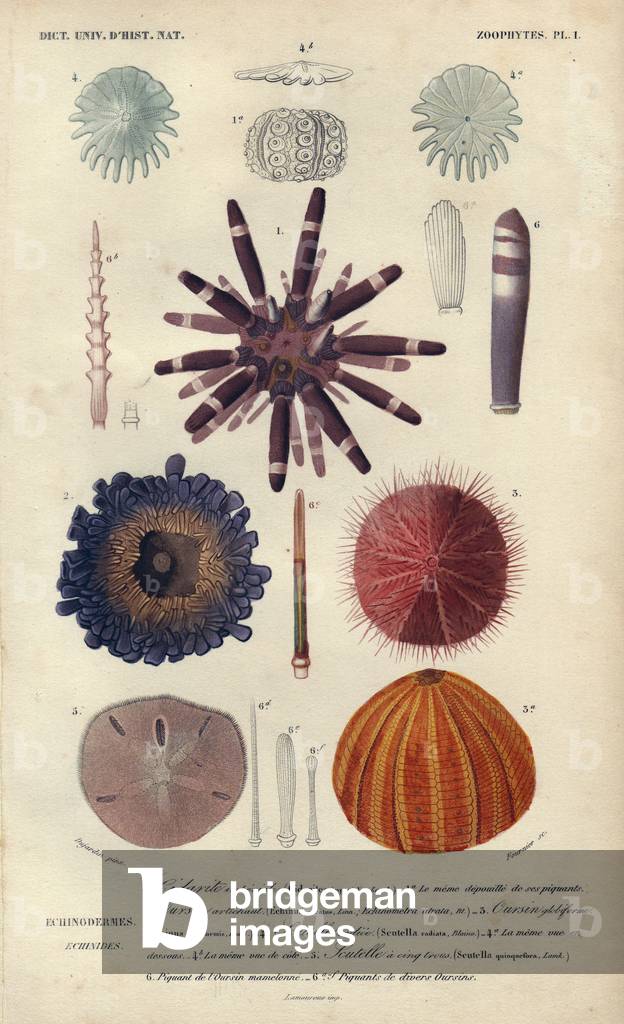
Different kinds of coloured sea urchins with their spines. Different types of colorful sea urchins and their spines.The very rare purple club spined or artichoke urchin (Echinus atratus), round urchin (Echinus globiformis), Cidarites imperialis, Scutella radiata, Scutella quinquefora. Handcolored engraving by Dujardin from Charles d'Orbigny's “Universal Dictionary of Natural History” 1849.

FLO4685471: Different kinds of coloured sea urchins with their spines. Different types of colorful sea urchins and their spines.The very rare purple club spined or artichoke urchin (Echinus atratus), round urchin (Echinus globiformis), Cidarites imperialis, Scutella radiata, Scutella quinquefora. Handcolored engraving by Dujardin from Charles d'Orbigny's “Universal Dictionary of Natural History” 1849. / Bridgeman Images
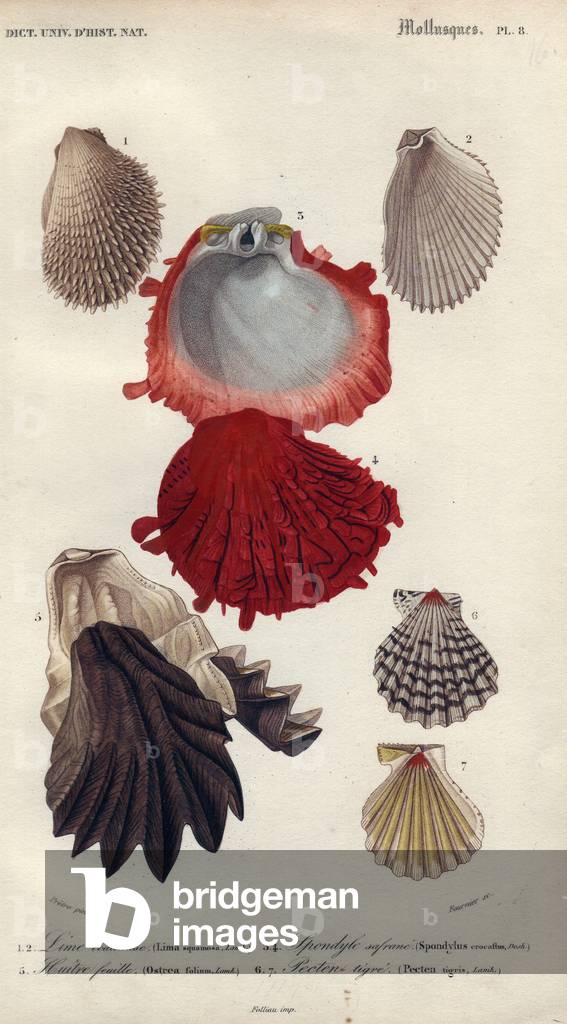
Variety of seafood including oysters and clams. Variety of seashells including oysters (Ostrea), file clams (Lima), smooth pectens and scarlet thorny oyster (Spondylus). Flake file: Lima squamosa, Spondyle sufrane: Spondylus crocastus, Oyster leaf: Ostrea folium, Pecten tigre: Pecten tigris. Handcolored engraving by Pretre from Charles d'Orbigny's “Universal Dictionary of Natural History” 1849.

FLO4685484: Variety of seafood including oysters and clams. Variety of seashells including oysters (Ostrea), file clams (Lima), smooth pectens and scarlet thorny oyster (Spondylus). Flake file: Lima squamosa, Spondyle sufrane: Spondylus crocastus, Oyster leaf: Ostrea folium, Pecten tigre: Pecten tigris. Handcolored engraving by Pretre from Charles d'Orbigny's “Universal Dictionary of Natural History” 1849. / Bridgeman Images

Empress Helena leaving Constantinople (C), and Judas revealing to her the location of the Holy Cross (D). Painting on the north side of the Chancel. Handcoloured etching drawn and etched by Thomas Fisher from his Paintings on the Walls of the Chapel of the Trinity, Stratford upon Avon, 1808.

FLO4685532: Empress Helena leaving Constantinople (C), and Judas revealing to her the location of the Holy Cross (D). Painting on the north side of the Chancel. Handcoloured etching drawn and etched by Thomas Fisher from his Paintings on the Walls of the Chapel of the Trinity, Stratford upon Avon, 1808. / Bridgeman Images

Calligraphic title reading A Series of Antient Allegorical Historical and Legendary Paintings which were uncovered in the summer of 1802 on the walls of the Chapel of the Trinity at Stratford upon Avon in Warwickshire. Handcoloured etching from Thomas Fisher's Paintings on the Walls of the Chapel of the Trinity.

FLO4685542: Calligraphic title reading A Series of Antient Allegorical Historical and Legendary Paintings which were uncovered in the summer of 1802 on the walls of the Chapel of the Trinity at Stratford upon Avon in Warwickshire. Handcoloured etching from Thomas Fisher's Paintings on the Walls of the Chapel of the Trinity. / Bridgeman Images

Bishop of Worcester praying before a crucifix, and mythical beasts above the Vicar's door. Paintings from the south side of the Chancel. Handcoloured etching drawn and etched by Thomas Fisher from his Paintings on the Walls of the Chapel of the Trinity, Stratford upon Avon, 1808.

FLO4685587: Bishop of Worcester praying before a crucifix, and mythical beasts above the Vicar's door. Paintings from the south side of the Chancel. Handcoloured etching drawn and etched by Thomas Fisher from his Paintings on the Walls of the Chapel of the Trinity, Stratford upon Avon, 1808. / Bridgeman Images

Margaret of Valois (1553-1615), first wife of Henri IV, 1572. Handcoloured steel engraving by Polidor Pauquet after Thomas de Leu from the Pauquet Brothers' “” Modes et Costumes Historique” (Historical Fashions and Costumes), Paris, 1865. Hippolyte (b. 1797) and Polydor Pauquet (b. 1799) ran a successful publishing house in Paris in the 19th century, specializing in illustrated books on costume, birds, butterflies, anatomy and natural history.

FLO4685942: Margaret of Valois (1553-1615), first wife of Henri IV, 1572. Handcoloured steel engraving by Polidor Pauquet after Thomas de Leu from the Pauquet Brothers' “” Modes et Costumes Historique” (Historical Fashions and Costumes), Paris, 1865. Hippolyte (b. 1797) and Polydor Pauquet (b. 1799) ran a successful publishing house in Paris in the 19th century, specializing in illustrated books on costume, birds, butterflies, anatomy and natural history. / Bridgeman Images

Variety of molluscs and shells. Variety of molluscs including terebratula, pearly fresh water mussel (Calecola), and jingle shells (Anomia).

FLO4685457: Variety of molluscs and shells. Variety of molluscs including terebratula, pearly fresh water mussel (Calecola), and jingle shells (Anomia). / Bridgeman Images
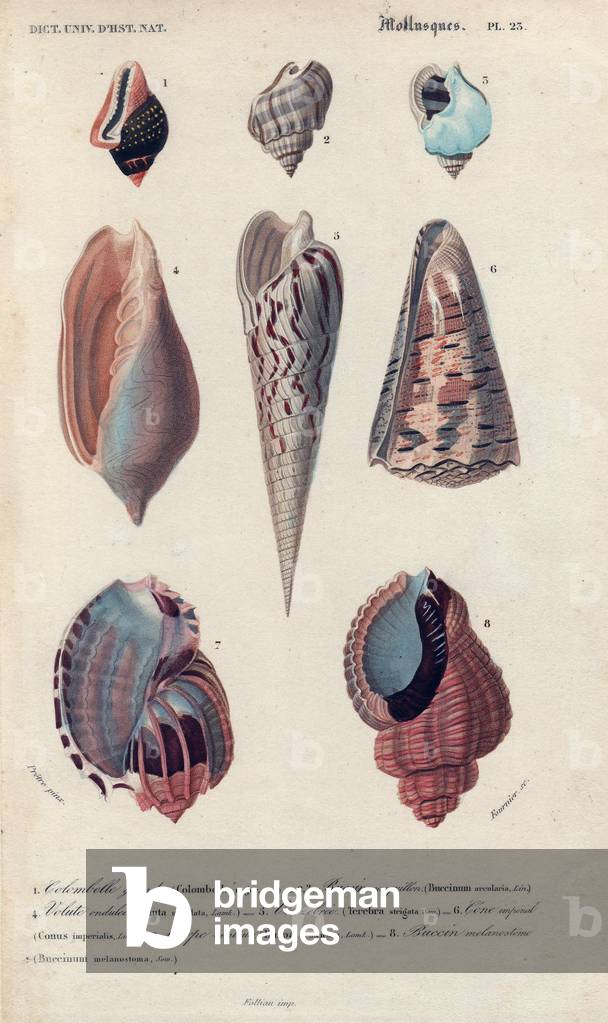
Tropical shells. Tropical shells including Colombella, Buccinum, Voluta, Terebra, Conus imperialis and Harpa.Columbelle grande: Colombella major, Casquin: Buccinum arcularia, Volute wavy: Voluta undulata,

FLO4685470: Tropical shells. Tropical shells including Colombella, Buccinum, Voluta, Terebra, Conus imperialis and Harpa.Columbelle grande: Colombella major, Casquin: Buccinum arcularia, Volute wavy: Voluta undulata, / Bridgeman Images

Bronze bucket (situla) decorates and uses as urn (6th century BC)

LRI4685487: Bronze bucket (situla) decorates and uses as urn (6th century BC), Etruscan, (6th century BC) / Bridgeman Images

Large black blue crayfish and scarlet. Large shiny blue black and crimson crawfish or crayfish (Palemon ornatum). Palemon adorns.

FLO4685516: Large black blue crayfish and scarlet. Large shiny blue black and crimson crawfish or crayfish (Palemon ornatum). Palemon adorns. / Bridgeman Images

Courtesan, reign of Charles VIII, 1491. Handcoloured steel engraving by Hippolyte Pauquet after a contemporary work from the Pauquet Brothers' “” Modes et Costumes Historique” (Historical Fashions and Costumes), Paris, 1865. Hippolyte (b. 1797) and Polydor Pauquet (b. 1799) ran a successful publishing house in Paris in the 19th century, specializing in illustrated books on costume, birds, butterflies, anatomy and natural history.

FLO4685843: Courtesan, reign of Charles VIII, 1491. Handcoloured steel engraving by Hippolyte Pauquet after a contemporary work from the Pauquet Brothers' “” Modes et Costumes Historique” (Historical Fashions and Costumes), Paris, 1865. Hippolyte (b. 1797) and Polydor Pauquet (b. 1799) ran a successful publishing house in Paris in the 19th century, specializing in illustrated books on costume, birds, butterflies, anatomy and natural history. / Bridgeman Images

Women's costume in the reign of Charles the Bald, after a contemporary manuscript, 9th century. Handcoloured steel engraving by Polidor Pauquet from the Pauquet Brothers' “” Modes et Costumes Historique” (Historical Fashions and Costumes), Paris, 1865. Hippolyte (b. 1797) and Polydor Pauquet (b. 1799) ran a successful publishing house in Paris in the 19th century, specializing in illustrated books on costume, birds, butterflies, anatomy and natural history.

FLO4685883: Women's costume in the reign of Charles the Bald, after a contemporary manuscript, 9th century. Handcoloured steel engraving by Polidor Pauquet from the Pauquet Brothers' “” Modes et Costumes Historique” (Historical Fashions and Costumes), Paris, 1865. Hippolyte (b. 1797) and Polydor Pauquet (b. 1799) ran a successful publishing house in Paris in the 19th century, specializing in illustrated books on costume, birds, butterflies, anatomy and natural history. / Bridgeman Images

Broker, reign of Henri III, 1580. Handcoloured steel engraving by Hippolyte Pauquet after a contemporary painting from the Pauquet Brothers' “” Modes et Costumes Historique” (Historical Fashions and Costumes), Paris, 1865. Hippolyte (b. 1797) and Polydor Pauquet (b. 1799) ran a successful publishing house in Paris in the 19th century, specializing in illustrated books on costume, birds, butterflies, anatomy and natural history.

FLO4685941: Broker, reign of Henri III, 1580. Handcoloured steel engraving by Hippolyte Pauquet after a contemporary painting from the Pauquet Brothers' “” Modes et Costumes Historique” (Historical Fashions and Costumes), Paris, 1865. Hippolyte (b. 1797) and Polydor Pauquet (b. 1799) ran a successful publishing house in Paris in the 19th century, specializing in illustrated books on costume, birds, butterflies, anatomy and natural history. / Bridgeman Images

Porter, reign of Henri III, 1586. Handcoloured steel engraving by Polidor Pauquet after Gaignieres from the Pauquet Brothers' “” Modes et Costumes Historique” (Historical Fashions and Costumes), Paris, 1865. Hippolyte (b. 1797) and Polydor Pauquet (b. 1799) ran a successful publishing house in Paris in the 19th century, specializing in illustrated books on costume, birds, butterflies, anatomy and natural history.

FLO4685955: Porter, reign of Henri III, 1586. Handcoloured steel engraving by Polidor Pauquet after Gaignieres from the Pauquet Brothers' “” Modes et Costumes Historique” (Historical Fashions and Costumes), Paris, 1865. Hippolyte (b. 1797) and Polydor Pauquet (b. 1799) ran a successful publishing house in Paris in the 19th century, specializing in illustrated books on costume, birds, butterflies, anatomy and natural history. / Bridgeman Images

Sconces used for decoration of burial boxes. 2nd half of the 4th century BC (gilded clay)

LRI4686537: Sconces used for decoration of burial boxes. 2nd half of the 4th century BC (gilded clay), Greek school, (4th century BC) / Bridgeman Images

Woman gardener from Holland, after Koning, 1804. Handcoloured steel engraving by Hippolyte Pauquet from the Pauquet Brothers' “” Modes et Costumes Etrangers Anciens et Modernes” (Foreign Fashions and Costumes Ancient and Modern), Paris, 1865. Hippolyte (b. 1797) and Polydor Pauquet (b. 1799) ran a successful publishing house in Paris in the 19th century, specializing in illustrated books on costume, birds, butterflies, anatomy and natural history.

FLO4686578: Woman gardener from Holland, after Koning, 1804. Handcoloured steel engraving by Hippolyte Pauquet from the Pauquet Brothers' “” Modes et Costumes Etrangers Anciens et Modernes” (Foreign Fashions and Costumes Ancient and Modern), Paris, 1865. Hippolyte (b. 1797) and Polydor Pauquet (b. 1799) ran a successful publishing house in Paris in the 19th century, specializing in illustrated books on costume, birds, butterflies, anatomy and natural history. / Bridgeman Images

Native of North America, after Cartias, National Library, 1780. Handcoloured steel engraving by Polydor Pauquet from the Pauquet Brothers' “” Modes et Costumes Etrangers Anciens et Modernes” (Foreign Fashions and Costumes Ancient and Modern), Paris, 1865. Hippolyte (b. 1797) and Polydor Pauquet (b. 1799) ran a successful publishing house in Paris in the 19th century, specializing in illustrated books on costume, birds, butterflies, anatomy and natural history.

FLO4686542: Native of North America, after Cartias, National Library, 1780. Handcoloured steel engraving by Polydor Pauquet from the Pauquet Brothers' “” Modes et Costumes Etrangers Anciens et Modernes” (Foreign Fashions and Costumes Ancient and Modern), Paris, 1865. Hippolyte (b. 1797) and Polydor Pauquet (b. 1799) ran a successful publishing house in Paris in the 19th century, specializing in illustrated books on costume, birds, butterflies, anatomy and natural history. / Bridgeman Images

Woman of Cadiz, Spain, 18th century, after Rodriguez. Handcoloured steel engraving by Hippolyte Pauquet from the Pauquet Brothers' “” Modes et Costumes Etrangers Anciens et Modernes” (Foreign Fashions and Costumes Ancient and Modern), Paris, 1865. Hippolyte (b. 1797) and Polydor Pauquet (b. 1799) ran a successful publishing house in Paris in the 19th century, specializing in illustrated books on costume, birds, butterflies, anatomy and natural history.

FLO4686549: Woman of Cadiz, Spain, 18th century, after Rodriguez. Handcoloured steel engraving by Hippolyte Pauquet from the Pauquet Brothers' “” Modes et Costumes Etrangers Anciens et Modernes” (Foreign Fashions and Costumes Ancient and Modern), Paris, 1865. Hippolyte (b. 1797) and Polydor Pauquet (b. 1799) ran a successful publishing house in Paris in the 19th century, specializing in illustrated books on costume, birds, butterflies, anatomy and natural history. / Bridgeman Images

Ring with scarab (Heracles leaning on a club), end 4th century BC (silver, chalcedony)

LRI4686615: Ring with scarab (Heracles leaning on a club), end 4th century BC (silver, chalcedony), Greek school, (4th century BC) / Bridgeman Images

Woman of Vialka, Russia, 1860. Handcoloured steel engraving by Hippolyte Pauquet from the Pauquet Brothers' “” Modes et Costumes Etrangers Anciens et Modernes” (Foreign Fashions and Costumes Ancient and Modern), Paris, 1865. Hippolyte (b. 1797) and Polydor Pauquet (b. 1799) ran a successful publishing house in Paris in the 19th century, specializing in illustrated books on costume, birds, butterflies, anatomy and natural history.

FLO4686695: Woman of Vialka, Russia, 1860. Handcoloured steel engraving by Hippolyte Pauquet from the Pauquet Brothers' “” Modes et Costumes Etrangers Anciens et Modernes” (Foreign Fashions and Costumes Ancient and Modern), Paris, 1865. Hippolyte (b. 1797) and Polydor Pauquet (b. 1799) ran a successful publishing house in Paris in the 19th century, specializing in illustrated books on costume, birds, butterflies, anatomy and natural history. / Bridgeman Images

Fashionable dandies, soldiers and ladies in the colonnade of the Palais Royal. Dick Wildfire and Squire Jenkins seeing Real Life in the Galleries of the Palais Royal. Handcoloured copperplate engraving by George Cruikshank from David Carey's Life in Paris, the Rambles, Sprees and Amours of Dick Wildfire, Fairburn, London, 1822.

FLO4686711: Fashionable dandies, soldiers and ladies in the colonnade of the Palais Royal. Dick Wildfire and Squire Jenkins seeing Real Life in the Galleries of the Palais Royal. Handcoloured copperplate engraving by George Cruikshank from David Carey's Life in Paris, the Rambles, Sprees and Amours of Dick Wildfire, Fairburn, London, 1822. / Bridgeman Images

Fashionable dandies and ladies in a gallery of the Louvre. Life among the Connoisseurs, or Dick Wildfire and his Friends in the Grand Gallery of the Louvre. Handcoloured copperplate engraving by George Cruikshank from David Carey's Life in Paris, the Rambles, Sprees and Amours of Dick Wildfire, Fairburn, London, 1822.

FLO4686801: Fashionable dandies and ladies in a gallery of the Louvre. Life among the Connoisseurs, or Dick Wildfire and his Friends in the Grand Gallery of the Louvre. Handcoloured copperplate engraving by George Cruikshank from David Carey's Life in Paris, the Rambles, Sprees and Amours of Dick Wildfire, Fairburn, London, 1822. / Bridgeman Images

Wall paintings from rooms in the House of the Epigrams. V, Ins. 1, No. 18. On the left, a mural from an atrium, and at right, a mural from an antichamber. Chromolithograph by Victor Steeger after an illustration by Geremia Discanno from Emile Presuhn (1844-1878) The Most Beautiful Paintings of Pompeii, Leipzig, 1881.

FLO4686902: Wall paintings from rooms in the House of the Epigrams. V, Ins. 1, No. 18. On the left, a mural from an atrium, and at right, a mural from an antichamber. Chromolithograph by Victor Steeger after an illustration by Geremia Discanno from Emile Presuhn (1844-1878) The Most Beautiful Paintings of Pompeii, Leipzig, 1881., Discanno, Geremia (1839-1907) / Bridgeman Images

Ariadne watching Theseus's boat depart from the island of Naxos. Mural from a triclinium in a shop/dwelling at Regio IX.II.5, Pompeii. Chromolithograph by Victor Steeger after an illustration by Geremia Discanno from Emile Presuhn (1844-1878) The Most Beautiful Paintings of Pompeii, Leipzig, 1881.

FLO4686919: Ariadne watching Theseus's boat depart from the island of Naxos. Mural from a triclinium in a shop/dwelling at Regio IX.II.5, Pompeii. Chromolithograph by Victor Steeger after an illustration by Geremia Discanno from Emile Presuhn (1844-1878) The Most Beautiful Paintings of Pompeii, Leipzig, 1881., Discanno, Geremia (1839-1907) / Bridgeman Images

Wall painting from a room in the Domus M. Asellini or House of Adonis or House of Venus and Adonis or Casa di Ione or Casa con Xystus, Reg. VI.7.18. Drawn and chromolithographed by Victor Steeger from Emile Presuhn (1844-1878) The Most Beautiful Paintings of Pompeii, Leipzig, 1881.

FLO4686942: Wall painting from a room in the Domus M. Asellini or House of Adonis or House of Venus and Adonis or Casa di Ione or Casa con Xystus, Reg. VI.7.18. Drawn and chromolithographed by Victor Steeger from Emile Presuhn (1844-1878) The Most Beautiful Paintings of Pompeii, Leipzig, 1881., Discanno, Geremia (1839-1907) / Bridgeman Images

Wall painting of an arabesque with a mask of Oceanus found in Herculaneum, and two other ornaments of Oceanus and a lotus flower found in the Temple of Isis. All now in the Museum of Naples. Chromolithograph by Victor Steeger after an illustration by Geremia Discanno from Emile Presuhn (1844-1878) The Most Beautiful Paintings of Pompeii, Leipzig, 1881.

FLO4687005: Wall painting of an arabesque with a mask of Oceanus found in Herculaneum, and two other ornaments of Oceanus and a lotus flower found in the Temple of Isis. All now in the Museum of Naples. Chromolithograph by Victor Steeger after an illustration by Geremia Discanno from Emile Presuhn (1844-1878) The Most Beautiful Paintings of Pompeii, Leipzig, 1881., Discanno, Geremia (1839-1907) / Bridgeman Images

Wall painting of cupids playing, fishing, sailing from a cubiculum in the House of the Restaurant (Casa di Lupanare Piccolo) at 14, Regio IX, Insula V. Chromolithograph by J.G. Bach after an illustration by Geremia Discanno from Emile Presuhn (1844-1878) The Most Beautiful Paintings of Pompeii, Leipzig, 1881.

FLO4687046: Wall painting of cupids playing, fishing, sailing from a cubiculum in the House of the Restaurant (Casa di Lupanare Piccolo) at 14, Regio IX, Insula V. Chromolithograph by J.G. Bach after an illustration by Geremia Discanno from Emile Presuhn (1844-1878) The Most Beautiful Paintings of Pompeii, Leipzig, 1881., Discanno, Geremia (1839-1907) / Bridgeman Images

Floors with colourful marble stones from the House of the Epigrams, Regio V, Insula 1, 18. Chromolithograph by Victor Steeger after an illustration by Geremia Discanno from Emile Presuhn (1844-1878) The Most Beautiful Paintings of Pompeii, Leipzig, 1881.

FLO4687149: Floors with colourful marble stones from the House of the Epigrams, Regio V, Insula 1, 18. Chromolithograph by Victor Steeger after an illustration by Geremia Discanno from Emile Presuhn (1844-1878) The Most Beautiful Paintings of Pompeii, Leipzig, 1881. / Bridgeman Images

Alexander the Great on horseback, 4th century BC (Bronze sculpture)

LRI4687108: Alexander the Great on horseback, 4th century BC (Bronze sculpture), Lysippos (fl.370-310 BC) (attributed to) / Bridgeman Images

Decorative figures from the House of Epigrams, Regio V, Insula 1, 18. An urn and mythical beast at top, and a goat and hunting scene with dog and hare below. Chromolithograph by Victor Steeger after an illustration by Geremia Discanno from Emile Presuhn (1844-1878) The Most Beautiful Paintings of Pompeii, Leipzig, 1881.

FLO4687119: Decorative figures from the House of Epigrams, Regio V, Insula 1, 18. An urn and mythical beast at top, and a goat and hunting scene with dog and hare below. Chromolithograph by Victor Steeger after an illustration by Geremia Discanno from Emile Presuhn (1844-1878) The Most Beautiful Paintings of Pompeii, Leipzig, 1881., Discanno, Geremia (1839-1907) / Bridgeman Images

Heracles at rest. Detail. 4th century BC (Bronze sculpture)

LRI4687118: Heracles at rest. Detail. 4th century BC (Bronze sculpture), Lysippos (fl.370-310 BC) (attributed to) / Bridgeman Images

Floor mosaic from a room in the viridarium (garden) in the House of Vesonius Primus, a fuller. Chromolithograph by Victor Steeger after an illustration by Geremia Discanno from Emile Presuhn (1844-1878) The Most Beautiful Paintings of Pompeii, Leipzig, 1881.

FLO4687124: Floor mosaic from a room in the viridarium (garden) in the House of Vesonius Primus, a fuller. Chromolithograph by Victor Steeger after an illustration by Geremia Discanno from Emile Presuhn (1844-1878) The Most Beautiful Paintings of Pompeii, Leipzig, 1881. / Bridgeman Images


Back to top