
Print this page or go back to standard view.

FLO4684516: Woman in mushroom fancy dress costume, le mushroom, hat and dress in mushroom form, decorated with snails and flowers. Lithograph by unknown artist with stencil handcolouring from “” Nos Travestis”” (Our Fancy Dress Costumes), Paris, 1928. / Bridgeman Images
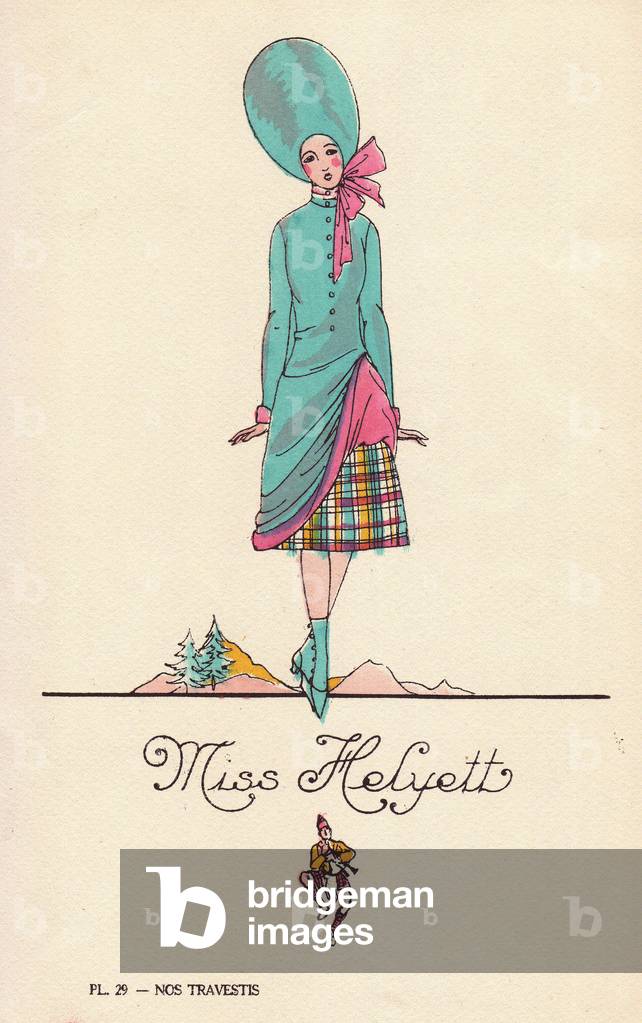
FLO4684529: Woman in fancy dress costume as Miss Helyett, with large hat, blue coat, pink ribbon, and tartan skirt. Miss Helyett was a comic operetta by Edmond Audran first performed in 1890. Lithograph by unknown artist with stencil handcolouring from “” Nos Travestis”” (Our Fancy Dress Costumes), Paris, 1928. / Bridgeman Images
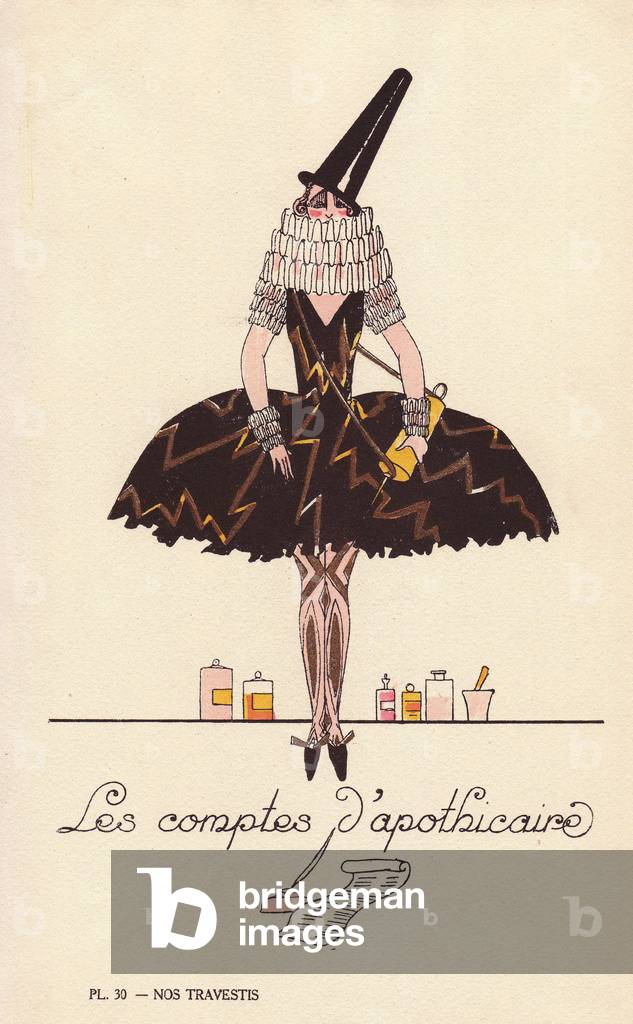
FLO4684533: Woman in fancy dress costume as an apothecary's recipe, with tall black hat, high ruff collar, black and gold dress, and handbag in the shape of a syringe. Lithograph by unknown artist with stencil handcolouring from “” Nos Travestis”” (Our Fancy Dress Costumes), Paris, 1928. / Bridgeman Images

FLO4684083: Lepidoptere, American moth variety, caterpillar, nymph and adult, Hypercompe scribonia - Lithography by Richard Polydore Nodder (1774-1823) published in The Naturalist Miscellany, 1812 / Bridgeman Images
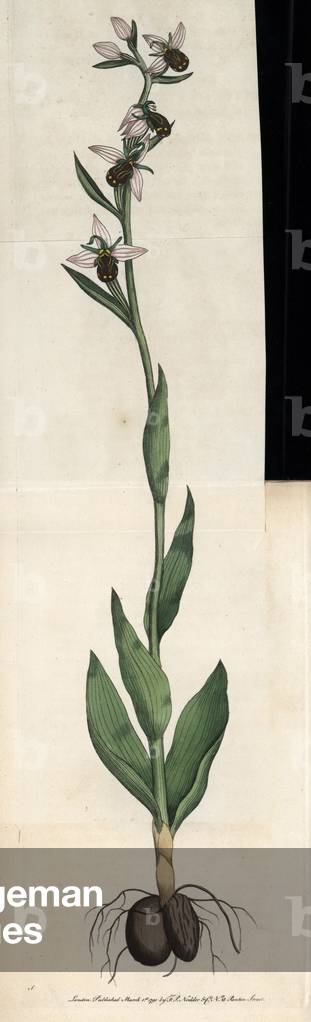
FLO4684174: Ophrys bee, European terrestrial variety of orchid. Copper engraving by Frederick Polydor Nodder (1751-1801), George Shaw's illustration for the naturalist collection, published in 1790 by George Shaw. Bee ophrys or bee orchis. Ophrys apifera. Handcolored copperplate engraving, illustration signed S (George Shaw) from George Shaw's “” Naturalist's Miscellany”” (1790). / Bridgeman Images
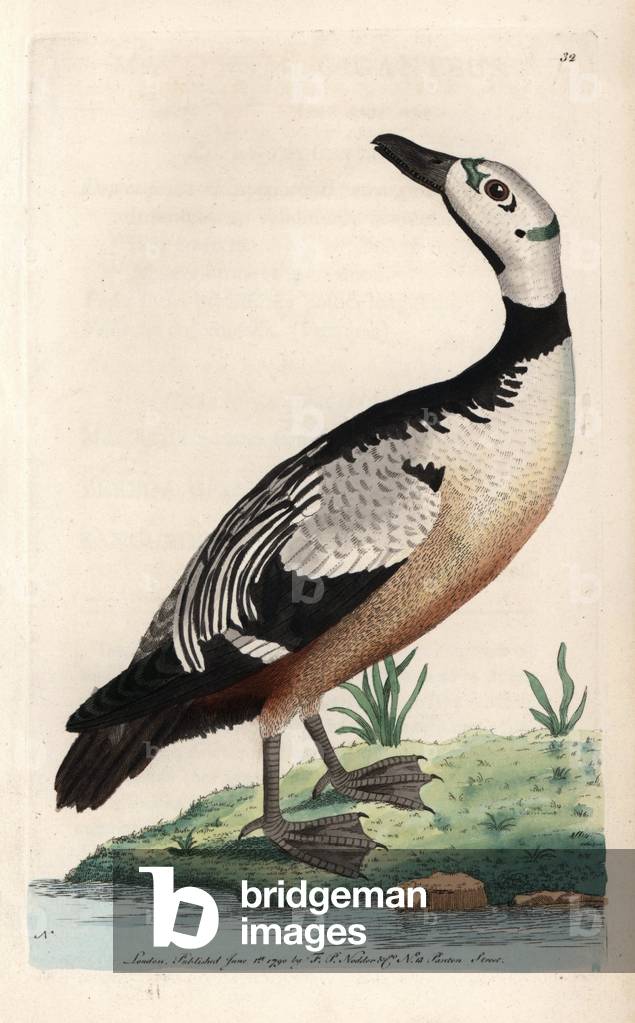
FLO4684218: Steller's Eider duck. Copper engraving by Frederick Polydor Nodder (1751-1801), for the naturalist collection, published in 1790 by George Shaw.Western, variegated duck or Steller's Eider duck / Bridgeman Images

JLJ4684312: The group called "Tetrarchs", 300-315 (bronze), Byzantine, (4th century) / Bridgeman Images

FLO4684315: Volute has orange striped shell. Copper engraving by Frederick Polydor Nodder (1751-1801), George Shaw's illustration for the naturalist collection, published in 1790 by George Shaw. Orange flag shell or Orange striped volute. Voluta arausiaca. Handcolored copperplate engraving, illustration signed S (George Shaw) from George Shaw's “” Naturalist's Miscellany”” (1790). / Bridgeman Images

FLO4684326: Lippu bear or lazy bear or long-lipped bear. Details of the head, jaw and teething. Copper engraving by Frederick Polydor Nodder (1751-1801), drawing by M.Catton, for the naturalist collection, published in 1790 by George Shaw.Ursiform sloth, ursine bradypus or sloth bear. Melursus ursinus (Bradypus ursinus). Drawing by Mr. Catton, showing the bear's head, jaw and teeth. Handcolored copperplate engraving, by Frederick Polydor Nodder (1751-1801), artist and engraver, from George Shaw's “” Naturalist's Miscellany”” (1790). / Bridgeman Images

FLO4684530: Woman in fancy dress costume as La fleur d'orange, with silver dress, glass hat and ballet shoes. La fleur d'orange was a short ballet by Andre Messager first performed in 1878 at the Folies Bergere. Lithograph by unknown artist with stencil handcolouring from “” Nos Travestis”” (Our Fancy Dress Costumes), Paris, 1928. / Bridgeman Images

FLO4672222: Man's costume in the time of King Henry VIII (1491-1547), wearing a short jacket, a cape, a collar (strawberry), trousers and shoes with square toe. From a portrait of Sir Thomas Gresham (circa 1519-1579) by Hans Holbein (1497-1543). Lithograph by Charles Martin, engraving by Leopold Martin, published in “” Costumes civils d'Angleterre depuis la conquete à nos jours”, 1842, London. / Bridgeman Images

FLO4672433: Shoulder and arm bone: scapula, humerus, cubitus and radius. Lithograph of Corbie, in Petity Atlas complet d'Anatomie descriptive du Corps Humain, by Dr. Joseph Nicolas Masse, published by Mequignon Marvis, Paris (France), 1864. / Bridgeman Images

FLO4672470: Saphene vein and medial plantar nerves. Lithograph of Corbie, based on a drawing by Leveille, in Petity Atlas complet d'Anatomie descriptive du Corps Humain, by Dr. Joseph Nicolas Masse, published by Mequignon Marvis, Paris (France), 1864. / Bridgeman Images

FLO4672529: Sympathic nervous system in the thoracic, lumbar and sacral plexus. Lithograph by Davesne, based on a drawing by Leveille, in Petity Atlas complet d'Anatomie descriptive du Corps Humain, by Dr. Joseph Nicolas Masse, published by Mequignon Marvis, Paris (France), 1864. / Bridgeman Images

FLO4672575: Bone of the forearm, wrist and hand. Lithograph of Corbie, in Petity Atlas complet d'Anatomie descriptive du Corps Humain, by Dr. Joseph Nicolas Masse, published by Mequignon Marvis, Paris (France), 1864. / Bridgeman Images

FLO4672628: Muscles of the pharynx and larynx. Lithograph by Davesne, based on a drawing by Leveille, in Petity Atlas complet d'Anatomie descriptive du Corps Humain, by Dr. Joseph Nicolas Masse, published by Mequignon Marvis, Paris (France), 1864. / Bridgeman Images

FLO4672265: Men's costume at the time of Elisabeth I (1533-1603), wearing a tunic and padded panties and a collar (strawberry) with a cape. From a period engraving. Lithograph by Charles Martin, engraving by Leopold Martin, published in “” Costumes civils d'Angleterre depuis la conquete à nos jours”, 1842, London. / Bridgeman Images

FLO4672284: William Villiers (1614-1643), Viscount Grandion, wearing a shirt with a wide lace collar under a blue jacket, with trousers of the boots, a feather hat and a cape. From a portrait of Antonie Van Dyck (1599-1641). Lithograph by Charles Martin, engraving by Leopold Martin, published in “” Costumes civils d'Angleterre depuis la conquete à nos jours”, 1842, London. / Bridgeman Images
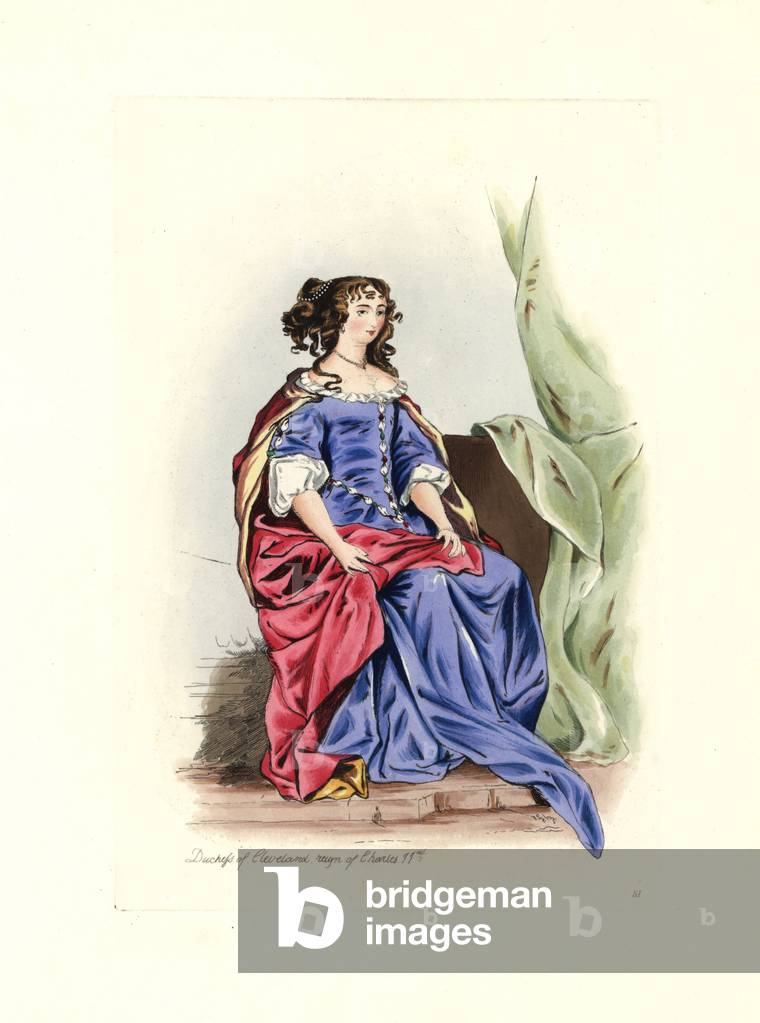
FLO4672337: Barbara Palmer (1640-1709), Duchess of Cleveland, mistress of Charles II (1630-1685), in a blue dress with lace and a red cape. By Peter Lely (1618-1680). Lithograph by Charles Martin, engraving by Leopold Martin, published in “” Costumes civils d'Angleterre depuis la conquete à nos jours”, 1842, London. / Bridgeman Images
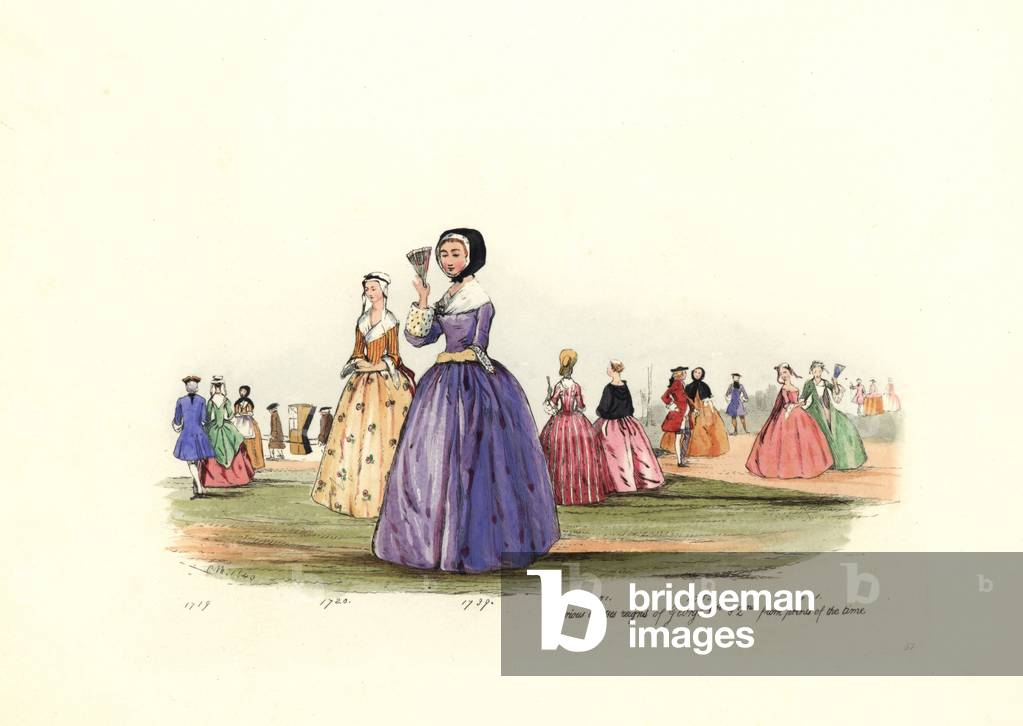
FLO4672397: Women's costumes from 1719 to 1755, regne of George I (1660-1727) and George II (1683-1760), Long dresses with cuffs, fan and bridle hat. Lithograph by Charles Martin, engraving by Leopold Martin, published in “” Costumes civils d'Angleterre depuis la conquete à nos jours”, 1842, London. / Bridgeman Images

FLO4672545: Shoulder and elbow joints. Lithograph of Corbie, in Petity Atlas complet d'Anatomie descriptive du Corps Humain, by Dr. Joseph Nicolas Masse, published by Mequignon Marvis, Paris (France), 1864. / Bridgeman Images

FLO4672670: Shoulder and arm muscles. Lithograph of Anneshower, based on a drawing by Leveille, in Petiure Atlas complet d'Anatomie descriptive du Corps Humain, by Dr. Joseph Nicolas Masse, published by Mequignon Marvis, Paris (France), 1864. / Bridgeman Images

FLO4672728: Aponevrosis of the neck, shoulder and eye. Lithograph of Corbie, based on a drawing by Leveille, in Petiure Atlas complet d'Anatomie descriptive du Corps Humain, by Dr. Joseph Nicolas Masse, published by Mequignon Marvis, Paris (France), 1864. / Bridgeman Images

FLO4672792: Sections of the pharynx and larynx. Lithograph of Anneshower, based on a drawing by Leveille, in Petity Atlas complet d'Anatomie descriptive du Corps Humain, by Dr. Joseph Nicolas Masse, published by Mequignon Marvis, Paris (France), 1864. / Bridgeman Images

FLO4672926: The circulatory system of the intestines. Lithograph of Anneshower, based on a drawing by Leveille, in Petity Atlas complet d'Anatomie descriptive du Corps Humain, by Dr. Joseph Nicolas Masse, published by Mequignon Marvis, Paris (France), 1864. / Bridgeman Images

FLO4672981: Circulatory system of the leg and foot. Lithograph of Choubard, based on a drawing by Leveille, in Petity Atlas complet d'Anatomie descriptive du Corps Humain, by Dr. Joseph Nicolas Masse, published by Mequignon Marvis, Paris (France), 1864. / Bridgeman Images

FLO4672702: Thigh muscles and tendons. Lithograph of Lebrun, based on a drawing by Leveille, in Petity Atlas complet d'Anatomie descriptive du Corps Humain, by Dr. Joseph Nicolas Masse, published by Mequignon Marvis, Paris (France), 1864. / Bridgeman Images

FLO4672795: Breast, tongue, skin and finger sections. Lithograph of Corbie, based on a drawing by Leveille, in Petity Atlas complet d'Anatomie descriptive du Corps Humain, by Dr. Joseph Nicolas Masse, published by Mequignon Marvis, Paris (France), 1864. / Bridgeman Images

FLO4672810: Sections of the nasal cavity. Lithograph of Corbie, based on a drawing by Leveille, in Petity Atlas complet d'Anatomie descriptive du Corps Humain, by Dr. Joseph Nicolas Masse, published by Mequignon Marvis, Paris (France), 1864. / Bridgeman Images

FLO4673246: Ultragotha (Ultragothe), Queen of the Franks, wife to Childebert I, 6th century. She wears a crown over her long hair, a tunic with sleeves, a type of chlamys cape tied at the shoulder with laces, and wears an escarcelle (purse) hanging from her belt. Handcoloured copperplate drawn and engraved by Leopold Massard from “” French Costumes from KingClovis to Our Days,”” Massard, Mifliez, Paris, 1834., Massard, Leopold (1812-1889) / Bridgeman Images

FLO4673005: Veins of the legs and foot. Lithograph of Corbie, based on a drawing by Leveille, in Petity Atlas complet d'Anatomie descriptive du Corps Humain, by Dr. Joseph Nicolas Masse, published by Mequignon Marvis, Paris (France), 1864. / Bridgeman Images

FLO4673145: Brain sections, cerebellum and ventricles. Lithograph by Davesne, based on a drawing by Leveille, in Petity Atlas complet d'Anatomie descriptive du Corps Humain, by Dr. Joseph Nicolas Masse, published by Mequignon Marvis, Paris (France), 1864. / Bridgeman Images

FLO4673112: Section through the brain. Lithograph by Davesne, based on a drawing by Leveille, in Petity Atlas complet d'Anatomie descriptive du Corps Humain, by Dr. Joseph Nicolas Masse, published by Mequignon Marvis, Paris (France), 1864. / Bridgeman Images

FLO4673204: Brain sections. Lithograph by Davesne, based on a drawing by Leveille, in Petity Atlas complet d'Anatomie descriptive du Corps Humain, by Dr. Joseph Nicolas Masse, published by Mequignon Marvis, Paris (France), 1864. / Bridgeman Images

FLO4686329: Elisabeth I Queen of England and Ireland (1533-1603) - Queen Elizabeth I of England, after Hans Holbein - Handcoloured steel engraving by Polydor Pauquet from the Pauquet Brothers' “” Foreign Fashions and Costumes Ancient and Modern””, Paris, 1865 / Bridgeman Images

FLO4685959: Costumes of French royalty, 10th century. Handcoloured steel engraving by Hippolyte Pauquet from a drawing by Wilmin from the Pauquet Brothers' “” Modes et Costumes Historique” (Historical Fashions and Costumes), Paris, 1865. Hippolyte (b. 1797) and Polydor Pauquet (b. 1799) ran a successful publishing house in Paris in the 19th century, specializing in illustrated books on costume, birds, butterflies, anatomy and natural history. / Bridgeman Images