Print Friendly Version Page

2501741 Search Results

Psoralier stinks. Copper engraving, painted by John Curtis and grave by Weddell, published in the “Curtis Botanical Magazine”, 1820, by Samuel Curtis, London, England.

FLO4609516: Psoralier stinks. Copper engraving, painted by John Curtis and grave by Weddell, published in the “Curtis Botanical Magazine”, 1820, by Samuel Curtis, London, England. / Bridgeman Images

Crossandre with wavy leaves or petard flower Copper engraving, starring John Curtis and grave by Weddell, published in Samuel Curtis's “” Botanical Magazine” in 1820, London, England.

FLO4609630: Crossandre with wavy leaves or petard flower Copper engraving, starring John Curtis and grave by Weddell, published in Samuel Curtis's “” Botanical Magazine” in 1820, London, England. / Bridgeman Images

Mountain bugbane or mountain black-cohosh, Actaea podocarpa [Cimicifuga cordifolia). Handcoloured copperplate engraving by Weddell from Samuel Curtis' Botanical Magazine, London, 1819.

FLO4609170: Mountain bugbane or mountain black-cohosh, Actaea podocarpa [Cimicifuga cordifolia). Handcoloured copperplate engraving by Weddell from Samuel Curtis' Botanical Magazine, London, 1819. / Bridgeman Images

Variete of white lupine. Copper engraving, painted by John Curtis and grave by Weddell, published in the “Curtis Botanical Magazine”, 1820, by Samuel Curtis, London, England.

FLO4609382: Variete of white lupine. Copper engraving, painted by John Curtis and grave by Weddell, published in the “Curtis Botanical Magazine”, 1820, by Samuel Curtis, London, England. / Bridgeman Images

Perennial lettuce or greedy heather lettuce. Copper engraving, starring John Curtis and grave by Weddell, published in the “Curtis Botanical Magazine”, 1820, by Samuel Curtis, London, England.

FLO4609398: Perennial lettuce or greedy heather lettuce. Copper engraving, starring John Curtis and grave by Weddell, published in the “Curtis Botanical Magazine”, 1820, by Samuel Curtis, London, England. / Bridgeman Images

Vesce has close leaves. Copper engraving, painted by John Curtis and grave by Weddell, published in the “Curtis Botanical Magazine”, 1820, by Samuel Curtis, London, England.

FLO4609412: Vesce has close leaves. Copper engraving, painted by John Curtis and grave by Weddell, published in the “Curtis Botanical Magazine”, 1820, by Samuel Curtis, London, England. / Bridgeman Images

The housing Silverline, construction 2001, photography 10/01/07 (photo)

LBY4609443: The housing Silverline, construction 2001, photography 10/01/07 (photo), Koolhaas, Rem (b.1944) / Bridgeman Images

Portrait of a lady, Allegory of Virginity. (Painting, 16th century)

LRI4609452: Portrait of a lady, Allegory of Virginity. (Painting, 16th century), Palma, Jacopo (Il Vecchio) (c.1480-1528) / Bridgeman Images

Digital. Copper engraving, painted by John Curtis and grave by Weddell, published in the “Curtis Botanical Magazine”, 1820, by Samuel Curtis, London, England.

FLO4609505: Digital. Copper engraving, painted by John Curtis and grave by Weddell, published in the “Curtis Botanical Magazine”, 1820, by Samuel Curtis, London, England. / Bridgeman Images

Fabagelle has sessile leaves. Copper engraving, painted by John Curtis and grave by Weddell, published in the “Curtis Botanical Magazine”, 1820, by Samuel Curtis, London, England.

FLO4609611: Fabagelle has sessile leaves. Copper engraving, painted by John Curtis and grave by Weddell, published in the “Curtis Botanical Magazine”, 1820, by Samuel Curtis, London, England. / Bridgeman Images

Telemaque, by order of Astarbe (Astebe), escapes from the persecutions of Pygmalion -Telemachus, by order of Astarbe, avoids the pursuits of Pygmalion. Copperplate engraving by Thomas Cook after an illustration by C. Monnet from The Copper Plate Magazine or Monthly Treasure, G. Kearsley, London, 1778.

FLO4607839: Telemaque, by order of Astarbe (Astebe), escapes from the persecutions of Pygmalion -Telemachus, by order of Astarbe, avoids the pursuits of Pygmalion. Copperplate engraving by Thomas Cook after an illustration by C. Monnet from The Copper Plate Magazine or Monthly Treasure, G. Kearsley, London, 1778. / Bridgeman Images

Virgin and Child (tempera and gold leaf on wood, c. 1335)

LRI4607899: Virgin and Child (tempera and gold leaf on wood, c. 1335), Lorenzetti, Ambrogio (1285-c.1348) / Bridgeman Images

John Hampden, English Parliamentarian, in oval above vignette of his death at the Battle of Chalgrove Field. Copperplate engraving by Robert Pollard from The Copper Plate Magazine or Monthly Treasure, G. Kearsley, London, 1778.

FLO4608095: John Hampden, English Parliamentarian, in oval above vignette of his death at the Battle of Chalgrove Field. Copperplate engraving by Robert Pollard from The Copper Plate Magazine or Monthly Treasure, G. Kearsley, London, 1778. / Bridgeman Images

Elisabeth Woodville (Wydville, Wydeville or Widvile, 1437-1492), with her sons, begged Edward IV (1442-1483) to restore her lands - Lady Elizabeth Grey with her two young sons Thomas and Richard petitioning King Edward IV to restore her lands. Copperplate engraving by C. Grignion after an illustration by Edwards from The Copper Plate Magazine or Monthly Treasure, G. Kearsley, London, 1778.

FLO4607647: Elisabeth Woodville (Wydville, Wydeville or Widvile, 1437-1492), with her sons, begged Edward IV (1442-1483) to restore her lands - Lady Elizabeth Grey with her two young sons Thomas and Richard petitioning King Edward IV to restore her lands. Copperplate engraving by C. Grignion after an illustration by Edwards from The Copper Plate Magazine or Monthly Treasure, G. Kearsley, London, 1778. / Bridgeman Images

Virgin and Child, detail. Triptych of Saint Prosecutor (Tempera on wood, 1332)

LRI4607833: Virgin and Child, detail. Triptych of Saint Prosecutor (Tempera on wood, 1332), Lorenzetti, Ambrogio (1285-c.1348) / Bridgeman Images

Denis Diderot, French philosopher, art critic and writer. Copperplate engraving by Ryder from The Copper Plate Magazine or Monthly Treasure, G. Kearsley, London, 1778.

FLO4608026: Denis Diderot, French philosopher, art critic and writer. Copperplate engraving by Ryder from The Copper Plate Magazine or Monthly Treasure, G. Kearsley, London, 1778. / Bridgeman Images

King George III of Great Britain. Copperplate engraving by William Walker from The Copper Plate Magazine or Monthly Treasure, G. Kearsley, London, 1775.

FLO4608083: King George III of Great Britain. Copperplate engraving by William Walker from The Copper Plate Magazine or Monthly Treasure, G. Kearsley, London, 1775. / Bridgeman Images

Tribute to Arman (Armand Pierre Fernandez, 1928-2005) in the Jardins du Palais Royal in Paris in 2006. Series “” the day after””, 1984-1985. Photography 14/05/06-

RCT4606561: Tribute to Arman (Armand Pierre Fernandez, 1928-2005) in the Jardins du Palais Royal in Paris in 2006. Series “” the day after””, 1984-1985. Photography 14/05/06-, Arman (Pierre Fernandez Armand) (1928-2005) / Bridgeman Images

Hedgehog hairstyle tied with a ribbon decorated with a garland of flowers and three large curls entitled Spring. Herisson girded with a ribbon with a garland of flowers and 3 curls said to Spring. Handcoloured copperplate engraving by an unknown artist from an Album of Fashionable Hairstyles of 1783, Suite des Coeffures a la Mode en 1783, Enauts et Rapilly, Paris, 1783.

FLO4606573: Hedgehog hairstyle tied with a ribbon decorated with a garland of flowers and three large curls entitled Spring. Herisson girded with a ribbon with a garland of flowers and 3 curls said to Spring. Handcoloured copperplate engraving by an unknown artist from an Album of Fashionable Hairstyles of 1783, Suite des Coeffures a la Mode en 1783, Enauts et Rapilly, Paris, 1783. / Bridgeman Images

Miss Anais or Anais-Pauline-Nathalie Aubert as Misael in Les Macchabees by Alexandre Guiraud, Theatre Royal de l'Odeon, 1822. Handcoloured lithograph by F. Noel after an illustration by Lavigne Marin from Portraits d'Acteurs et d'Actrices dans different roles, F. Noel, Paris, 1825.

FLO4606918: Miss Anais or Anais-Pauline-Nathalie Aubert as Misael in Les Macchabees by Alexandre Guiraud, Theatre Royal de l'Odeon, 1822. Handcoloured lithograph by F. Noel after an illustration by Lavigne Marin from Portraits d'Acteurs et d'Actrices dans different roles, F. Noel, Paris, 1825. / Bridgeman Images

Contralto singer Madame Montano as Rosine in the opera Le Barbier de Seville by Gioachino Rossini, Theatre Royal de l'Odeon, 1823. Handcoloured lithograph by F. Noel after an illustration by Lavigne Marin from Portraits d'Acteurs et d'Actrices dans different roles, F. Noel, Paris, 1825.

FLO4606959: Contralto singer Madame Montano as Rosine in the opera Le Barbier de Seville by Gioachino Rossini, Theatre Royal de l'Odeon, 1823. Handcoloured lithograph by F. Noel after an illustration by Lavigne Marin from Portraits d'Acteurs et d'Actrices dans different roles, F. Noel, Paris, 1825. / Bridgeman Images

Charles-Edme Vernet and Dominique in La Famille du Porter d'Eau by Allarde, Gabriel de Lurieu, Theatre des Varietes, 1824. Handcoloured lithograph by F. Noel after an illustration by Alexandre-Marie Colin from Portraits d'Acteurs et d'Actrices dans different roles, F. Noel, Paris, 1825.

FLO4607025: Charles-Edme Vernet and Dominique in La Famille du Porter d'Eau by Allarde, Gabriel de Lurieu, Theatre des Varietes, 1824. Handcoloured lithograph by F. Noel after an illustration by Alexandre-Marie Colin from Portraits d'Acteurs et d'Actrices dans different roles, F. Noel, Paris, 1825. / Bridgeman Images

Miss Rose Dupuis as Madame Dorval in La Mere Rivale by Casimir Bonjour, Theatre Français. Handcoloured lithograph by F. Noel after an illustration by Alexandre-Marie Colin from Portraits d'Acteurs et d'Actrices dans different roles, F. Noel, Paris, 1825.

FLO4606892: Miss Rose Dupuis as Madame Dorval in La Mere Rivale by Casimir Bonjour, Theatre Français. Handcoloured lithograph by F. Noel after an illustration by Alexandre-Marie Colin from Portraits d'Acteurs et d'Actrices dans different roles, F. Noel, Paris, 1825. / Bridgeman Images

English soprano opera singer Caroline Branchu as Dido, Queen of Carthage, in Didon by Nicolo Piccinni, Royal Academy of Music, 1824. Handcoloured lithograph by F. Noel after an illustration by Lavigne Marin from Portraits d'Acteurs et d'Actrices dans different roles, F. Noel, Paris, 1825.

FLO4606955: English soprano opera singer Caroline Branchu as Dido, Queen of Carthage, in Didon by Nicolo Piccinni, Royal Academy of Music, 1824. Handcoloured lithograph by F. Noel after an illustration by Lavigne Marin from Portraits d'Acteurs et d'Actrices dans different roles, F. Noel, Paris, 1825. / Bridgeman Images

Recuperation of samples from the Stardust probe - Stardust sample return capsule - Artwork - The Stardust probe was launched on February 7, 1999 with the primary objective of studying comet Wild 2 and taking samples during a passage through the comet's hair. Stardust was the first probe to collect and bring back to Earth interstellar and cometary dust. The return capsule landed on Earth on 15 January 2006 with the samples. Artist's view. Stardust is an interplanetary spacecraft, whose primary purpose was to investigate the makeup of the comet Wild 2 and its coma. It was launched on February 07 1999 and returned to Earth on January 15 2006. It is the first sample return mission to collect cosmic dust and return the sample to Earth; the capsule contains cometary and interstellar samples gathered by the Stardust spacecraft

PIX4607221: Recuperation of samples from the Stardust probe - Stardust sample return capsule - Artwork - The Stardust probe was launched on February 7, 1999 with the primary objective of studying comet Wild 2 and taking samples during a passage through the comet's hair. Stardust was the first probe to collect and bring back to Earth interstellar and cometary dust. The return capsule landed on Earth on 15 January 2006 with the samples. Artist's view. Stardust is an interplanetary spacecraft, whose primary purpose was to investigate the makeup of the comet Wild 2 and its coma. It was launched on February 07 1999 and returned to Earth on January 15 2006. It is the first sample return mission to collect cosmic dust and return the sample to Earth; the capsule contains cometary and interstellar samples gathered by the Stardust spacecraft / Bridgeman Images

The Ulysses probe observes the Sun - The Ulysses probe observes the Sun - Artist's view

PIX4607369: The Ulysses probe observes the Sun - The Ulysses probe observes the Sun - Artist's view / Bridgeman Images

Plains coreopsis or calliopsis, Coreopsis tinctoria. Handcoloured botanical illustration drawn and engraved by William Clark from Richard Morris's “Flora Conspicua” London, Longman, Rees, 1826. William Clark was former draughtsman to the London Horticultural Society and illustrated many botanical books in the 1820s and 1830s.

FLO4607385: Plains coreopsis or calliopsis, Coreopsis tinctoria. Handcoloured botanical illustration drawn and engraved by William Clark from Richard Morris's “Flora Conspicua” London, Longman, Rees, 1826. William Clark was former draughtsman to the London Horticultural Society and illustrated many botanical books in the 1820s and 1830s. / Bridgeman Images

Willow gentian, Gentiana asclepiadea. Handcoloured botanical illustration drawn and engraved by William Clark from Richard Morris's “Flora Conspicua” London, Longman, Rees, 1826. William Clark was former draughtsman to the London Horticultural Society and illustrated many botanical books in the 1820s and 1830s.

FLO4607393: Willow gentian, Gentiana asclepiadea. Handcoloured botanical illustration drawn and engraved by William Clark from Richard Morris's “Flora Conspicua” London, Longman, Rees, 1826. William Clark was former draughtsman to the London Horticultural Society and illustrated many botanical books in the 1820s and 1830s. / Bridgeman Images

Dark purple larkspur, Delphinium elegans pleno. Handcoloured botanical illustration drawn and engraved by William Clark from Richard Morris's “Flora Conspicua” London, Longman, Rees, 1826. William Clark was former draughtsman to the London Horticultural Society and illustrated many botanical books in the 1820s and 1830s.

FLO4607472: Dark purple larkspur, Delphinium elegans pleno. Handcoloured botanical illustration drawn and engraved by William Clark from Richard Morris's “Flora Conspicua” London, Longman, Rees, 1826. William Clark was former draughtsman to the London Horticultural Society and illustrated many botanical books in the 1820s and 1830s. / Bridgeman Images

Adoration of the Magi - Altarpiece of San Donato (oil on panel, 1496)

LRI4607526: Adoration of the Magi - Altarpiece of San Donato (oil on panel, 1496), Lippi, Filippino (c.1457-1504) / Bridgeman Images

Slender Canadian columbine. Aquilegia canadensis gracilis. Handcoloured botanical illustration drawn and engraved by William Clark from Richard Morris's “Flora Conspicua” London, Longman, Rees, 1826. William Clark was former draughtsman to the London Horticultural Society and illustrated many botanical books in the 1820s and 1830s.

FLO4607562: Slender Canadian columbine. Aquilegia canadensis gracilis. Handcoloured botanical illustration drawn and engraved by William Clark from Richard Morris's “Flora Conspicua” London, Longman, Rees, 1826. William Clark was former draughtsman to the London Horticultural Society and illustrated many botanical books in the 1820s and 1830s. / Bridgeman Images

Round-leaved cyclamen, Cyclamen coum. Handcoloured botanical illustration drawn and engraved by William Clark from Richard Morris's “Flora Conspicua” London, Longman, Rees, 1826. William Clark was former draughtsman to the London Horticultural Society and illustrated many botanical books in the 1820s and 1830s.

FLO4607605: Round-leaved cyclamen, Cyclamen coum. Handcoloured botanical illustration drawn and engraved by William Clark from Richard Morris's “Flora Conspicua” London, Longman, Rees, 1826. William Clark was former draughtsman to the London Horticultural Society and illustrated many botanical books in the 1820s and 1830s. / Bridgeman Images

Therigny and Lepreux in Le Lepreux de la Vallee d'Aoste by Aubigny, Theatre de la Porte St. Martin, 1822. Handcoloured lithograph by F. Noel after an illustration by Alexandre-Marie Colin from Portraits d'Acteurs et d'Actrices dans different roles, F. Noel, Paris, 1825.

FLO4607119: Therigny and Lepreux in Le Lepreux de la Vallee d'Aoste by Aubigny, Theatre de la Porte St. Martin, 1822. Handcoloured lithograph by F. Noel after an illustration by Alexandre-Marie Colin from Portraits d'Acteurs et d'Actrices dans different roles, F. Noel, Paris, 1825. / Bridgeman Images

Perennial or Narbonne flax, Linum narbonense. Handcoloured botanical illustration drawn and engraved by William Clark from Richard Morris's “Flora Conspicua” London, Longman, Rees, 1826. William Clark was former draughtsman to the London Horticultural Society and illustrated many botanical books in the 1820s and 1830s.

FLO4607188: Perennial or Narbonne flax, Linum narbonense. Handcoloured botanical illustration drawn and engraved by William Clark from Richard Morris's “Flora Conspicua” London, Longman, Rees, 1826. William Clark was former draughtsman to the London Horticultural Society and illustrated many botanical books in the 1820s and 1830s. / Bridgeman Images
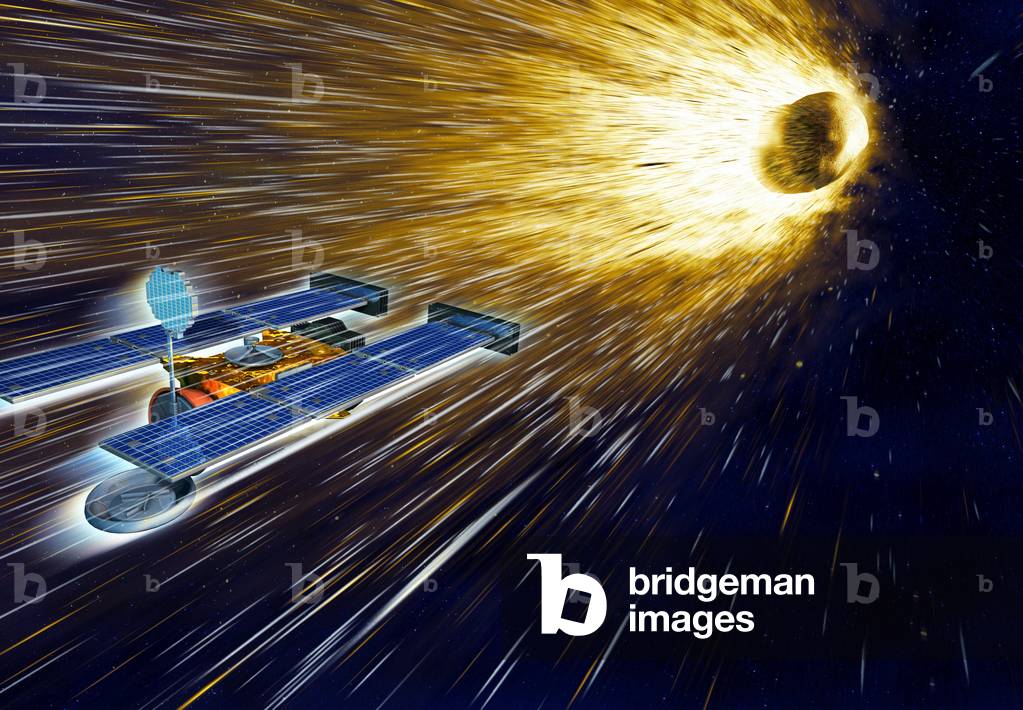
Stardust probe and comet Wild 2 - Artist view - The Stardust probe and comet Wild 2 - Artist view - The Stardust probe was launched on February 7, 1999 with the primary objective of studying the comet Wild 2 and taking samples during a passage through the comet's hair. Stardust was the first probe to collect and bring back to Earth interstellar and cometary dust. The return capsule landed on Earth on 15 January 2006 with the samples. Stardust is an interplanetary spacecraft, whose primary purpose was to investigate the makeup of the comet Wild 2 and its coma. It was launched on February 07 1999 and returned to Earth on January 15 2006. It is the first sample return mission to collect cosmic dust and return the sample to Earth; the capsule contains cometary and interstellar samples gathered by the Stardust spacecraft

PIX4607214: Stardust probe and comet Wild 2 - Artist view - The Stardust probe and comet Wild 2 - Artist view - The Stardust probe was launched on February 7, 1999 with the primary objective of studying the comet Wild 2 and taking samples during a passage through the comet's hair. Stardust was the first probe to collect and bring back to Earth interstellar and cometary dust. The return capsule landed on Earth on 15 January 2006 with the samples. Stardust is an interplanetary spacecraft, whose primary purpose was to investigate the makeup of the comet Wild 2 and its coma. It was launched on February 07 1999 and returned to Earth on January 15 2006. It is the first sample return mission to collect cosmic dust and return the sample to Earth; the capsule contains cometary and interstellar samples gathered by the Stardust spacecraft / Bridgeman Images
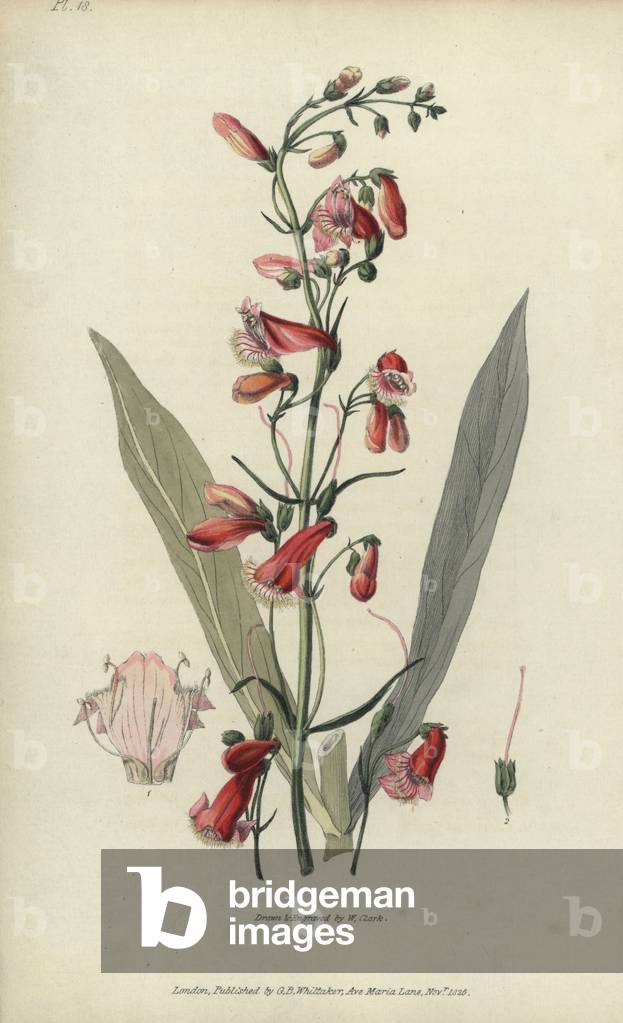
Scarlet bugler, Penstemon barbatus. Handcoloured botanical illustration drawn and engraved by William Clark from Richard Morris's “Flora Conspicua” London, Longman, Rees, 1826. William Clark was former draughtsman to the London Horticultural Society and illustrated many botanical books in the 1820s and 1830s.

FLO4607224: Scarlet bugler, Penstemon barbatus. Handcoloured botanical illustration drawn and engraved by William Clark from Richard Morris's “Flora Conspicua” London, Longman, Rees, 1826. William Clark was former draughtsman to the London Horticultural Society and illustrated many botanical books in the 1820s and 1830s. / Bridgeman Images


Back to top