Search options

Orientation
Colour

Display options

View

Print

To print search results, use print friendly version of this page.

2497527 Search Results

Venice Lido, Venice Film Festival 1991. Italian director Claudio Sestieri, at the Festival to present his movie “” Barocco””/Lido di Venezia, Mostra del Cinema di Venezia 1991. He registered Claudio Sestieri, alla Mostra per presentare il suo film “” Barocco””” -

MME4789835: Venice Lido, Venice Film Festival 1991. Italian director Claudio Sestieri, at the Festival to present his movie “” Barocco””/Lido di Venezia, Mostra del Cinema di Venezia 1991. He registered Claudio Sestieri, alla Mostra per presentare il suo film “” Barocco””” -, Mencarini, Marcello / Bridgeman Images

Salzburg, 1991 Italian soprano Luciana Serra/Salisburgo, 1991 Il soprano Luciana Serra-

MME4790061: Salzburg, 1991 Italian soprano Luciana Serra/Salisburgo, 1991 Il soprano Luciana Serra-, Mencarini, Marcello / Bridgeman Images

Milan, 1980 Italian writer Vittorio Sereni/Milano, 1980 Lo scrittore Vittorio Sereni-

MME4790131: Milan, 1980 Italian writer Vittorio Sereni/Milano, 1980 Lo scrittore Vittorio Sereni-, Mencarini, Marcello / Bridgeman Images

Costume clerical: a Dominican nun, 14th century - Dominican nun, 14th century - She wears a black veil, brown scapular and white tunic - From a painting by Ambrogio Lorenzetti - Handcoloured illustration drawn and lithographed by Paul Mercuri with text by Camille Bonnard from “” Historical Costumes from the 12th to 15th Centuries,” Levy Fils, Paris, 1860

FLO4676805: Costume clerical: a Dominican nun, 14th century - Dominican nun, 14th century - She wears a black veil, brown scapular and white tunic - From a painting by Ambrogio Lorenzetti - Handcoloured illustration drawn and lithographed by Paul Mercuri with text by Camille Bonnard from “” Historical Costumes from the 12th to 15th Centuries,” Levy Fils, Paris, 1860, Mercuri, Paolo (1804-84) / Bridgeman Images

Costume d'un homme de la nobility Milanese (Italy), 14th century - Nobleman of Milan, 14th century - He wears a fur almuce, scarlet cape lined with fur, green robe, doublet with black sleeves and white buttons - From a painting in the porticos of the Basilica of Sant'Ambrogio, Milan - Handcoloured illustration drawn and lithographed by Paul Mercuri with text by Camille Bonnard from “” Historical Costumes from the 12th to 15th Centuries,”” Levy Fils, Paris, 1860

FLO4676898: Costume d'un homme de la nobility Milanese (Italy), 14th century - Nobleman of Milan, 14th century - He wears a fur almuce, scarlet cape lined with fur, green robe, doublet with black sleeves and white buttons - From a painting in the porticos of the Basilica of Sant'Ambrogio, Milan - Handcoloured illustration drawn and lithographed by Paul Mercuri with text by Camille Bonnard from “” Historical Costumes from the 12th to 15th Centuries,”” Levy Fils, Paris, 1860, Mercuri, Paolo (1804-84) / Bridgeman Images

Accommodation in Emerainville (Marne la Vallee). Realisation 1986, architect Lucien Kroll. Photography 1986.

TEC4676948: Accommodation in Emerainville (Marne la Vallee). Realisation 1986, architect Lucien Kroll. Photography 1986., Kroll, Lucien (b. 1927) / Bridgeman Images

Costume d'un homme de la nobility italian, 14th century - Italian nobleman in cape with ermine border, 14th century, from the Titius Livius manuscript in the Biblioteca Ambrosiana, Milan - Handcoloured illustration drawn and lithographed by Paul Mercuri with text by Camille Bonnard from “” Historical Costumes from the 12th to 15th Centuries,” Levy Fils, Paris, 1861

FLO4676971: Costume d'un homme de la nobility italian, 14th century - Italian nobleman in cape with ermine border, 14th century, from the Titius Livius manuscript in the Biblioteca Ambrosiana, Milan - Handcoloured illustration drawn and lithographed by Paul Mercuri with text by Camille Bonnard from “” Historical Costumes from the 12th to 15th Centuries,” Levy Fils, Paris, 1861, Mercuri, Paolo (1804-84) / Bridgeman Images

Pugiello Pertinario (d. 1368), Florentine noble, Quaestor general of the ducal incomes of Milan (Italy) - Costume of Pugiello Pertinario, Florentine nobleman, founder of St Peter's chapel, St Eustorge Church, Milan, 14th century - He wears a fur hat that resemble a wig, a wide-sleeved cape in embroidered white damask bordered in brown fur, and white shoes - Handcoloured illustration drawn and lithographed by Paul Mercuri with text by Camille Bonnard from “” Historical Costumes from the 12th to 15th Centuries,”” Levy Fils, Paris, 1861 -

FLO4677147: Pugiello Pertinario (d. 1368), Florentine noble, Quaestor general of the ducal incomes of Milan (Italy) - Costume of Pugiello Pertinario, Florentine nobleman, founder of St Peter's chapel, St Eustorge Church, Milan, 14th century - He wears a fur hat that resemble a wig, a wide-sleeved cape in embroidered white damask bordered in brown fur, and white shoes - Handcoloured illustration drawn and lithographed by Paul Mercuri with text by Camille Bonnard from “” Historical Costumes from the 12th to 15th Centuries,”” Levy Fils, Paris, 1861 -, Mercuri, Paolo (1804-84) / Bridgeman Images

Costume d'un jeune ecuyer, 14th century - Costume of a young squire, 14th century - He wears a yellow tabard, green stockings and silver spurs - He carries the sword and cape of his knight - From a fresco by Spinello Aretino in the Campo Santo cemetery, Pisa - Handcoloured illustration drawn and lithographed by Paul Mercuri with text by Camille Bonnard from “” Historical Costumes from the 12th to 15th Centuries,” Levy Fils, Paris, 1861

FLO4677187: Costume d'un jeune ecuyer, 14th century - Costume of a young squire, 14th century - He wears a yellow tabard, green stockings and silver spurs - He carries the sword and cape of his knight - From a fresco by Spinello Aretino in the Campo Santo cemetery, Pisa - Handcoloured illustration drawn and lithographed by Paul Mercuri with text by Camille Bonnard from “” Historical Costumes from the 12th to 15th Centuries,” Levy Fils, Paris, 1861, Mercuri, Paolo (1804-84) / Bridgeman Images

A couple of the Middle Ages play at the wheel, on a bridge - Lithograph from an illustration by J.E. Rogers, from Passe temps actuels de l'Engleterre heureuse, by Francis Cowley Burnand (1836-1917), 1873 - Medieval man and woman playing a game of battledore and shuttlecock on a bridge over a river - Handcoloured lithograph after an illustration by J. E. Rogers from Francis Cowley Burnand's “” Present Pastimes of Merrie England, Cassell, London, 1873

FLO4677242: A couple of the Middle Ages play at the wheel, on a bridge - Lithograph from an illustration by J.E. Rogers, from Passe temps actuels de l'Engleterre heureuse, by Francis Cowley Burnand (1836-1917), 1873 - Medieval man and woman playing a game of battledore and shuttlecock on a bridge over a river - Handcoloured lithograph after an illustration by J. E. Rogers from Francis Cowley Burnand's “” Present Pastimes of Merrie England, Cassell, London, 1873 / Bridgeman Images

Tuna fishing (traps or tonnara or mattanza) in Capo Passero in Sicily Detail. Painting by Paolo de Albertis (19th century) Around 1800 Museo Nazionale di San Martino Naples

LRI4676816: Tuna fishing (traps or tonnara or mattanza) in Capo Passero in Sicily Detail. Painting by Paolo de Albertis (19th century) Around 1800 Museo Nazionale di San Martino Naples, Albertis, Paolo de (1770-1844) / Bridgeman Images

Costume d'un homme de la nobility venitienne (Italy), 12th century - Nobleman of Venice, 12th century - He wears a hat surmounted by a pearl, green chlamys lined with scarlet, violet robe with gold shoulders, red belt, green stockings and black shoes - From a figure in the mosaic doors of Saint Mark's Basilica - Handcoloured illustration drawn and lithographed by Paul Mercuri with text by Camille Bonnard from “” Historical Costumes from the 12th to 15th Centuries,”” Levy Fils, Paris, 1860

FLO4676809: Costume d'un homme de la nobility venitienne (Italy), 12th century - Nobleman of Venice, 12th century - He wears a hat surmounted by a pearl, green chlamys lined with scarlet, violet robe with gold shoulders, red belt, green stockings and black shoes - From a figure in the mosaic doors of Saint Mark's Basilica - Handcoloured illustration drawn and lithographed by Paul Mercuri with text by Camille Bonnard from “” Historical Costumes from the 12th to 15th Centuries,”” Levy Fils, Paris, 1860, Mercuri, Paolo (1804-84) / Bridgeman Images

Costume d'un docteur des lois, lecture un livre sur un lutrin, 14th century - Doctor of law reading books at a lectern, 14th century - He wears a pink bonnet, ermine almuce over scarlet robes lined with ermine, black shoes - From the monument to Nicolas dei Fabri, church of San Giacomo Maggiore - Handcoloured illustration drawn and lithographed by Paul Mercuri with text by Camille Bonnard from “” Historical Costumes from the 12th to 15th Centuries,”” Levy Fils, Paris, 1860

FLO4676826: Costume d'un docteur des lois, lecture un livre sur un lutrin, 14th century - Doctor of law reading books at a lectern, 14th century - He wears a pink bonnet, ermine almuce over scarlet robes lined with ermine, black shoes - From the monument to Nicolas dei Fabri, church of San Giacomo Maggiore - Handcoloured illustration drawn and lithographed by Paul Mercuri with text by Camille Bonnard from “” Historical Costumes from the 12th to 15th Centuries,”” Levy Fils, Paris, 1860, Mercuri, Paolo (1804-84) / Bridgeman Images

Mastino II della Scala (1308-1351), Lord of Verona and Vicenza (Italy) - Mastino II della Scala, lord of Verona, 14th century - He wears a very ornate suit of chaimmail and armour: helm surmounted by a dog's head and wings, buckler, lance, saddle, greaves, spurs - His tunic and the horse's caparison are embroidered in with his coat of arms, a ladder on a blue field - From a statue on his tomb - Handcoloured illustration drawn and lithographed by Paul Mercuri with text by Camille Bonnard from “” Historical Costumes from the 12th to 15th Centuries,”” Levy Fils, Paris, 1860

FLO4676949: Mastino II della Scala (1308-1351), Lord of Verona and Vicenza (Italy) - Mastino II della Scala, lord of Verona, 14th century - He wears a very ornate suit of chaimmail and armour: helm surmounted by a dog's head and wings, buckler, lance, saddle, greaves, spurs - His tunic and the horse's caparison are embroidered in with his coat of arms, a ladder on a blue field - From a statue on his tomb - Handcoloured illustration drawn and lithographed by Paul Mercuri with text by Camille Bonnard from “” Historical Costumes from the 12th to 15th Centuries,”” Levy Fils, Paris, 1860, Mercuri, Paolo (1804-84) / Bridgeman Images

Military costume: un soldat italien, 14eme century - Italian military costume, 14th century - He wears a round helmet with chainmail neck protector, chainmail suit, gauntlets, greaves, spurs - His cape is scarlet and lined with fur, and the tabard is white - From a figure in the tomb of Mastino II della Scala - Handcoloured illustration drawn and lithographed by Paul Mercuri with text by Camille Bonnard from “” Historical Costumes from the 12th to 15th Centuries,”” Levy Fils, Paris, 1860

FLO4676953: Military costume: un soldat italien, 14eme century - Italian military costume, 14th century - He wears a round helmet with chainmail neck protector, chainmail suit, gauntlets, greaves, spurs - His cape is scarlet and lined with fur, and the tabard is white - From a figure in the tomb of Mastino II della Scala - Handcoloured illustration drawn and lithographed by Paul Mercuri with text by Camille Bonnard from “” Historical Costumes from the 12th to 15th Centuries,”” Levy Fils, Paris, 1860, Mercuri, Paolo (1804-84) / Bridgeman Images

Une jeune femme jouant de l'organ portable, 14th century - Young woman playing a portable organ, 14th century - It was the fashion to wear garlands of flowers during public festivals and events - From a painting by Domenico Bartoli, Siena, later copied in a fresco by Benozzi Gozzoli at Campo Santo cemetery, Pisa - Handcoloured illustration drawn and lithographed by Paul Mercuri with text by Camille Bonnard from “” Historical Costumes from the 12th to 15th Centuries,”” Levy Fils, Paris, 1861

FLO4677130: Une jeune femme jouant de l'organ portable, 14th century - Young woman playing a portable organ, 14th century - It was the fashion to wear garlands of flowers during public festivals and events - From a painting by Domenico Bartoli, Siena, later copied in a fresco by Benozzi Gozzoli at Campo Santo cemetery, Pisa - Handcoloured illustration drawn and lithographed by Paul Mercuri with text by Camille Bonnard from “” Historical Costumes from the 12th to 15th Centuries,”” Levy Fils, Paris, 1861, Mercuri, Paolo (1804-84) / Bridgeman Images

Costume d'une jeune femme italian, 14th century - Costume of a young Italian woman, 14th century - She wears her hair loose but tied with a thin chain, a cape bordered with gold over a blue dress - From a painting by Ambrogio Lorenzetti - Handcoloured illustration drawn and lithographed by Paul Mercuri with text by Camille Bonnard from “” Historical Costumes from the 12th to 15th Centuries,” Levy Fils, Paris, 1861

FLO4677165: Costume d'une jeune femme italian, 14th century - Costume of a young Italian woman, 14th century - She wears her hair loose but tied with a thin chain, a cape bordered with gold over a blue dress - From a painting by Ambrogio Lorenzetti - Handcoloured illustration drawn and lithographed by Paul Mercuri with text by Camille Bonnard from “” Historical Costumes from the 12th to 15th Centuries,” Levy Fils, Paris, 1861, Mercuri, Paolo (1804-84) / Bridgeman Images

Costume d'un homme de la noblesse francaise, 14eme century - French noble man, 14th century - He wears a tabard in yellow decorated with eyes and violet decorated with flowers, blue hood, red and grey stockings, and cracows (pointed shoes a la poulaine) - From a manuscript of “” Lancelot of the Lake”” in the Imperiale Library, 6964 - Handcoloured illustration drawn and lithographed by Paul Mercuri with text by Camille Bonnard from “” Historical Costumes from the 12th to 15th Centuries,”” Levy Fils, Paris, 1861

FLO4677087: Costume d'un homme de la noblesse francaise, 14eme century - French noble man, 14th century - He wears a tabard in yellow decorated with eyes and violet decorated with flowers, blue hood, red and grey stockings, and cracows (pointed shoes a la poulaine) - From a manuscript of “” Lancelot of the Lake”” in the Imperiale Library, 6964 - Handcoloured illustration drawn and lithographed by Paul Mercuri with text by Camille Bonnard from “” Historical Costumes from the 12th to 15th Centuries,”” Levy Fils, Paris, 1861, Mercuri, Paolo (1804-84) / Bridgeman Images

Costume d'un homme de la noblesse italian, 14th century - Costume of an Italian nobleman, 14th century - He wears a decorated, plumed hat, cape with large hanging sleeves and fur border, with black cracows (pointed shoes a la poulaine) - From the Titius Livius manuscript in the Biblioteca Ambrosiana, Milan - Handcoloured illustration drawn and lithographed by Paul Mercuri with text by Camille Bonnard from “” Historical Costumes from the 12th to 15th Centuries,”” Levy Fils, Paris, 1861

FLO4677134: Costume d'un homme de la noblesse italian, 14th century - Costume of an Italian nobleman, 14th century - He wears a decorated, plumed hat, cape with large hanging sleeves and fur border, with black cracows (pointed shoes a la poulaine) - From the Titius Livius manuscript in the Biblioteca Ambrosiana, Milan - Handcoloured illustration drawn and lithographed by Paul Mercuri with text by Camille Bonnard from “” Historical Costumes from the 12th to 15th Centuries,”” Levy Fils, Paris, 1861, Mercuri, Paolo (1804-84) / Bridgeman Images

Italian street pantomime artist in grotesque wig, playing a bizarre one-string violin with balloon. “” This young Italian man with black eyes excels at terrible grimaces. His genre is the melodrama of the grimace.” Handcoloured engraving by Gatine from Pierre de la Mesanger's Le Bon Genre, Paris, 1817.

FLO4677342: Italian street pantomime artist in grotesque wig, playing a bizarre one-string violin with balloon. “” This young Italian man with black eyes excels at terrible grimaces. His genre is the melodrama of the grimace.” Handcoloured engraving by Gatine from Pierre de la Mesanger's Le Bon Genre, Paris, 1817. / Bridgeman Images

Title page decoree with illuminated borders of the Middle Ages - Lithography from an illustration by J.E. Rogers, from Passe temps actuels de l'Engleterre heureuse, by Francis Cowley Burnand (1836-1917), 1873 - Illuminated title page - Handcoloured lithograph after an illustration by J. E. Rogers from Francis Cowley Burnand's “” Present Pastimes of Merrie England, Cassell, London, 1873

FLO4677254: Title page decoree with illuminated borders of the Middle Ages - Lithography from an illustration by J.E. Rogers, from Passe temps actuels de l'Engleterre heureuse, by Francis Cowley Burnand (1836-1917), 1873 - Illuminated title page - Handcoloured lithograph after an illustration by J. E. Rogers from Francis Cowley Burnand's “” Present Pastimes of Merrie England, Cassell, London, 1873 / Bridgeman Images

Mutual borrowing of fashions between French and English women, early 19th century. Both wear identical style cups, frilled dresses, shawls and spencer jackets. Handcoloured engraving from Pierre de la Mesanger's Le Bon Genre, Paris, 1817.

FLO4677797: Mutual borrowing of fashions between French and English women, early 19th century. Both wear identical style cups, frilled dresses, shawls and spencer jackets. Handcoloured engraving from Pierre de la Mesanger's Le Bon Genre, Paris, 1817. / Bridgeman Images
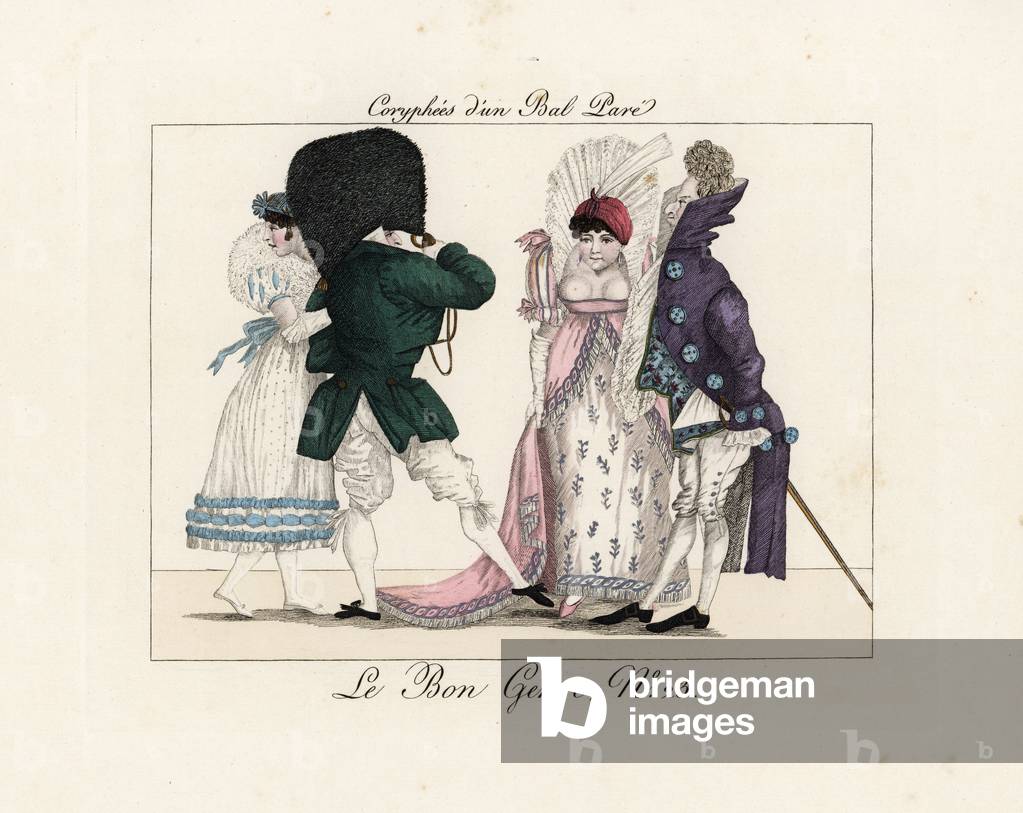
Coryphees at a ball. Incredible in jackets with outsize buttons and collars, long tie, huge bicorn hat, and merveilleuses with decollete dresses and large lace collars. (Coryphees are ballet dancers of a rank between corps du ballet and soloist.) What to say about these breeches with a thousand folds and large jackets that fall with as little grace as from a coat rack? Handcoloured engraving from Pierre de la Mesanger's Le Bon Genre, Paris, 1817.

FLO4677891: Coryphees at a ball. Incredible in jackets with outsize buttons and collars, long tie, huge bicorn hat, and merveilleuses with decollete dresses and large lace collars. (Coryphees are ballet dancers of a rank between corps du ballet and soloist.) What to say about these breeches with a thousand folds and large jackets that fall with as little grace as from a coat rack? Handcoloured engraving from Pierre de la Mesanger's Le Bon Genre, Paris, 1817. / Bridgeman Images

A Parisian woman getting dressed in the Chinese style. “” Our artist has turned three magots (grotesque porcelain figures) into makeup artists eager to transform a beautiful Parisian into a Chinese beauty. One plays with her hair, another helps her put on a pair of slippers, and a third shows a tunic with bells.” Handcoloured engraving from Pierre de la Mesanger's Le Bon Genre, Paris, 1817.

FLO4677439: A Parisian woman getting dressed in the Chinese style. “” Our artist has turned three magots (grotesque porcelain figures) into makeup artists eager to transform a beautiful Parisian into a Chinese beauty. One plays with her hair, another helps her put on a pair of slippers, and a third shows a tunic with bells.” Handcoloured engraving from Pierre de la Mesanger's Le Bon Genre, Paris, 1817. / Bridgeman Images
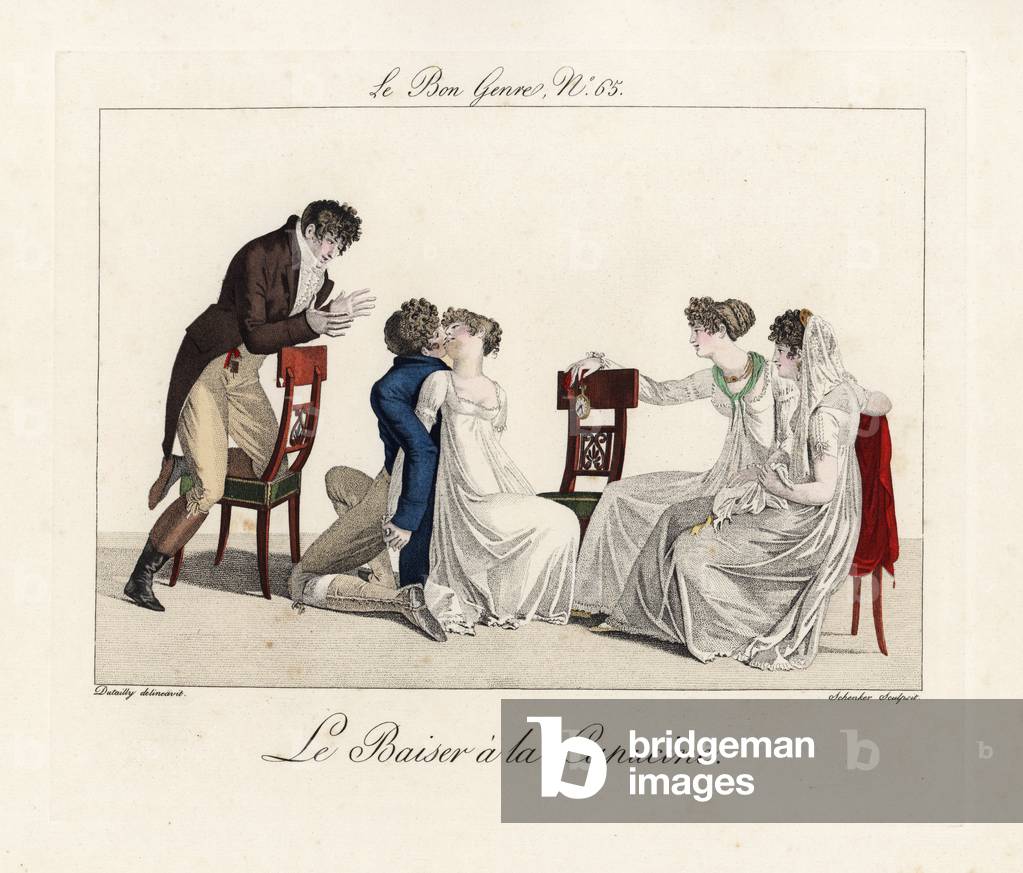
Fashionable people playing the Capucine kissing game. The players must sit back to back with their arms entwined and endeavor to give each other a kiss on the lips by their contortions. Illustration by Dumailly, engraved by Schenker, from Pierre de la Mesanger's Le Bon Genre, Paris, 1817.

FLO4677448: Fashionable people playing the Capucine kissing game. The players must sit back to back with their arms entwined and endeavor to give each other a kiss on the lips by their contortions. Illustration by Dumailly, engraved by Schenker, from Pierre de la Mesanger's Le Bon Genre, Paris, 1817. / Bridgeman Images

Cartoon of English costumes, circa 1815. Men with flowerpot hats, long coats and trousers worn over boots, women in shawls with tassles. “One can see in the background of these English fashions a few borrowings from Spain with all their national awkwardness.”” Handcoloured engraving from Pierre de la Mesanger's Le Bon Genre, Paris, 1817.

FLO4677515: Cartoon of English costumes, circa 1815. Men with flowerpot hats, long coats and trousers worn over boots, women in shawls with tassles. “One can see in the background of these English fashions a few borrowings from Spain with all their national awkwardness.”” Handcoloured engraving from Pierre de la Mesanger's Le Bon Genre, Paris, 1817. / Bridgeman Images

Badminton. Wonderful in flimsy dresses play a game of badminton in a garden. Several have their hair in the fashionable short cut known as the martyr or victim. “” In old times we played without rackets, using our hands to hit the ball or shuttlecock in the version called Palm. Now we are more delicate, we have racquets decorated with gold and silk. Illustration by Dominique Bosio. Handcoloured engraving from Pierre de la Mesanger's Le Bon Genre, Paris, 1817.

FLO4677779: Badminton. Wonderful in flimsy dresses play a game of badminton in a garden. Several have their hair in the fashionable short cut known as the martyr or victim. “” In old times we played without rackets, using our hands to hit the ball or shuttlecock in the version called Palm. Now we are more delicate, we have racquets decorated with gold and silk. Illustration by Dominique Bosio. Handcoloured engraving from Pierre de la Mesanger's Le Bon Genre, Paris, 1817. / Bridgeman Images

The bored women of Longchamp racetrack. Three fashionable bored women sit among a mountain of chairs as a maid clears them away. “Where is everyone? Damn rain! Where can we meet someone to talk to, to be seen? They wear the latest hairstyles - almost like those of children in a choir.” Handcoloured engraving from Pierre de la Mesanger's Le Bon Genre, Paris, 1817.

FLO4677858: The bored women of Longchamp racetrack. Three fashionable bored women sit among a mountain of chairs as a maid clears them away. “Where is everyone? Damn rain! Where can we meet someone to talk to, to be seen? They wear the latest hairstyles - almost like those of children in a choir.” Handcoloured engraving from Pierre de la Mesanger's Le Bon Genre, Paris, 1817. / Bridgeman Images
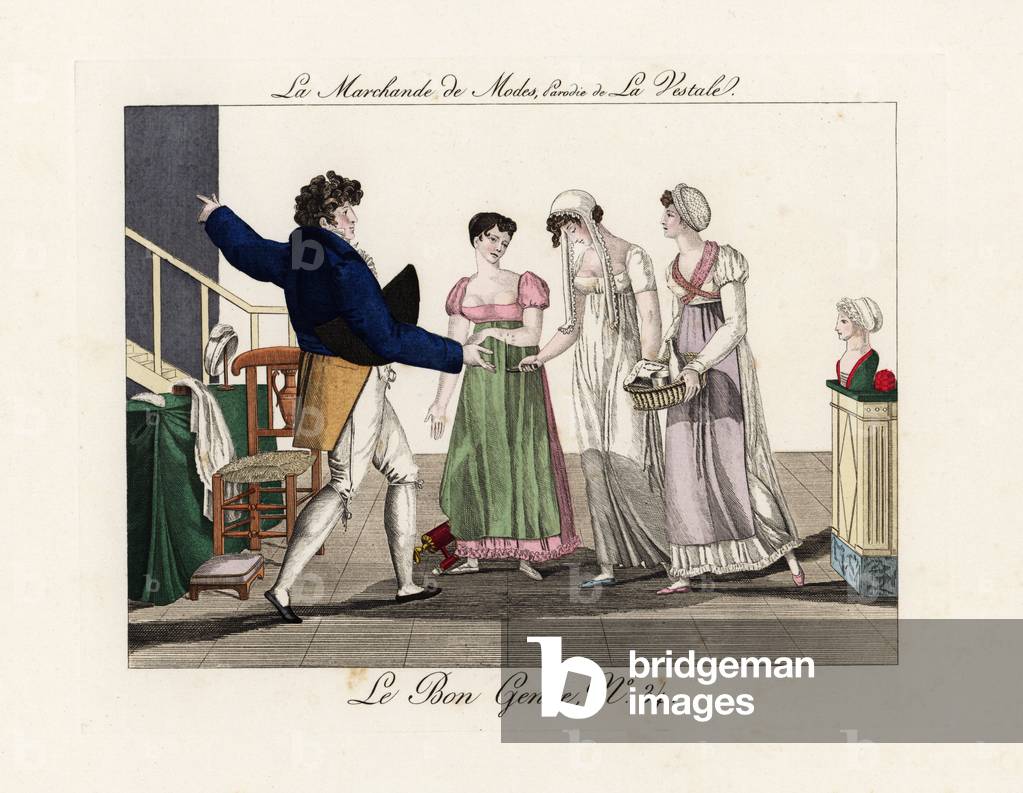
Scene from Etienne Jouy's 1808 play La Merchant des Modes, a parody of La Vestale (his own opera from 1807 with music by Spontini). A despondent Miss Julie, fashion apprentice, is ordered upstairs by Mr de Crepanville while her companions hold a basket of bread and water and sing, “” Dip your bread, dip your bread Julie, Dip your bread in the clear water.”” Handcoloured engraving from Pierre de la Mesanger's Le Bon Genre, Paris, 1817.

FLO4678008: Scene from Etienne Jouy's 1808 play La Merchant des Modes, a parody of La Vestale (his own opera from 1807 with music by Spontini). A despondent Miss Julie, fashion apprentice, is ordered upstairs by Mr de Crepanville while her companions hold a basket of bread and water and sing, “” Dip your bread, dip your bread Julie, Dip your bread in the clear water.”” Handcoloured engraving from Pierre de la Mesanger's Le Bon Genre, Paris, 1817. / Bridgeman Images

Woman in a muslin dress with frills, fichu wimple, and perkale skirt. The headdress is an accessory, and its height should never equal the length of the face. For many months now, this principle has been ignored.” Handcoloured engraving from Pierre de la Mesanger's Le Bon Genre, Paris, 1817.

FLO4677408: Woman in a muslin dress with frills, fichu wimple, and perkale skirt. The headdress is an accessory, and its height should never equal the length of the face. For many months now, this principle has been ignored.” Handcoloured engraving from Pierre de la Mesanger's Le Bon Genre, Paris, 1817. / Bridgeman Images

Seated blind man's buff. A dandy in Regency fashion guesses the identity of the woman in muslin dress who provides his chair. Handcoloured engraving from Pierre de la Mesanger's Le Bon Genre, Paris, 1817.

FLO4677566: Seated blind man's buff. A dandy in Regency fashion guesses the identity of the woman in muslin dress who provides his chair. Handcoloured engraving from Pierre de la Mesanger's Le Bon Genre, Paris, 1817. / Bridgeman Images

Indian jugglers, 1816. The man in the centre balances a whip between his eyes, spins rings on his toes and fingers, and threads pearls on a rope with his tongue. An assistant accompanies him on tiny cymbals. Handcoloured engraving from Pierre de la Mesanger's Le Bon Genre, Paris, 1817.

FLO4677586: Indian jugglers, 1816. The man in the centre balances a whip between his eyes, spins rings on his toes and fingers, and threads pearls on a rope with his tongue. An assistant accompanies him on tiny cymbals. Handcoloured engraving from Pierre de la Mesanger's Le Bon Genre, Paris, 1817. / Bridgeman Images
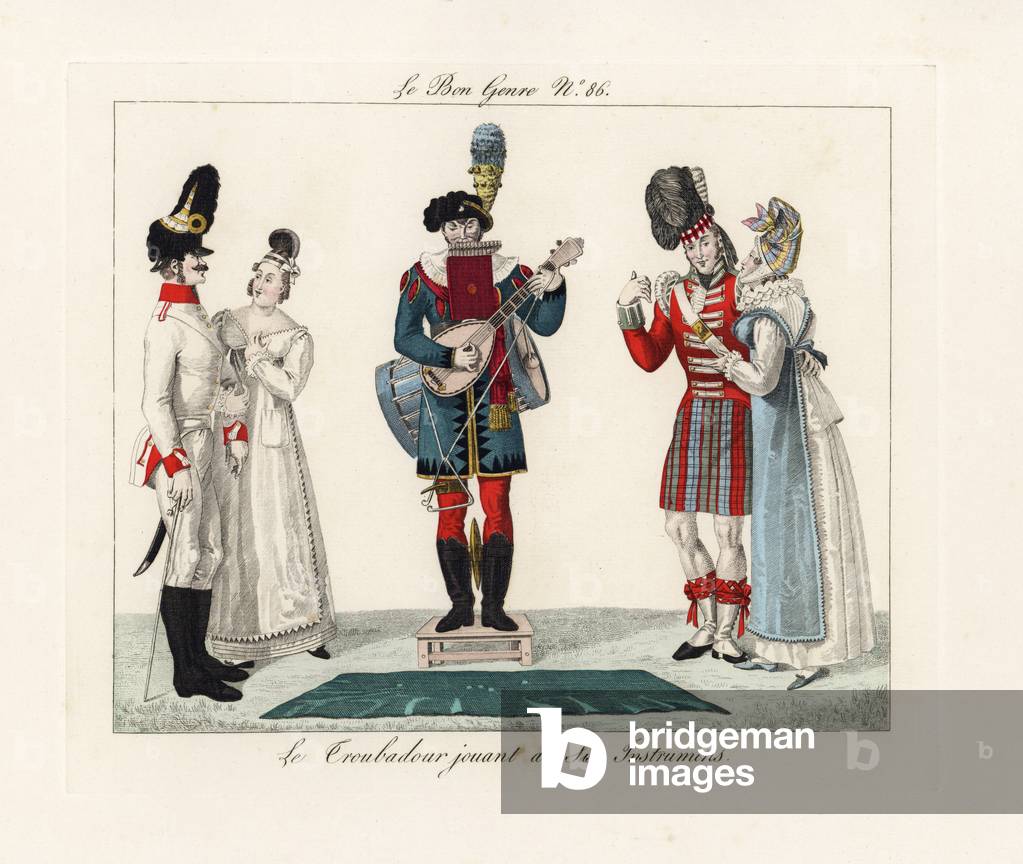
Troubadour playing on six instruments in front of Prussian and Scots soldiers, 1815. By moving his head, elbows and knees, he plays pan pipes, mandolin, drum, triangle, cymbals and three rows of bells on his plumed hat. Handcoloured engraving from Pierre de la Mesanger's Le Bon Genre, Paris, 1817.

FLO4677605: Troubadour playing on six instruments in front of Prussian and Scots soldiers, 1815. By moving his head, elbows and knees, he plays pan pipes, mandolin, drum, triangle, cymbals and three rows of bells on his plumed hat. Handcoloured engraving from Pierre de la Mesanger's Le Bon Genre, Paris, 1817. / Bridgeman Images

Jacques de Falaise, street entertainer who ate anything. He is shown eating a live mouse, holding a snake, while an assistant receives a dagger and rose from the audience. Handcoloured engraving from Pierre de la Mesanger's Le Bon Genre, Paris, 1817.

FLO4677660: Jacques de Falaise, street entertainer who ate anything. He is shown eating a live mouse, holding a snake, while an assistant receives a dagger and rose from the audience. Handcoloured engraving from Pierre de la Mesanger's Le Bon Genre, Paris, 1817. / Bridgeman Images

Woman asleep on a cot, with hat boxes for a somno or night table, and a chipped vase for a candlestick. Her clothes are expensive: a cornette night cap, fancy bonnet, frilly dress and lace shawl for curtains. Handcoloured engraving from Pierre de la Mesanger's Le Bon Genre, Paris, 1817.

FLO4677727: Woman asleep on a cot, with hat boxes for a somno or night table, and a chipped vase for a candlestick. Her clothes are expensive: a cornette night cap, fancy bonnet, frilly dress and lace shawl for curtains. Handcoloured engraving from Pierre de la Mesanger's Le Bon Genre, Paris, 1817. / Bridgeman Images

Three girls in mid-calf length dresses and pantalons dancing with a shawl. Handcoloured engraving from Pierre de la Mesanger's Le Bon Genre, Paris, 1817.

FLO4677771: Three girls in mid-calf length dresses and pantalons dancing with a shawl. Handcoloured engraving from Pierre de la Mesanger's Le Bon Genre, Paris, 1817. / Bridgeman Images


Back to top