2491557 Search Results

FLO4633811: Lavender, Mines, Savory, Marjoram and Marigold (Winter's Tale). Handcoioured botanical illustration drawn and lithographed by Jane Elizabeth Giraud from The Flowers of Shakespeare, Day and Haghe, London, 1845. / Bridgeman Images

FLO4633973: Persian costumes: a couple of courtiers and ordinary traditional costumes. Lithography for the book: “” Galerie complete en tableaux fideles des peuples d'Asie”” by Friedrich Wilhelm Goedsche (1785-1863), edition Meissen (Germany), 1835-1840. Costumes of high ranking Persian men and women at top, and commoners below. Physiognomy of a Persian man in turban. Handcoloured lithograph from Friedrich Wilhelm Goedsche's “” Vollstaendige Voelkergallerie in getreuen Abbildungen”” (Complete Gallery of Peoples in True Pictures), Meissen, circa 1835-1840. / Bridgeman Images

PIX4634142: Evolution of the universe: from the dark age to galaxies - In this diagram, the upper left represents the cosmic Dark Age, when the universe was so hot that atoms could not form and photons could not travel freely. The red area represents the de-ionization era, when the universe became transparent. The Cosmic Background Radiation comes from this time, Dixon, Don (b.1951) / Bridgeman Images

FLO4634295: The Chinese flag, women's shoes and little feet, a man's shoe, Chinese characters and the porcelain pagoda of the Temple of Gratitude in Nanjing. Lithography for the book: “” Galerie complete en tableaux fideles des peuples d'Asie”” by Friedrich Wilhelm Goedsche (1785-1863), edition Meissen (Germany), 1835-1840. Chinese flag, women's shoes and feet, men's shoe, Chinese writing characters and the Porcelain Pagoda at Nanking (Nanjing) built during the Ming dynasty. Handcoloured lithograph from Friedrich Wilhelm Goedsche's “” Vollstaendige Voelkergallerie in getreuen Abbildungen”” (Complete Gallery of Peoples in True Pictures), Meissen, circa 1835-1840. / Bridgeman Images
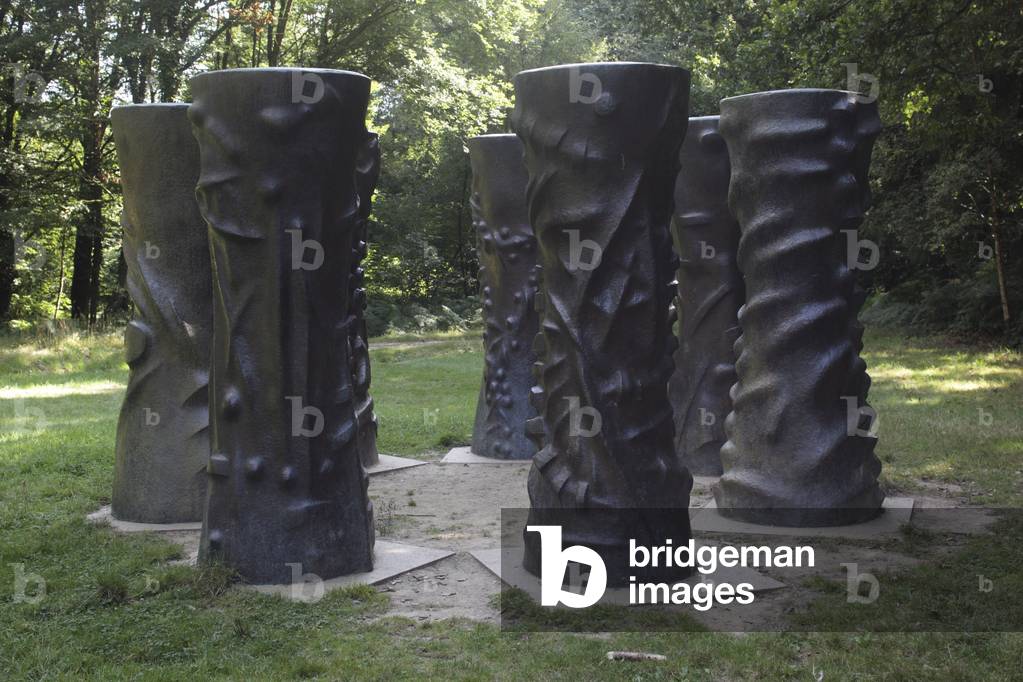
TEC4634351: Seven Columns a Mallarme, 1971 by Etienne Hajdu, Sculpture Park. Centre d'art contemporain, Domaine de Kerguehennec, in Bignan (Morbihan, Brittany). Photography 13/08/09., Hajdu, Etienne (1907-1996) / Bridgeman Images

PIX4634513: The neighbourhood of our solar system - The neighbourhood of our solar system / Bridgeman Images

PIX4634421: Large structures - Artist's view of large structures, these gas filaments in which clusters of galaxies are formed / Bridgeman Images

PIX4634527: Neighbouring of our solar system - Illustration showing the position of the Sun in our galaxy. Illustration showing our Sun and nearest stars in our galaxy, Dixon, Don (b.1951) / Bridgeman Images

FLO4634586: The Tatar leader of the city of Kazan (Russia), with a turban and a long striped dress, a couple from the city and a Kachin man (Burma, Myanmar). Lithography for the book: “” Galerie complete en tableaux fideles des peuples d'Asie”” by Friedrich Wilhelm Goedsche (1785-1863), edition Meissen (Germany), 1835-1840. Chief of the Tatar city of Kazan with turban and long striped robe, male and female Kazaners, and a Kachin man in long coat over boots. Handcoloured lithograph from Friedrich Wilhelm Goedsche's “” Vollstaendige Voelkergallerie in getreuen Abbildungen”” (Complete Gallery of Peoples in True Pictures), Meissen, circa 1835-1840. / Bridgeman Images
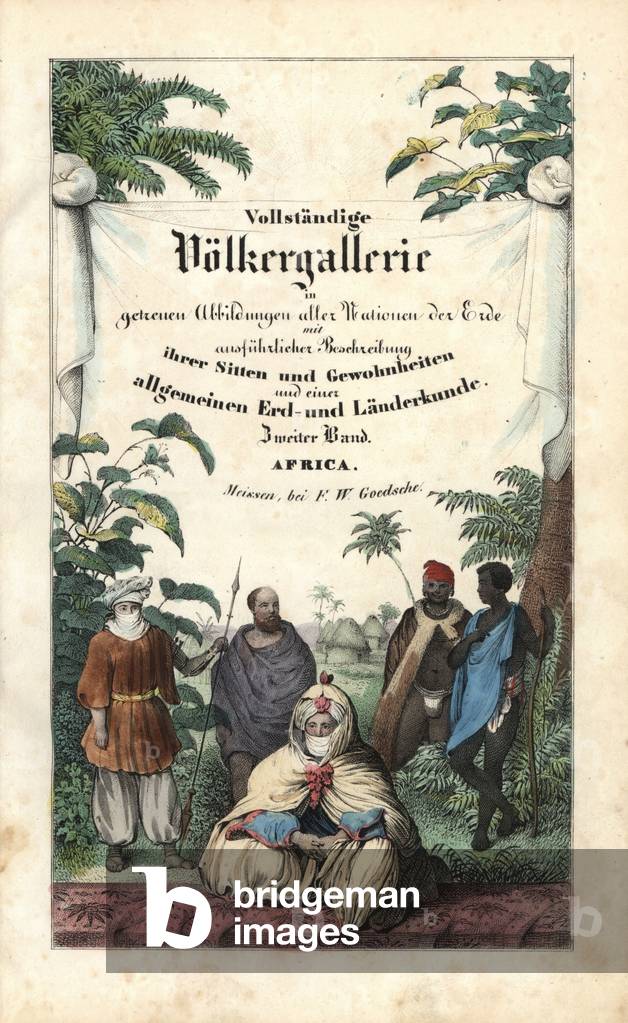
FLO4634710: Costumes vary from the peoples of Africa. Lithograph for the title page of the book: “” Galerie complete en tableaux fideles des peuples d'Afrique”” by Friedrich Wilhelm Goedsche (1785-1863), edition Meissen (Germany), 1835-1840. Title page to volume two: calligraphic title and vignette of peoples of Africa. Handcoloured lithograph from Friedrich Wilhelm Goedsche's “” Vollstaendige Voelkergallerie in getreuen Abbildungen”” (Complete Gallery of Peoples in True Pictures), Meissen, circa 1835-1840. / Bridgeman Images

PIX4634649: Universe has 11 dimensions - 11-dimension Universe - Many universes could coexist and evolve in completely different ways. Artwork showing multiple universes / Bridgeman Images

FLO4634707: Costume of the Itelmen people of Kamchatka (Russia): faces of men and women and couple in fur coat with a baby. Lithography for the book: “” Galerie complete en tableaux fideles des peuples d'Asie”” by Friedrich Wilhelm Goedsche (1785-1863), edition Meissen (Germany), 1835-1840. Itelmen people of the Kamchatka peninsula. Physiognomy, and man, woman and child wearing furlined clothes. Handcoloured lithograph from Friedrich Wilhelm Goedsche's “” Vollstaendige Voelkergallerie in getreuen Abbildungen”” (Complete Gallery of Peoples in True Pictures), Meissen, circa 1835-1840. / Bridgeman Images

PIX4634770: Artist's view of the planet Uranus from its satellite Miranda. - Artist's view of the planet Uranus from its satellite Miranda. - Artist's view of the planet Uranus from its satellite Miranda, Dixon, Don (b.1951) / Bridgeman Images

FLO4634768: An Egyptian leader accompanies a child servant who carries his curved sword. Below is a Mamluk warrior with a spear on his horse. Lithography for the book: “” Galerie complete en tableaux fideles des peuples d'Afrique” by Friedrich Wilhelm Goedsche (1785-1863), edition Meissen (Germany), 1835-1840. Egyptian chieftain in turban and robes with servant boy with curved sword, and a Mamluk warrior with spear on horseback. Handcoloured lithograph from Friedrich Wilhelm Goedsche's “” Vollstaendige Voelkergallerie in getreuen Abbildungen”” (Complete Gallery of Peoples in True Pictures), Meissen, circa 1835-1840. / Bridgeman Images

PIX4634808: Uranus view of Miranda - Illustration - Artist view of the planet Uranus from its satellite Miranda, Dixon, Don (b.1951) / Bridgeman Images

FLO4634820: Cossack costumes (Russia): Cossack dancing to the sound of the guitar, while a hunter returns with a duck. Lithography for the book: “” Galerie complete en tableaux fideles des peuples d'Asie”” by Friedrich Wilhelm Goedsche (1785-1863), edition Meissen (Germany), 1835-1840. Cosack men dancing to music from a guitar, while a hunter returns with a duck. Handcoloured lithograph from Friedrich Wilhelm Goedsche's “” Vollstaendige Voelkergallerie in getreuen Abbildungen”” (Complete Gallery of Peoples in True Pictures), Meissen, circa 1835-1840. / Bridgeman Images
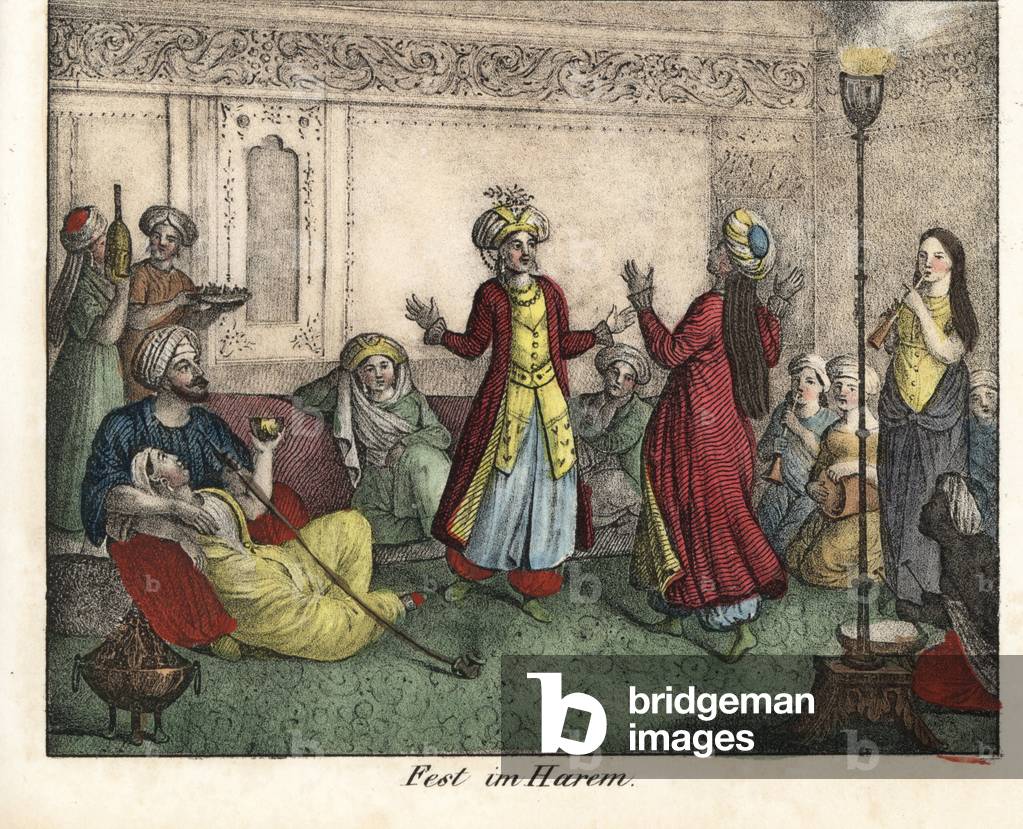
FLO4634935: Entertainment in an Egyptian harem: dancers and musicians, flutists and drummer, a man in a turban smokes the pipe, a woman gives him a cup, behind servants bring wine and food. Lithography for the book: “” Galerie complete en tableaux fideles des peuples d'Afrique” by Friedrich Wilhelm Goedsche (1785-1863), edition Meissen (Germany), 1835-1840. Entertainment in an Egyptian harem: women dancing, playing music on pipes and drums, while a man in a turban smokes a long tobacco pipe and is offered a drink by a woman. Servants bring wine and food. Handcoloured lithograph from Friedrich Wilhelm Goedsche's “” Vollstaendige Voelkergallerie in getreuen Abbildungen”” (Complete Gallery of Peoples in True Pictures), Meissen, circa 1835-1840. / Bridgeman Images
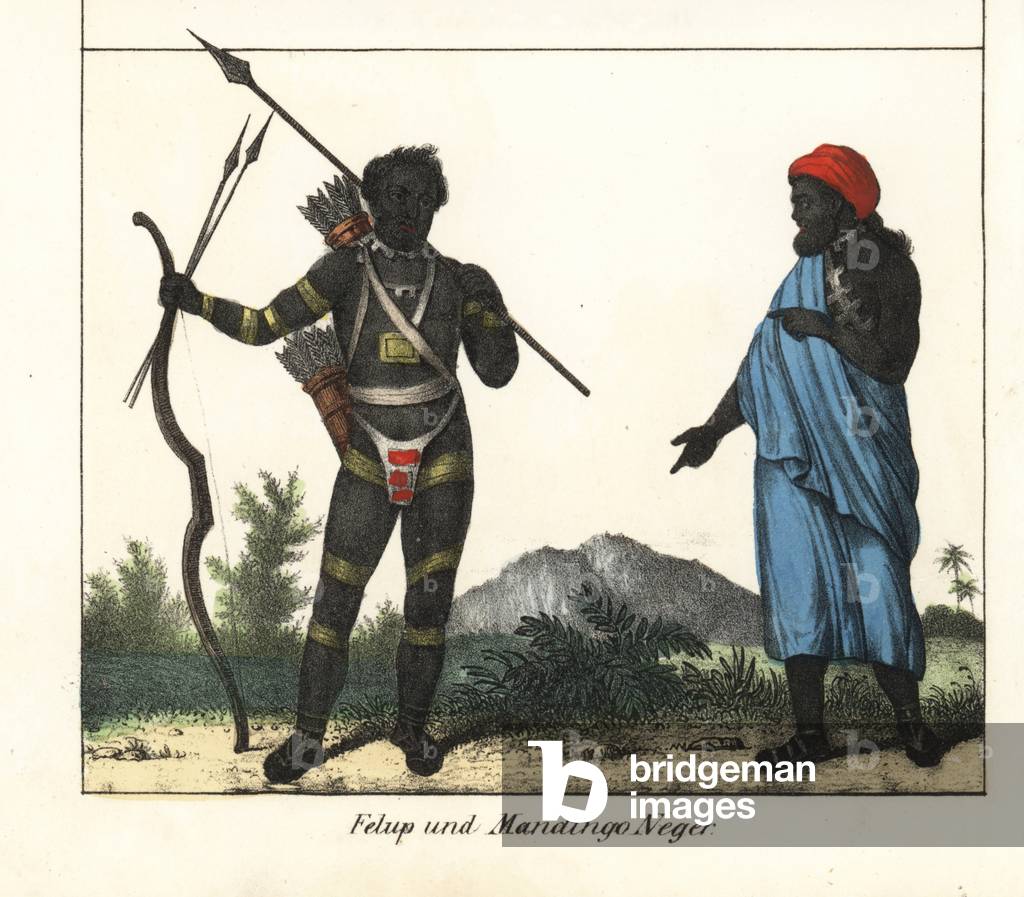
FLO4635208: Man bloup (Flup or feloupe) (Senegal) wearing gold circles around legs and arms and a mandinka (Mandinka or Mande) (West Africa) bearded, with a tunic and turban. Lithography for the book: “” Galerie complete en tableaux fideles des peuples d'Afrique” by Friedrich Wilhelm Goedsche (1785-1863), edition Meissen (Germany), 1835-1840. Fulup man in loin cloth and gold leg and arm bands with quivers, spears, bow and arrow, and a bearded Mandingo man in robe and turban. Handcoloured lithograph from Friedrich Wilhelm Goedsche's “” Vollstaendige Voelkergallerie in getreuen Abbildungen”” (Complete Gallery of Peoples in True Pictures), Meissen, circa 1835-1840. / Bridgeman Images
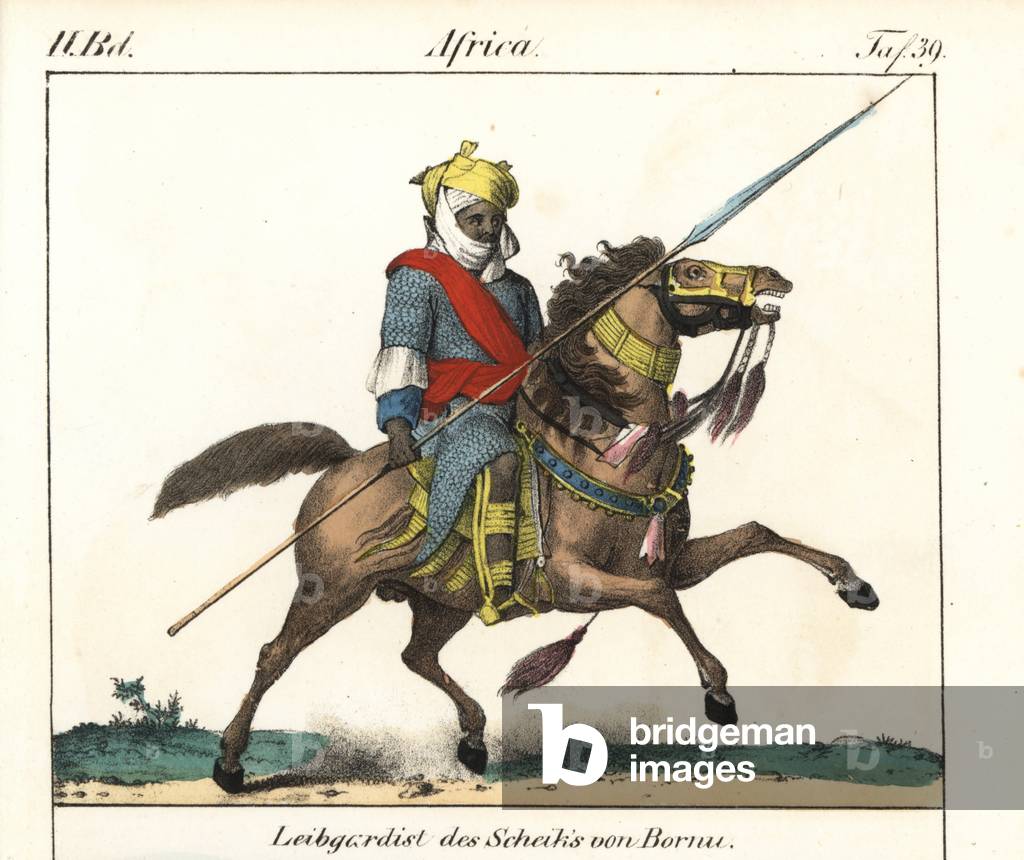
FLO4635209: Bodyguard of the Sheikh of Bornu (Chad, Nigeria). Lithography for the book: “” Galerie complete en tableaux fideles des peuples d'Afrique” by Friedrich Wilhelm Goedsche (1785-1863), edition Meissen (Germany), 1835-1840. Mounted bodyguard to the Sheik of Bornu in chain-mail armour and turban carrying a spear. Handcoloured lithograph from Friedrich Wilhelm Goedsche's “” Vollstaendige Voelkergallerie in getreuen Abbildungen”” (Complete Gallery of Peoples in True Pictures), Meissen, circa 1835-1840. / Bridgeman Images

FLO4635357: Native of Gona (Angola), a family with loons and below, a khoikhoi couple (South Africa) in fur coat. Lithography for the book: “” Galerie complete en tableaux fideles des peuples d'Afrique” by Friedrich Wilhelm Goedsche (1785-1863), edition Meissen (Germany), 1835-1840. Natives of Gona (Angola) above, man with bow and arrow, woman with beaded apron, child in loincloth, and Khoikhoi man in fur cape with spear and Khoikhoi woman in fur cape over beaded belts and apron. Handcoloured lithograph from Friedrich Wilhelm Goedsche's “” Vollstaendige Voelkergallerie in getreuen Abbildungen”” (Complete Gallery of Peoples in True Pictures), Meissen, circa 1835-1840. / Bridgeman Images

FLO4635327: Group of khoikhoi (South Africa) resting around a fire near the estuary of the Orange River and a couple of gonaqua (Lithography for the book: “” Galerie complete in faithful paintings of the peoples of Africa””” by Friedrich Wilhelm Goedsche (1785-1863), Meissen edition (Germany), 1835-1840. Khoikhoi in fur capes resting around a campfire near the Orange River estuary, and Gonaqua man and woman with bow and arrow, necklace, and beaded apron. Handcoloured lithograph from Friedrich Wilhelm Goedsche's “” Vollstaendige Voelkergallerie in getreuen Abbildungen”” (Complete Gallery of Peoples in True Pictures), Meissen, circa 1835-1840. / Bridgeman Images
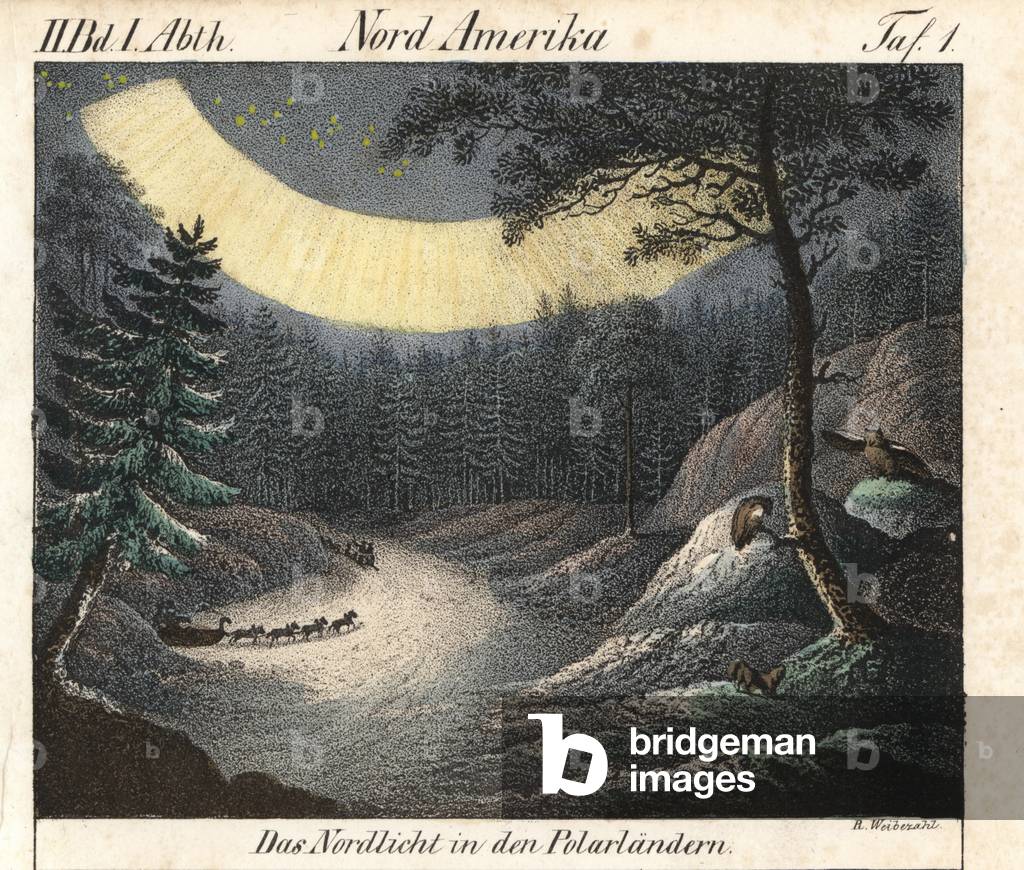
FLO4635408: Dog-drawn sleds, illuminated by the light of the aurora boreale, in the snow-covered forest of the polar regions of North America. Lithograph by R. Weiberzahl, for the book “” Galerie complete en tableaux fideles des peuples d'Amérique et d'Australie” by Friedrich Wilhelm Goedsche (1785-1863), edition Meissen (Germany), 1835-1840. Dogsled team riding through a snowy mountain scene against the northern lights or Aurora borealis in the polar region of North America. Lithograph by R. Weiberzahl. Handcoloured lithograph from Friedrich Wilhelm Goedsche's “” Vollstaendige Voelkergallerie in getreuen Abbildungen”” (Complete Gallery of Peoples in True Pictures), Meissen, circa 1835-1840. / Bridgeman Images

FLO4635425: Greenland dwellers wearing skins and one Inuit from Labrador (Canada) with a trident. Below is a daily scene of Inuit family life in front of an igloo, a tent and a canoe, North America. Lithography for the book: “” Galerie complete en tableaux fideles des peuples d'Amérique et d'Australie”” by Friedrich Wilhelm Goedsche (1785-1863), Meissen edition (Germany), 1835-1840. People from Greenland in fur clothes with bow, arrow and staff, eskimo from Labrador with bow, arrow and trident, and eskimo family in front of igloo, tipi and canoe in North America. Handcoloured lithograph from Friedrich Wilhelm Goedsche's “” Vollstaendige Voelkergallerie in getreuen Abbildungen”” (Complete Gallery of Peoples in True Pictures), Meissen, circa 1835-1840. / Bridgeman Images
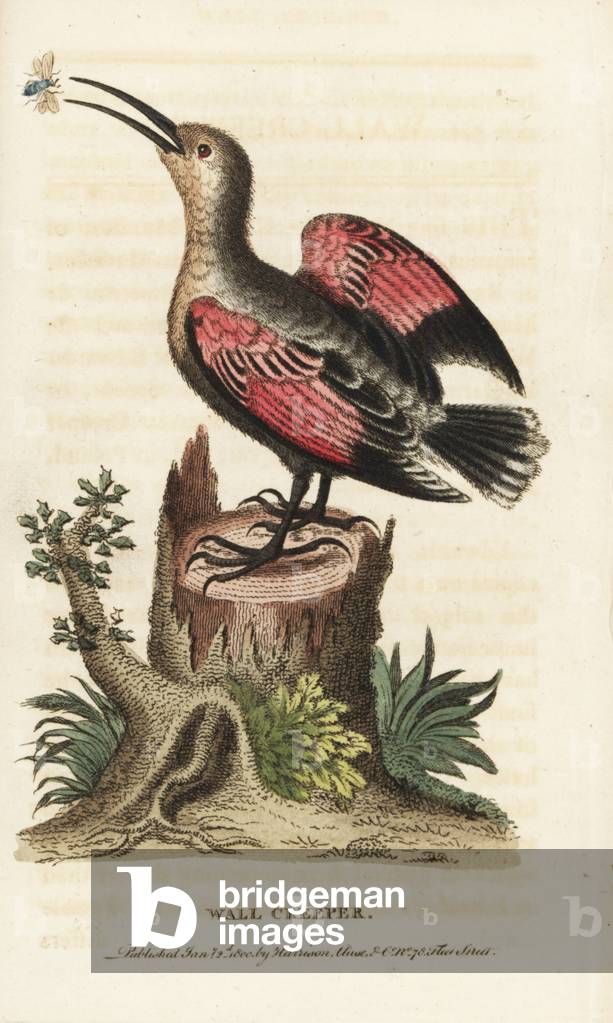
FLO4640010: Wallcreeper, Tichodroma muraria. Illustration copied from George Edwards. Handcoloured copperplate engraving from “” The Naturalist's Pocket Magazine,”” Harrison, London, 1800. / Bridgeman Images

FLO4640345: Spotted axis deer, Axis axis. Handcoloured copperplate engraving from “” The Naturalist's Pocket Magazine,”” Harrison, London, 1802. / Bridgeman Images

FLO4640377: Spotted blue fly of New South Wales. Handcoloured copperplate engraving from “” The Naturalist's Pocket Magazine,”” Harrison, London, 1802. / Bridgeman Images

PIX4640109: Space station in orbit - Illustration - Space station in orbit - Illustratio / Bridgeman Images

PIX4640264: Journey to the Nebula of Orion - Trip to the Orion nebula - Artist view - Vue artiste / Bridgeman Images

FLO4640340: Garden or great tiger moth, Arctia caja. Illustration copied from Moses Harris. Handcoloured copperplate engraving from “” The Naturalist's Pocket Magazine,”” Harrison, London, 1799. / Bridgeman Images

PIX4640370: Artist view of a spacecraft and a comet - A spacecraft approaching a comet - Artist view - Artist view of a spacecraft approaching a comet on Earth. Illustration made for the cover of Gregory Benford's novel “Dans l'ocean de la nuit” (in the ocean of night). A spacecraft approaches a comet that is on a collision course with earth, Dixon, Don (b.1951) / Bridgeman Images

FLO4640378: Songar rat, Mus songarus. Illustration copied from Thomas Pennant. Handcoloured copperplate engraving from “” The Naturalist's Pocket Magazine,”” Harrison, London, 1799. / Bridgeman Images

FLO4640432: Coral snake, Micrurus surinamensis? (Surinam amphisboena, Amphisbaena magnifica?) Illustration by Maria Sybilla Merian. Handcoloured copperplate engraving from “” The Naturalist's Pocket Magazine,”” Harrison, London, 1800. / Bridgeman Images

FLO4640441: Western or Arfak parotia, Parotia sefilata, bird of paradise with six head wires. Illustration copied from George Edwards. Handcoloured copperplate engraving from “” The Naturalist's Pocket Magazine,”” Harrison, London, 1799. / Bridgeman Images

FLO4640547: European sea squirt, Ascidiella aspersa. (Animal plant, Priapus polypus.) Copied from George Edwards' Gleanings of Natural History, 1758. Handcoloured copperplate engraving from “” The Naturalist's Pocket Magazine,”” Harrison, London, 1799. / Bridgeman Images

FLO4640554: Banded cotinga, Cotinga maculata, male. (Purple-breasted blue manakin) Endangered. Copied from George Edwards “Natural History of Birds,” 1749. Handcoloured copperplate engraving from “” The Naturalist's Pocket Magazine,”” Harrison, London, 1799. / Bridgeman Images

FLO4640575: Ribband fish, unknown species. Illustration copied from George Edwards from a specimen sent from the Caribbean islands. Handcoloured copperplate engraving from “” The Naturalist's Pocket Magazine,”” Harrison, London, 1799. / Bridgeman Images
