2491708 Search Results

DPL443625: Cheyenne chiefs held as hostages by General Custer for the return of Mrs Morgan and Mrs White (b/w photo), American Photographer, (19th century) / Bridgeman Images

NCO434805: John Desford, 1419 (brass) (detail of 343804), English School, (15th century) / Bridgeman Images

NCO434811: John Palmer, 1479 (brass), English School, (15th century) / Bridgeman Images

NCO434814: Anthony Aylworth, 1619 (brass) (detail of 434813), English School, (17th century) / Bridgeman Images

NCO434817: Walter Hylle, 1494 (brass), English School, (15th century) / Bridgeman Images

HRM434832: Set of 64 buttons, Moscow, early 18th century (ivory & gold), Russian School, (18th century) / Bridgeman Images

HRM434865: Detail of the grave blanket of Tsarevich Ivan Mickhailovich, Kremlin workshops, 1639 (gold, damask & pearls) (see also 343864), Gomulin, Ivan (17th century) (after) / Bridgeman Images

HRM434876: Panagia with chain, Vyatka, c.1690 (silver, filigree, enamel & precious stones), Russian School, (17th century) / Bridgeman Images

STC434944: Tomb of Sultan Qalaoun in Cairo (litho), French School, (19th century) / Bridgeman Images

MIA437338: Burdine's Boulevard Shop, Miami Beach, 27 April 1930 (b/w photo), American Photographer, (20th century) / Bridgeman Images

XIR442224: French hosts: His Majesty Oscar II, King of Sweden and Norway, front cover illustration of 'Le Petit Journal', supplement illustre, 26th March 1899 (coulour litho), Meyer, Henri (1841-99) / Bridgeman Images

MIA437373: Buildings on Avenue D (Miami Avenue), c.1896 (b/w photo), Matlack, Claude C. (1878-1944) / Bridgeman Images

MIA437380: Line of buses heading east on Flagler Street, Downtown Miami, 1925 (b/w photo), American Photographer, (20th century) / Bridgeman Images

CHT442250: Poster advertising the Folies Bergere, rue Richer, Paris, 1875 (engraving) (b/w photo), Levy, Emile (1826-90) / Bridgeman Images

NCO443290: Old Master Engraving (engraving), Collaert, Adriaen (1560-1618) / Bridgeman Images

NCO443293: Adam and Eve in the Garden of Eden surrounded by trees and wildlife (engraving), Bolswert, Boetius Adams (1580-1633) / Bridgeman Images

MAN443318: The Old Squire, 1838 (oil on canvas), Tennant, John F. (1796-1872) / Bridgeman Images

DPL443610: Sintegaleska, Spotted Tail, Oglala Dakota I, 1880s (b/w photo), Barry, David Frances (1854-1934) / Bridgeman Images

CH443718: Portrait of a Gentleman (oil on canvas), Lely, Peter (1618-80) / Bridgeman Images

WGL443779: On Jura's Heath (pen & ink with w/c on paper), Cox, Edward W. (1826-99) / Bridgeman Images

HGP443836: Dominations, with triple crown and sceptre, and Seraphim, with a thurible, two of the Nine Orders of Angels, detail of the rood screen, St. Michael's Church, Barton Turf, Norfolk, UK (tempera on wood) (see also 443835, 443837, 443839, 443840 and 443851), English School / Bridgeman Images

HGP443848: Principalities, one of the Nine Orders of Angels, Superior Hierarchy, detail of the rood screen, St. Michael's Church, Barton Turf, Norfolk, UK (tempera on wood) (see also 443814 to 443816, 443827 to 443830 and 443846 to 443850), English School / Bridgeman Images

HGP443857: St. Apollonia, holding a pair of pincers and a tooth, detail of the rood screen, St. Michael's Church, Barton Turf, Norfolk, UK (tempera on wood) (see also 443838, 443840 and 443855 to 443859), English School / Bridgeman Images

HGP443904: Saints Philip, James the Less, Matthias, Jude, John the Divine and James the Great, detail of the rood screen, north side, Castle Acre Priory, Norfolk, UK (see also 443902 to 443917), English School, (15th century) / Bridgeman Images

HGP443916: St. Philip, holding loaves of bread, and St. James the Less, holding a fuller's club, detail of the rood screen, Castle Acre Priory, Norfolk, UK (see also 443902 to 443917), English School, (15th century) / Bridgeman Images

HGP443922: St. Jerome, wearing the red hat and gown of a cardinal, detail of the pulpit, Castle Acre Priory, Norfolk, UK (tempera on wood) (see also 443918 to 443922), English School, (15th century) / Bridgeman Images

HGP443931: St. Augustine, Bishop of Hippo, detail of the rood screen, St. Agnes Church. Cawston, Norfolk, UK (tempera on wood), English School, (15th century) / Bridgeman Images

HGP443955: St. Philip, detail of the rood screen, St. Agnes Church, Cawston, Norfolk, UK (tempera on wood), English School, (15th century) / Bridgeman Images

HGP443961: St. Paul and St. Margaret of Antioch, detail of the rood screen, All Saints Church, Filby, Norfolk, UK, c.1450 (tempera on wood), English School, (15th century) / Bridgeman Images

HGP443982: St. Barbara with Castle Tower, detail of the rood screen, All Saints Church, Filby, Norfolk, UK, c.1450 (tempera on wood), English School, (15th century) / Bridgeman Images

HGP443994: St. Jerome and St. Ambrose, detail of the rood screen, St. Thomas Church, Foxley, Norfolk, UK (tempera on wood), English School, (15th century) / Bridgeman Images

HGP444009: St. Walstan of Bawburgh and St. Hubert, detail of the rood screen, All Saints Church, Litcham, Norfolk, UK (tempera on wood), English School, (16th century) / Bridgeman Images

HGP444030: St Edmund, detail of the rood screen, St Catherine's Church, Ludham, Norfolk, UK (tempera on wood), English School, (16th century) / Bridgeman Images

HGP444033: Saints Lawrence and Apollonia, detail of the rood screen, St Catherine's Church, Ludham, Norfolk, UK (tempera on wood), English School, (16th century) / Bridgeman Images

XJF437515: Composita, engraved by Johannes Wierix (1549-c.1618) reprinted 1638 (engraving), Vredeman de Vries, Hans (1527-1604 or 1623) (after) / Bridgeman Images
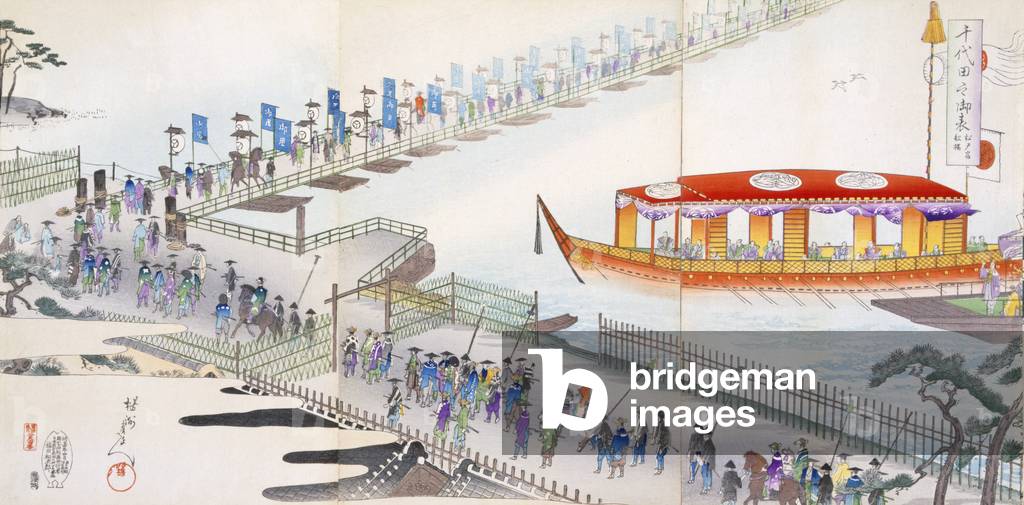
STC437651: Attending a Festival: crossing a pontoon bridge to the sacred site (colour woodblock print), Japanese School, (19th century) / Bridgeman Images
