Search options

Orientation
Colour

Display options

View

Print

To print search results, use print friendly version of this page.

2491514 Search Results

Breakfast. Gentlemen in coat tails and breeches and ladies in veils and dresses share a breakfast of coffee and bread. Great familiarity reigns in the morning, one has no time to become ceremonial, breakfast is the honest meal.” Handcoloured engraving from Pierre de la Mesanger's Le Bon Genre, Paris, 1817.

FLO4677718: Breakfast. Gentlemen in coat tails and breeches and ladies in veils and dresses share a breakfast of coffee and bread. Great familiarity reigns in the morning, one has no time to become ceremonial, breakfast is the honest meal.” Handcoloured engraving from Pierre de la Mesanger's Le Bon Genre, Paris, 1817. / Bridgeman Images
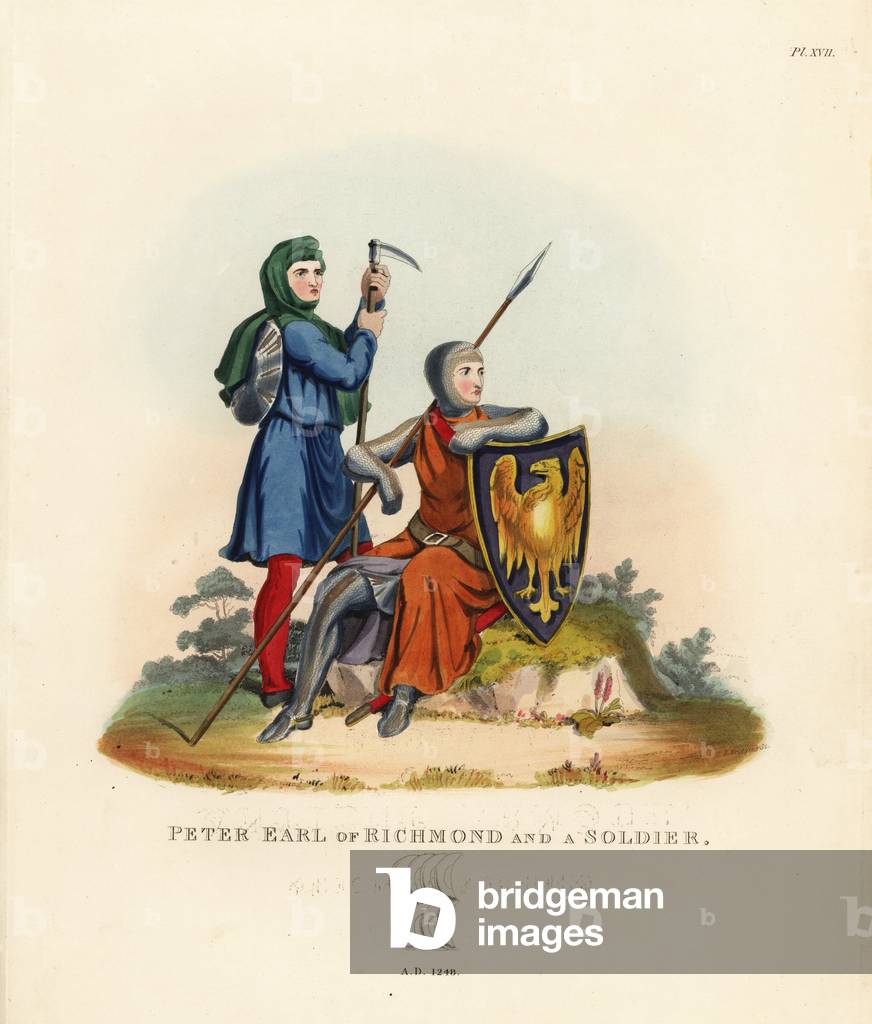
Peter II, Count of Savoy, Earl of Richmond, and a soldier. 1248. The Earl wears a chainmail hauberk and chausses, tunic, and carries a lance and shield with coat of arms. The footsoldier wears a cargan hood, carries an oucin and round shield. Handcoloured lithograph after an illustration by S.R. Meyrick from Sir Samuel Rush Meyrick's A Critical Inquiry into Antient Armour.

FLO4678629: Peter II, Count of Savoy, Earl of Richmond, and a soldier. 1248. The Earl wears a chainmail hauberk and chausses, tunic, and carries a lance and shield with coat of arms. The footsoldier wears a cargan hood, carries an oucin and round shield. Handcoloured lithograph after an illustration by S.R. Meyrick from Sir Samuel Rush Meyrick's A Critical Inquiry into Antient Armour. / Bridgeman Images

Orchid: oncidium variete, West Indies epiphyte - Plate engraved by S.Watts, from an illustration by Sarah Anne Drake (1803-1857), from the Botanical Register of Sydenham Edwards (1768-1819), England, 1833 - Oncidium baueri orchid (Lofty oncidium, Oncidium altissimum) - Engraving by S. Watts after an after an illustration by Miss Drake from Sydenham Edwards' “” The Botanical Register,” London, Ridgway, 1833

FLO4679302: Orchid: oncidium variete, West Indies epiphyte - Plate engraved by S.Watts, from an illustration by Sarah Anne Drake (1803-1857), from the Botanical Register of Sydenham Edwards (1768-1819), England, 1833 - Oncidium baueri orchid (Lofty oncidium, Oncidium altissimum) - Engraving by S. Watts after an after an illustration by Miss Drake from Sydenham Edwards' “” The Botanical Register,” London, Ridgway, 1833, Edwards, Sydenham Teast (c.1768-1819) / Bridgeman Images

The Flower Walk, 1839 (oil on canvas)

JLJ4675142: The Flower Walk, 1839 (oil on canvas), Demay, Jean Francois (1798-1850) / Bridgeman Images
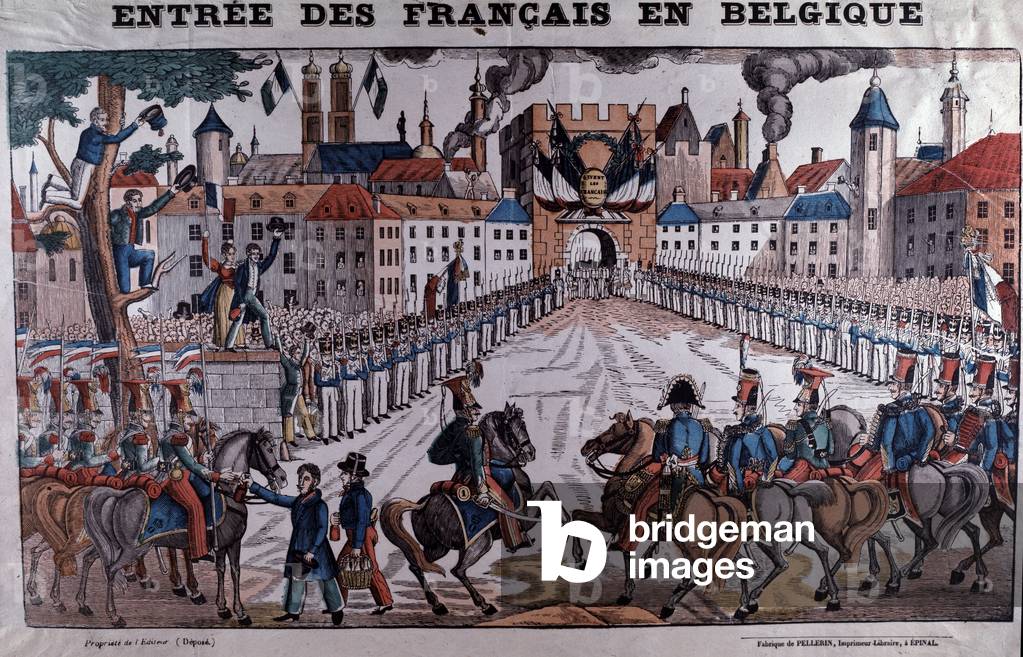
French army entering belgium to support the Belgian independance in October 1830 (Engraving)

LRI4675774: French army entering belgium to support the Belgian independance in October 1830 (Engraving), Unknown Artist, (19th century) / Bridgeman Images

Kneeling donor Fragment of a carved altarpiece in polychrome wood. From Swabia, c.1520 (sculpture)

JLJ4675292: Kneeling donor Fragment of a carved altarpiece in polychrome wood. From Swabia, c.1520 (sculpture), German School, (16th century) / Bridgeman Images

Auriga, 6th century (Bronze sculpture)

LRI4675030: Auriga, 6th century (Bronze sculpture), Greek school, (6th century BC) / Bridgeman Images

December. The size of the vines. 1206-1211 (sculpture)

LRI4677553: December. The size of the vines. 1206-1211 (sculpture), Antelami, Benedetto (c.1150-c.1230) / Bridgeman Images

Arabe d'El-Aghouat en burnous, 1857 (porphyry, bronze and onyx)

JLJ4678854: Arabe d'El-Aghouat en burnous, 1857 (porphyry, bronze and onyx), Cordier, Charles-Henri-Joseph (1827-1905) / Bridgeman Images

Man and rider. 12th-13th century (Sculpture)

LRI4677541: Man and rider. 12th-13th century (Sculpture), Antelami, Benedetto (c.1150-c.1230) / Bridgeman Images

Armor chest designed for Emperor Napoleon I (1769-1821) in 1807 for the Battle of Tilsit in 1807, 19th century

JLJ4677746: Armor chest designed for Emperor Napoleon I (1769-1821) in 1807 for the Battle of Tilsit in 1807, 19th century, Unknown Artist, (19th century) / Bridgeman Images
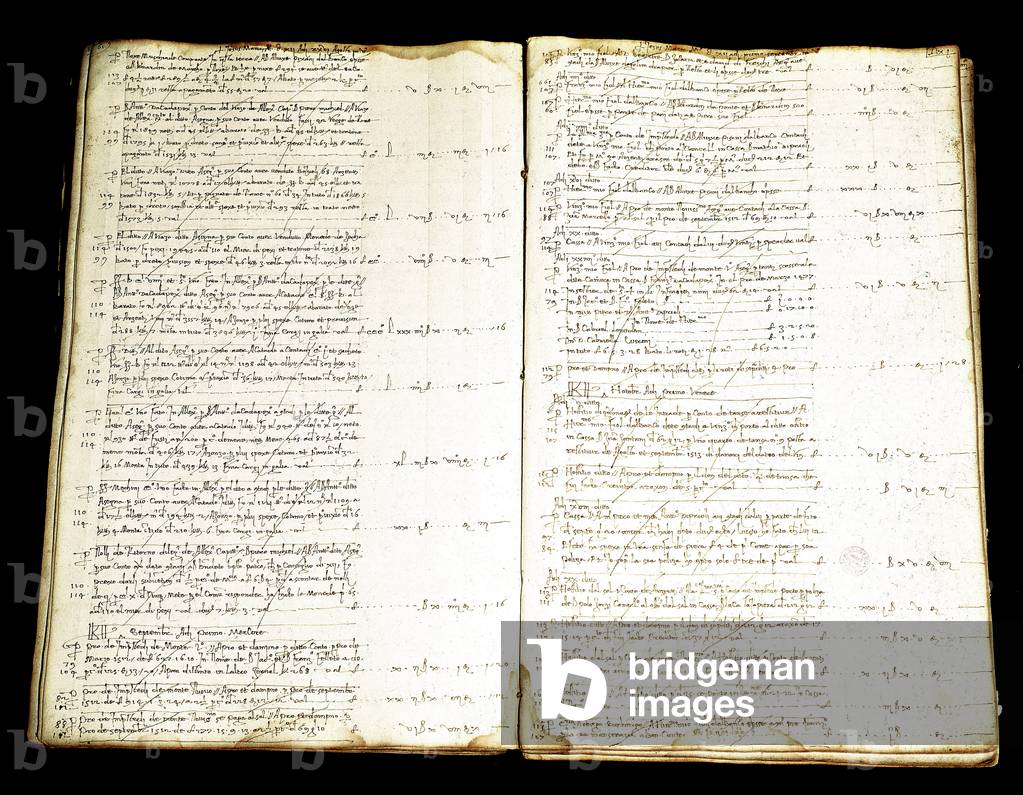
Double page of a register of accounts of the Priuli family of the Venetian nobility, rich traders with the East. 16th century Museo Correr, Venice

LRI4676855: Double page of a register of accounts of the Priuli family of the Venetian nobility, rich traders with the East. 16th century Museo Correr, Venice, Italian School, (16th century) / Bridgeman Images

Medicine: influence of the zodiac on human diseases (Miniature, 15th century)

LRI4677266: Medicine: influence of the zodiac on human diseases (Miniature, 15th century), Albik, M, (15th century) / Bridgeman Images

Fashionable women or wonderful eating ice cream with their dogs at a cafe, circa 1800. The menu includes lemon, orange, pistachio, and white cream. “” Parisiennes are the most graceful of women, even when eating greedily.”” Handcoloured engraving from Pierre de la Mesanger's Le Bon Genre, Paris, 1817.

FLO4678047: Fashionable women or wonderful eating ice cream with their dogs at a cafe, circa 1800. The menu includes lemon, orange, pistachio, and white cream. “” Parisiennes are the most graceful of women, even when eating greedily.”” Handcoloured engraving from Pierre de la Mesanger's Le Bon Genre, Paris, 1817. / Bridgeman Images

Tomb of Publius Vibius Marianus, Rome. Copperplate engraving by Henry Moses from A Collection of Antique Vases, Altars, etc., London, 1814.

FLO4679441: Tomb of Publius Vibius Marianus, Rome. Copperplate engraving by Henry Moses from A Collection of Antique Vases, Altars, etc., London, 1814. / Bridgeman Images

From a very ancient vase in the British Museum decorated with a man riding a two-horse chariot, another man with a spear. Copperplate engraving by Henry Moses from A Collection of Antique Vases, Altars, etc., London, 1814.

FLO4679311: From a very ancient vase in the British Museum decorated with a man riding a two-horse chariot, another man with a spear. Copperplate engraving by Henry Moses from A Collection of Antique Vases, Altars, etc., London, 1814. / Bridgeman Images

Costume d'un medecin italian, 14th century - Italian doctor or physician, 14th century - He wears a velvet cap trimmed with fur, a black cape lined in white, scarlet robe, green sleeves, red shoes - He carries a gold box and pincers - From a painting by an unknown artist in the Academy of Fine Arts, Siena - Handcoloured illustration drawn and lithographed by Paul Mercuri with text by Camille Bonnard from “” Historical Costumes from the 12th to 15th Centuries,”” Levy Fils, Paris, 1860

FLO4676721: Costume d'un medecin italian, 14th century - Italian doctor or physician, 14th century - He wears a velvet cap trimmed with fur, a black cape lined in white, scarlet robe, green sleeves, red shoes - He carries a gold box and pincers - From a painting by an unknown artist in the Academy of Fine Arts, Siena - Handcoloured illustration drawn and lithographed by Paul Mercuri with text by Camille Bonnard from “” Historical Costumes from the 12th to 15th Centuries,”” Levy Fils, Paris, 1860, Mercuri, Paolo (1804-84) / Bridgeman Images

Military suit: Victor (Vettore) Pisani (1324-1380), venitian admiral (Italy) - Vettore Pisani, Venetian admiral, 14th century - He wears a red toque, ted tunic buckled up the front, suit of steel plate armour, thighs, greaves, gauntlets, and shoes, edged with gold - His arms include two-handed sword and dagger - From the statue in Venice arsenal - Handcoloured illustration drawn and lithographed by Paul Mercuri with text by Camille Bonnard from “” Historical Costumes from the 12th to 15th Centuries,”” Levy Fils, Paris, 1860

FLO4676769: Military suit: Victor (Vettore) Pisani (1324-1380), venitian admiral (Italy) - Vettore Pisani, Venetian admiral, 14th century - He wears a red toque, ted tunic buckled up the front, suit of steel plate armour, thighs, greaves, gauntlets, and shoes, edged with gold - His arms include two-handed sword and dagger - From the statue in Venice arsenal - Handcoloured illustration drawn and lithographed by Paul Mercuri with text by Camille Bonnard from “” Historical Costumes from the 12th to 15th Centuries,”” Levy Fils, Paris, 1860, Mercuri, Paolo (1804-84) / Bridgeman Images

Mathilde of Tuscany (ca. 1046-1145), called Countess Mathilde, Mathilde de Briey or Mathilde de Canossa - Matilda of Tuscany, 1046-1115 - She wears a conical hat decorated with gemstones, pink veil, red chlamys edged with gold tied at the left shoulder, blue robe edged with gold on the sleeves She sits on a throne, with cushion and footrest - Illustration taken from a manuscript of Donizo's “” Vita Mathildis -”” Handcoloured illustration drawn and lithographed by Paul Mercuri with text by Camille Bonnard from “” Historical Costumes from the 12th to 15th Centuries,”” Levy Fils, Paris, 1860

FLO4676631: Mathilde of Tuscany (ca. 1046-1145), called Countess Mathilde, Mathilde de Briey or Mathilde de Canossa - Matilda of Tuscany, 1046-1115 - She wears a conical hat decorated with gemstones, pink veil, red chlamys edged with gold tied at the left shoulder, blue robe edged with gold on the sleeves She sits on a throne, with cushion and footrest - Illustration taken from a manuscript of Donizo's “” Vita Mathildis -”” Handcoloured illustration drawn and lithographed by Paul Mercuri with text by Camille Bonnard from “” Historical Costumes from the 12th to 15th Centuries,”” Levy Fils, Paris, 1860, Mercuri, Paolo (1804-84) / Bridgeman Images

Variete d'heliconia (so-called floury) - Plate engraved by S.Watts, based on an illustration by Sarah Anne Drake (1803-1857), from the Botanical Register of Sydenham Edwards (1768-1819), England, 1833 - Powdered heliconia, Heliconia farinosa (Heliconia pulverulenta) - Engraving by S. Watts after an illustration by S. Watts after an illustration by Miss Drake from Denham Edwards' “” The Botanical Register,” London, Ridgway, 1833

FLO4679068: Variete d'heliconia (so-called floury) - Plate engraved by S.Watts, based on an illustration by Sarah Anne Drake (1803-1857), from the Botanical Register of Sydenham Edwards (1768-1819), England, 1833 - Powdered heliconia, Heliconia farinosa (Heliconia pulverulenta) - Engraving by S. Watts after an illustration by S. Watts after an illustration by Miss Drake from Denham Edwards' “” The Botanical Register,” London, Ridgway, 1833, Edwards, Sydenham Teast (c.1768-1819) / Bridgeman Images

Military costume of an officer in the court of Frederic III of the Holy Empire (1415-1493) - Military costume of an officer in the court of Frederick III, Holy Roman Emperor, 15th century - He wears a black cap, doublet with slashed sleeves revealing his shirt, breeches, stockings, garters, and carries a cane - From the Titius Livius manuscript in the Biblioteca Ambrosiana, Milan - Handcoloured illustration drawn and lithographed by Paul Mercuri with text by Camille Bonnard from “” Historical Costumes from the 12th to 15th Centuries,”” Levy Fils, Paris, 1861

FLO4676237: Military costume of an officer in the court of Frederic III of the Holy Empire (1415-1493) - Military costume of an officer in the court of Frederick III, Holy Roman Emperor, 15th century - He wears a black cap, doublet with slashed sleeves revealing his shirt, breeches, stockings, garters, and carries a cane - From the Titius Livius manuscript in the Biblioteca Ambrosiana, Milan - Handcoloured illustration drawn and lithographed by Paul Mercuri with text by Camille Bonnard from “” Historical Costumes from the 12th to 15th Centuries,”” Levy Fils, Paris, 1861, Mercuri, Paolo (1804-84) / Bridgeman Images

Sir John Harsich, 1384. He wears his tilting helmet with turkey-feather crest and cointisse over his bassinet. The wreath below the crest is two pieces of silk in his armorial colours twisted together by a lady. Handcoloured lithograph by Maddocks after an illustration by S.R. Meyrick from Sir Samuel Rush Meyrick's A Critical Inquiry into Antient Armour.

FLO4678208: Sir John Harsich, 1384. He wears his tilting helmet with turkey-feather crest and cointisse over his bassinet. The wreath below the crest is two pieces of silk in his armorial colours twisted together by a lady. Handcoloured lithograph by Maddocks after an illustration by S.R. Meyrick from Sir Samuel Rush Meyrick's A Critical Inquiry into Antient Armour. / Bridgeman Images

Suit d'un homme jeif, 14eme century - Jewish man, 14th century - He wears a white hood, yellow cape with gold embroidery, green robe, red belt and shoes - From a painting by Sano di Pietro in the Academy of Fine Arts, Siena - Handcoloured illustration drawn and lithographed by Paul Mercuri with text by Camille Bonnard from “” Historical Costumes from the 12th to 15th Centuries,”” Levy Fils, Paris, 1860

FLO4676850: Suit d'un homme jeif, 14eme century - Jewish man, 14th century - He wears a white hood, yellow cape with gold embroidery, green robe, red belt and shoes - From a painting by Sano di Pietro in the Academy of Fine Arts, Siena - Handcoloured illustration drawn and lithographed by Paul Mercuri with text by Camille Bonnard from “” Historical Costumes from the 12th to 15th Centuries,”” Levy Fils, Paris, 1860, Mercuri, Paolo (1804-84) / Bridgeman Images

Knight of the short-lived Order of the Knot, an order of chivalry founded in 1352 by Louis of Taranto, King of Naples - He wears a brown tabard, steel helm, suit of armour, gauntlets and spurs - The helm edges of the shield are decorated with knots - From a sepulchral stone in the church of Saint Catherine, Pisa - Handcoloured illustration drawn and lithographed by Paul Mercuri with text by Camille Bonnard from “” Historical Costumes from the 12th to 15th Centuries,”” Levy Fils, Paris, 1861

FLO4675970: Knight of the short-lived Order of the Knot, an order of chivalry founded in 1352 by Louis of Taranto, King of Naples - He wears a brown tabard, steel helm, suit of armour, gauntlets and spurs - The helm edges of the shield are decorated with knots - From a sepulchral stone in the church of Saint Catherine, Pisa - Handcoloured illustration drawn and lithographed by Paul Mercuri with text by Camille Bonnard from “” Historical Costumes from the 12th to 15th Centuries,”” Levy Fils, Paris, 1861, Mercuri, Paolo (1804-84) / Bridgeman Images

Military costume: un soldat en cotes de meshes, 13th century (supposedly representation of Hugues III (1148-1192), Duke of Burgundy) - Military costume, 13th century - He wears a blue casque with yellow bend sinister, full chainmail suit of armour, violet tunic, buckler (shield) and sword - From a contemporary manuscript - According to Massard, this is Hugh III, Duke of Burgundy, 12th century - Handcoloured illustration drawn and lithographed by Paul Mercuri with text by Camille Bonnard from “” Historical Costumes from the 12th to 15th Centuries,”” Levy Fils, Paris, 1860

FLO4676632: Military costume: un soldat en cotes de meshes, 13th century (supposedly representation of Hugues III (1148-1192), Duke of Burgundy) - Military costume, 13th century - He wears a blue casque with yellow bend sinister, full chainmail suit of armour, violet tunic, buckler (shield) and sword - From a contemporary manuscript - According to Massard, this is Hugh III, Duke of Burgundy, 12th century - Handcoloured illustration drawn and lithographed by Paul Mercuri with text by Camille Bonnard from “” Historical Costumes from the 12th to 15th Centuries,”” Levy Fils, Paris, 1860, Mercuri, Paolo (1804-84) / Bridgeman Images

Francoise d'Aubigne, Marquise de Maintenon, wife of King Louis XIV of France, 1653-1719. After an enamel portrait. Handcoloured copperplate engraving by Gatine after an illustration by Louis Marie Lante from Pierre de la Mesanger's “Costumes des femmes celebres” (Costumes of Famous Women), Paris, 1827.

FLO4678098: Francoise d'Aubigne, Marquise de Maintenon, wife of King Louis XIV of France, 1653-1719. After an enamel portrait. Handcoloured copperplate engraving by Gatine after an illustration by Louis Marie Lante from Pierre de la Mesanger's “Costumes des femmes celebres” (Costumes of Famous Women), Paris, 1827. / Bridgeman Images

Alexander I King of Scotland - Alexander I, King of Scotland, 1107. Alexander the Fierce, 1078-1124. He wears a helmet, hauberk tunic with hood, rides a horse and carries a lance with pennant and targe shield. Handcoloured lithograph after an illustration by S.R. Meyrick from Sir Samuel Rush Meyrick's A Critical Inquiry into Antient Armour.

FLO4678322: Alexander I King of Scotland - Alexander I, King of Scotland, 1107. Alexander the Fierce, 1078-1124. He wears a helmet, hauberk tunic with hood, rides a horse and carries a lance with pennant and targe shield. Handcoloured lithograph after an illustration by S.R. Meyrick from Sir Samuel Rush Meyrick's A Critical Inquiry into Antient Armour. / Bridgeman Images

Knight armed for the bond, a joust where the horse's eyes were covered, 1512. Knight in visored salad helmet with ring hooked to the grand guard a la montoniere, breastplate with lance rest and drapery, lance with morne, coronel and pennant. Horse in chamfron and caparison covering the eyes. Handcoloured lithograph by Maddocks after an illustration by S.R. Meyrick from Sir Samuel Rush Meyrick's A Critical Inquiry into Antient Armour.

FLO4678549: Knight armed for the bond, a joust where the horse's eyes were covered, 1512. Knight in visored salad helmet with ring hooked to the grand guard a la montoniere, breastplate with lance rest and drapery, lance with morne, coronel and pennant. Horse in chamfron and caparison covering the eyes. Handcoloured lithograph by Maddocks after an illustration by S.R. Meyrick from Sir Samuel Rush Meyrick's A Critical Inquiry into Antient Armour. / Bridgeman Images

Map of the Molucca Islands east of Indonesia. (engraving, 1638)

LRI4678184: Map of the Molucca Islands east of Indonesia. (engraving, 1638), Blaeu, Willem (1571-1638) / Bridgeman Images

Allies of Prussia under Schwartzenberg defeated French under Marmont/Mortier (engraving)

LRI4675729: Allies of Prussia under Schwartzenberg defeated French under Marmont/Mortier (engraving), Unknown Artist, (19th century) / Bridgeman Images

Cashew tree and nuts (Western Anacardium), 1788-1803 (engraving)

LRI4677071: Cashew tree and nuts (Western Anacardium), 1788-1803 (engraving), Austrian School, (18th century) / Bridgeman Images

Moonlight, 1887 (oil on canvas)

JLJ4675631: Moonlight, 1887 (oil on canvas), Breitner, Georg-Hendrik (1857-1923) / Bridgeman Images

Fashion:
Fashion:

JLJ4678229: Fashion: "Woman and Child, Japanese Blouse and Marine Costume", 1913 (engraving), Barbier, Georges (1882-1932) / Bridgeman Images

The Italian patriot Giuseppe Garibaldi transports his wife Anita suffering from tiphoid to Ravenna in 1849 (Watercolour)

LRI4676693: The Italian patriot Giuseppe Garibaldi transports his wife Anita suffering from tiphoid to Ravenna in 1849 (Watercolour), Induno, Gerolamo (1827-90) / Bridgeman Images

The Mont Renault Lookout (April 1918), 1918 (oil on canvas)

JLJ4675209: The Mont Renault Lookout (April 1918), 1918 (oil on canvas), Flameng, Francois (1856-1923) / Bridgeman Images

Cartoon depicting composer Franz Liszt (1811-1886), 1842 (drawing)

JLJ4677938: Cartoon depicting composer Franz Liszt (1811-1886), 1842 (drawing), Lorentz, Alcide Joseph (1813-89) / Bridgeman Images


Back to top