2497532 Search Results

PIX4585397: Sundial - Sundial - Vertical sundial of the village of Moncenisio (Ferrera Cenisio) in Italy. Vertical sundial in Ferrera Cenisio, Italy / Bridgeman Images

PIX4585462: Meridian of the Church of Saint Martin des Vignes (Troyes) - Noon Mark on Saint Martin des Vignes (Troyes) - It dates from 1778. This is one of the few Meridians in France to indicate the time of the Meridian of the Ile de Fer (now Hierro in the Canary Islands). The Meridian of Iron Island was defined as the Meridian of origin by Ptolemee, in order to count positively the longitude in Europe. At that time, Iron Island was the most western known land. This meridian was considered in France as a meridian of reference, from 1634 to 1792, then abandoned to the profile of the meridian of Paris, then that of Greenwich / Bridgeman Images

PIX4585679: Prague Astronomical Clock - 15th century - The Prague Astronomical Clock - 15th century - The Prague Astronomical Clock - 15th century - The Prague City Hall Astronomical Clock, built by Nicholas of Kadau in 1410, and redesigned by Master Hanus de la Rose (Jan Ruze) around 1490. May 2007. (clock and calendar). Prague astronomical clock was made by clockmaker Mikulas of Kadan in 1410 and rearranged in 1490. May 2007 / Bridgeman Images

PIX4599393: Gemini 4: release of Ed.White - Gemini 4: Ed White EVA - First release of an American into space made by Edward White on June 3, 1965. On June 3, 1965 Edward H. White II became the first American to step outside his spacecraft and let go, effectively setting himself adrift in the zero gravity of space. For 23 minutes White floated and maneuvered himself around the Gemini spacecraft while logging 6500 miles during his orbital walk. White was attached to the spacecraft by a 25 foot umbilical line and a 23 - ft. tether line, both wrapped in gold tape to form one cord. In his right hand White carries a Hand Held Self Maneuvering Unit (HHSMU) which is used to move about the weightless environment of space. The visor of his helmet is gold plated to protect him from the unfiltered rays of the sun / Bridgeman Images

OMG4599756: Renovation of the glass court of the Palais des Etudes des Beaux-Arts in Paris. The courtyard is an extraordinary architectural ensemble designed by Felix Duban (1798-1870) during the 1830s. In 1867, in order to protect the carving castings from the Musee du Louvre, this courtyard was covered with a glass on a metal frame which then constituted all its wealth. At the death of Felix Duban, Ernest Coquart (1831-1903) took over the construction site by covering the facades of a polychrome decor from Italian inspiration. The Palais des Etudes is an exceptional testimony of 19th century architecture. With the Cour vitree, Felix Duban completed the formidable educational program. In 1970, most of the castings were transferred to the Petite stables of the Chateau de Versailles.Photography 03/06/09. / Bridgeman Images

LRI4599817: Aerial view of the city of Recife, Pernambuco state (1983 - Photography) / Bridgeman Images

LRI4599838: Aerial view of the city of Recife, Pernambuco state (1983 - Photography) / Bridgeman Images

PIX4599946: ISS: Unity, Zarya and Zvezda modules. 09/2000 - ISS: Unity, Zarya and Zvezda modules. 09/2000 - Unity, Zarya and Zvezda modules photographs from the Atlantis shuttle. 10/09/2000 The three modules of the International Space Station (Zarya, Unity and Zvezda) are in orbit over the South China Sea. Sep 10 2000 / Bridgeman Images

TEC4599986: The military school in Paris. Construction 1756-1773, Architect Jacques Ange Gabriel (1698-1782). / Bridgeman Images

PIX4616438: March: Victoria crater. - March: Victoria Crater at Meridiani Planum - View of the Victoria crater obtained by the HIRISE camera on board the Mars Reconnaissance orbiter probe. This crater is 800 meters in diameter. The opportunity rover reached this crater on September 27, 2006. After exploring about a quarter of the crater's edges, the rover descended almost a year later to begin an exploration of the crater's interior. Victoria Crater, about 800 meters (one - half mile) in diameter, has been home ground for Nasa's Mars Exploration Rover Opportunity for more 14 of the rover's first 46 months on Mars. Opportunity first reached the crater's rim on Sept. 27, 2006, during the 951st Martian day, or sol, of the rover's work in the Meridian Planum region of Mars. The rover then explored clockwise about one - fourth of the way around the rim before returning to a point close to its first overlook. On the mission's 1,293rd sol (Sept. 13, 2007), Opportunity began a sustained exploration of the interior of the crater, entering at an alcove called “” Duck Bay””” on the western side of Victoria. Image obtained from the HIRISE camera aboard the Mars Reconnaissance orbiter / Bridgeman Images

TEC4616484: The cemetery of the Pere Lachaise in Paris 20th. Opened around 1804 on a land formerly owned by the Jesuit. The architect Alexandre Theodore Brongniart conceived the plans of 1810. Many artists worked at Pere Lachaise in the first half of the 19th century. With an area of almost 44 hectares, it has nearly 70,000 monuments. Photography 06/06/05. / Bridgeman Images

TEC4616597: La Place Gambetta in Paris 20th. Photogaphie 26/08/07. / Bridgeman Images

PIX4616696: The Phoenix probe on its landing site - Phoenix landing site - Mosaic of polar projection images showing the Phoenix probe placed on Martian soil. The black circle corresponds to the position of the probe camera. The hundreds of clicks needed to make this image were taken between June 5 and July 12, 2008. Phoenix landed on a vast plain north of Mars, in the Vastitas Borealis region. This view is a polar projection that combines more than 500 exposures taken by the Surface Stereo Imager camera on Nasa's Mars Phoenix Lander and projects them as if looking down from above. The black circle on the spacecraft is where the camera itself is mounted on the lander, out of view in images taken by the camera. North is toward the top of the image. The lander's meteorology mast extends above the southwest horzon and is topped by the telltale wind gauge. The ground surface around the lander has polygonal patterning similar to patterns in permafrost areas on Earth. The landing site is at 68.22 degrees north latitude, 234.25 degrees east longitude on Mars. This view in approximately true color includes more than 100 different Stereo Surface Imager pointings, with images taken through three different filters at each pointing. The images were taken throughout the period from the 13th Martian day, or sol, after landing to the 47th sol (June 5 through July 12, 2008) / Bridgeman Images

TEC4616718: Housing building in the 20th arrondissement in Paris. Photograph 26/08/07. / Bridgeman Images
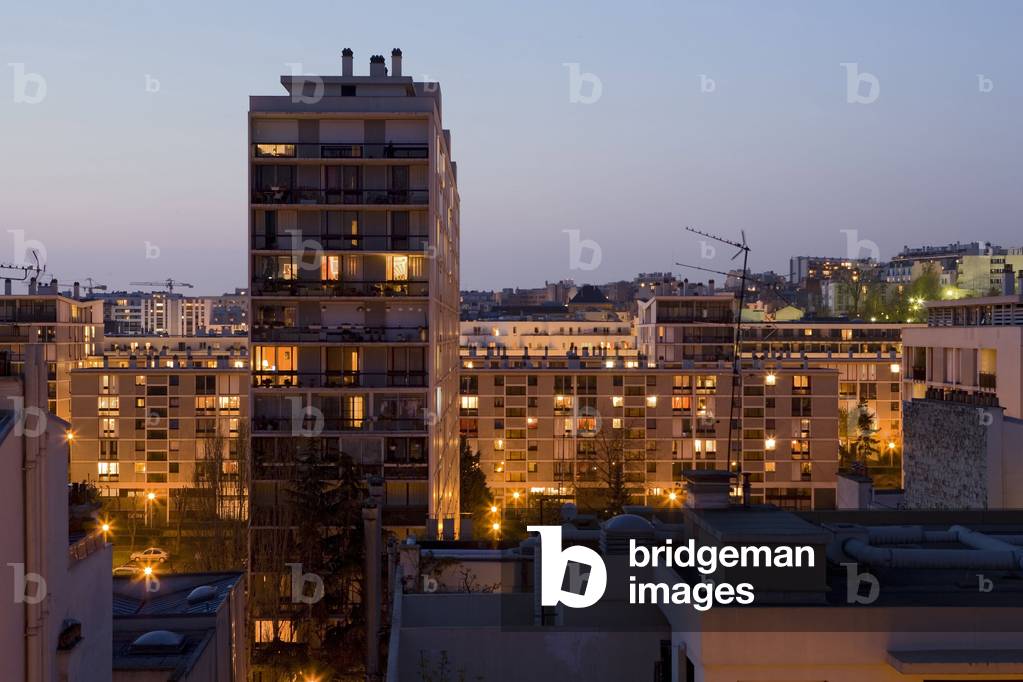
OMG4616821: View on Belleville Menilamount, night in Paris. Photography 10/04/07. / Bridgeman Images

OMG4616856: Paris building hall, Paris 20th. Photography 10/04/07. / Bridgeman Images

PIX4616909: Mars - Illustration - Artist's view of Mars Planet. This detailed artist's view of the planet Mars, based on high-resolution spacecraft imaging, reveals some of the many craters that cover much of its surface / Bridgeman Images

OMG4617011: Paris seen from the 20th arrondissement. Photography 10/04/09. / Bridgeman Images

PIX4617062: Phobos - Illustration - Phobos - Illustratio / Bridgeman Images

TEC4617242: Eglise Notre Dame de Lorette, 18 bis rue de Chateaudun, Paris 9th. Its name comes from the light and elegant young women lorettes who housed behind the church. Construction 1823, architect Hippolyte Lebas (1782-1867). / Bridgeman Images

PIX4585758: Prague Astronomical Clock - 15th century - The Prague Astronomical Clock - 15th century - The Prague Astronomical Clock - 15th century - The Prague City Hall Astronomical Clock, built by Nicholas of Kadau in 1410, and redesigned by Master Hanus de la Rose (Jan Ruze) around 1490. May 2007. Prague astronomical clock was made by clockmaker Mikulas of Kadan in 1410 and rearranged in 1490. May 2007 / Bridgeman Images

TEC4585877: Cafe Charcoal 109 rue Oberkanpf Paris 11th arrondissement. / Bridgeman Images

TEC4585961: 70 Rue Amelot Paris 11th arrondissement. / Bridgeman Images

TEC4585981: Boulevard Richard Lenoir Paris 11th arrondissement. Architect Pierre Manguin, landscape designer Jacqueline Osty. / Bridgeman Images

TEC4586035: Squat du Passage Saint Bernard overlooking Fuksas Paris 11th arrondissement. / Bridgeman Images

TEC4586168: Square Jules Ferry Paris 11th arrondissement. / Bridgeman Images

PIX4586245: La meridienne de la cathedrale saint Etienne - Bourges - Meridian Line - Bourges - France - Bourges - Cathedrale saint Etienne. The Meridian dates back to 1757. It has been traced to know the true local noon time (when the Sun passes exactly to the Meridian). Meridian Line (1757) in Saint Etienne cathedral, Bourges, France / Bridgeman Images

PIX4586402: Sundial - Turckheim Door - Sundial - Turckheim - Sundial on the French Door. Sundial on the Franc Porte / Bridgeman Images

LRI4586412: View of the cloister, 1462-1472 / Bridgeman Images

TEC4600014: Au Bon Marche, 24 rue de Sevres, Paris 7th arrondissement. Construction 1869-1887, architect Louis Charles Boileau, engineer Gustave Eiffel. / Bridgeman Images

PIX4600055: ISS: astronaut K. Wakata - 10/2000 - Koichi Wakata floats in ISS module Zarya - 10/2000 - Koichi Wakata in the FGB (Functional Cargo Block) module (now called Zarya) of the International Space Station (ISS). 15/10/2000. Koichi Wakata, mission specialist representing Japan's National Space Development Agency (NASDA), floats through the functional cargo block (FGB) of the International Space Station (ISS), replete now with supplies for permanent occupancy beginning in less than two weeks. October 15 2000 / Bridgeman Images

LRI4600183: Aerial view of meeting point of river Rio African-American and Amazon river (1983 - Photography) / Bridgeman Images

TEC4600237: Map of Paris on the boulevard Saint Germain in Paris 7th arrondissement. / Bridgeman Images

PIX4600344: J. Voss trains in Zvezda - James S. Voss reads a book while doing training bikes. ISS Expedition 2. 25/04/2001 / Bridgeman Images

LRI4600354: Aerial view of Three powers square and Parliament House and ministries buildings (1983 - Photography) / Bridgeman Images

PIX4600380: C. Hadfield Release 04/01 - Chris A. Hadfield under the all-new Arm (Canadarm2) of the International Space Station. ISS STS-100. April 2001 / Bridgeman Images
