2490880 Search Results

PIX4581993: Star sky above the Alps - Starry sky above mountains - Star sky with stars of the constellation Taurus lying on the horizon. Starry sky with the stars of Taurus constellation setting near the horizon / Bridgeman Images

JLJ4582080: Representation of St. Catherine of Siena, 15th century (limestone), Unknown Artist, (15th century) / Bridgeman Images

JLJ4582133: Romance Secretaire squeezes jewels: detail of paintings of the porcelain plates of sevres representing a bucolic scene with a shepherd, c.1859 (oil on canvas), Mayer, Moritz (19th century) / Bridgeman Images

LRI4582352: Portrait of Mademoiselle Caroline Riviere - oil on canvas, 1805, Ingres, Jean Auguste Dominique (1780-1867) / Bridgeman Images

PIX4582472: Supernovae in the Galaxy of Hunting Dogs - Supernovae in M51 - On the left, image of the galaxy before the appearance of the supernovae, in the centre, with the supernova 2005CS (bright star in the center of the image, in the arm closest to the nucleus of the galaxy); the supernova 2005CS appeared in the galaxy of Hunting Dogs on June 28, 2005. On the right, with the supernova SN2011DH, which appeared on May 31, 2011. Here is a comparison showing the galaxy before (left) and after the supernovae events. The image in the centre shows the supernova 2005CS (which appeared in the galaxy M51 on June 28, 2005); the exploding star is the white dot at center of the image. The image at right shows the supernova SN2011dH, which appeared on May 31, 2011 / Bridgeman Images
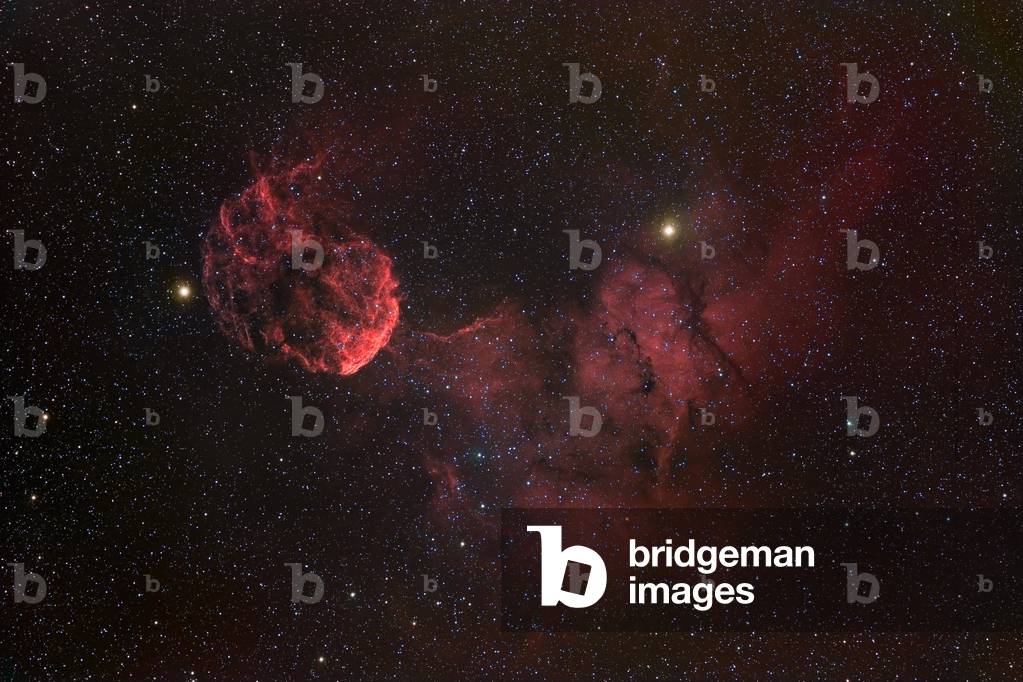
PIX4582532: Remains of supernova IC 443 in the Gemels - Located about 5000 years ago - light from Earth, IC 443 is the rest of a supernova that exploded 30,000 years ago. The bright star on the left is Eta Geminorum (Propus), a variable star / Bridgeman Images

PIX4582633: Swan Lace - detail - This delicate Hubble Space Telescope image shows a tiny portion of the Cygnus loop, a supernova remnant in the constellation of Cygnus, the Swan. Measurements on this super - detailed image of a cosmic veil shows that the original supernova explosion took place only 5000 years ago. The Cygnus loop, also known as the Veil Nebula, is well - known to amateur astronomers as a challenging target for larger telescopes. It has a diameter of about 3 degrees (corresponding to 6 full moons). This spectacular nebula was created when a massive star ended its days in an immense supernova explosion. A bubble of dust and gas was expelled into space and has continued to expand outwards ever since. The Cygnus Loop consists of two main arcs, designated NGC 6992/95 for the Eastern arc and NGC 6960 for the Western arc (also called the Witch's Broom Nebula). The tiny area of the Hubble image is seen in the upper left - hand corner of the nebula, at the outer edge of one of the large filaments, just where the blast wave rams into the surrounding interstellar gas. We are seeing the shock front almost exactly edge - on, thus explaining its wispy, sheet - like appearance. The image is a striking example of how processes that take place hundreds of light years away can sometimes resemble effects we see around us in our daily life. It was obtained with the WFPC2 instrument in November 1997 with an exposure time of 7400 seconds. The image shows light emitted by neutral hydrogen (656.3 nm) and measures 150 x 70 arc - seconds / Bridgeman Images

PIX4582644: Swan Lace - detail - This is an image of a small portion of the Cygnus Loop supernova remnant, taken with the Wide Field and Planetary Camera on Nasa's Hubble Space Telescope on April 24, 1991. The Cygnus Loop marks the edge of a bubble - like, expanding blast wave from a colossal stellar explosion which occurred about 15,000 years ago. The supernova blast wave is slamming into tenuous clouds of interstellar gas. This collision heats and compresses the gas, causing it to glow. The shock acts as a searchlight by revealing the structure of the interstellar medium. Hubble's detailed image shows the blast wave overrunning dense clumps of gas. Although HST can reveal details about as small as our Solar System, the clumps are still unresolvable. This means that they must be small enough to fit inside our Solar System, making them relatively small structures by interstellar standards. A bluish ribbon of light stretching left to right across the picture might be a knot of gas ejected by the supernoya. This interstellar “” bullet,”” traveling over three million miles per hour (5 million km), is just catching up with the shock front (which has been slowed by plowing into interstellar material). The Cygnus Loop appears as a faint ring of glowing gases about three degrees across (six times the diameter of the Full Moon), located in the northern constellation Cygnus the Swan. The supernova remnant is within the plane of our Milky Way Galaxy and is 2,600 light - years away. Supernova remnants play an important role in stellar evolution by enriching space with heavy elements, and triggering new star formation by compressing interstellar gas. Technical Details: The photo is a combination of separate images taken in three colors. Oxygen atoms (blue) emit light at temperatures of 30,000 to 60,000 degrees Celsius (50,000 to 100,000 degrees Fahrenheit). Hydrogen atoms (green) arise throughout the region of shocked gas. Sulfur atoms (red) form when the gas cools to around 10,000 by / Bridgeman Images

PIX4582656: Les Dentelles du Swan - Detail - NGC 6960 - Les Dentelles du Swan - Detail - NGC 6960 - Part to the west of the rest of the supernova des Dentelles du Swan situated about 1500 years - light of the Earth / Bridgeman Images

PIX4649428: Atlantis Approaching Space Station 05/2010 - Atlantis Approaching the International Space Station 05/2010 - Atlantis Shuttle seen from the International Space Station (ISS) May 16, 2010. Last mission of the Atlantis shuttle. Space shuttle Atlantis is featured in this image photographed by an Expedition 23 crew member as the shuttle approaches the International Space Station during STS - 132 rendezvous and docking operations. Docking occurred at 9:28 a.m. (CDT) on May 16, 2010 / Bridgeman Images

PIX4649445: Atlantis Approaching Space Station 05/2010 - Atlantis Approaching the International Space Station 05/2010 - Atlantis Shuttle seen from the International Space Station (ISS) May 16, 2010. Last mission of the Atlantis shuttle. Backdropped by a colorful Earth, space shuttle Atlantis is featured in this image photographed by an Expedition 23 crew member as the shuttle approaches the International Space Station during STS - 132 rendezvous and docking operations. Docking occurred at 9:28 a.m. (CDT) on May 16, 2010 / Bridgeman Images

PIX4649464: Space Shuttle Atlantis and ISS - Space Shuttle Atlantis docked to ISS - Space Shuttle Atlantis moored to the International Space Station (ISS). 17 May 2010. Space shuttle Atlantis, docked to the International Space Station, is featured in this image photographed by an STS - 132 spacewalker during the mission's first session of extravehicular activity (EVA). 17 May 2010 / Bridgeman Images

PIX4649482: Atlantis Shuttle from ISS 05/2010 - Atlantis leaves the International Space Station - 05/2010 - Atlantis Space Shuttle before returning to Earth, seen from the International Space Station (ISS) on May 23, 2010. Space shuttle Atlantis is featured in this image photographed by an Expedition 23 crew member on the International Space Station soon after the shuttle and station began their post - undocking relative separation. Undocking of the two spacecraft occurred at 10:22 a.m. (CDT) on May 23, 2010, ending a seven - day stay that saw the addition of a new station module, replacement of batteries and resupply of the orbiting outpost. Earth's horizon and the blackness of space provide the backdrop for the scene / Bridgeman Images

PIX4649514: Decolving the shuttle Discovery 02/2011 - Launch of Shuttle Discovery STS - 133. 02/2011 - Decolving the shuttle Discovery (mission STS - 133) with a crew of six astronauts on board as well as Robonaut2. This mission is the 33rd and last mission of the Shuttle Discovery. 24/02/2011. Space shuttle Discovery lifts off Launch Pad 39A at Nasa's Kennedy Space Center in Florida on a late February afternoon. Launch of the STS - 133 mission was at 4:53 p.m. EST on Feb. 24. Discovery and its six - member crew are on a mission to deliver the Permanent Multipurpose Module, packed with supplies and critical spare parts, as well as Robonaut 2, the dexterous humanoid astronaut helper, to the International Space Station. Discovery is making its 39th mission and is scheduled to be retired following STS-133. This is the 133rd Space Shuttle Program mission and the 35th shuttle voyage to the space station / Bridgeman Images

JLJ4649569: Portrait of Marguerite de Valois (1553-1615), 16th century (pencil and blood), Clouet, Francois (c.1510-72) / Bridgeman Images

LRI4649605: Spike from the Polada bog, Lonato. Bronze Age. (bone), Prehistoric / Bridgeman Images

PIX4649669: Shuttle Endeavour landing 06/2011 - Space Shuttle Endeavour landing 06/2011 - Shuttle Endeavour landing at Kennedy Space Center. Mission STS-134, 1 June 2011. Space shuttle Endeavour approaches Runway 15 on the Shuttle Landing Facility at Nasa's Kennedy Space Center in Florida for the final time. Main gear touchdown was at 2:34:51 a.m. (EDT) on June 1, 2011, followed by nose gear touchdown at 2:35:04 a.m., and wheelstop at 2:35:36 a.m. Onboard are NASA astronauts Mark Kelly, STS - 134 commander; Greg H. Johnson, pilot; Michael Fincke, Andrew Feustel, Greg Chamitoff and European Space Agency astronaut Roberto Vittori, all mission specialists. STS-134 delivered the Alpha Magnetic Spectrometer - 2 (AMS) and the Express Logistics Carrier - 3 (ELC-3) to the International Space Station. AMS will help researchers understand the origin of the universe and search for evidence of dark matter, strange matter and antimatter from the station. ELC - 3 carried spare parts that will sustain station operations once the shuttles are retired from service. STS - 134 was the 25th and final flight for Endeavour, which has spent 299 days in space, orbited Earth 4,671 times and traveled 122,883,151 miles / Bridgeman Images

LRI4649753: Warrior figurine of the Treasure of Galic, 1500 BC (bronze), Bronze Age (1800-1500 BC) / Bridgeman Images

LRI4649806: Venus of Kostenki , gravettian, 30000-25000 BC Upper Paleolithic, Prehistoric / Bridgeman Images

PIX4649873: B.Mac Candless Extra Vehicle Release STS - 41 - B - 02/1984 - Astronaut Bruce McCandless II EVA 02/1984 - Astronaut Bruce McCandless II, works in the cargo bay of the Shuttle Challenger. 11/02/1984. Astronaut Bruce McCandless, II, is using a special tool to conduct an experiment. His feet are anchored in the mobile foot restraints, which are connected to the remote manipulator system (RMS). The Shuttle pallet satellite (SPAS-01A) serves as a test subject for McCandless's experiment. Feb 11 1984 / Bridgeman Images

LRI4660113: Greek Art: “” caryatid head”” Marble sculpture from the Tresor of Siphnos (or Tresor of the Siphnians). 530 BC. Delphi, archeological museum, Greek school, (6th century BC) / Bridgeman Images

PIX4660135: Dubai Night View from Space - City of Dubai at night - The coasts of the Emirates of Dubai with the Palm Island of Jumeirah, seen at night from the International Space Station (ISS) on September 11, 2009. This nighttime astronaut photograph of the city of Dubai was taken at approximately 2 a.m. local time on September 11, 2009. Orange sodium vapor lights trace the major highways and street grid in and around the metropolitan area, while grey - white mercury vapor lamps fill in the commercial and residential areas. The lighted islands and peninsula of Palm Jumeirah are clearly visible along the coastline. A spiral pattern of lights on the southeastern fringe of the urban area is a camel racetrack. Nighttime images like these are useful to climate modelers, urban planners, and geographers as they allow for simple definition of urban (densely lit) and rural (sparely lit) areas / Bridgeman Images

PIX4625230: Tempete sur Saturn seen by the Cassini probe - Huge Storm on Saturn seen by Cassini spacecraft - Evolution of a huge tempete on Saturn seen by the Cassini probe from December 5, 2010 to August 12, 2011. This series of images from Nasa's Cassini spacecraft shows the development of the largest storm seen on the planet since 1990. These true - color and composite near - true - color views chronicle the storm from its start in late 2010 through mid - 2011, showing how the distinct head of the storm quickly grew large but eventually became engulfed by the storm's tail. The earliest image of the storm, taken Dec. 5, 2010, is in the top left of the panel. The storm appears only as a small, white cloud on the terminator between the day side and night side of the planet. The next view, in the top middle of the panel and taken Jan. 2, 2011, shows that the head quickly grew much larger and a tail began to trail a great distance eastward. Some of the clouds moved south and got caught up in a current that flows to the east (to the right) relative to the storm head. In the top right of the panel, this tail, which appears as slightly blue clouds south and now west (left) of the storm head, can be seen encountering the storm in the Feb. 25 image.The April 22 image, in the bottom left of the panel, is one of Cassini's last views of the storm when it still had a recognizable head. In this view, the tail is south of the head and is well established by this time.The May 18 view, in the bottom middle, shows only the storm's tail. The head still existed at this time, but it is beyond the horizon and out of the field of view here.Between the time of the May 18 image and the next image shown here (from Aug. 12), the head of the storm was engulfed by the part of the storm's tail that spread eastward at the same latitude as the head. The Aug. 12 image, in the bottom right, shows that the head has lost its distinct identity and is now just part of the jumble of the storm. Also visible in these / Bridgeman Images

JLJ4625245: Illustration from the book "Histoire du chevalier Bayard ", Bayard acclame at Grenoble (engraving), Semant, Paul de (1855-1915) / Bridgeman Images

JLJ4625425: Illustration from the book "Le bon roy Henri": Portrait of Charles de Lorraine (1554-1611) (litho), Job, pseudonym for Onfray de Breville, Jacques (1858-1931) / Bridgeman Images

JLJ4625491: Illustration from the book "Le bon roy Henri": The Duchess of Montpensier (litho), Job, pseudonym for Onfray de Breville, Jacques (1858-1931) / Bridgeman Images

JLJ4625741: Offering a Galante Venus Scene in a romantic landscape of ancient ruins, 1786 (oil on canvas), Trinquesse, Louis Rolland (c.1746-1800) / Bridgeman Images

PIX4594450: Star sky, Constellations of the Virgin and the Raven - Starry sky with Virgo and Corvus constellations - The Raven, the Virgin and the Great Bear above the Chapel of Mount Saint - Michel de Braspart. In overprint, the mythological forms of these constellations, extracted from the Uranographia of Hevelius. Ursa Major, Virgo and Corvus constellations above a chapel, Brittany, France. Constellation mythological forms from “” Uranographia”” star atlas by Hevelius (1690) have been added / Bridgeman Images

LRI4594455: Mary Magdelen. Polychrome wood sculpture, 1430-1440, Donatello, (c.1386-1466) / Bridgeman Images

PIX4594477: Constellation of the Virgin and Menhirs of Carnac - Virgo constellation above standing stones in Carnac - The Virgin and the Raven dominate menhirs of the Carnac alignments. March 2009. Starry sky with standing stones in Carnac, Brittany - France. Constellations of Corvus is also visible in the sky. March 2009 / Bridgeman Images

PIX4594508: Charles Chene Constellation - Former Constellation of Robur Caroli - Uranographia by Johann Bode (1801) recolorise by us Uranographia by Johann Bode (1801), recolored / Bridgeman Images

PIX4594529: Kiwi Asterism - The Kiwi asterism - Kiwi is an asterism unique to New Zealand. These stars belong to the constellations of Centaur and Wolf. The Kiwi is a New Zealand asterism and these stars are located in Centaurus and Lupus / Bridgeman Images

PIX4594760: Map of the summer sky in France - Illustration - Summer sky map. Artwork - Map plotted for a latitude of 45 degrees north, showing the sky in July at 2 am or in August at midnight. Map showing the sky in july at 2 a.m or in august at midnight for a latitude of 45 degrees north (metropolitan France) / Bridgeman Images

PIX4594782: Map of the winter sky in France - Illustration - Winter sky map. Artwork - Map plotted for a latitude of 45 degrees north, showing the sky visible in France in late January at 11 pm, and more broadly in Europe and the world inside a strip stretching from 38 degrees to 52 degrees north latitude. This map also corresponds to the sky visible in December during the night and in February in the middle of the evening. The position of Mars is given for the beginning of February 2010. Map showing the sky visible in France in january in the end of the evening at 11 p.m (english hour) for a latitude of 45 degrees north. This map also shows the sky in the whole world between 38 degrees and 52 degrees north. This map also refers to february in the middle of the evening and to december at night. Planet Mars is shown for the beginning of February 2010 / Bridgeman Images

PIX4594792: Map of the winter sky in France - Illustration - Winter sky map. Artwork - Map plotted for a latitude of 45 degrees north, showing the sky visible in France in late January at 11 pm, and more broadly in Europe and the world inside a strip stretching from 38 degrees to 52 degrees north latitude. This map also corresponds to the sky visible in December during the night and in February in the middle of the evening. The position of Mars is given for the beginning of February 2010. Map showing the sky visible in France in january in the end of the evening at 11 p.m (english hour) for a latitude of 45 degrees north. This map also shows the sky in the whole world between 38 degrees and 52 degrees north. This map also refers to february in the middle of the evening and to december at night. Planet Mars is shown for the beginning of February 2010 / Bridgeman Images

JLJ4594894: Sacramental eveque drogon of Metz (826, 855). Top flat binding: scenes from the life of christ (object) / Bridgeman Images
