2491100 Search Results

JLJ4600430: Landscape inspires from the view of Frascati, 1822 (painting), Michallon, Achille Etna (1796-1822) / Bridgeman Images

PIX4600457: Astronauts in Zvezda - Hairdressing seance in module Zvezda: Mikhail Tyurin cuts the hair of Frank Culbertson. ISS Expedition 3. 22/09/2001 / Bridgeman Images

PIX4637091: Summer triangle and Milky way - Summer triangle and Milky way - Summer lake route with summer triangle consists of the stars Deneb du Swan, Vega de la Lyre and Altair de l'Eagle. From bottom to top and left to right: Pegase, the Dolphin, the Eagle, the Fleche, the Swan, the Lyre, the Dragon, Hercules, a tip of the Little Bear and the Crown Boreale June 24, 2008. From bottom to top and left to right: Pegasus, Delphinus, Aquila, Sagitta, Cygnus, Lyra, Draco, Hercules, a part of Ursa Minor and Corona Borealis. June 24 2008 / Bridgeman Images

JLJ4637116: French and Germans, Anecdotal History of the War of 1870-1871, 1888 (engraving), Lonlay, Dick de (Hardouin Georges pseud.) (1846-1893) / Bridgeman Images

PIX4637202: The Milky Way above The Isle of Sein, Brittany, 27 September 2008 / Bridgeman Images

PIX4637204: Autumn lactee route - Pointe du Raz - Autumn Milky way - Pointe du Raz - The lactee route above Notre Dame des Shipwrecks, Pointe du Raz. Brittany, 27 September 2008. Milky Way above the statue dedicated to “” Our Lady of the Shipwrecks”””. The zodiacal band is visible under the aspect of a fuzzy and pale band extending from the top of the statue to the upper right. A the top of the picture is the powerful lighthouse of the Sein Island. at Pointe du Raz, the western tip of France. Brittany, 27 September 2008 / Bridgeman Images

PIX4637237: Lactee and Jupiter - Milky way and Jupiter - The Lactee Way accompanied by Jupiter, the bright planet on the left, seen from Cherry Springs State Park in the United States. The center of our own galaxy, the Milky Way, sets in the southwest as night begins at the Cherry Springs State Park, one of the darkest observing locations in the eastern United States. The Milky Way is a vast collection of more than 200 billion stars, planets, nebulae, clusters, dust and gas. Our own Sun and solar system are also part of the Milky Way galaxy. Seen as a luminous band of light and star clouds that stretch across the night sky, the brighter star clouds of the Milky Way are frequently mistaken for real Earth-bound clouds by observers who are unfamiliar with their appearance. Sometimes interrupted by dark nebulae and rifts, these star clouds are actually innumerable unresolved faint stars. The central bulge of the Milky Way, the brightest and most spectacular portion, is visible here in the Sagittarius region, seen at the lower left. Numerous dark nebula, clouds of non-luminous dust that obscure the stars behind them, are also part of the Milky Way and are scattered throughout the image. Brilliant Jupiter is the brightest “” star”” in the image, seen at left / Bridgeman Images

JLJ4637358: Arbitrary imprisonment in Lyon during the National Convention (1792-1795), 1793 (engraving), French School, (18th century) / Bridgeman Images

PIX4637471: Lactee and Summer Triangle - Summer triangle and Milky way - Summer lactee route with summer triangle consists of the stars Deneb du Swan, Vega de la Lyre and Altair de l'Aigle. Lesconil, Finistere. Summer Milky way seen in Brittany. The bright stars are from top to bottom Deneb, Vega and Altair which form the summer triangle / Bridgeman Images

LRI4637492: The flight in Egypt Low bronze relief by Bonanno Pisano (12th century) 1180 Porte San Ranieri du Duomo (cathedral) of Pisa, Italy, Pisano, Bonanno (12th century) / Bridgeman Images

JLJ4637522: French and Germans, Anecdotal History of the War of 1870-1871, 1888 (engraving), Lonlay, Dick de (Hardouin Georges pseud.) (1846-1893) / Bridgeman Images

JLJ4637557: French and Germans, Anecdotal History of the War of 1870-1871, 1888 (engraving), Lonlay, Dick de (Hardouin Georges pseud.) (1846-1893) / Bridgeman Images

PIX4637693: Summer Lactee Route - Summer Milky Way: The lactee route seen in Crete (Omalos) on August 8, 2016. - Milky Way above a road. Omalos, Crete, August 8 2016 / Bridgeman Images

PIX4637712: Lactee route in Teide National Park - Milky Way above Tenerife: Lactee route in Teide National Park. Roques de Garcia, Tenerife, Canary Islands. June 2011 - Milky way above Teide national Park, Roques de Garcia. June 2011 / Bridgeman Images

PIX4637736: Lactee and Zodiacal Light - Milky Way and Zodiacal light: Lactee and Zodiacal Light in Tyrol. The zodiacal light is the elongated glow blade visible in the sky. It comes from the reflection of the Sun's light on the countless interplanetary dust and draws the plane of the Solar System / Bridgeman Images

JLJ4568312: Soup A couple of workers eating soup, the mother breastfeeding the baby, 1862-65 (w/c), Daumier, Honore (1808-79) / Bridgeman Images

LRI4568379: Manuscript preface page of sheet music with drawings, Satie, Erik (1866-1925) / Bridgeman Images

LRI4568613: Page of musical score for the first violin in the overture of opera Jessonda by Louis Spohr, 1823, Unknown Artist, (19th century) / Bridgeman Images

JLJ4568626: Portrait of unknown perhaps Louis I, Prince of Conde, 1565 (drawing), Clouet, Francois (c.1510-72) / Bridgeman Images

LRI4568675: Frontispiece of musical score of Waltzes for Piano by Eduard Strauss, Anonymous / Bridgeman Images

LRI4568714: Frontispiece of musical score of Carnevals-Botschafter (op 270) by Johann Strauss, Anonymous / Bridgeman Images

JLJ4600470: Portrait of Achille Deveria (1800-1857) painter and engraver, 19th century (oil on canvas), Boulanger, Louis (1806-67) / Bridgeman Images

LRI4600537: Advertising poster for the fungicide winnowed sulphur produced by italian company Vergnasco Candelo, 20th Century, Anonymous / Bridgeman Images

PIX4600559: Russian Mooring Module Pirs 09/01 - Russian Mooring Module Pirs seen from the International Space Station on 16/09/2001 / Bridgeman Images

PIX4600568: Russian Mooring Module Pirs 09/01 - Russian Mooring Module Pirs seen from the International Space Station on 16/09/2001 / Bridgeman Images

PIX4600610: ISS 12/01 - Partial view of the international space station after the observed stowage of the shuttle Endeavour. ISS STS - 108. 15Dec 2001 / Bridgeman Images

JLJ4600625: Taken of Montmedy on August 6, 1657 (oil on canvas), Laminois, Simon de (1623-1683) / Bridgeman Images
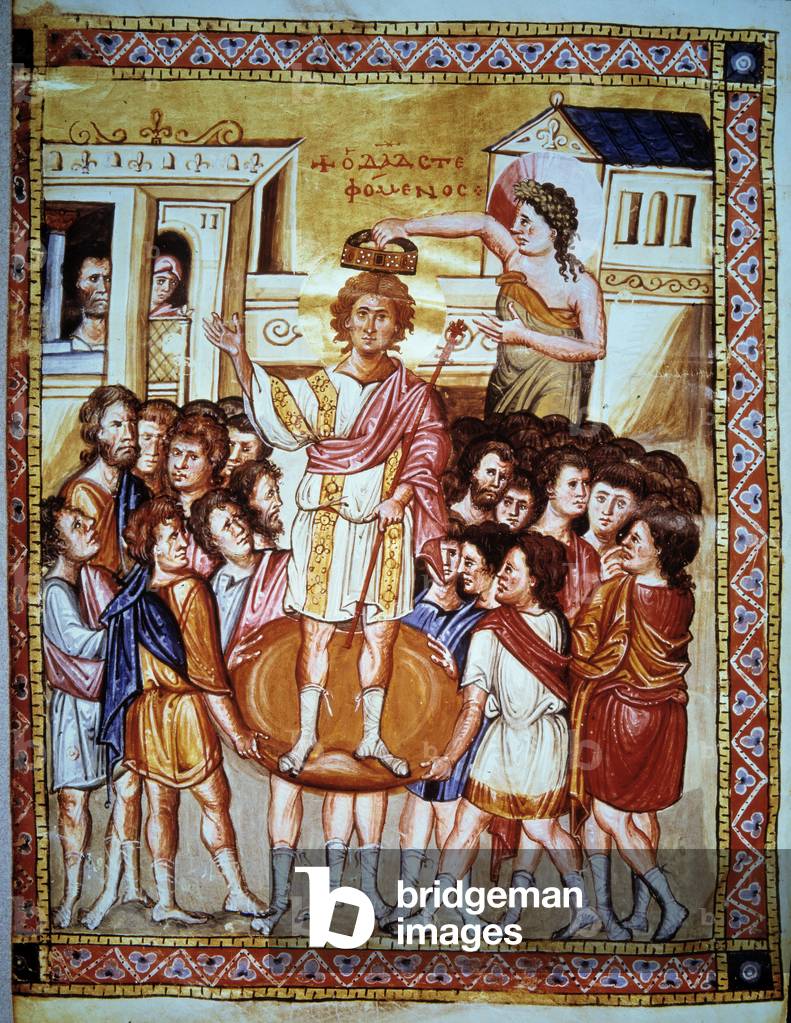
JLJ4600632: Coronation of King David (1015 - 975 BC) King of Israel. Miniature in "Psaltier de Paris" Folio 6v, 10th century (miniature), Unknown artist, (10th century) / Bridgeman Images

JLJ4600695: Saint Jeanne de France (oil on canvas), Deshays, Jean-Baptiste (1729-65) / Bridgeman Images

JLJ4600716: The woman in the mirror, 19th century (oil on canvas), Renoir, Pierre Auguste (1841-1919) / Bridgeman Images

JLJ4600732: Annunciation, 1545 (oil on canvas), Bordone, Paris (1500-71) / Bridgeman Images

PIX4600785: Crews in Destiny 04/02 - Carl Walz (Expedition 4) plays on the keyboard; crew STS - 110 (clockwise): Rex Walheim, Jerry Ross, Ellen Ochoa, Lee Morin, Stephen Frick and Daniel Bursch (Expedition 4, profile a d.). ISS STS-110. April 2002 / Bridgeman Images

PIX4600869: Back to Earth of the Soyuz TM capsule - 33 - 05/2002 - Return module of Soyuz TM - 33 - 05/2002 - View of the Soyuz TM capsule - 33 after landing in the Kazakhstan steppes on 5 May 2002. The recovery team is preparing to get astronauts Roberto Vittori, Yuri Gidzenko and Mark Shuttleworth out of the capsule. Russian recovery team members gather around the scorched return module of Soyuz TM - 33, shortly after its landing in the steppes of Kazakhstan and the completion of the Marco Polo mission to the International Space Station (ISS), on May 5, 2002. The recovery team is about to install a scaffolding to help the crew out the module. The Marco Polo mission, with ESA astronaut Roberto Vittori, from Italy, was performed under an agreement between Russia's Rosaviakosmos, the Italian Space Agency (ASI) and ESA. Roberto Vittori was launched into space onboard Soyuz TM - 34 at 12:26 local time on April 25 with Russian mission commander Yuri Gidzenko and South African flight participant Mark Shuttleworth. The spacecraft successfully docked with the ISS two days later. Roberto Vittori spent one week onboard the orbital outpost, performing experiments, and returned to Earth with his crewmates onboard Soyuz TM - 33. Soyuz TM - 33 landed safely some 26 km south - east of the city of Arkalyk in Kazakhstan, at 10:51 local time, concluding a mission that lasted 237 hours and 25 minutes / Bridgeman Images

LRI4600890: Poster published to celebrate the 10th anniversary of the annexation of Fiume by Italy, 1934, Italian School, (20th century) / Bridgeman Images

PIX4600970: ISS STS-112 10/02 - The International Space Station after stowage from Shuttle Atlantis. ISS STS - 112. 16/10/2002 / Bridgeman Images

JLJ4637780: Musicien et fou dansant à Paris au 14th century - Musician and dancing fool at Paris 14th Century (engraving), Anonymous / Bridgeman Images
