Search options

Orientation
Colour

Display options

View

Print

To print search results, use print friendly version of this page.

2490903 Search Results

Poet Enee Silvio Piccolomini presents Eleonore of Portugal to Emperor Frederic III of the Holy Empire at the Camollia Gate. Detail of Life of Pope Pius II (Fresco, 1505-1507)

LRI4619165: Poet Enee Silvio Piccolomini presents Eleonore of Portugal to Emperor Frederic III of the Holy Empire at the Camollia Gate. Detail of Life of Pope Pius II (Fresco, 1505-1507), Pinturicchio, Bernardino di Betto (c.1452-1513) / Bridgeman Images

A deer. Upper Paleolithic (Magdalenian) (rock painting)

LRI4649423: A deer. Upper Paleolithic (Magdalenian) (rock painting), Prehistoric / Bridgeman Images

View of the castle of Fontainebleau in 1669 (oil on canvas)

JLJ4649457: View of the castle of Fontainebleau in 1669 (oil on canvas), Meulen, Adam Frans van der (1632-90) / Bridgeman Images

Decolving the shuttle Discovery 02/2011 - Launch of Shuttle Discovery STS - 133. 02/2011 - Decolving the shuttle Discovery (mission STS - 133) with a crew of six astronauts on board as well as Robonaut2. This mission is the 33rd and last mission of the Shuttle Discovery. 24/02/2011. Space shuttle Discovery lifts off Launch Pad 39A at Nasa's Kennedy Space Center in Florida on a late February afternoon. Launch of the STS - 133 mission was at 4:53 p.m. EST on Feb. 24. Discovery and its six - member crew are on a mission to deliver the Permanent Multipurpose Module, packed with supplies and critical spare parts, as well as Robonaut 2, the dexterous humanoid astronaut helper, to the International Space Station. Discovery is making its 39th mission and is scheduled to be retired following STS-133. This is the 133rd Space Shuttle Program mission and the 35th shuttle voyage to the space station

PIX4649512: Decolving the shuttle Discovery 02/2011 - Launch of Shuttle Discovery STS - 133. 02/2011 - Decolving the shuttle Discovery (mission STS - 133) with a crew of six astronauts on board as well as Robonaut2. This mission is the 33rd and last mission of the Shuttle Discovery. 24/02/2011. Space shuttle Discovery lifts off Launch Pad 39A at Nasa's Kennedy Space Center in Florida on a late February afternoon. Launch of the STS - 133 mission was at 4:53 p.m. EST on Feb. 24. Discovery and its six - member crew are on a mission to deliver the Permanent Multipurpose Module, packed with supplies and critical spare parts, as well as Robonaut 2, the dexterous humanoid astronaut helper, to the International Space Station. Discovery is making its 39th mission and is scheduled to be retired following STS-133. This is the 133rd Space Shuttle Program mission and the 35th shuttle voyage to the space station / Bridgeman Images

Culture of Remedello: vase in the shape of a bell from the cave Santa Cristina, 2200 BC. (terracotta)

LRI4649546: Culture of Remedello: vase in the shape of a bell from the cave Santa Cristina, 2200 BC. (terracotta), Prehistoric / Bridgeman Images

Decolving the shuttle Discovery 02/2011 - Launch of Shuttle Discovery STS - 133. 02/2011 - Decolving the shuttle Discovery (mission STS - 133) with a crew of six astronauts on board as well as Robonaut2. This mission is the 33rd and last mission of the Shuttle Discovery. 24/02/2011. Rising on twin columns of fire and creating rolling clouds of smoke and steam, space shuttle Discovery lifts off Launch Pad 39A at Nasa's Kennedy Space Center in Florida on a picturesque, warm, late February afternoon. Launch of the STS - 133 mission was at 4:53 p.m. EST on Feb. 24. Discovery and its six - member crew are on a mission to deliver the Permanent Multipurpose Module, packed with supplies and critical spare parts, as well as Robonaut 2, the dexterous humanoid astronaut helper, to the International Space Station. Discovery is making its 39th mission and is scheduled to be retired following STS-133. This is the 133rd Space Shuttle Program mission and the 35th shuttle voyage to the space station

PIX4649554: Decolving the shuttle Discovery 02/2011 - Launch of Shuttle Discovery STS - 133. 02/2011 - Decolving the shuttle Discovery (mission STS - 133) with a crew of six astronauts on board as well as Robonaut2. This mission is the 33rd and last mission of the Shuttle Discovery. 24/02/2011. Rising on twin columns of fire and creating rolling clouds of smoke and steam, space shuttle Discovery lifts off Launch Pad 39A at Nasa's Kennedy Space Center in Florida on a picturesque, warm, late February afternoon. Launch of the STS - 133 mission was at 4:53 p.m. EST on Feb. 24. Discovery and its six - member crew are on a mission to deliver the Permanent Multipurpose Module, packed with supplies and critical spare parts, as well as Robonaut 2, the dexterous humanoid astronaut helper, to the International Space Station. Discovery is making its 39th mission and is scheduled to be retired following STS-133. This is the 133rd Space Shuttle Program mission and the 35th shuttle voyage to the space station / Bridgeman Images

Cup from the necropolis of Tolfa, 10th century BC. (bronze)

LRI4649580: Cup from the necropolis of Tolfa, 10th century BC. (bronze), Prehistoric / Bridgeman Images

Shuttle Atlantis - Last Shuttle Flight - July 2011 - Liftoff of Space Shuttle Atlantis - Final mission of Space Shuttle Program. July 2011 - Launch of the Atlantis space shuttle on July 8, 2011. Mission STS-135, last flight of American space shuttles. At Nasa's Kennedy Space Center in Florida, space shuttle Atlantis lifts off of Launch Pad 39A leaving behind billows of steam and smoke as it heads past the tower on its STS - 135 mission to the International Space Station. Atlantis with its crew of four; Commander Chris Ferguson, Pilot Doug Hurley, Mission Specialists Sandy Magnus and Rex Walheim, lifted off at 11:29 a.m. EDT on July 8, 2011 to deliver the Raffaello multi - purpose logistics module packed with supplies and spare parts for the International Space Station. Atlantis also will fly the Robotic Refueling Mission experiment that will investigate the potential for robotically refueling existing satellites in orbit. In addition, Atlantis will return with a failed ammonia pump module to help NASA better understand the failure mechanism and improve pump designs for future systems. STS - 135 is the 33rd flight of Atlantis, the 37th shuttle mission to the space station, and the 135th and final mission of NASA's Space Shuttle Program

PIX4649713: Shuttle Atlantis - Last Shuttle Flight - July 2011 - Liftoff of Space Shuttle Atlantis - Final mission of Space Shuttle Program. July 2011 - Launch of the Atlantis space shuttle on July 8, 2011. Mission STS-135, last flight of American space shuttles. At Nasa's Kennedy Space Center in Florida, space shuttle Atlantis lifts off of Launch Pad 39A leaving behind billows of steam and smoke as it heads past the tower on its STS - 135 mission to the International Space Station. Atlantis with its crew of four; Commander Chris Ferguson, Pilot Doug Hurley, Mission Specialists Sandy Magnus and Rex Walheim, lifted off at 11:29 a.m. EDT on July 8, 2011 to deliver the Raffaello multi - purpose logistics module packed with supplies and spare parts for the International Space Station. Atlantis also will fly the Robotic Refueling Mission experiment that will investigate the potential for robotically refueling existing satellites in orbit. In addition, Atlantis will return with a failed ammonia pump module to help NASA better understand the failure mechanism and improve pump designs for future systems. STS - 135 is the 33rd flight of Atlantis, the 37th shuttle mission to the space station, and the 135th and final mission of NASA's Space Shuttle Program / Bridgeman Images

Shuttle Atlantis - Last Shuttle Flight - July 2011 - Liftoff of Space Shuttle Atlantis - Final mission of Space Shuttle Program. July 2011 - Launch of the Atlantis space shuttle on July 8, 2011. Mission STS-135, last flight of American space shuttles. Smoke and steam billow outward as space shuttle Atlantis lifts off on twin columns of flame from Launch Pad 39A at Nasa's Kennedy Space Center in Florida as it begins its STS - 135 mission to the International Space Station. Atlantis with its crew of four; Commander Chris Ferguson, Pilot Doug Hurley, Mission Specialists Sandy Magnus and Rex Walheim, lifted off at 11:29 a.m. EDT on July 8, 2011 to deliver the Raffaello multi - purpose logistics module packed with supplies and spare parts for the station. Atlantis also will fly the Robotic Refueling Mission experiment that will investigate the potential for robotically refueling existing satellites in orbit. In addition, Atlantis will return with a failed ammonia pump module to help NASA better understand the failure mechanism and improve pump designs for future systems. STS - 135 is the 33rd flight of Atlantis, the 37th shuttle mission to the space station, and the 135th and final mission of NASA's Space Shuttle Program

PIX4649758: Shuttle Atlantis - Last Shuttle Flight - July 2011 - Liftoff of Space Shuttle Atlantis - Final mission of Space Shuttle Program. July 2011 - Launch of the Atlantis space shuttle on July 8, 2011. Mission STS-135, last flight of American space shuttles. Smoke and steam billow outward as space shuttle Atlantis lifts off on twin columns of flame from Launch Pad 39A at Nasa's Kennedy Space Center in Florida as it begins its STS - 135 mission to the International Space Station. Atlantis with its crew of four; Commander Chris Ferguson, Pilot Doug Hurley, Mission Specialists Sandy Magnus and Rex Walheim, lifted off at 11:29 a.m. EDT on July 8, 2011 to deliver the Raffaello multi - purpose logistics module packed with supplies and spare parts for the station. Atlantis also will fly the Robotic Refueling Mission experiment that will investigate the potential for robotically refueling existing satellites in orbit. In addition, Atlantis will return with a failed ammonia pump module to help NASA better understand the failure mechanism and improve pump designs for future systems. STS - 135 is the 33rd flight of Atlantis, the 37th shuttle mission to the space station, and the 135th and final mission of NASA's Space Shuttle Program / Bridgeman Images

Atlantis amarree la station spatiale 07/2011 - Atlantis docked to the International Space station 07/2011 - The space shuttle Atlantis moored to the International Space Station (ISS) on July 18, 2011. Mission STS-135, the last United States space shuttle mission. This view of the space shuttle Atlantis while still docked with the International Space Station was taken by a crew member aboard the station on the final day of joint activities between the crew members for the STS - 135 and Expedition 28 missions. The robotic arm on the shuttle appears to be saluting “” good - bye”” to the station. Earth's airglow is seen as a thin blue line above Earth's horizon. The Raffaello multi - purpose logistics module, full of items to be returned to Earth, is seen in the aft cargo bay. 18 July 2011

PIX4649828: Atlantis amarree la station spatiale 07/2011 - Atlantis docked to the International Space station 07/2011 - The space shuttle Atlantis moored to the International Space Station (ISS) on July 18, 2011. Mission STS-135, the last United States space shuttle mission. This view of the space shuttle Atlantis while still docked with the International Space Station was taken by a crew member aboard the station on the final day of joint activities between the crew members for the STS - 135 and Expedition 28 missions. The robotic arm on the shuttle appears to be saluting “” good - bye”” to the station. Earth's airglow is seen as a thin blue line above Earth's horizon. The Raffaello multi - purpose logistics module, full of items to be returned to Earth, is seen in the aft cargo bay. 18 July 2011 / Bridgeman Images

Petroglyph of human figures, neolithic, stone age.

LRI4649832: Petroglyph of human figures, neolithic, stone age., Prehistoric / Bridgeman Images

Petroglyph of a hunting scene, neolithic, stone age.

LRI4649844: Petroglyph of a hunting scene, neolithic, stone age., Prehistoric / Bridgeman Images

Representation of a Redhead Duck, 19th century (engraving)

JLJ4649880: Representation of a Redhead Duck, 19th century (engraving), Blanchere, Henri de la (1821-80) / Bridgeman Images

B.Mac Candless Extra Vehicle Release STS - 41 - B - 02/1984 - B.McCandless II spacewalk 02/1984 - Astronaut Bruce McCandless II uses his hands to control his movements in space while using the MMU (Manned Maneuvering Unit), a standalone space chair allowing him to move away from the Challenger Space Shuttle by several meters without being connected. 11/02/1984. Astronaut Bruce McCandless II, mission specialist, participates in a extravehicular activity (EVA), a few meters away from the cabin of the shuttle Challenger. He is using a nitrogen - propelled hand - controlled manned maneuvering unit (MMU). He is performing this EVA without being tethered to the shuttle. Feb 11 1984

PIX4649962: B.Mac Candless Extra Vehicle Release STS - 41 - B - 02/1984 - B.McCandless II spacewalk 02/1984 - Astronaut Bruce McCandless II uses his hands to control his movements in space while using the MMU (Manned Maneuvering Unit), a standalone space chair allowing him to move away from the Challenger Space Shuttle by several meters without being connected. 11/02/1984. Astronaut Bruce McCandless II, mission specialist, participates in a extravehicular activity (EVA), a few meters away from the cabin of the shuttle Challenger. He is using a nitrogen - propelled hand - controlled manned maneuvering unit (MMU). He is performing this EVA without being tethered to the shuttle. Feb 11 1984 / Bridgeman Images

Landscape In Chaponval, 1880 (oil on canvas)

JLJ4685340: Landscape In Chaponval, 1880 (oil on canvas), Pissarro, Camille (1830-1903) / Bridgeman Images

Project for the monastery of the Virgin of the Resurrection (Smolny) in Saint Petersburg, 1750-1756 (Model, painted wood, gilding and lead)

LRI4685384: Project for the monastery of the Virgin of the Resurrection (Smolny) in Saint Petersburg, 1750-1756 (Model, painted wood, gilding and lead), Rastrelli, Bartolomeo Franceso (1700-71) / Bridgeman Images

The Dance Of The Muses, 1851 (oil on canvas)

JLJ4685413: The Dance Of The Muses, 1851 (oil on canvas), Boulanger, Louis (1806-67) / Bridgeman Images

Dagger, fom the site of Ur (gold)

LRI4685508: Dagger, fom the site of Ur (gold), Sumerian / Bridgeman Images

Moorish Woman Leaving The Bath, 1854 (oil on canvas)

JLJ4685531: Moorish Woman Leaving The Bath, 1854 (oil on canvas), Chasseriau, Theodore (1819-56) / Bridgeman Images

Portrait Of A Woman On A Terrace By The Sea, 1882 (oil on canvas)

JLJ4685541: Portrait Of A Woman On A Terrace By The Sea, 1882 (oil on canvas), Stevens, Alfred Emile (1823-1906) / Bridgeman Images

Set of bronze and glass bracelets, 250-200 BC

LRI4685671: Set of bronze and glass bracelets, 250-200 BC, Celtic, (3rd century BC) / Bridgeman Images

Detail of iron spade with bronze slats. From tomb 394 of Epiais-Rhus

LRI4685804: Detail of iron spade with bronze slats. From tomb 394 of Epiais-Rhus, Celtic / Bridgeman Images
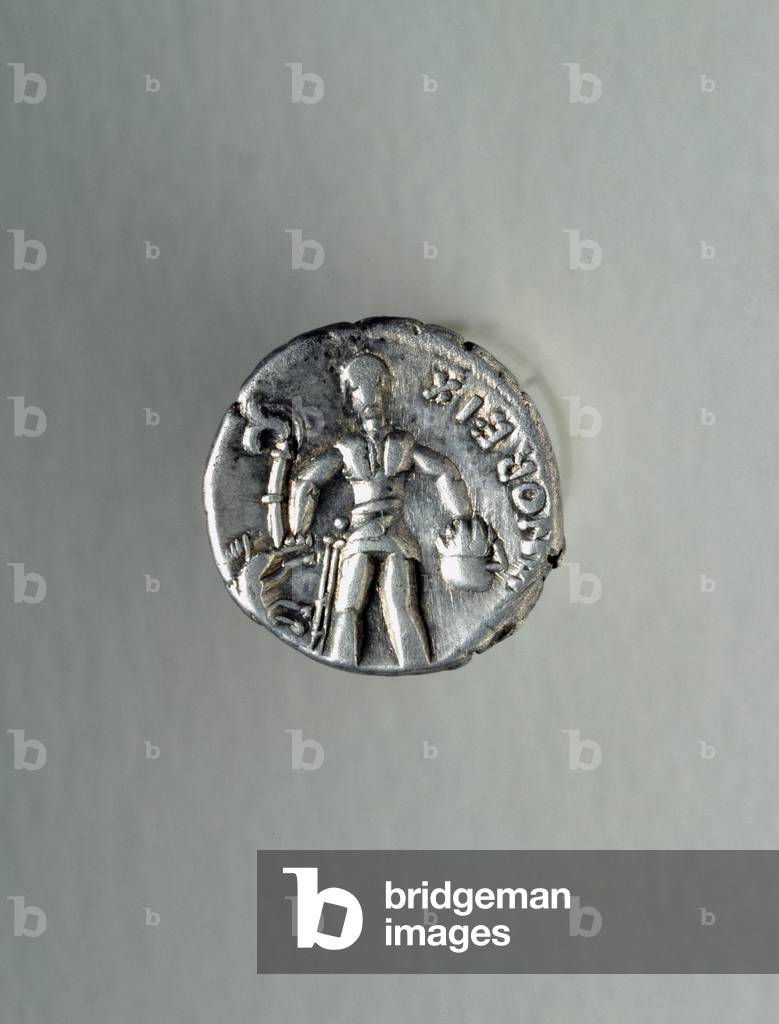
Coin in the name of Dvbnoreix, Eduan chief: warrior holding a carnyx and the head of an enemy in the left hand. 60-50 BC (silver)

LRI4685837: Coin in the name of Dvbnoreix, Eduan chief: warrior holding a carnyx and the head of an enemy in the left hand. 60-50 BC (silver), Celtic, (1st century BC) / Bridgeman Images

Molten bronze torquis. 4th century BC.

LRI4685866: Molten bronze torquis. 4th century BC., Celtic, (4th century BC) / Bridgeman Images

Woman's mask, 4th - 3rd century BC (terracotta)

LRI4685908: Woman's mask, 4th - 3rd century BC (terracotta), Phoenician, (3rd century BC) / Bridgeman Images

Armilla: The Resurrection, 1170-1180 (gold)

JLJ4685966: Armilla: The Resurrection, 1170-1180 (gold), Nicholas of Verdun (fl.1181-1205) / Bridgeman Images

Art Roman Empire of Antiquity. Venatio: Gladiators' fight against the fawned, 1st century BC (sculpture)

JLJ4619279: Art Roman Empire of Antiquity. Venatio: Gladiators' fight against the fawned, 1st century BC (sculpture), Roman, (1st century BC) / Bridgeman Images

Nebula NGC 6334 in the Scorpion - The 'reddened' nebulosity of NGC 6334 - The nebula NGC 6334 is located about 5500 years - light from Earth. Image made with the 1.2m Telescope of Schmidt UK from Siding Spring. The star - forming nebula NGC 6334 shows no evidence of a blue component in their colour - indeed, the blue - light plate used in these 3 - colour pictures had no nebulous image at all - nor is there any obvious sign of the bright blue stars normally found in these objects. They are excellent examples of the phenomenon known as 'interstellar reddening', the selective removal of blue light by minute particles of dust in the line of sight. This accounts for both the ruddy hue and apparent absence of blue stars. The hot stars are present but only some of the red part of their light is seen so they are not conspicuous. This nebula is quite nearby (5500 light years) but located close to the Galactic plane and are buried in the dust of the Milky Way. Careful measurement of the colour of stars associated with the nebula indicate that they are dimmed by a factor of about 10 in the green part of the spectrum, much more in the blue, but relatively little at red wavelengths. Some care has been taken to ensure that these images are as close to true - colour as possible

PIX4619360: Nebula NGC 6334 in the Scorpion - The 'reddened' nebulosity of NGC 6334 - The nebula NGC 6334 is located about 5500 years - light from Earth. Image made with the 1.2m Telescope of Schmidt UK from Siding Spring. The star - forming nebula NGC 6334 shows no evidence of a blue component in their colour - indeed, the blue - light plate used in these 3 - colour pictures had no nebulous image at all - nor is there any obvious sign of the bright blue stars normally found in these objects. They are excellent examples of the phenomenon known as 'interstellar reddening', the selective removal of blue light by minute particles of dust in the line of sight. This accounts for both the ruddy hue and apparent absence of blue stars. The hot stars are present but only some of the red part of their light is seen so they are not conspicuous. This nebula is quite nearby (5500 light years) but located close to the Galactic plane and are buried in the dust of the Milky Way. Careful measurement of the colour of stars associated with the nebula indicate that they are dimmed by a factor of about 10 in the green part of the spectrum, much more in the blue, but relatively little at red wavelengths. Some care has been taken to ensure that these images are as close to true - colour as possible / Bridgeman Images

Portrait of girl or lace dress. Portrait of a little girl in a white dress looks sad, 1879 (painting)

JLJ4619365: Portrait of girl or lace dress. Portrait of a little girl in a white dress looks sad, 1879 (painting), Cassatt, Mary Stevenson (1844-1926) / Bridgeman Images

Nebula NGC 6357 in Scorpio - Nebula NGC 6357 in Scorpius - This nebulae is located about 5500 years - light from Earth. Image made with the 1.2m Telescope of Schmidt UK from Siding Spring. Star - forming region located 5500 light year away

PIX4619393: Nebula NGC 6357 in Scorpio - Nebula NGC 6357 in Scorpius - This nebulae is located about 5500 years - light from Earth. Image made with the 1.2m Telescope of Schmidt UK from Siding Spring. Star - forming region located 5500 light year away / Bridgeman Images

Nebula M20 in Sagittarius - View of the nebula Trifide (M20/ngc 6514) in the constellation Sagittarius

PIX4619445: Nebula M20 in Sagittarius - View of the nebula Trifide (M20/ngc 6514) in the constellation Sagittarius / Bridgeman Images

Nebula Trifide (M20) in the constellation Sagittarius. - Nebula Trifide (M20) in the constellation Sagittarius. - View of the Nebula Trifide (M20/ngc 6514) located in the constellation Sagittarius between 5000 and 10,000 years - light of Earth. Composite image, 9 hours of installation

PIX4619455: Nebula Trifide (M20) in the constellation Sagittarius. - Nebula Trifide (M20) in the constellation Sagittarius. - View of the Nebula Trifide (M20/ngc 6514) located in the constellation Sagittarius between 5000 and 10,000 years - light of Earth. Composite image, 9 hours of installation / Bridgeman Images

Nebula Trifide (M20) in the constellation Sagittarius - Trifid nebula (M20) in Sagittarius - View of the Trifide nebula (M20/NGC 6514) located in the constellation Sagittarius between 5000 and 10,000 years - light from Earth. Measuring some forty light years across, this nebula contains enough gas to make many thousands of suns. Within it a number of young hot stars have already formed. The hottest cause the gas, mostly hydrogen, to emit its characteristic red light. Around the red emission nebula the gas contains many dust grains which preferentially reflect the blue component of starlight. In some parts of the nebula there are so many dust grains that they hide the glowing gas, producing the three dark lanes which give the object its name. Trifid is located in Sagittarius constellation between 5000 and 10 000 light - years away

PIX4619512: Nebula Trifide (M20) in the constellation Sagittarius - Trifid nebula (M20) in Sagittarius - View of the Trifide nebula (M20/NGC 6514) located in the constellation Sagittarius between 5000 and 10,000 years - light from Earth. Measuring some forty light years across, this nebula contains enough gas to make many thousands of suns. Within it a number of young hot stars have already formed. The hottest cause the gas, mostly hydrogen, to emit its characteristic red light. Around the red emission nebula the gas contains many dust grains which preferentially reflect the blue component of starlight. In some parts of the nebula there are so many dust grains that they hide the glowing gas, producing the three dark lanes which give the object its name. Trifid is located in Sagittarius constellation between 5000 and 10 000 light - years away / Bridgeman Images

Center of the Trifid Nebula (M20) - Center of the Trifid Nebula - The Trifid Nebula (M20) is located between 5000 and 10,000 years - light of the Earth in the constellation of Sagittarius. This image obtained by the Hubble space telescope shows the center of this nebula. A group of bright stars is visible in the center of the image near the dark bands of interstellar dust. These stars are young, blue, massive and extremely hot stars; they are O-type stars and the radiation they emit influence the evolution and structure of the nebula. Trifid Nebula, also known as Messier 20 and NGC 6514, lies within our own Milky Way Galaxy between 5000 and 10 000 light - years from Earth, in the constellation Sagittarius. This image from the Hubble Space Telescope offers a close - up view of the center of the Trifid Nebula, near the intersection of the dust bands, where a group of recently formed, massive, bright stars is easily visible. These stars, which astronomers classify as belonging to the hottest and bluest types of stars called type “” O,””” are releasing a flood of ultraviolet radiation that dramatically influences the structure and evolution of the surrounding nebula

PIX4619552: Center of the Trifid Nebula (M20) - Center of the Trifid Nebula - The Trifid Nebula (M20) is located between 5000 and 10,000 years - light of the Earth in the constellation of Sagittarius. This image obtained by the Hubble space telescope shows the center of this nebula. A group of bright stars is visible in the center of the image near the dark bands of interstellar dust. These stars are young, blue, massive and extremely hot stars; they are O-type stars and the radiation they emit influence the evolution and structure of the nebula. Trifid Nebula, also known as Messier 20 and NGC 6514, lies within our own Milky Way Galaxy between 5000 and 10 000 light - years from Earth, in the constellation Sagittarius. This image from the Hubble Space Telescope offers a close - up view of the center of the Trifid Nebula, near the intersection of the dust bands, where a group of recently formed, massive, bright stars is easily visible. These stars, which astronomers classify as belonging to the hottest and bluest types of stars called type “” O,””” are releasing a flood of ultraviolet radiation that dramatically influences the structure and evolution of the surrounding nebula / Bridgeman Images

Nebula Trifide (M20) in the constellation Sagittarius - Trifid nebula (M20) in Sagittarius - View of the Trifide nebula (M20/NGC 6514) located in the constellation Sagittarius between 5000 and 10,000 years - light from Earth. Measuring some forty light years across, this nebula contains enough gas to make many thousands of suns. Within it a number of young hot stars have already formed. The hottest cause the gas, mostly hydrogen, to emit its characteristic red light. Around the red emission nebula the gas contains many dust grains which preferentially reflect the blue component of starlight, and to the north (top) of the nebula can be seen a bright star which illuminates part of the dust to create a region of blue reflection. In some parts of the nebula there are so many dust grains that they hide the glowing gas, producing the three dark lanes which give the object its name. Trifid is located in Sagittarius constellation between 5000 and 10 000 light - years away

PIX4619560: Nebula Trifide (M20) in the constellation Sagittarius - Trifid nebula (M20) in Sagittarius - View of the Trifide nebula (M20/NGC 6514) located in the constellation Sagittarius between 5000 and 10,000 years - light from Earth. Measuring some forty light years across, this nebula contains enough gas to make many thousands of suns. Within it a number of young hot stars have already formed. The hottest cause the gas, mostly hydrogen, to emit its characteristic red light. Around the red emission nebula the gas contains many dust grains which preferentially reflect the blue component of starlight, and to the north (top) of the nebula can be seen a bright star which illuminates part of the dust to create a region of blue reflection. In some parts of the nebula there are so many dust grains that they hide the glowing gas, producing the three dark lanes which give the object its name. Trifid is located in Sagittarius constellation between 5000 and 10 000 light - years away / Bridgeman Images

Map of the Molucca Archipelago in East Indonesia. Geographic map, 17th century (gouache and lead mine)

JLJ4619573: Map of the Molucca Archipelago in East Indonesia. Geographic map, 17th century (gouache and lead mine), Doetechum, Jan van (17th century) / Bridgeman Images


Back to top