Print Friendly Version Page

2497570 Search Results

Explosion of a rocket top floor - Artist view - Rocket upperstage explosion - Artist view. - Explosion of a rocket top floor in space creating thousands of space debris - Artist view Rocket upperstage explosion - Artist view. The explosions are mainly caused by onboard energy sources, either due to pressure build - up in propellant tanks, battery explosions, or the ignition of hypergolic fuels. Each explosion creates thousands of small debris objects

PIX4642681: Explosion of a rocket top floor - Artist view - Rocket upperstage explosion - Artist view. - Explosion of a rocket top floor in space creating thousands of space debris - Artist view Rocket upperstage explosion - Artist view. The explosions are mainly caused by onboard energy sources, either due to pressure build - up in propellant tanks, battery explosions, or the ignition of hypergolic fuels. Each explosion creates thousands of small debris objects / Bridgeman Images

Military communication satellite Syracuse 3A - Syracuse 3A military communication satellite - View of the French military satellite Syracuse 3A in clean room at the Guyanese Space Centre on 4 September 2005. France's Syracuse 3A military communication satellite is mated on top of its payload adapter in the S5 payload processing facility of the Guiana Space Centre (CSG), Europe's space port, on September 4, 2005, in preparation for its launch atop an Ariane 5GS on October 13

PIX4642782: Military communication satellite Syracuse 3A - Syracuse 3A military communication satellite - View of the French military satellite Syracuse 3A in clean room at the Guyanese Space Centre on 4 September 2005. France's Syracuse 3A military communication satellite is mated on top of its payload adapter in the S5 payload processing facility of the Guiana Space Centre (CSG), Europe's space port, on September 4, 2005, in preparation for its launch atop an Ariane 5GS on October 13 / Bridgeman Images

Passage of a communication satellite Iridium. - Iridium communication satellite flare. - Passage of a communication satellite Iridium. An Iridium satellite communication “” flares””, as it passes overhead through a star field. The flares are caused by a mirror on the satellite reflecting direct sunshine

PIX4643227: Passage of a communication satellite Iridium. - Iridium communication satellite flare. - Passage of a communication satellite Iridium. An Iridium satellite communication “” flares””, as it passes overhead through a star field. The flares are caused by a mirror on the satellite reflecting direct sunshine / Bridgeman Images

Skylab station - The Skylab space station - Skylab station seen from the Skylab module - 2 before returning to Earth. The Skylab space station photographed from the Skylab 2 Command/Service Module before departing for earth

PIX4643295: Skylab station - The Skylab space station - Skylab station seen from the Skylab module - 2 before returning to Earth. The Skylab space station photographed from the Skylab 2 Command/Service Module before departing for earth / Bridgeman Images

The Museum of Indigenous Cultures of Brasilia (Brazil). Photo 18/04/07.

TEC4665414: The Museum of Indigenous Cultures of Brasilia (Brazil). Photo 18/04/07. / Bridgeman Images

Star sky and menhirs of Carnac - Starry sky above standing stones in Carnac - A menhir of Carnac masks the Gibbous Moon. On the left, the constellation of the Little Dog and Cancer above, in the center the Gemeaux, and finally the Coach on the right. March 2009. Starry sky above standing stones in Carnac, with Moon hidden by a menhir. Brittany, France. March 2009

PIX4665451: Star sky and menhirs of Carnac - Starry sky above standing stones in Carnac - A menhir of Carnac masks the Gibbous Moon. On the left, the constellation of the Little Dog and Cancer above, in the center the Gemeaux, and finally the Coach on the right. March 2009. Starry sky above standing stones in Carnac, with Moon hidden by a menhir. Brittany, France. March 2009 / Bridgeman Images

Star sky and menhirs of Carnac - Starry sky above standing stones in Carnac - Panoramic among the lines of Carnac. March 2009. Starry sky above standing stones in Carnac. Brittany, France. March 2009

PIX4665523: Star sky and menhirs of Carnac - Starry sky above standing stones in Carnac - Panoramic among the lines of Carnac. March 2009. Starry sky above standing stones in Carnac. Brittany, France. March 2009 / Bridgeman Images

Star Sky and Menhirs of Carnac - Starry sky above standing stones in Carnac - An observer among the Carnac alignments. March 2009. A night sky observer among standing stones in Carnac. Brittany, France. March 2009

PIX4665540: Star Sky and Menhirs of Carnac - Starry sky above standing stones in Carnac - An observer among the Carnac alignments. March 2009. A night sky observer among standing stones in Carnac. Brittany, France. March 2009 / Bridgeman Images

First public clock of Paris - Paris oldest public clock - First public clock of Paris, commissioned in 1371 by Charles V, redone and decoree under Henri III. It is located on the Clock Tower, at the corner of Boulevard du Palais and Quai de l'Horloge. She's not working anymore and she's lost her needles. Paris 'first clock is on the wall of the Concierge and was built in 1370

PIX4665719: First public clock of Paris - Paris oldest public clock - First public clock of Paris, commissioned in 1371 by Charles V, redone and decoree under Henri III. It is located on the Clock Tower, at the corner of Boulevard du Palais and Quai de l'Horloge. She's not working anymore and she's lost her needles. Paris 'first clock is on the wall of the Concierge and was built in 1370 / Bridgeman Images
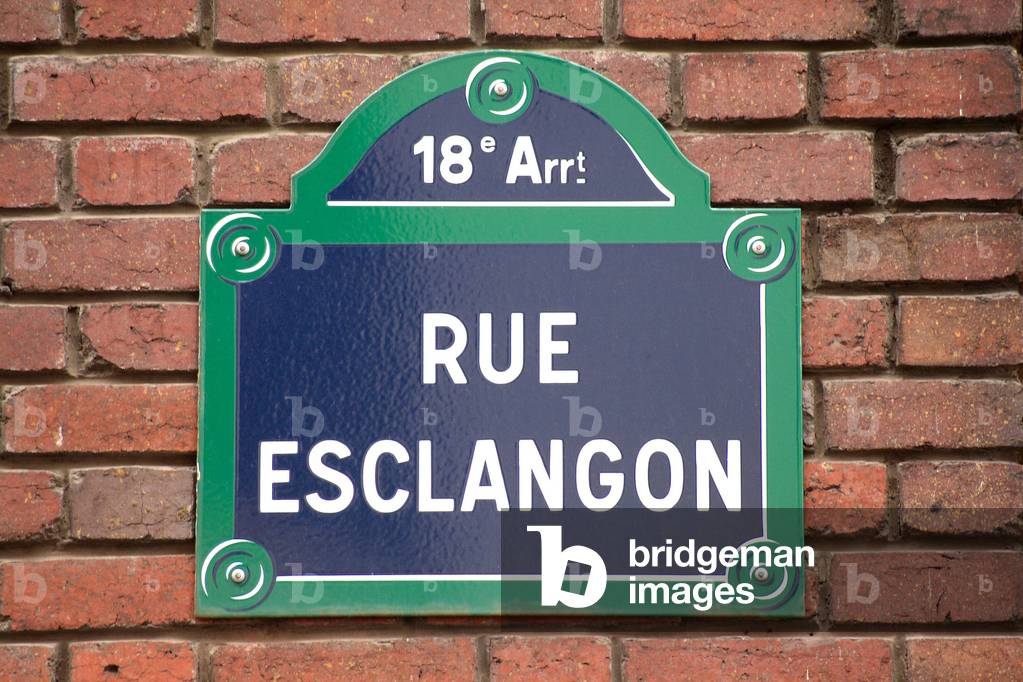
Plaque de la rue Esclangon a Paris - Street Plaque in Paris - Rue du XVIIIème arrondissement de Paris, in tribute to Ernest Benjamin Esclangon, astronomer and physicist (1876 - 1954) First astronomer at the Observatoire de Bordeaux (1899), Esclangon was then Director of the Observatory of Strasbourg (1918 - 1929), before becoming Director of the Observatory of Paris (1929 - 1944). Member of the Academy of Sciences in 1929, he joined the International Astronomical Union from 1935 to 1938. We owe him the invention of the talking clock. Street Esclangon, street sign. Benjamin Esclangon (1876 - 1954) was a french astronomer

PIX4665744: Plaque de la rue Esclangon a Paris - Street Plaque in Paris - Rue du XVIIIème arrondissement de Paris, in tribute to Ernest Benjamin Esclangon, astronomer and physicist (1876 - 1954) First astronomer at the Observatoire de Bordeaux (1899), Esclangon was then Director of the Observatory of Strasbourg (1918 - 1929), before becoming Director of the Observatory of Paris (1929 - 1944). Member of the Academy of Sciences in 1929, he joined the International Astronomical Union from 1935 to 1938. We owe him the invention of the talking clock. Street Esclangon, street sign. Benjamin Esclangon (1876 - 1954) was a french astronomer / Bridgeman Images

Crete vue de l'espace - Crete seen from space - La Crete vue from the International Space Station (ISS) on 22 July 2011. Crete is the largest and most heavily populated island of Greece (or the Hellenic Republic). The island stretches approximately 260 kilometers (161 miles) from west to east, and it is roughly 60 kilometers (37 miles) across at its widest point. The rugged terrain of Crete includes mountains, plateaus, and several deep gorges. The largest city on the island, Heraklion, sits on the northern coastline. Several smaller islands ring Crete. Two of the largest of these, Dia and Gavdos, are sparsely populated year - round, although Gavdos hosts numerous summer visitors. The western and central parts of Crete appear surrounded by quicksilver in this astronaut photograph taken from the International Space Station. This phenomenon is known as sunglint, caused by light reflecting off of the sea surface directly towards the observer. The point of maximum reflectance is visible as a bright white region to the northwest of the island. Surface currents causing variations in the degree of reflectance are visible near the southwestern shoreline of Crete and the smaller island of Gavdos (image lower left). This astronaut photograph was acquired on July 22, 2011, with a Nikon D3S digital camera using a 48 mm lens

PIX4665986: Crete vue de l'espace - Crete seen from space - La Crete vue from the International Space Station (ISS) on 22 July 2011. Crete is the largest and most heavily populated island of Greece (or the Hellenic Republic). The island stretches approximately 260 kilometers (161 miles) from west to east, and it is roughly 60 kilometers (37 miles) across at its widest point. The rugged terrain of Crete includes mountains, plateaus, and several deep gorges. The largest city on the island, Heraklion, sits on the northern coastline. Several smaller islands ring Crete. Two of the largest of these, Dia and Gavdos, are sparsely populated year - round, although Gavdos hosts numerous summer visitors. The western and central parts of Crete appear surrounded by quicksilver in this astronaut photograph taken from the International Space Station. This phenomenon is known as sunglint, caused by light reflecting off of the sea surface directly towards the observer. The point of maximum reflectance is visible as a bright white region to the northwest of the island. Surface currents causing variations in the degree of reflectance are visible near the southwestern shoreline of Crete and the smaller island of Gavdos (image lower left). This astronaut photograph was acquired on July 22, 2011, with a Nikon D3S digital camera using a 48 mm lens / Bridgeman Images

Netherlands by satellite - View obtained by satellite Landsat

PIX4666110: Netherlands by satellite - View obtained by satellite Landsat / Bridgeman Images

Aurore boreale et Jupiter - Aurora with Jupiter in Norway - Aurora boreale et la planete Jupiter (bright dot down the image) observed in Norway. 1 December 2011. Aurora borealis with planet Jupiter (bright dot in the bottom of the image) seen in Norway on december 1st 2011

PIX4670133: Aurore boreale et Jupiter - Aurora with Jupiter in Norway - Aurora boreale et la planete Jupiter (bright dot down the image) observed in Norway. 1 December 2011. Aurora borealis with planet Jupiter (bright dot in the bottom of the image) seen in Norway on december 1st 2011 / Bridgeman Images

Aurora boreale - Norway - Northern Lights and fisherman cabins - Aurora boreale in the clouds above traditional fishing houses. Lofoten. Aurora Borealis and traditional fisherman cabins (called rorbu) in the small hamlet of Hamnoy, Lofoten Islands, Norway

PIX4670222: Aurora boreale - Norway - Northern Lights and fisherman cabins - Aurora boreale in the clouds above traditional fishing houses. Lofoten. Aurora Borealis and traditional fisherman cabins (called rorbu) in the small hamlet of Hamnoy, Lofoten Islands, Norway / Bridgeman Images

Aurora boreale - Finland - 10/2003 - Aurora borealis in Finland 10/2003 - Aurora boreale observed in Lapland, Kittilae (Finland), October 2003. Aurora borealis seen in Lapland, in Kittilae (Finland). October 2003

PIX4670285: Aurora boreale - Finland - 10/2003 - Aurora borealis in Finland 10/2003 - Aurora boreale observed in Lapland, Kittilae (Finland), October 2003. Aurora borealis seen in Lapland, in Kittilae (Finland). October 2003 / Bridgeman Images

Aurora boreale - Finland - 08/2007 - Aurora borealis in Finland 08/2007 - Aurora boreale observed in Lapland, (Pallas National Park - Yllaestunturi, Muonio, Finland), August 2007. Aurora borealis seen in Lapland, Pallas lake, Muonio (Finland). August 2007

PIX4670310: Aurora boreale - Finland - 08/2007 - Aurora borealis in Finland 08/2007 - Aurora boreale observed in Lapland, (Pallas National Park - Yllaestunturi, Muonio, Finland), August 2007. Aurora borealis seen in Lapland, Pallas lake, Muonio (Finland). August 2007 / Bridgeman Images

Aurora boreale in Iceland - Northern light in Iceland - Aurora boreale in the region of Myvatn in Iceland

PIX4670644: Aurora boreale in Iceland - Northern light in Iceland - Aurora boreale in the region of Myvatn in Iceland / Bridgeman Images

Southern aurora observed from New Zealand on 24 November 2001. - Southern aurora observed from New Zealand on 24 November 2001.

PIX4670732: Southern aurora observed from New Zealand on 24 November 2001. - Southern aurora observed from New Zealand on 24 November 2001. / Bridgeman Images

Southern Aurora observed from New Zealand on 15 May 2005. - Southern Aurora observed from New Zealand on 15 May 2005

PIX4670792: Southern Aurora observed from New Zealand on 15 May 2005. - Southern Aurora observed from New Zealand on 15 May 2005 / Bridgeman Images
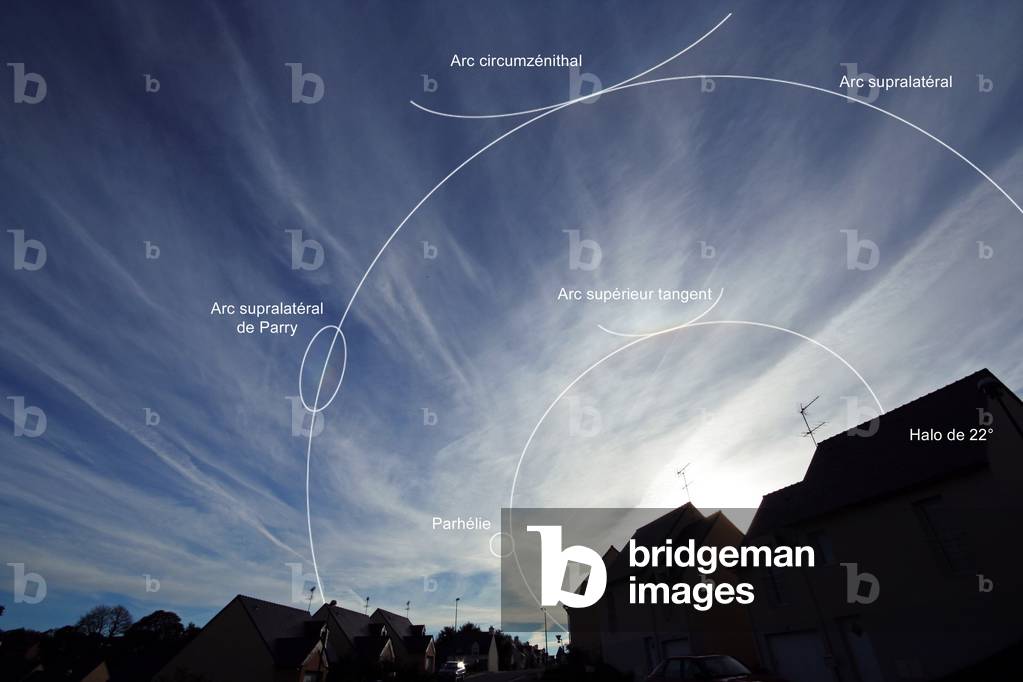
Halo around the Sun - Sun Halo - Halos are due to the light of the Sun reflected by high-altitude clouds, cirrostratus, composed of ice crystals. They bend the light and cause a perfect circle around the Sun. Here we can see: - around the Sun, the halo of 22* radius, rather little contrast. - on the left of the Sun, a brilliant parhely but little colour. - on the top of the halo of 22* radius, the upper arc tangent in the shape of a U evase. - on the left, the arc of Parry. - near the zenith, the arc circumzenithal, colour. 28 October 2006, Quimper O are caused by sunlight being refracted by cirro - stratus clouds. These are thin clouds, very high in the atmosphere, and are composed of ice crystals. They bend light at a 22 degree angle, which creates a halo around the sun that is 44 degrees in diameter. In brief: - around the Sun, the 22* halo, not very contrasted. - on the left of the Sun, a bright parhelia uncolored. - atop the 22* halo, the upper tangent arc. - on the left, the Parry arc. - near the zenith, the circumzenithal arc. October 28, 2006

PIX4670954: Halo around the Sun - Sun Halo - Halos are due to the light of the Sun reflected by high-altitude clouds, cirrostratus, composed of ice crystals. They bend the light and cause a perfect circle around the Sun. Here we can see: - around the Sun, the halo of 22* radius, rather little contrast. - on the left of the Sun, a brilliant parhely but little colour. - on the top of the halo of 22* radius, the upper arc tangent in the shape of a U evase. - on the left, the arc of Parry. - near the zenith, the arc circumzenithal, colour. 28 October 2006, Quimper O are caused by sunlight being refracted by cirro - stratus clouds. These are thin clouds, very high in the atmosphere, and are composed of ice crystals. They bend light at a 22 degree angle, which creates a halo around the sun that is 44 degrees in diameter. In brief: - around the Sun, the 22* halo, not very contrasted. - on the left of the Sun, a bright parhelia uncolored. - atop the 22* halo, the upper tangent arc. - on the left, the Parry arc. - near the zenith, the circumzenithal arc. October 28, 2006 / Bridgeman Images

Halo around the Sun - Sun Halo - Halos are due to the light of the Sun reflected by high-altitude clouds, cirrostratus, composed of ice crystals. They bend the light and thus cause a perfect circle around the Sun. 14 May 2006, Finistere. Halos are caused by sunlight being refracted by cirro - stratus clouds. These are thin clouds, very high in the atmosphere, and are composed of ice crystals. They bend light at a 22 degree angle, which creates a halo around the sun that is 44 degrees in diameter. May 14, 2006

PIX4670972: Halo around the Sun - Sun Halo - Halos are due to the light of the Sun reflected by high-altitude clouds, cirrostratus, composed of ice crystals. They bend the light and thus cause a perfect circle around the Sun. 14 May 2006, Finistere. Halos are caused by sunlight being refracted by cirro - stratus clouds. These are thin clouds, very high in the atmosphere, and are composed of ice crystals. They bend light at a 22 degree angle, which creates a halo around the sun that is 44 degrees in diameter. May 14, 2006 / Bridgeman Images

G.Carr in weightlessness in Skylab Station 02 - 1974 - Astronaut Gerald Carr floats in Skylab - Astronaut Gerald Carr demonstrates the effects of weightlessness in Skylab Station. 1974. Astronaut Gerald P. Carr, commander for the Skylab 4 mission, demonstrates the effects of zero - gravity as he floats in the forward dome area of the Orbital Workshop of the Skylab space station while in Earth orbit. Skylab 4 mission lasted 84 days

PIX4643426: G.Carr in weightlessness in Skylab Station 02 - 1974 - Astronaut Gerald Carr floats in Skylab - Astronaut Gerald Carr demonstrates the effects of weightlessness in Skylab Station. 1974. Astronaut Gerald P. Carr, commander for the Skylab 4 mission, demonstrates the effects of zero - gravity as he floats in the forward dome area of the Orbital Workshop of the Skylab space station while in Earth orbit. Skylab 4 mission lasted 84 days / Bridgeman Images

Halo around the Sun - Sun Halo - Halos are due to the light of the Sun reflected by high-altitude clouds, cirrostratus, composed of ice crystals. They bend the light and cause a perfect circle around the Sun. To the top left of the halo, a halo circumscribed. 26 April 2008, Finistere. Halos are caused by sunlight being refracted by cirro - stratus clouds. These are thin clouds, very high in the atmosphere, and are composed of ice crystals. They bend light at a 22 degree angle, which creates a halo around the sun that is 44 degrees in diameter. A circumscribed halo is also visible towards top left. April 26, 2008

PIX4671000: Halo around the Sun - Sun Halo - Halos are due to the light of the Sun reflected by high-altitude clouds, cirrostratus, composed of ice crystals. They bend the light and cause a perfect circle around the Sun. To the top left of the halo, a halo circumscribed. 26 April 2008, Finistere. Halos are caused by sunlight being refracted by cirro - stratus clouds. These are thin clouds, very high in the atmosphere, and are composed of ice crystals. They bend light at a 22 degree angle, which creates a halo around the sun that is 44 degrees in diameter. A circumscribed halo is also visible towards top left. April 26, 2008 / Bridgeman Images

Halo around the Sun - Sun Halo - Halos are due to the light of the Sun reflected by high-altitude clouds, cirrostratus, composed of ice crystals. They bend the light and cause a perfect circle around the Sun. Here is a halo circumscribed. 26 April 2008, Finistere. Halos are caused by sunlight being refracted by cirro - stratus clouds. These are thin clouds, very high in the atmosphere, and are composed of ice crystals. They bend light at a 22 degree angle, which creates a halo around the sun that is 44 degrees in diameter. Here is a circumscribed halo. April 26, 2008

PIX4671012: Halo around the Sun - Sun Halo - Halos are due to the light of the Sun reflected by high-altitude clouds, cirrostratus, composed of ice crystals. They bend the light and cause a perfect circle around the Sun. Here is a halo circumscribed. 26 April 2008, Finistere. Halos are caused by sunlight being refracted by cirro - stratus clouds. These are thin clouds, very high in the atmosphere, and are composed of ice crystals. They bend light at a 22 degree angle, which creates a halo around the sun that is 44 degrees in diameter. Here is a circumscribed halo. April 26, 2008 / Bridgeman Images
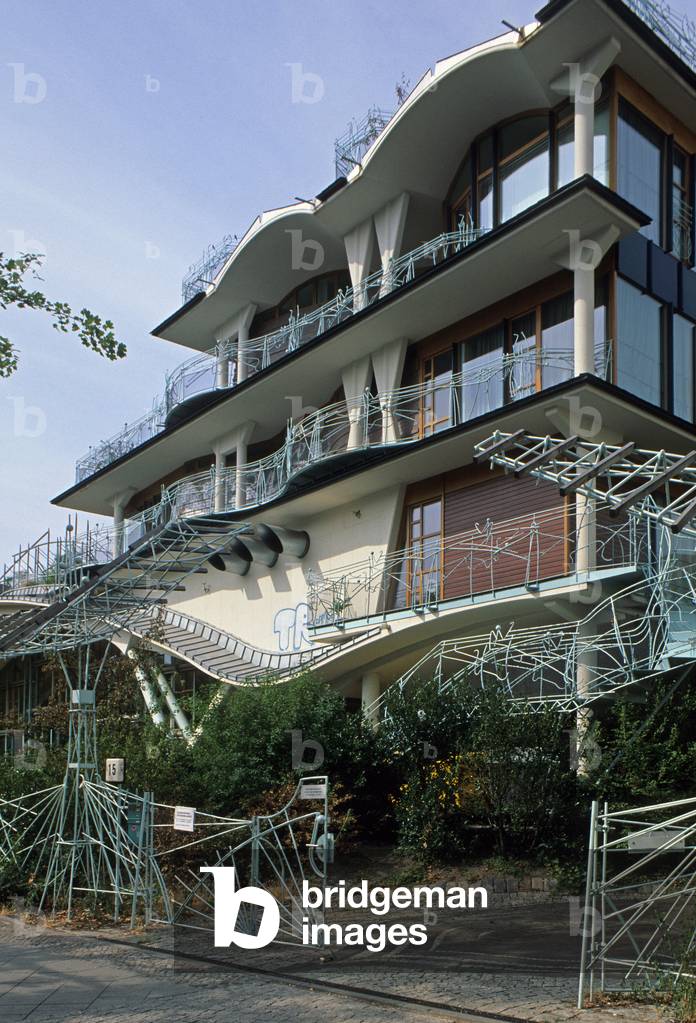
Accommodation in Berlin (Germany). Architects Inken and Hinrich Baller, 1987. Photograph 15/08/03.

TEC4647505: Accommodation in Berlin (Germany). Architects Inken and Hinrich Baller, 1987. Photograph 15/08/03. / Bridgeman Images
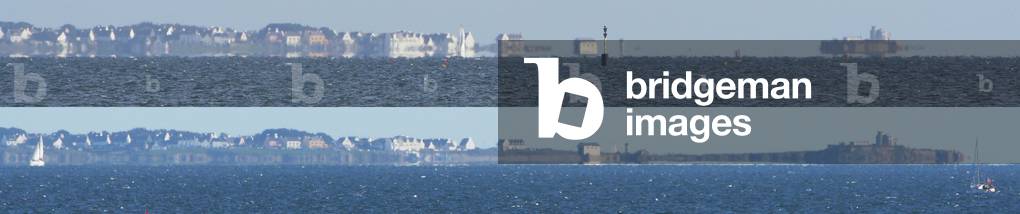
Mirage inferior - Inferior mirage - Mirage inferior caused by the difference in temperature of the sea warmer than that of the air

PIX4672024: Mirage inferior - Inferior mirage - Mirage inferior caused by the difference in temperature of the sea warmer than that of the air / Bridgeman Images
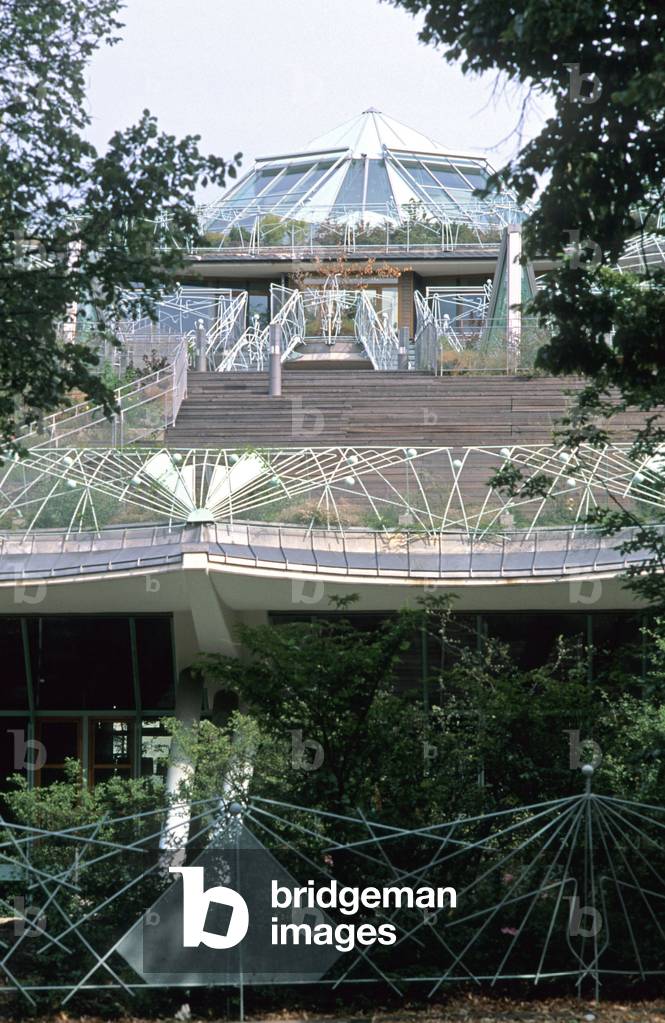
Accommodation in Berlin (Germany). Architects Inken and Hinrich Baller, 1987. Photography 15/08/03.

TEC4647513: Accommodation in Berlin (Germany). Architects Inken and Hinrich Baller, 1987. Photography 15/08/03. / Bridgeman Images
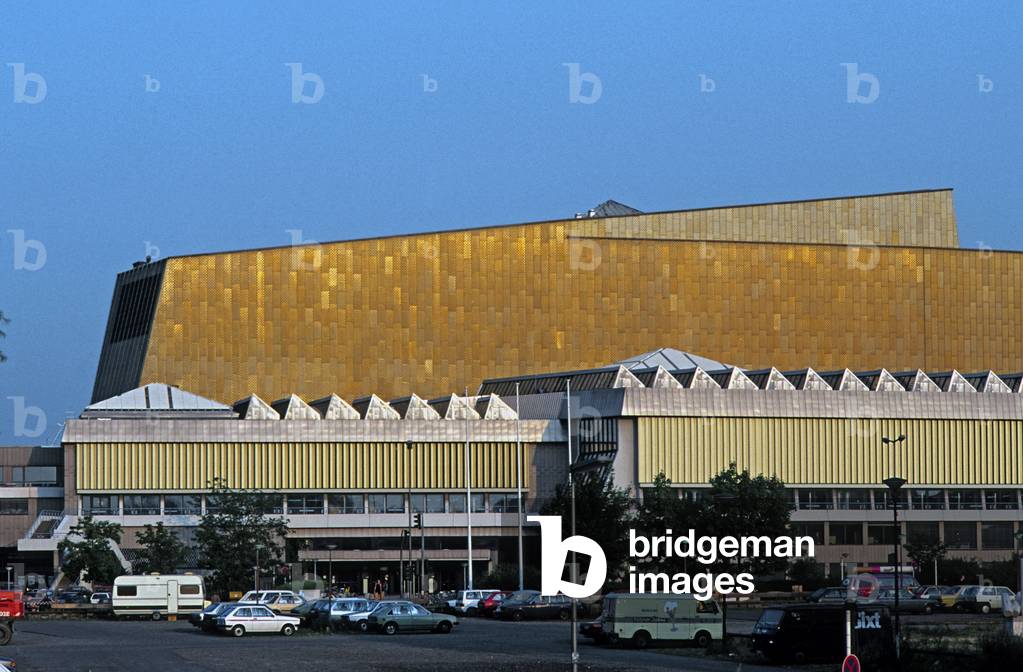
Philarmony (Kultur Forum) and Berlin Zoo (Germany). Architects Hans Scharoun, 1960-1963 and Edgar Winieewski, 1987.

TEC4647536: Philarmony (Kultur Forum) and Berlin Zoo (Germany). Architects Hans Scharoun, 1960-1963 and Edgar Winieewski, 1987. / Bridgeman Images
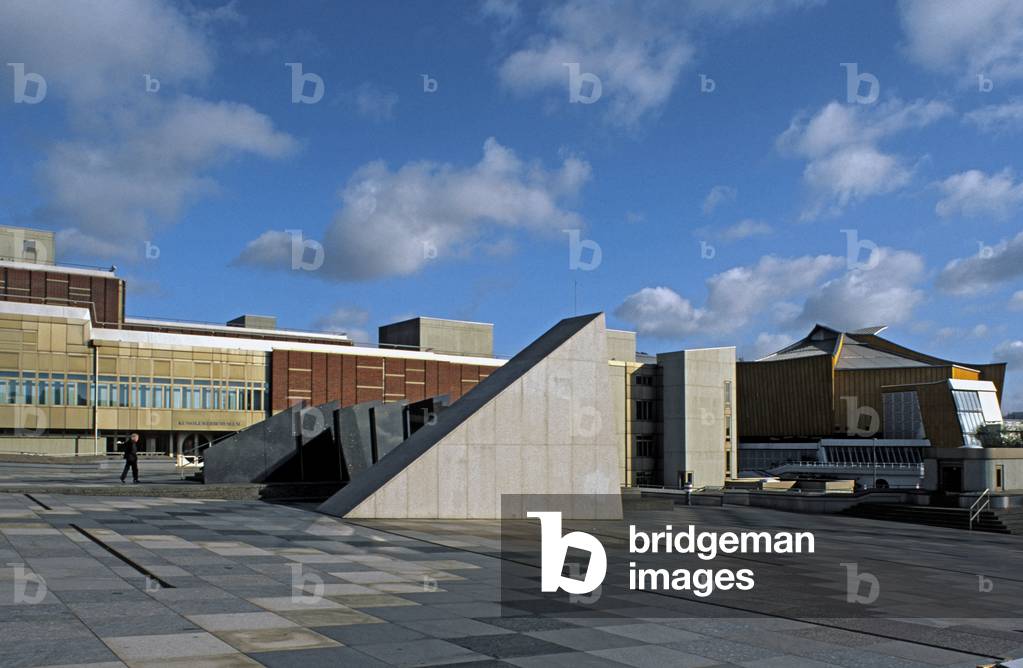
The Museum of Appliques Arts (Kultur Forum) in Berlin (Germany). Architect Rolf Gutbrod, realisation 1978-1985.

TEC4647615: The Museum of Appliques Arts (Kultur Forum) in Berlin (Germany). Architect Rolf Gutbrod, realisation 1978-1985. / Bridgeman Images

Shuttle Atlantis in orbit 02/2001 - Space shuttle Atlantis 02/2001 - Shuttle Atlantis joins Earth, photographed by astronauts in the international space station. 16 February 2001. STS-98 Atlantis photographed from the International Space Station (ISS) shortly after the shuttle and the outpost unlinked following several days of joint operations of the two crews. Feb 16 2001

PIX4647715: Shuttle Atlantis in orbit 02/2001 - Space shuttle Atlantis 02/2001 - Shuttle Atlantis joins Earth, photographed by astronauts in the international space station. 16 February 2001. STS-98 Atlantis photographed from the International Space Station (ISS) shortly after the shuttle and the outpost unlinked following several days of joint operations of the two crews. Feb 16 2001 / Bridgeman Images
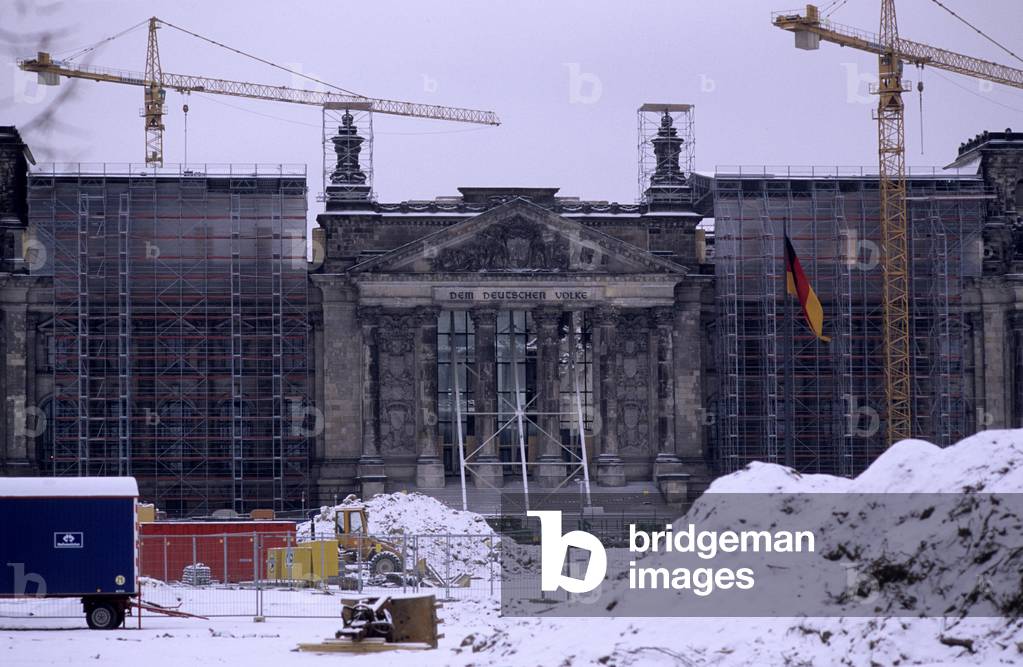
The renovation of the Bundestag in Berlin, Germany. Photography 01/10/1996

TEC4647750: The renovation of the Bundestag in Berlin, Germany. Photography 01/10/1996 / Bridgeman Images
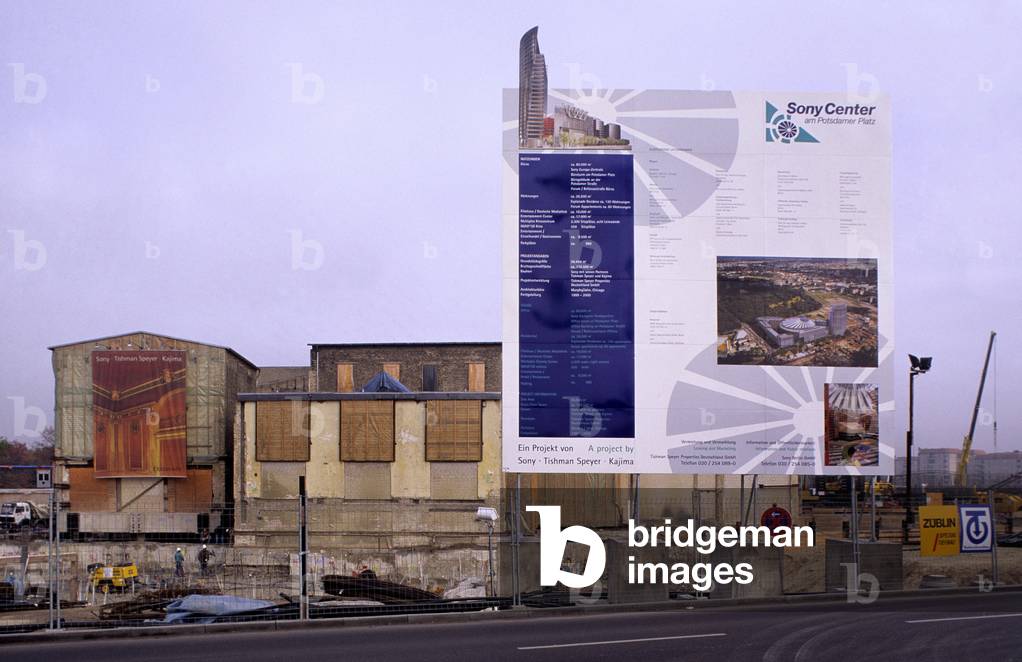
Sony Center site, Potsdamer platz in Berlin (Germany). Architect Helmut Jahn, 2000. Photography 01/10/96.

TEC4647816: Sony Center site, Potsdamer platz in Berlin (Germany). Architect Helmut Jahn, 2000. Photography 01/10/96. / Bridgeman Images
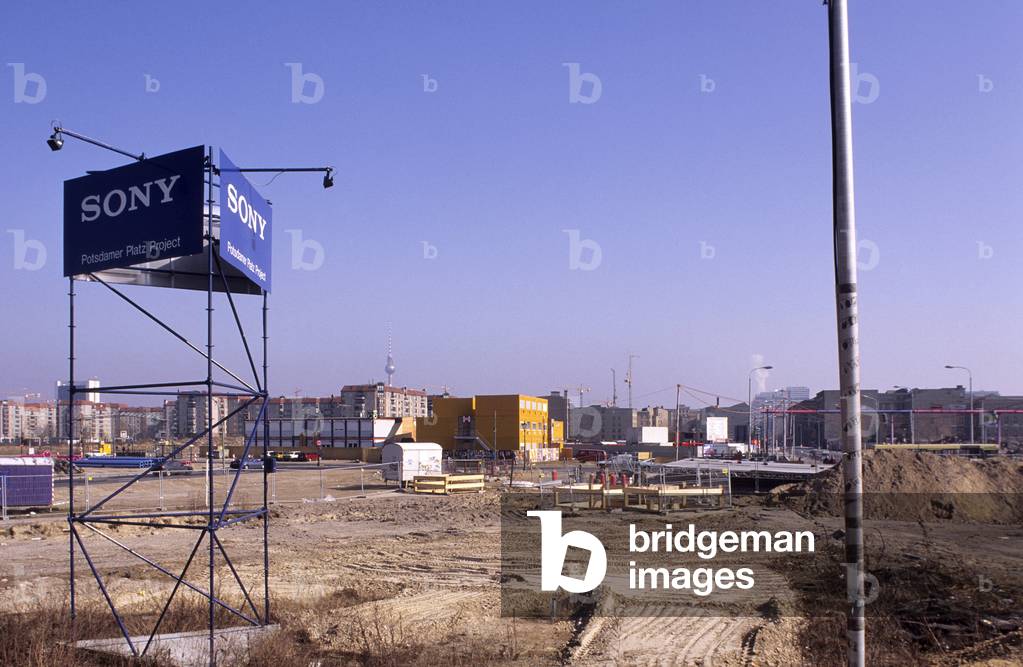
The Sony Center, relocation of the Potsdamer Platz in Berlin (Germany). Realisation 2000, architect Helmut Jahn. Photography 01/10/95.

TEC4647861: The Sony Center, relocation of the Potsdamer Platz in Berlin (Germany). Realisation 2000, architect Helmut Jahn. Photography 01/10/95. / Bridgeman Images

The restoration of the Potsdamer Platz in Berlin (Germany). Infobox, construction 1995, architects Schneider and Schumacher. Photography 01/10/95.

TEC4647872: The restoration of the Potsdamer Platz in Berlin (Germany). Infobox, construction 1995, architects Schneider and Schumacher. Photography 01/10/95. / Bridgeman Images

Space Astronaut STS - 103 12/1999 - Reflection in astronaut hemet visor 12/1999 - Earth and Space Shuttle Discovery are reflected in the visor of an astronaut's helmet. The Space Shuttle Discovery's Cargo Bay and Crew Module, and the Earth's horizon are reflected in the helmet visor of one of the space walking astronauts. Astronauts Steven Smith, John Grunsfeld, Michael Foale and Claude Nicollier participated in three days of extravehicular activity on the NASA's third servicing visit to the Hubble Space Telescope (HST). Dec 1999

PIX4647917: Space Astronaut STS - 103 12/1999 - Reflection in astronaut hemet visor 12/1999 - Earth and Space Shuttle Discovery are reflected in the visor of an astronaut's helmet. The Space Shuttle Discovery's Cargo Bay and Crew Module, and the Earth's horizon are reflected in the helmet visor of one of the space walking astronauts. Astronauts Steven Smith, John Grunsfeld, Michael Foale and Claude Nicollier participated in three days of extravehicular activity on the NASA's third servicing visit to the Hubble Space Telescope (HST). Dec 1999 / Bridgeman Images
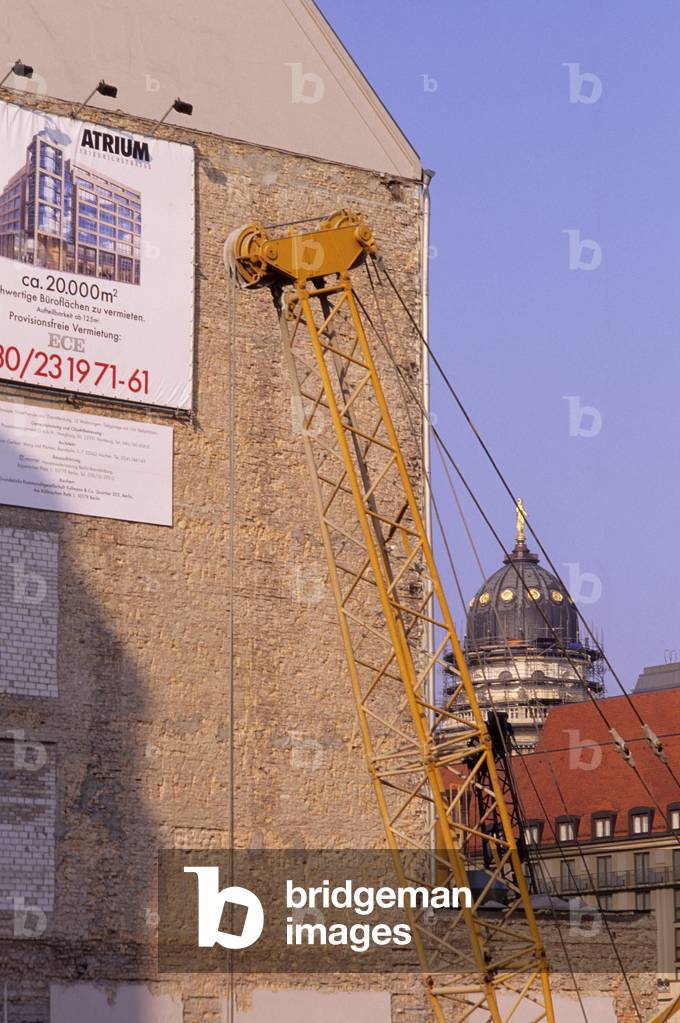
The construction site on the Friedrichstrasse in Berlin (Germany).

TEC4647951: The construction site on the Friedrichstrasse in Berlin (Germany). / Bridgeman Images


Back to top