
Print this page or go back to standard view.

PIX4620260: Southern Crown Nebula - The tail of the CRA reflection nebula - R Coronae Australis is a region of star formations visible in the southern hemisphere. It is located about 500 light years away from Earth. On the right, the globular cluster NGC 6723, located 30 000 light years from Earth in Sagittarius. Image made with the 1.2m Telescope of Schmidt UK from Siding Spring. Corona Australis (the southern crown, CRA) is in the far southern sky but visible from the southern states of the USA. The constellation is small but distinctive. The conspicuous globular cluster NGC 6723 is at the western (right) edge of the photograph, but it is in Sagittarius, and is about 30,000 light years distant. Our picture is about 4.5 degrees across and the extremely faint Corona Australis nebula meanders along the Sgr - CRA border nebula in the same E - W direction. Almost all the nebulosity here is starlight, reflected from minute grains of dust, some of which gather into darker condensations ('molecular clouds'), blotting out the background stars. By far the largest and densest of the molecular clouds is at the western end of the picture, seen in more detail here. It is about a degree long, corresponding to eight light years at the 500ly distance of the nebula and is extremely opaque - - background stars are dimmed by an astonishing 35 magnitudes. However, not all is darkness, and the dusty cloud appears to be tipped by a pair of bright stars, embedded in bright reflection nebulae. The brightest of these is NGC 6726 - 27 and it contains both a visual binary and a variable star. Other wispy nebulae in the western part of the dark cloud betray the presence of young, hidden stars / Bridgeman Images

PIX4620322: Nebula of the crescent ngc 6888 in swan - 12.5” RC, F6, RRGB = 180:20:40 / Bridgeman Images

JLJ4620337: Jules Mazarin sits between France and Spain, ready to fight for his life at Casal, 1901 (illustration), Leloir, Maurice (1853-1940) / Bridgeman Images

TEC4620396: Frankfurter Tor, Friedrichshain District in Berlin (Germany). Architecet Hermann Henselmann (1905-1995), 1957-1961. Photography 10/08/03. / Bridgeman Images

LRI4620409: Portrait of Countess Rucellai Painting by Giuseppe Bezzuoli (1784-1855) 19th century Florence, private collection, Bezzuoli, Giuseppe (1784-1855) / Bridgeman Images

JSN4620521: The Maxim Gorki Theater in Berlin (Germany). Architect Carl Theodor Ottmer, 1825-1827. This photographic work came from the exhibition Berlin, urban mutations presented at the Musee Carnavalet in Paris in 1997. A catalogue is available in the Open City editions. Maxime Gorki, who was the former Singer Akademie Academy, founded in 1792. This institution was created by Goethe's friend Karl Friedrich Zelter. Almost thirty years later, the Academie de Chant settled in the current building designed by Carl Theodor Ottmer, who was inspired by Schinkel's plans. Photography 10/06/95., Salmon, Jacqueline / Bridgeman Images

JSN4620532: Portrait of Andrea Breth at the Schaubuhne, Berlin (Germany). This photographic work came from the exhibition Berlin, urban mutations presented at the Musee Carnavalet in Paris in 1997. A catalogue is available in the Open City editions. Photography 10/06/95., Salmon, Jacqueline / Bridgeman Images

PIX4620300: Star births in the nebula NGC 6729 - Young stars in the nebula NGC 6729 - Close up on a star-forming region. The new stars are invisible, hidden behind the dust cloud at the top left of the image, but the material they eject at very high speed causes colorful and luminous arcs in contact with the surrounding gas. Image obtained in Chile with the VLT. This very detailed false - colour image from Eso's Very Large Telescope shows the dramatic effects of very young stars on the dust and gas from which they were born in the star - forming region NGC 6729. The baby stars are invisible in this picture, being hidden behind dust clouds at the upper left of the picture, but material they are ejecting is crashing into the surroundings at speeds of that can be as high as one million kilometres per hour. These shocks cause the gas to shine and create the strangely coloured glowing arcs and blobs known as Herbig - Haro objects. In this view the Herbig - Haro objects form two lines marking out the probable directions of ejected material. One stretches from the upper left to the lower centre, ending in the bright, circular group of glowing blobs and arcs at the lower centre. The other starts near the left upper edge of the picture and extends towards the centre right. The peculiar scimitar - shaped bright feature at the upper left is probably mostly due to starlight being reflected from dust and is not a Herbig - Haro object. This picture was taken by the FORS1 instrument and records the scene in the light of glowing hydrogen and sulphur / Bridgeman Images

TEC4620325: The Pergamonnumseum (Pergamon Museum), before its restoration, Museum Island in Berlin (Germany). Construction 1909-1930, architects Ludwig Hoffmann (1852-1932) and Alfred Messel (1853-1909). Photography 10/08/03. / Bridgeman Images

PIX4620345: Nebula of the crescent NGC 6888 in the Swan - Crescent nebula in Cygnus - NGC 6888 the nebula of the Crescent. This nebula is a gas shell located in the constellation Swan. The bright star in the center of the nebula is the star WR 136, a star of Wolf - Rayet, massive, very hot. The nebula is a shell of gas that is being energized by the strong stellar wind from the Wolf - Rayet star WR 136, the bright star at the center of the nebula. It is located about 5,000 light years from Earth in the constellation of Cygnus, the Swan. Wolf - Rayet stars are very hot, massive stars that are blowing off their outer layers / Bridgeman Images
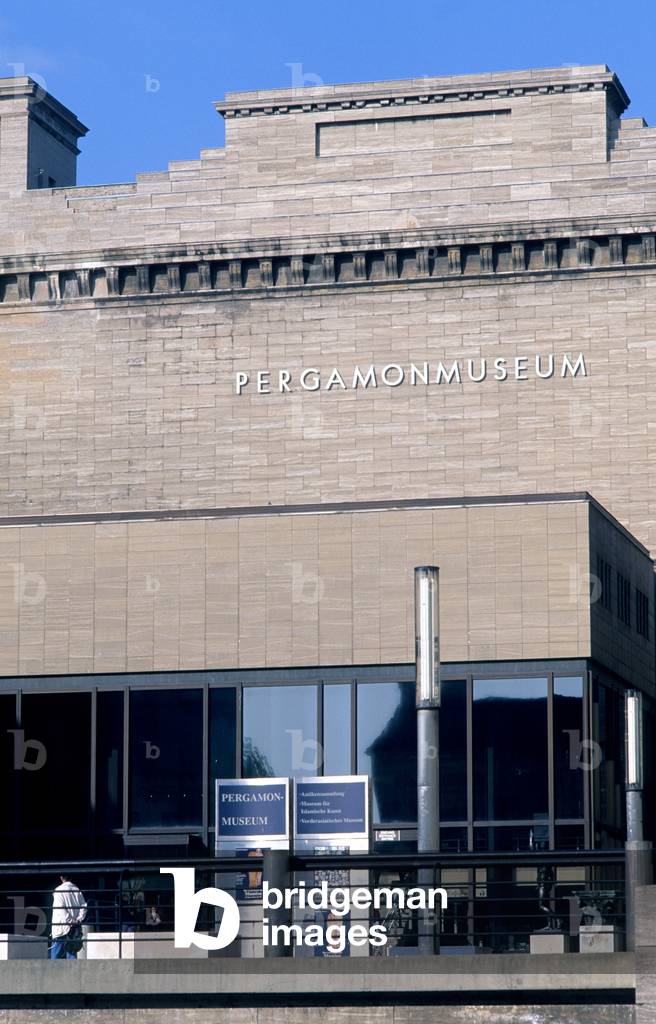
TEC4620367: The Pergamonnumseum (Pergamon Museum), before its restoration, Museum Island in Berlin (Germany). Construction 1909-1930, architects Ludwig Hoffmann (1852-1932) and Alfred Messel (1853-1909). Photography 10/08/03. / Bridgeman Images

LRI4620574: The crippled, 1568 (painting), Brueghel, Pieter The Elder (c.1525-69) / Bridgeman Images

PIX4620765: Nebula N11 in the Great Magellan Cloud - N11 star forming region in Large Magellanic Cloud (LMC) - N11 (Henize 11) is a vast star-forming region located in the Great Magellan Cloud galaxy. It is home to a cluster of hot young stars, NGC 1760. This glowing complex of rings, shells, and powerful young stars lies in the Large Magellanic Cloud, a satellite galaxy of the Milky Way. The overall complex of glowing gas and stars is known as N11 while the central cluster of hot young blue stars is know as NGC 1760. The complex expanding shells of gas have likely formed from multiple generations of hot O and B type stars and their supernovae. N11 spans over 1000 light years across / Bridgeman Images

PIX4620807: Nebula N44 in the Great Magellan Cloud - Henize 44, an emission nebula in the LMC - Vast region of star formation located in the Great Magellan Cloud. Image obtained by the 1.2m Schmidt UK Telescope from Siding Spring. The nearby Large Magellanic Cloud (LMC) is a very active star - forming galaxy. The most massive region of star formation is around 30 Doradus (the Tarantula nebula) which can be seen with the unaided eye, but hundreds of lesser examples are visible with a telescope. This picture shows Henize 44. The energetic ultraviolet light from these stars is absorbed by hydrogen and produces the distinctive red glow from an enormous distance around the cluster. Image obtained with the Schmidt UK telescope of Siding Spring / Bridgeman Images

PIX4620872: Nebula N70 in the Great Magellan Cloud - The N 70 nebula in Large Magellanic Cloud (LMC) - The Henize 70 nebula extends for about 400 years - light, it is located in the Great Magellan Cloud. In the center, a small group of very massive and extremely hot stars, stars of Wolf - Rayet. Image obtained by Siding Spring's 3.9m telescope. At the centre of this remarkable bubble - like nebula nebula is a small group of extremely hot stars. Some of these stars are rapdly losing mass and have stellar winds blowing from their surfaces with velocities that approach 4000 kilometers per second. Such stars are known as Wolf - Rayet stars and are found in galaxies capable of forming massive stars. There are many such stars in the Large Magellanic Cloud (LMC) but not all of them are associated with distinctive nebulae. The outward flowing streams of energetic particles from Wolf - Rayet (and other energetic stars) eventually interact with the relatively stationary interstellar medium pervading the LMC, releasing much of their energy as a thin spherical shell of luminous material. The hollow structure accounts for the shape we see in the sky. This nebula is almost 400 light years across, about 100 times the distance from the Sun to the nearest star. The LMC is about 160,000 light years away and is the closest galaxy to the Milky Way / Bridgeman Images

PIX4620911: Nebula N90 in the Little Magellan Cloud - Nebula N90 in the Little Magellan Cloud - View of nebula N90 in the Little Magellan Cloud, a galaxy next to our located 200,000 years - light from Earth. At the heart of this star-forming region is the cluster of stars NGC 602. These young stars have emerge from their cocoon of gas blowing the surrounding matter; the gas pillars pointing towards these stars are a sign of this erosion. In the dark clouds, other stars are forming. In the background, many galaxies are visible. Composite images obtained by the Hubble Space Telescope in July 2004 / Bridgeman Images

LRI4620941: The Prophet Salomon Detrempe on wood by Duccio di Buoninsegna (1255-1318/9) 1308-1311 Dim. 42,5x16 cm Siena, Museo del 'Opera Metropolitana, Duccio di Buoninsegna (1255-1319) / Bridgeman Images

PIX4620955: Nebula SH2 - 64 in Snake - Nebula SH2 - 64 in Serpens - Low emission nebula (red) in the constellation Serpent. Sh2 - 64 is number 64 in a catalog of 313 HII (emission nebulae) regions published by Stewart Sharpless in 1959. This cataog was intended to be comprehensive north of - 27 degrees declination. Sh2 - 64 is the emission (red) nebula just left of center. The reflection nebulosity is of an unknown catalog / Bridgeman Images

JLJ4620970: Ninth Italian War (1542-1546): the Battle of Cherry (Italy), 11 April 1544, 1909 (illustration), Robida, Albert (1848-1926) / Bridgeman Images

PIX4620597: Nebula NGC 7129 in Cephee - Grand Champ - Nebula NGC 7129 in Cepheus - Wide field - Nebula reflexion located 3300 years - light of the Earth. This nebula houses very young stars, aged less than a million years old. NGC 7129 is a young compact star forming region which displays an unusual patchwork of colorful nebulosity and bright stars contrasted against the dust clouds of the Milky Way. NGC 7129 contains several bright reflection nebulae including the large blue reflection cloud NGC 7133 and the unusual small yellow reflection cloud LBN 497. The dominant blue reflection nebula, NGC 7133 is illuminated by two young B - type stars BD+65* 1637 and BD+65* 1638. Both stars are less than one million years old and represent the core of NGC 7129, a small cluster of low mass stars which populate the 36 light year wide cavity / Bridgeman Images

JLJ4620672: Cardinal Richelieu announces capture of Brisach in Alsace to Père Joseph, 1638, 1901 (Illustration), Leloir, Maurice (1853-1940) / Bridgeman Images

JLJ4620686: Louis XI reviewed Parisians assembled in arms to defend France on Sept 14, 1467, 1905 (Illustration), Job, pseudonym for Onfray de Breville, Jacques (1858-1931) / Bridgeman Images

JLJ4620703: Mary of Burgundy (1457-1482), Duchess of Burgundy claimed clemence for her advisors in 1477, 1905 (illustration), Job, pseudonym for Onfray de Breville, Jacques (1858-1931) / Bridgeman Images

JLJ4620768: Royal Hunt of Francois I (1494-1547), 1909 (illustration), Robida, Albert (1848-1926) / Bridgeman Images

PIX4620832: Nebula NGC 346 in the Small Magellan Cloud - Nebula NGC 346 in the Small Magellanic Cloud - Photo of the nebula NGC 346 in the galaxy of the Small Magellan Cloud obtained by the Hubble space telescope. At the center of this nebula, a cluster of very young stars in which some stars are only 5 million years old. Nebula NGC 346 in the Small Magellanic Cloud, a nearby irregular galaxy, seen by the Hubble space telescope in July 2004. In the center of this nebula, a cluster of very young stars, some of them are less than 5 million years old / Bridgeman Images

LRI4620884: Saint Veronica The young woman is fainted near the holy Shroud. The Holy Veil represents the face of Christ whose sweat Veronique was said to have been sweaty during the climb to Calvary. Painting by Paul Delaroche (1797-1856) 19th century Sun. 28x49 cm Paris, Musee du Louvre, Delaroche, Hippolyte (Paul) (1797-1856) / Bridgeman Images

PIX4620932: Nebula N90 in the Little Magellan Cloud - N90 nebula in the Small Magellanic Cloud - View of nebula N90 in the Little Magellan Cloud, a galaxy next to our located 200 000 years - light from Earth. At the heart of this star-forming region is the cluster of stars NGC 602. These young stars have emerge from their cocoon of gas blowing the surrounding matter; the gas pillars pointing towards these stars are a sign of this erosion. In the dark clouds, other stars are forming. In the background, many galaxies are visible. Composite images obtained by the Hubble Space Telescope in July 2004. N90 is one of the star - forming regions in the Small Magellanic Cloud approximately 200,000 light - years away from the Earth.. The rich populations of infant stars found here enable astronomers to examine star forming processes in an environment that is very different from that in our own Milky Way. The high energy radiation blazing out from the hot young stars in N90 is eroding the outer portions of the nebula from the inside, as the diffuse outer reaches of the nebula prevent the energetic outflows from streaming away from the cluster directly. Numerous background galaxies in this picture can be seen. Composite image taken by the Hubble space telescope in July 2004 / Bridgeman Images

PIX4621018: Star Deneb and Nebulae in the Swan - Deneb and the nebular complex of Sh2 - 112 and Sh2 - 115 in Cygnus North is at top. Deneb is the brightest star in the constellation Cygnus and one of the brightest stars in the night sky, with apparent magnitude 1.25. Deneb's absolute magnitude is - 8.73, placing it among the most luminous stars known. Deneb's exact distance from the Earth is a matter of some dispute; figures from 1600 to 3200 light years appear on various online sources. Estimates for Deneb's luminosity range from about 60,000 to 250,000 times the Sun's brightness. At the distance of Sirius it would be brighter than a full moon. In the image is also visible the nebular complexes called Sh2 - 115 (above) and Sh2 - 112 (below), and Abell 71 visible as a tiny bubble in upper right corner. This image is based on data acquired by the Oschin Telescope at the Mount Palomar Observatory / Bridgeman Images

JSN4620569: Kulturbrauerei a Berlin (Germany). This photographic work came from the exhibition Berlin, urban mutations presented at the Musee Carnavalet in Paris in 1997. A catalogue is available in the Open City editions. Photography 10/06/95., Salmon, Jacqueline / Bridgeman Images

JLJ4620582: History of France: Armand Jean Du Plessis, Cardinal of Richelieu (1585-1642), 1901 (illustration), Leloir, Maurice (1853-1940) / Bridgeman Images

JSN4620590: The portrait of Heiner Muller in his theatre the Berliner Ensemble in Berlin (Germany), seven months before his death. This photographic work came from the exhibition Berlin, urban mutations presented at the Musee Carnavalet in Paris in 1997. A catalogue is available in the Open City editions. Photography 10/06/95., Salmon, Jacqueline / Bridgeman Images
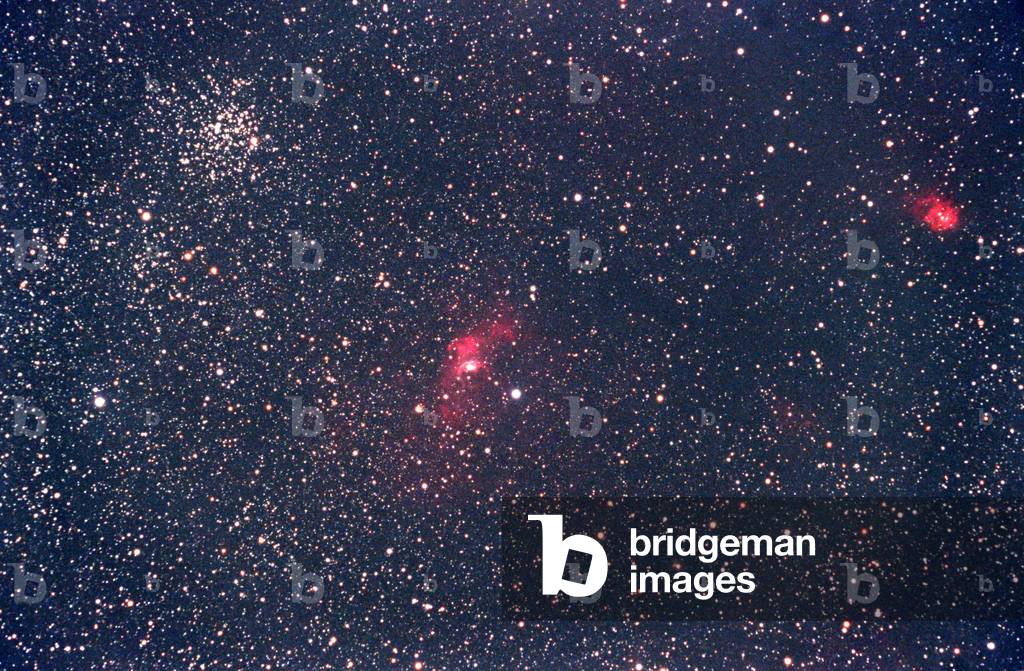
PIX4620613: Nebulae NGC7635 & 7538 & M52 clusters in Cassiopee - M52, The Bubble Nebua, NGC 7538 Open cluster M52 is at left in this photo, and NGC 7635, the Bubble Nebula is near the center. Bright emission nebula NGC 7538 is at the upper right. Single 57 minute exposure on gas - hypersensitized Fujicolor Super G 800 color negative film with an Astro - Physic's Starfire 130 EdT f/8 refractor from Chews Ridge, CA on October 8, 1994 at 9:32 pm / Bridgeman Images

JLJ4620782: Election of Charles V (1500-1558) as Emperor of Germany on 28 June 1519, 1909 (illustration), Robida, Albert (1848-1926) / Bridgeman Images

PIX4620791: Nebula N11 in the Great Magellan Cloud - N11 star forming region in Large Magellanic Cloud (LMC) - N11 (LHA 120 - N 11) is a large star-forming region located in the Great Magellan Cloud galaxy. Image, obtained by the Hubble space telescope. This broad vista of young stars and gas clouds in our neighbouring galaxy, the Large Magellanic Cloud, was captured by the NASA/ESA Hubble Space Telescope's Advanced Camera for Surveys (ACS). This region is named LHA 120 - N 11, informally known as N11, and is one of the most active star formation regions in the nearby Universe. This picture is a mosaic of ACS data from five different positions and covers a region about six arcminutes across / Bridgeman Images

LRI4620834: After bathing Naked woman wiping her right thigh. Pastel painting by Edgar Degas (1834-1917) 1866 Sun. 72x49 cm Rome, Galleria d'arte moderna, Degas, Edgar (1834-1917) / Bridgeman Images

PIX4620999: Nebula Sh2 - 106 in the Swan - Sh2 - 106 nebula in Cygnus - Sharpless 106 (Sh2 - 106) is a star-forming region in the constellation Swan. Image obtained by Hubble Space Telescope (HST) and Subaru Telescope. The bipolar star - forming region, called Sharpless 2 - 106, or S106 for short, looks like a soaring, celestial snow angel. The outstretched “” wings”” of the nebula record the contrasting imprint of heat and motion against the backdrop of a colder medium. Twin lobes of super - hot gas, glowing blue in this image, stretch outward from the central star. This hot gas creates the “” wings”” of our angel. A ring of dust and gas orbiting the star acts like a belt, cinching the expanding nebula into an “” hourglass””” shape. This composite image combines optical and near - infrared astronomical data from the Hubble Space Telescope with mid - infrared data from the ground - based Subaru Telescope, located on Mauna Kea in Hawaii. The Hubble data (H - alpha, J, and H) were taken as part of Hubble Heritage observations of S106 in February 2011. The Subaru data were obtained in May 1999 / Bridgeman Images