Print Friendly Version Page

2501287 Search Results

France, Champagne-Ardenne, Marne (51), Vienne le Chateau (Vienne-le-Chateau) - Museum of the First World War (First World War 1914-1918 or 14-18) - Photography Florent Lamontagne

LOR4251698: France, Champagne-Ardenne, Marne (51), Vienne le Chateau (Vienne-le-Chateau) - Museum of the First World War (First World War 1914-1918 or 14-18) - Photography Florent Lamontagne / Bridgeman Images

Queens of France and illustrious Women, Jardin du Luxembourg, Paris: Statue of Anne of Austria (1601-1666), queen of France, austrian and mother of Louis XIV “” the King Sun””. Sculpture by Joseph Marius Ramus, 1847. Photography Florent Lamontagne

LOR4251777: Queens of France and illustrious Women, Jardin du Luxembourg, Paris: Statue of Anne of Austria (1601-1666), queen of France, austrian and mother of Louis XIV “” the King Sun””. Sculpture by Joseph Marius Ramus, 1847. Photography Florent Lamontagne / Bridgeman Images

Bust of Simon Bolivar (1783-1830), hero of independance in South America.”” El Liberador”” was president of Peru, Columbia, Venezuela and of the Great Columbia. Politician and military man. Photography Florent Lamontagne

LOR4251922: Bust of Simon Bolivar (1783-1830), hero of independance in South America.”” El Liberador”” was president of Peru, Columbia, Venezuela and of the Great Columbia. Politician and military man. Photography Florent Lamontagne / Bridgeman Images

Pau Casals (1876-1973). Board remembering (Plaque commemorative) the famous spanish musician and violonist. Photography Florent Lamontagne

LOR4251938: Pau Casals (1876-1973). Board remembering (Plaque commemorative) the famous spanish musician and violonist. Photography Florent Lamontagne / Bridgeman Images

Statue of Charles Juste de Beauvau-Craon (Beauvau Craon, 1720-1793), marshal and minister of France from the French Academy. Photography Florent Lamontagne

LOR4251881: Statue of Charles Juste de Beauvau-Craon (Beauvau Craon, 1720-1793), marshal and minister of France from the French Academy. Photography Florent Lamontagne / Bridgeman Images

Dalida House (1933-1987), famous french singer and actress. Her house in Paris in Montmartre, rue d'Orchampt. Photography Florent Lamontagne

LOR4252012: Dalida House (1933-1987), famous french singer and actress. Her house in Paris in Montmartre, rue d'Orchampt. Photography Florent Lamontagne / Bridgeman Images

12 rue Saint-Anastase where lived Juliette DROUET (1806-1883), board on the house where used to live the famous mistress of the english writer Victor Hugo. Photography Florent Lamontagne

LOR4252042: 12 rue Saint-Anastase where lived Juliette DROUET (1806-1883), board on the house where used to live the famous mistress of the english writer Victor Hugo. Photography Florent Lamontagne / Bridgeman Images

View over the old tonw and the port of Chania, With The Giali Tzami Mosques (Mosques of the sea side) also known as the Kioutsouk (little) Hassan. It is a bright example of the Islamic art of the Renaissance. Work of an armenian architect, this Mosques is the only preverved Mosques of the city of Chania that was built during the second half of the 17th Century. Chania, Crete.

FBU4250328: View over the old tonw and the port of Chania, With The Giali Tzami Mosques (Mosques of the sea side) also known as the Kioutsouk (little) Hassan. It is a bright example of the Islamic art of the Renaissance. Work of an armenian architect, this Mosques is the only preverved Mosques of the city of Chania that was built during the second half of the 17th Century. Chania, Crete. / Bridgeman Images

The Giali Tzami Mosques (Mosques of the sea side) also known as the Kioutsouk (little) Hassan, is a bright example of the Islamic art of the Renaissance. Work of an armenian architect, This Mosques is the only preverved Mosques of the city of Chania that was built during the second half of the 17th Century. Chania, Crete.

FBU4250379: The Giali Tzami Mosques (Mosques of the sea side) also known as the Kioutsouk (little) Hassan, is a bright example of the Islamic art of the Renaissance. Work of an armenian architect, This Mosques is the only preverved Mosques of the city of Chania that was built during the second half of the 17th Century. Chania, Crete. / Bridgeman Images

Remains of the Ancient City of Phalasarna. West coast of Crete. The city was inhabited, in the Minoan period, in the archaic and the classical years. At its peak between the middle of the 4th century BC and 67 BC., it was destroyed by the Romans, because it turned to piracy and its harbour went out of use.

FBU4250429: Remains of the Ancient City of Phalasarna. West coast of Crete. The city was inhabited, in the Minoan period, in the archaic and the classical years. At its peak between the middle of the 4th century BC and 67 BC., it was destroyed by the Romans, because it turned to piracy and its harbour went out of use. / Bridgeman Images

Archaeological site of Gournia. Street system, storage and workshop houses of the palace from the west aera. Upright unworked stone slab deliberately set into the pavement of the street interpreted as a sacred stone. Gournia is the best preserved of all Minoan cities, and has been characterized as the “” Pompei Minoan Crete””. The cities has been found as it is now and has never been rebuilt. Gournia offers a picture of the daily life of the Minoan, who were engaged in agricultural, animal husbandry, fishing and vase-making as shown by the tools discovered in the settlement. Crete

FBU4250583: Archaeological site of Gournia. Street system, storage and workshop houses of the palace from the west aera. Upright unworked stone slab deliberately set into the pavement of the street interpreted as a sacred stone. Gournia is the best preserved of all Minoan cities, and has been characterized as the “” Pompei Minoan Crete””. The cities has been found as it is now and has never been rebuilt. Gournia offers a picture of the daily life of the Minoan, who were engaged in agricultural, animal husbandry, fishing and vase-making as shown by the tools discovered in the settlement. Crete / Bridgeman Images

Archaeological site of Gournia. Gournia is the best preserved of all Minoan cities, and has been characterized as the “” Pompei Minoan Crete””. The city has been found as it is now and has never been rebuilt. Gournia offers a picture of the daily life of the Minoan, who were engaged in agricultural, animal husbandry, fishing and vase-making as shown by the tools discovered in the settlement.

FBU4250650: Archaeological site of Gournia. Gournia is the best preserved of all Minoan cities, and has been characterized as the “” Pompei Minoan Crete””. The city has been found as it is now and has never been rebuilt. Gournia offers a picture of the daily life of the Minoan, who were engaged in agricultural, animal husbandry, fishing and vase-making as shown by the tools discovered in the settlement. / Bridgeman Images

France, Poitou Charentes province, Department of Charente Maritime (17), La Rochelle. The Saint Nicolas 'tower, one of the main tower at the entrance of the port of La Rochelle. Photography Florent Lamontagne

LOR4250750: France, Poitou Charentes province, Department of Charente Maritime (17), La Rochelle. The Saint Nicolas 'tower, one of the main tower at the entrance of the port of La Rochelle. Photography Florent Lamontagne / Bridgeman Images

Archaeological site of Gournia. Gournia is the best preserved of all Minoan cities, and has been characterized as the “” Pompei Minoan Crete””. The city has been found as it is now and has never been rebuilt. Gournia offers a picture of the daily life of the Minoan, who were engaged in agricultural, animal husbandry, fishing and vase-making as shown by the tools discovered in the settlement.

FBU4250636: Archaeological site of Gournia. Gournia is the best preserved of all Minoan cities, and has been characterized as the “” Pompei Minoan Crete””. The city has been found as it is now and has never been rebuilt. Gournia offers a picture of the daily life of the Minoan, who were engaged in agricultural, animal husbandry, fishing and vase-making as shown by the tools discovered in the settlement. / Bridgeman Images

France, Poitou Charentes province, Department of Charente Maritime (17), La Roche Courbon (La Roche-Courbon). Castle of La Roche Courbon with its special architecture, garden, parc and entrance. One of the most famous monument of the province. Photography Florent Lamontagne

LOR4250730: France, Poitou Charentes province, Department of Charente Maritime (17), La Roche Courbon (La Roche-Courbon). Castle of La Roche Courbon with its special architecture, garden, parc and entrance. One of the most famous monument of the province. Photography Florent Lamontagne / Bridgeman Images

France, Centre province, Department of Indre (36), Nohant-Vic.

LOR4250894: France, Centre province, Department of Indre (36), Nohant-Vic. / Bridgeman Images

France, Centre province, Department of Indre (36), Sarzay.

LOR4250902: France, Centre province, Department of Indre (36), Sarzay. / Bridgeman Images

France, Pays de la Loire province, Department of Loire Atlantique (44), Nantes. One of the main place in Nantes, la Place Royale with its beautiful fountain. Photography Florent Lamontagne

LOR4250911: France, Pays de la Loire province, Department of Loire Atlantique (44), Nantes. One of the main place in Nantes, la Place Royale with its beautiful fountain. Photography Florent Lamontagne / Bridgeman Images

France, Aquitaine province, Department of Gironde (33), Verdelais.

LOR4250881: France, Aquitaine province, Department of Gironde (33), Verdelais. / Bridgeman Images

France, Pays de la Loire province, Department of Loire Atlantique (44), Nantes. The Elephant machine of the Feydeau island which has been inspired by the novels of Jules Verne, famous english writer born in Nantes. This Elephant is today an attraction for families visiting the city. Photography Florent Lamontagne

LOR4250907: France, Pays de la Loire province, Department of Loire Atlantique (44), Nantes. The Elephant machine of the Feydeau island which has been inspired by the novels of Jules Verne, famous english writer born in Nantes. This Elephant is today an attraction for families visiting the city. Photography Florent Lamontagne / Bridgeman Images

France, Lorraine province, Department of Meuse (55), Bar le Duc (Bar-le-Duc). First World War 1914-1918. The famous road of the first world war going to the front named “” The Sacred Way””” started from Bar Le Duc. Thousands of taxis (Taxi de la Marne) were used to send soldiers to the front because of the lack of military vehicles. Photography Florent Lamontagne

LOR4250916: France, Lorraine province, Department of Meuse (55), Bar le Duc (Bar-le-Duc). First World War 1914-1918. The famous road of the first world war going to the front named “” The Sacred Way””” started from Bar Le Duc. Thousands of taxis (Taxi de la Marne) were used to send soldiers to the front because of the lack of military vehicles. Photography Florent Lamontagne / Bridgeman Images

Cuirassy of modest size for a child or adolescent. Indicative of the military upbringing ot youths and rites of passage in Doric Crete. Archaic period, 6th cent. BC. Archeological museum, Herakleion, Crete.

FBU4250126: Cuirassy of modest size for a child or adolescent. Indicative of the military upbringing ot youths and rites of passage in Doric Crete. Archaic period, 6th cent. BC. Archeological museum, Herakleion, Crete. / Bridgeman Images

Minoan archeological site of Phaistos. The west magazines. Large complex of the palace storerooms. It consists of the antechamber, the corridor of the storerooms, and the storerooms themselves. To right and left of the corridor were 11 magazines in which the goods of the palace were stored. The column insde supported the roof. The antechamber opens off the central court and under the floor of the antechamber was discovered the Archive Room of the Old Palace (1900-1700 BC) containing over 6000 clay sealings, ie impressions on balls of clay which were used to monitor the use of the goods in the magazines.

FBU4250156: Minoan archeological site of Phaistos. The west magazines. Large complex of the palace storerooms. It consists of the antechamber, the corridor of the storerooms, and the storerooms themselves. To right and left of the corridor were 11 magazines in which the goods of the palace were stored. The column insde supported the roof. The antechamber opens off the central court and under the floor of the antechamber was discovered the Archive Room of the Old Palace (1900-1700 BC) containing over 6000 clay sealings, ie impressions on balls of clay which were used to monitor the use of the goods in the magazines., Minoan / Bridgeman Images

General view towards South from the minoan site Phaistos.

FBU4250232: General view towards South from the minoan site Phaistos. / Bridgeman Images

View over the old tonw and the port of Chania, Crete.

FBU4250409: View over the old tonw and the port of Chania, Crete. / Bridgeman Images

Remains of the harbour of the Ancient City of Phalasarna. West coast of Crete. The harbour was built aroud a lagoon and link to the sea via two channels.The city was inhabited, in the Minoan period, in the archaic and the classical years. At its peak between the middle of the 4th century BC and 67 BC., it was destroyed by the Romans, because it turned to piracy and its harbour went out of use.

FBU4250437: Remains of the harbour of the Ancient City of Phalasarna. West coast of Crete. The harbour was built aroud a lagoon and link to the sea via two channels.The city was inhabited, in the Minoan period, in the archaic and the classical years. At its peak between the middle of the 4th century BC and 67 BC., it was destroyed by the Romans, because it turned to piracy and its harbour went out of use. / Bridgeman Images

Archaeological site of Gournia. Street system, storage and workshop houses of the palace from the west aera. Upright unworked stone slab deliberately set into the pavement of the street interpreted as a sacred stone. Gournia is the best preserved of all Minoan cities, and has been characterized as the “” Pompei Minoan Crete””. The cities has been found as it is now and has never been rebuilt. Gournia offers a picture of the daily life of the Minoan, who were engaged in agricultural, animal husbandry, fishing and vase-making as shown by the tools discovered in the settlement. Crete

FBU4250582: Archaeological site of Gournia. Street system, storage and workshop houses of the palace from the west aera. Upright unworked stone slab deliberately set into the pavement of the street interpreted as a sacred stone. Gournia is the best preserved of all Minoan cities, and has been characterized as the “” Pompei Minoan Crete””. The cities has been found as it is now and has never been rebuilt. Gournia offers a picture of the daily life of the Minoan, who were engaged in agricultural, animal husbandry, fishing and vase-making as shown by the tools discovered in the settlement. Crete / Bridgeman Images
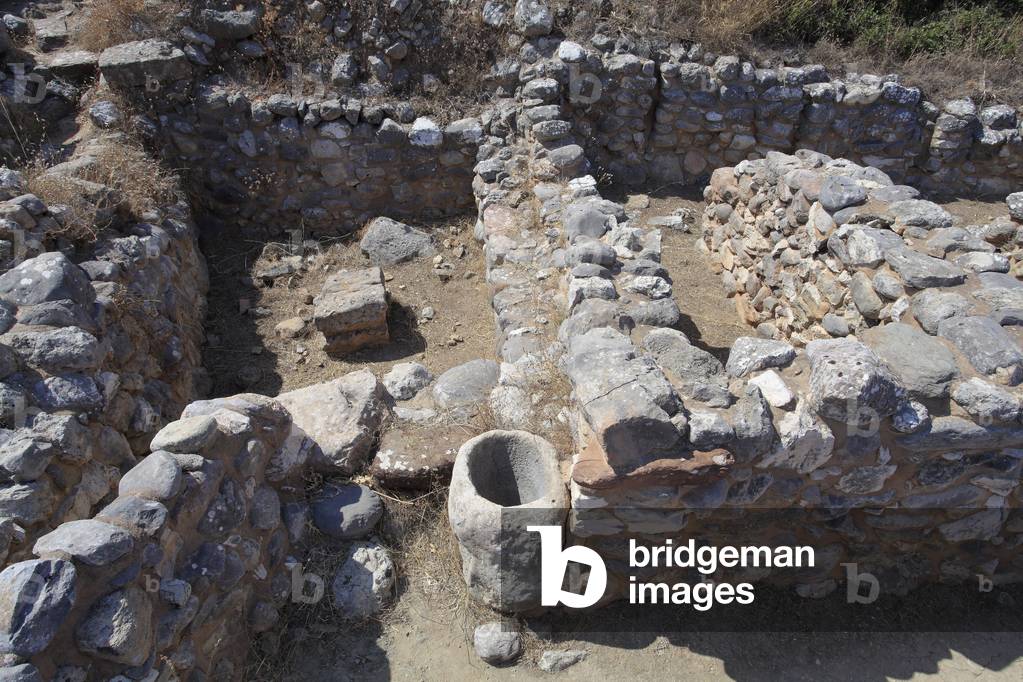
Archaeological site of Gournia. Work and storage houses of the palace in the north west aera. Gournia is the best preserved of all Minoan cities, and has been characterized as the “” Pompei Minoan Crete””. The cities has been found as it is now and has never been rebuilt. Gournia offers a picture of the daily life of the Minoan, who were engaged in agricultural, animal husbandry, fishing and vase-making as shown by the tools discovered in the settlement. Crete

FBU4250599: Archaeological site of Gournia. Work and storage houses of the palace in the north west aera. Gournia is the best preserved of all Minoan cities, and has been characterized as the “” Pompei Minoan Crete””. The cities has been found as it is now and has never been rebuilt. Gournia offers a picture of the daily life of the Minoan, who were engaged in agricultural, animal husbandry, fishing and vase-making as shown by the tools discovered in the settlement. Crete / Bridgeman Images

Archaeological site of Gournia. South complex. Characteristic street of Gournia, stepped because of the inclination of the ground with remains of houses used as Workshop and storage room. Gournia is the best preserved of all Minoan cities, and has been characterized as the “” Pompei Minoan Crete””. The cities has been found as it is now and has never been rebuilt. Gournia offers a picture of the daily life of the Minoan, who were engaged in agricultural, animal husbandry, fishing and vase-making as shown by the tools discovered in the settlement. Crete

FBU4250617: Archaeological site of Gournia. South complex. Characteristic street of Gournia, stepped because of the inclination of the ground with remains of houses used as Workshop and storage room. Gournia is the best preserved of all Minoan cities, and has been characterized as the “” Pompei Minoan Crete””. The cities has been found as it is now and has never been rebuilt. Gournia offers a picture of the daily life of the Minoan, who were engaged in agricultural, animal husbandry, fishing and vase-making as shown by the tools discovered in the settlement. Crete / Bridgeman Images

France, Champagne-Ardenne, Marne (51), Vienne le Chateau (Vienne-le-Chateau) - Camp de la Vallee Moreau - recontitution and remnants of a german camp of the First World War (First World War 1914-1918 or 14-18). Photography Florent Lamontagne

LOR4251657: France, Champagne-Ardenne, Marne (51), Vienne le Chateau (Vienne-le-Chateau) - Camp de la Vallee Moreau - recontitution and remnants of a german camp of the First World War (First World War 1914-1918 or 14-18). Photography Florent Lamontagne / Bridgeman Images

Queens of France and illustrious Women, Luxembourg Gardens, Paris: Statue of Anne de Beaujeu (1461-1522), queen and regent of France. Sculpture by Jacques Edouard Gatteaux, 1847. Photography Florent Lamontagne

LOR4251849: Queens of France and illustrious Women, Luxembourg Gardens, Paris: Statue of Anne de Beaujeu (1461-1522), queen and regent of France. Sculpture by Jacques Edouard Gatteaux, 1847. Photography Florent Lamontagne / Bridgeman Images

Charles Augustin Coulomb (1736-1806), scientist, engineer, physicist. His name is used for an electric unity. Photography Florent Lamontagne

LOR4251987: Charles Augustin Coulomb (1736-1806), scientist, engineer, physicist. His name is used for an electric unity. Photography Florent Lamontagne / Bridgeman Images

Home of Elisa Deroche (1882-1919), first woman in the world becoming official plane's pilot. She died during a flight and was born 61, rue de la Verrerie in Paris. Photography Florent Lamontagne

LOR4252019: Home of Elisa Deroche (1882-1919), first woman in the world becoming official plane's pilot. She died during a flight and was born 61, rue de la Verrerie in Paris. Photography Florent Lamontagne / Bridgeman Images

Bust of Simon Bolivar (1783-1830), hero of independance in South America.”” El Liberador”” was president of Peru, Columbia, Venezuela and of the Great Columbia. Politician and military man. Photography Florent Lamontagne

LOR4251906: Bust of Simon Bolivar (1783-1830), hero of independance in South America.”” El Liberador”” was president of Peru, Columbia, Venezuela and of the Great Columbia. Politician and military man. Photography Florent Lamontagne / Bridgeman Images

France, Aquitaine province, Department of Gironde (33), Cussac.

LOR4250856: France, Aquitaine province, Department of Gironde (33), Cussac. / Bridgeman Images

France, Pays de la Loire province, Department of Loire Atlantique (44), Nantes. Modern symbol of the city, the Brittany Tower offers a modern architecture between the traditional old buildings of Nantes. The Tour de Bretagne can be seen almost from everywhere around the city. Photography Florent Lamontagne

LOR4250913: France, Pays de la Loire province, Department of Loire Atlantique (44), Nantes. Modern symbol of the city, the Brittany Tower offers a modern architecture between the traditional old buildings of Nantes. The Tour de Bretagne can be seen almost from everywhere around the city. Photography Florent Lamontagne / Bridgeman Images


Back to top