
Print this page or go back to standard view.

PIX4644645: Satellite MSG - 1 - Meteosat 8 - Artist's view of the European satellite MSG - 1 (Meteosat Second Generation, MSG) or Meteosat 8, in orbit around the Earth. Launched on August 28, 2002, it is a geostationary satellite located 35 600 km from Earth; dedicated to meteorology, it observes the Earth in visible, and in infrared. Artist's view of Meteosat Second Generation (MSG). Satellite observations from space contribute to better weather forecasts as only satellites can observe weather patterns on a global scale, including the Atlantic Ocean over which most of Europe's weather originates / Bridgeman Images

PIX4644648: Satellite MSG - 1 - Meteosat 8 - Anaglyph - Satellite MSG - 1 - Meteosat 8 - Anaglyph - Artist's view of the European satellite MSG - 1 (Meteosat Second Generation) or Meteosat 8, in orbit around the Earth. Launched on August 28, 2002, it is a geostationary satellite located 35 600 km from Earth; dedicated to meteorology, it observes the Earth in visible, and in infrared. Meteosat Second Generation (MSG), is equipped with an extremely sophisticated imaging radiometer that can separate the incoming radiation into 12 (3 with the current Meteosat) different spectral bands. Each section, four of them in the visible and eight in the thermal infrared, delivers different information. They vary from visible images of weather systems during the day to cloud temperature at night; from surface temperature and water vapour to trace gas concentrations and dust particles in the atmosphere. MSG will deliver about twenty times as much information as its predecessor Meteosat, resulting in much more accurate short and medium - range forecasts / Bridgeman Images

PIX4644759: Launch of satellite METOP - A - Launch of satellite METOP - A - Artist's view of the European satellite METOP - A put into orbit by a Soyuz - Fregat rocket. Launched on October 19, 2006, it is the first European meteorological satellite in polar orbit; it includes twelve meteorological instruments. Launch of satellite METOP - A by a Soyuz rocket. MetOp is a series of three meteorological operational polar orbiting satellites, the first of which, MetOp - A is the prototype. The instruments on MetOp will produce high - resolution images, vertical temperature and humidity profiles, and temperatures of the land and ocean surface on a global basis. Also on board the satellites will be instruments for monitoring ozone and wind flow over the oceans. The first launch was on October 19 2006 / Bridgeman Images

PIX4644764: THEMIS satellites - View of THEMIS satellites in preparation at Cap Canaveral on 8 February 2007. This constellation of five satellites aims to better understand the origin of the polar aurora; for two years, satellites will align along the tail of the Earth's magnetic field to identify disturbances observed in the magnetosphere / Bridgeman Images

PIX4644893: Satellite METOP - A - Artist's view of the European satellite METOP - A in orbit around the Earth. Launch on October 19, 2006, it is the first European meteorological satellite in polar orbit; it includes twelve meteorological instruments. MetOp is a series of three meteorological operational polar orbiting satellites, the first of which, MetOp-1 is the prototype. The instruments on MetOp will produce high - resolution images, vertical temperature and humidity profiles, and temperatures of the land and ocean surface on a global basis. Also on board the satellites will be instruments for monitoring ozone and wind flow over the oceans. The first launch was on October 19 2006 / Bridgeman Images

PIX4644937: Hubble space telescope: 1st maintenance mission 12 - 1993 - The Hubble space telescope first mission repair - The astronaut Story Musgrave is visible at the bottom of this fish-eye photo during the fifth and last extravehicular exit. Behind the space telescope, and Australia. A fisheye lens was used to capture the Hubble Space Telescope (HST), a spherical Earth and Australian landmass with a bit of distortion during the final space walk on the STS - 61 HST - servicing mission. Astronaut F. Story Musgrave can be seen at bottom of the frame. The STS - 61 mission was launched aboard Space Shuttle Endeavour on December 2, 1993 / Bridgeman Images

PIX4644817: The mirror of the Hubble space telescope - The mirror of the Hubble space telescope - The 2.4 m mirror inspects before it is installed on the satellite. Inspection of the 94 inch primary mirror for NASA's Hubble Space Telescope at Perkin - Elmers Optical facilities in Wilton, CT / Bridgeman Images

PIX4644889: Hubble space telescope: 1st maintenance mission 12 - 1993 - Hubble space telescope: first repair mission 12 - 1993 - Astronauts Story Musgrave (right) and Jeffrey Hoffman, on the arm of the shuttle Endeavour, prepare the installation of the new planetary wide field camera (WFPC2); the old camera is visible at the bottom right of the image; third extravehicular exit. Anchored on the end of Endeavour's Remote Manipulator System (RMS) arm, Jeffrey Hoffman (foreground) prepares to install the new Wide Field/Planetary Camera (WFPC II) into the empty cavity (top left) on the Hubble Space Telescope (HST). WFPC I is seen temporarily stowed at bottom right. Story Musgrave works with a Portable Foot Restraint (PFR) at frame center, as his image is reflected in the shiny surface of the telescope. Hoffman and Musgrave shared chores on three of the five space walks during the STS - 61 mission / Bridgeman Images

PIX4644915: Hubble Space Telescope: 1st maintenance mission 12 - 1993 - Astronauts install COSTAR during EVA for HST repair - Astronaut Thomas Akers prepares the installation of COSTAR, an instrument intended to correct Hubble's myopia. Kathryn C. Thornton is on the arm of the shuttle Endeavour with the instrument. Fourth extravehicular exit. Astronaut Thomas D. Akers maneuvers inside the bay which will house the Corrective Optics Space Telescope Axial Replacement (COSTAR) while assisting astronaut Kathryn C. Thornton with the installation of the 640 - pound instrument. Thornton, anchored on the end of the Remote Manipulator System (RMS) arm, is partially visible as she prepares to install the COSTAR. Dec 1993 / Bridgeman Images

PIX4644985: Hubble Space Telescope: 2nd maintenance mission 02 - 1997 - Redeployment of the telescope after its second maintenance mission / Bridgeman Images

PIX4644999: Hubble Space Telescope: 2nd maintenance mission 02 - 1997 - Redeployment of the telescope after its second maintenance mission / Bridgeman Images

MDA4644951: Corner building between the Berthier birch and avenue Stephane Mallarme, Paris 7501. Photography 1990. / Bridgeman Images

PIX4644976: Hubble Space Telescope: 2nd Maintenance Mission 02 - 1997 - View of astronauts Steven Smith (centre) and Mark Lee (right, arm) during the fifth and last extravehicular exit of this maintenance mission / Bridgeman Images

PIX4643577: Bepicolombo will be a mission to explore the planet Mercury, carried out jointly by the Japanese Space Agency and the European Space Agency. Its launch is scheduled in October 2018, to reach Mercure in 2025. Two probes form the Bepicolombo mission, the Mercury Planet Orbiter (DFO), which will perform a complete mapping of the surface of Mercury and the Mercury Magnetospheric Orbiter (MMO), which will study the Mercurian magnetosphere. / Bridgeman Images

PIX4643732: The New Horizons probe near 2014 MU69 - Artist's View - New Horizons and 2014 MU69 (binary) - Artwork: Artist's view of the New Horizons probe near the small object of Kuiper 2014 MU69. Observations in 2017 show that 2014 MU69 would be either a binary object (model favors), in contact or not, or a single object lengthens. Speculative illustration of Nasa's New Horizons interplanetary probe flying by classical Kuiper belt object (486958) 2014 MU69, about 3 billion miles from the Earth, on 1 January 2019. 2014 MU69 is either a single elongated object about 30 miles long, or two smaller objects orbiting very closely together, maybe even touching; this image illustrates the latter. New Horizons is about the size and shape of a grand piano and weighed 1,054 pounds at launch. The high-gain dish antenna is about 7 feet in diameter and is employed for communication with the Earth / Bridgeman Images

PIX4642853: Intelsat satellite 6 - Intelsat VI satellite - Recoveration of the Intelsat VI satellite by shuttle Endeavour in May 1992. From left to right are astronauts Richard J. Hieb, Thomas D. Akers, and Pierre J. Thuot. Three STS - 49 crewmembers hold onto the 4.5 - ton Intelsat VI satellite in May 1992 after a six - handed “” capture””” was made minutes earlier. Left to right are astronauts Richard J. Hieb, Thomas D. Akers and Pierre J. Thuot. Thuot stands on the end of the Canadarm, which was instrumental as a mobile working platform in the capture / Bridgeman Images

PIX4642921: Satellite Artemis - Satellite Artemis - Artist's view of the European satellite Artemis (Advanced Relay and Technology Mission). Communication and relay satellite for other satellites, it was launched in July 2001 / Bridgeman Images

PIX4643031: Galileo satellites - Illustration - Artist's view of the European satellite network Galileo consists of 30 satellites at about 24,000 km of altitude (27 operationals, 3 reserve). This satellite positioning system is expected to be operational in 2011 / Bridgeman Images

PIX4643101: The Giove satellite - Deploying its solar panels - Vue d'artiste / Bridgeman Images

PIX4643111: Fusee Soyuz - Fregat et satellite Giove - B - Vue d'artiste - Giove - B satellite in Soyuz - Fregat rocket - Artist view - Vue d'artiste du satellite Giove - B (Galileo In - Orbit Validation Element - B) places in the cap of a Soyuz - Fregat rocket. Giove - B (Galileo In - Orbit Validation Element - B) into a Soyuz - Fregat rocket. Artist view / Bridgeman Images

PIX4643136: Satellite Giove - B - Artist's view - View of the Giove satellite - B (Galileo In - Orbit Validation Element - B), the second satellite intended to validate the positioning system of Galileo / Bridgeman Images

LRI4643310: Allegory of the government of the city of Siena surrounded by citizens who are symbolically linked to it by a rope, 1385 (painting on wood), Italian School, (14th century) / Bridgeman Images

PIX4643771: The New Horizons probe near 2014 MU69 - Artist's View - New Horizons and 2014 MU69 (single) - Artwork: Artist's view of the New Horizons probe near the small object of Kuiper 2014 MU69. Observations in 2017 show that 2014 MU69 would be either a binary object (model favors), in contact or not, or a single object lengthens (as here). Speculative illustration of Nasa's New Horizons interplanetary probe flying by classical Kuiper belt object (486958) 2014 MU69, about 3 billion miles from the Earth, on 1 January 2019. 2014 MU69 is either a single elongated object about 30 miles long, or two smaller objects orbiting very closely together, maybe even touching; this image illustrates the latter. New Horizons is about the size and shape of a grand piano and weighed 1,054 pounds at launch. The high-gain dish antenna is about 7 feet in diameter and is employed for communication with the Earth / Bridgeman Images

PIX4643784: The New Horizons probe near 2014 MU69 - Artist's View - New Horizons and 2014 MU69 (single) - Artwork: Artist's view of the New Horizons probe near the small object of Kuiper 2014 MU69. Observations in 2017 show that 2014 MU69 would be either a binary object (model favors), in contact or not, or a single object lengthens (as here). Speculative illustration of Nasa's New Horizons interplanetary probe flying by classical Kuiper belt object (486958) 2014 MU69, about 3 billion miles from the Earth, on 1 January 2019. 2014 MU69 is either a single elongated object about 30 miles long, or two smaller objects orbiting very closely together, maybe even touching; this image illustrates the latter. New Horizons is about the size and shape of a grand piano and weighed 1,054 pounds at launch. The high-gain dish antenna is about 7 feet in diameter and is employed for communication with the Earth / Bridgeman Images

LBY4643885: La Chapelle de La Pie Salpetriere in Paris 75013. / Bridgeman Images
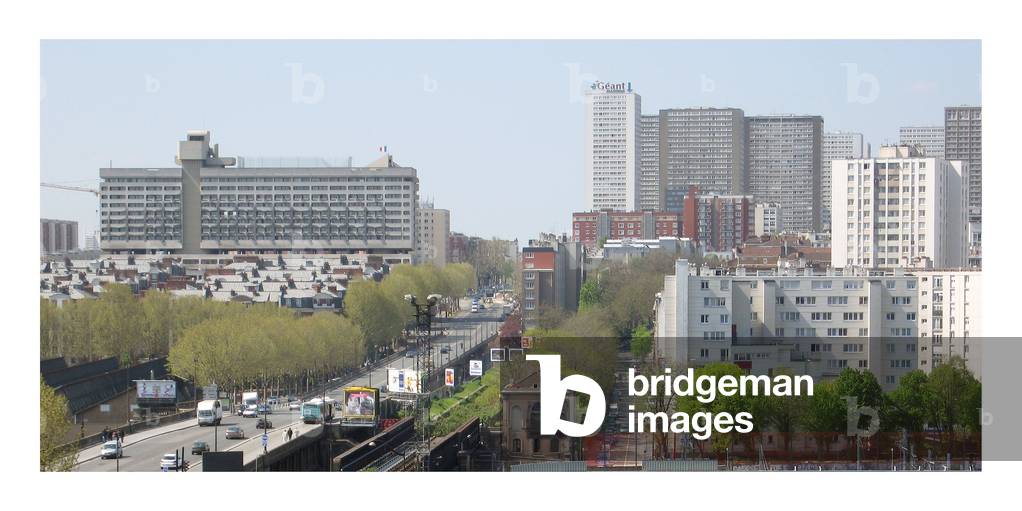
LBY4643916: Panoramic view of Paris 75013. Photography 10/05/06. / Bridgeman Images

PIX4643921: Satellite Spot - 4 - Artist's view of the Earth observation satellite Spot - 4. Spot - 4 is a english earth observation satellite launched on march 23 199 / Bridgeman Images

PIX4643958: Satellite Spot - 5 - Satellite Spot - 5, artwork - Vue d'artiste du satellite d'observation de la terre Spot - 5, launched on May 3, 2002. Spot - 5 is an earth observation satellite launched on May 3 2002 / Bridgeman Images
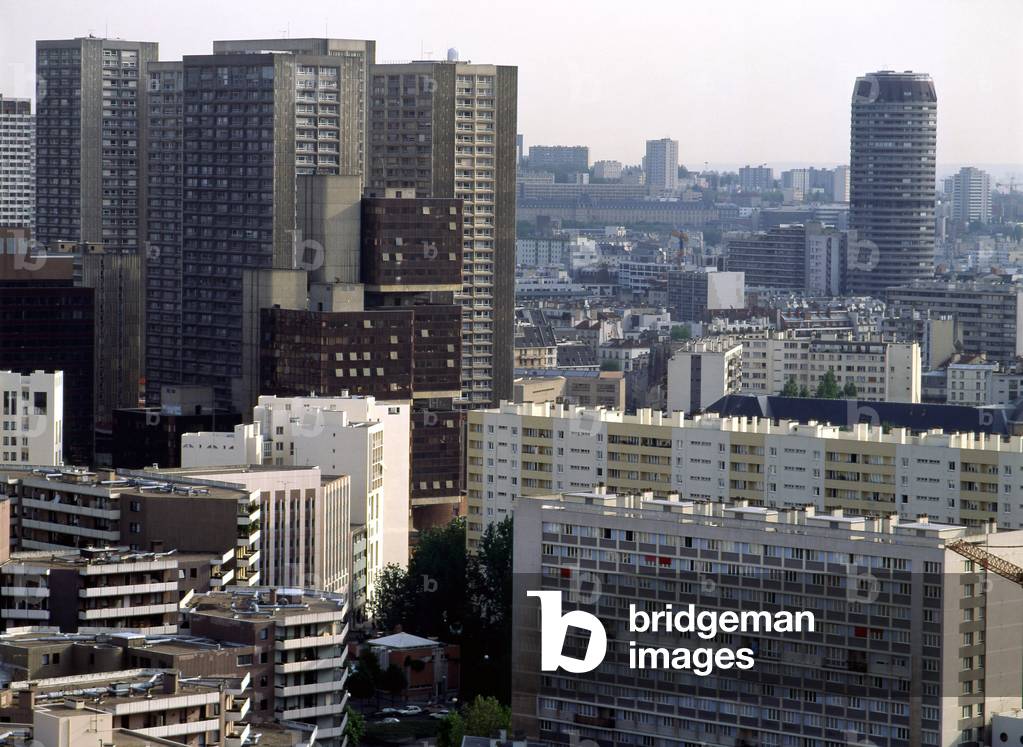
MDA4643990: Panoramic view of the towers of the 13th arrondissement in Paris (75013). / Bridgeman Images

PIX4644031: Satellite Parasol - Artist's view of the microsatellite Parasol in orbit around the Earth. This satellite launched in December 2004 studies the Earth's atmosphere. Parasol is a english earth observation microsatellite launched in december 2004 to study the Earth atmosphere / Bridgeman Images

PIX4643341: Skylab station 07/1973 - Skylab station seen from Skylab module - 3 just before mooring. 28/07/1973. The Skylab space station photographed from the Skylab 3 Command/Service Module during station keeping maneuvers prior to docking. Aboard the command module were astronauts Alan Bean, Owen Garriott and Jack Lousma, who remained with the Skylab space station in Earth's orbit for 59 days. Note the one solar array system wing on the Orbital Workshop (OWS) which was successfully deployed during extravehicular activity (EVA) on the first manned Skylab flight. The parasol solar shield which was deployed by the Skylab 2 crew can be seen through the support struts of the Apollo Telescope Mount. Jul 28 1973 / Bridgeman Images

LRI4643345: Battle between Sienese and Florentines at Poggio Imperiale on 8/10/1479. Detail. Fresco by G. di Cristoforo and F. D'Andrea, 1480. Palazzo Pubblico, Siena, Cristofano Ghini, Giovanni di & d’Andrea, Francesco (15th century) / Bridgeman Images

PIX4643443: Skylab station 02/1974 - Skylab station above earth. 02/1974 - Skylab station seen from Skylab 4 module before returning to Earth. 08/02/1974. The Skylab Orbital Workshop in Earth orbit photographed from the Skylab 4 Command and Service Modules during the final fly - around by the CSM before returning home. Feb 08 1974 / Bridgeman Images

PIX4643590: Bepicolombo will be a mission to explore the planet Mercury, carried out jointly by the Japanese Space Agency and the European Space Agency. Its launch is scheduled for October 2018, to reach Mercure in 2025. Two probes form the Bepicolombo mission, the Mercury Planet Orbiter (DFO), which will perform a complete mapping of the surface of Mercury, and the Mercury Magnetospheric Orbiter (MMO), which will study the Mercurian magnetosphere. On his 7-year journey, the probe will pass twice near Venus. / Bridgeman Images

LBY4643697: Un abris S.D.F in Paris 75013. / Bridgeman Images

PIX4644070: Launch of the Helios 2A satellite - Satellite Helios 2A launch - Artist's view of the launch of the military satellite Helios 2A and the parasol and swarm microsatellites by an Ariane 5 G+rocket in December 2004. Artwork of the launch of the military satellite Helios 2A with the microsatellites Essaim and Parasol by an ariane 5 rocket in december 2004 / Bridgeman Images