13739 Search Results for sword

CH3899044: Detail from the Sabretache of Joseph-Napoleon Bonaparte, King of Spain, before 1813 (red morocco leather with embroidered goldwork & gilt-brass mounts), Spanish School, (19th century) / Bridgeman Images

MEP3115021: Davide kills Golia, (by Guido Reni), 1606-1607, oli on canvas, Private Collection, 174 x 132 cm, Reni, Guido (1575-1642) / Bridgeman Images
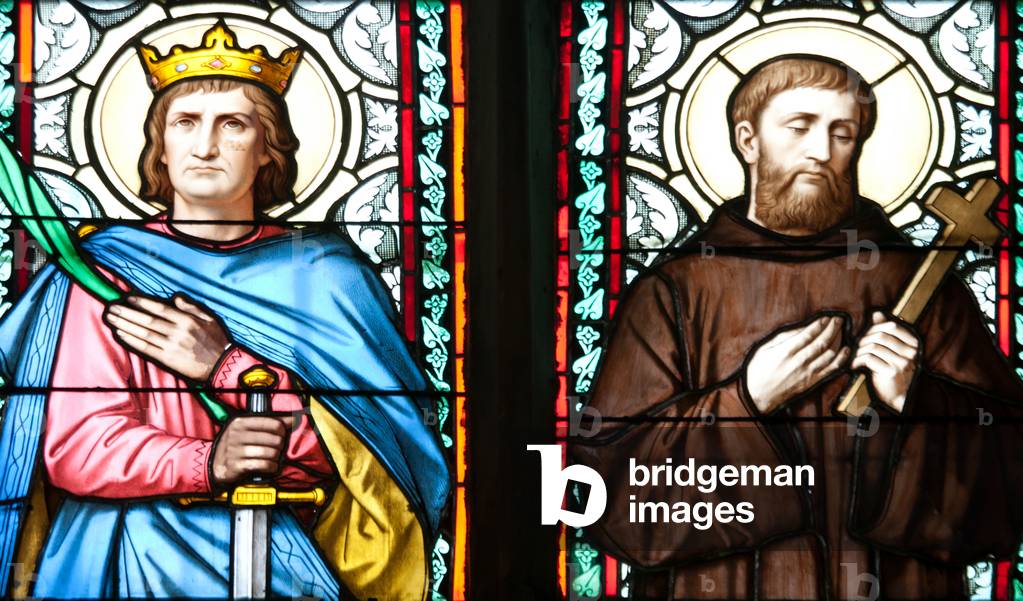
SAP491870: Stained glass window depicting two standing Holy Men (photo) / Bridgeman Images

PCT4273309: Medieval iconography: costume of the Middle Ages. Hungarian Tartar warlord / Bridgeman Images

ELC848804: St. Martin and the Beggar (San Martino e il povero), by Niccolò Paganelli, 16th Century, oil on canvas, Paganelli, Niccolò (1538-1620) / Bridgeman Images

SZT717212: Perseus Fountain at the Residenz in Munich, 1934 (b/w photo) / Bridgeman Images

NAM5929465: Scottish Broadsword, 79th Regiment of Foot (Cameron Highlanders), c.1806 (Scottish broadsword), Runkel, Johann Justus (1751-1808) / Bridgeman Images

NAM5929468: Scottish Broadsword, 79th Regiment of Foot (Cameron Highlanders), c.1806 (Scottish broadsword), Runkel, Johann Justus (1751-1808) / Bridgeman Images

PIX4618046: Nebulae NGC 1973 - 1975 - 1977 in Orion - The reflection nebulae NGC 1973 - 75 - 77 in Orion - Reflection nebulae located just north of the Great Orion Nebula. This group of nebulous stars is just half a degree north of the much brighter Orion Nebula and has largely been ignored because of it. The group of stars here appear as a single star to the unaided eye, the northernmost 'star' in the sword of Orion. Most of the blue nebulosity is starlight scattered by dust, while some of the stars are sufficiently hot to excite the wisps of hydrogen that linger here and create a distinctive red glow. To the south of the nebula (at the bottom of the picture) faint traces of the yellow reflected light of the Orion nebula can just be detected / Bridgeman Images

PIX4617736: Orion's Nebula - The Great Nebula in Orion - Located 1500 years ago - the light of the Earth, Orion's Nebula is the closest region to the formation of stars of the Sun. In its heart, a group of young stars called Orion's Trapeze. To the eye, the nebula appears as a misty patch around the central star of the line of three which form Orion's sword. The central group of stars is the Trapezium cluster and these stars are responsible for producing the nebula. It is the high concentration of dust and gas in this part of the sky which has resulted in the formation of the stars, so the Orion nebula is no random association of bright stars and dusty gas. At a distance of 1500 light years, the Orion nebula is the nearest star - forming region to the Sun / Bridgeman Images

FLO4634272: Chinese costumes: a guard in a tiger suit, a monk burning an offering, merchants negociating a deal, a walking barber, and fishermen carrying their boat and fishing birds, circa 1800. Lithography for the book: “” Galerie complete en tableaux fideles des peuples d'Asie”” by Friedrich Wilhelm Goedsche (1785-1863), edition Meissen (Germany), 1835-1840. Costumes of China: guard with shield and sword in tiger suit, a monk burning an offering, merchants making a deal, a traveling barber, and fishermen with boat and fishing birds, circa 1800. Handcoloured lithograph from Friedrich Wilhelm Goedsche's “” Vollstaendige Voelkergallerie in getreuen Abbildungen”” (Complete Gallery of Peoples in True Pictures), Meissen, circa 1835-1840. / Bridgeman Images

XAB329102: Achilles recognised, 1799 (oil on canvas), Argunov, Nikolay Ivanovich (1771-p.1829) / Bridgeman Images

NAM5929463: Scottish Broadsword, 79th Regiment of Foot (Cameron Highlanders), c.1806 (Scottish broadsword), Runkel, Johann Justus (1751-1808) / Bridgeman Images

NAM5929467: Scottish Broadsword, 79th Regiment of Foot (Cameron Highlanders), c.1806 (Scottish broadsword), Runkel, Johann Justus (1751-1808) / Bridgeman Images

LLM5223631: Sir Philip Sidney (engraving), English School, (19th century) / Bridgeman Images

LLM5223633: Sir Humphrey Gilbert (engraving), English School, (19th century) / Bridgeman Images

LLR6033900: TM King George and Queen Mary's silver jubilee (b/w photo), English Photographer, (20th century) / Bridgeman Images

XRE1791876: Prince Harald, Unknown photographer, (20th century) / Bridgeman Images

CH1065823: Highly important La Tene warrior fibula, detail (gold) (see also 1065822-7), Celtic, (3rd century BC) / Bridgeman Images

NGW215391: The Family of Henry VIII: An Allegory of the Tudor Succession, c.1572 (oil on panel), Heere, Lucas de (1534-84) / Bridgeman Images

FAF7132576: Allegory of Bad Government, detail from the Sala della Pace in the Palazzo Pubblico, Siena, 1338-40 (fresco), Lorenzetti, Ambrogio (1285-c.1348) / Bridgeman Images

STC908166: Statue of Roland in Bremen Market Square, pub. c.1895 (postcard chromolithograph), German Photographer, (19th century) / Bridgeman Images

LLM964000: Trade card depicting Brennus (chromolitho), French School, (19th century) / Bridgeman Images

SZT3016751: A police officer warns people in bathing suits (b/w photo) / Bridgeman Images

BRQ3925300: Theodor Bertram as Wotan in Richard Wagner 's Ring Cycle / Bridgeman Images

USB1157099: Possibly Sharington II Talbot (d.1677), English School / Bridgeman Images

PIX4580124: Orion's Nebula - The Great Nebula in Orion - Located 1500 light years from Earth, Orion's Nebula is the closest region to the formation of stars of the Sun. In its heart, a group of young stars called Orion's Trapeze. To the eye, the nebula appears as a misty patch around the central star of the line of three which form Orion's sword. The central group of stars is the Trapezium cluster and these stars are responsible for producing the nebula. It is the high concentration of dust and gas in this part of the sky which has resulted in the formation of the stars, so the Orion nebula is no random association of bright stars and dusty gas. At a distance of 1500 light years, the Orion nebula is the nearest star-forming region to the Sun / Bridgeman Images

GLC479179: Surrender of General Burgoyne at Saratoga N.Y. Oct 17th 1777 New York, print made by Nathaniel Currier, 1852 (litho), Trumbull, John (1756-1843) (after) / Bridgeman Images

GBW698982: First World war: American propaganda poster for war savings stamps, c.1918 (poster), Coffin, Haskell William (1878-1941) / Bridgeman Images

LIS2651207: Troops at Middle Assendon near Henley-on-Thames, 1940-44 (oil on canvas), Ford, Michael (1920-2005) / Bridgeman Images

LLM971660: Mr Charles Kean as Hamlet, Hamlet, Act III, Scene II (engraving), English School, (19th century) / Bridgeman Images

STC2636948: Comforts of a Bed of Roses: pub. Hannah Humphrey, 21st April, 1806 (hand coloured engraving), Gillray, James (1757-1815) / Bridgeman Images

XLA3754539: Theseus and the Queen, Theaker, Harry George (1873-1954) / Bridgeman Images

BEG778088: The attack on Pearl Harbor, recorded from the attacking Japanese aircraft and soldiers fighting / Bridgeman Images

PIX4617828: Orion Nebula - the trapeze - The Trapezium region in M42 - Located 1500 years - light, Orion Nebula is the closest region of formation of stars of the Sun. In the center of the picture, the Trapeze of Orion. The Trapeze is among the youngest known open clusters, it is made up of 4 massive stars that make the nebula shine. The central 'star' of the three groups forming the asterism of Orion's sword is in reality a nebula, and is clearly nebulous to the unaided eye. At the heart of the most luminous nebulosity shimmer a handful of stars known as the Trapezium cluster, visible in binoculars. These are the brightest members of a substantial cluster of stars, most of which are still hidden in the dusty recesses of the Orion nebula against which they are seen. The stars of the Trapezium provide much of the energy which makes the brilliant Orion Nebula visible and are at a distance of about 1500 light years / Bridgeman Images

MEP2371684: Dana Andrews surrounded by three soldiers / Bridgeman Images
