Search options

Orientation
Colour

Display options

View

Print

To print search results, use print friendly version of this page.

41859 Search Results for medieval or gothic or late medieval

Old city hall in Wuerzburg, 1911 (b/w photo)

SZT3015541: Old city hall in Wuerzburg, 1911 (b/w photo) / Bridgeman Images

Alexander the Great surrounded by Indian fauna during the conquest of India. With the hellenistic deluge and the construction of the Tower of Babel. 1163-1166 (Mosaic, pavement)

LRI4689850: Alexander the Great surrounded by Indian fauna during the conquest of India. With the hellenistic deluge and the construction of the Tower of Babel. 1163-1166 (Mosaic, pavement), Unknown Artist, (12th century) / Bridgeman Images

Valkyrie and a dying hero, 19th century (oil on canvas)

FIA5408975: Valkyrie and a dying hero, 19th century (oil on canvas), Makart, Hans (1840-84) / Bridgeman Images

Abelard welcoming Heloise at Paraclete, illustration from 'Lettres d'Heloise et d'Abelard', volume I, 1795 (engraving)

XIR346154: Abelard welcoming Heloise at Paraclete, illustration from 'Lettres d'Heloise et d'Abelard', volume I, 1795 (engraving), Moreau, Jean Michel the Younger (1741-1814) (after) / Bridgeman Images

The Walkueren (Valkyrien), 1864 (oil on canvas)

FIA5407566: The Walkueren (Valkyrien), 1864 (oil on canvas), Arbo, Peter Nicolai (1831-92) / Bridgeman Images

The Ride of the Valkyries (oil on canvas)

FIA5408996: The Ride of the Valkyries (oil on canvas), Sandberg, Johan Gustaf (1782-1854) / Bridgeman Images

View of the Facade of Villa Arconati, Bollate, Milan, Italy (photo)

MRZ3496137: View of the Facade of Villa Arconati, Bollate, Milan, Italy (photo) / Bridgeman Images

View of the Facade of Villa Arconati, Bollate, Milan, Italy (photo)

MRZ3496139: View of the Facade of Villa Arconati, Bollate, Milan, Italy (photo) / Bridgeman Images

Ms 0338 f.1 The Church and the Synagogue, c.1465-70 (vellum)

BMR344027: Ms 0338 f.1 The Church and the Synagogue, c.1465-70 (vellum), French School, (15th century) / Bridgeman Images

The Ballad Seller, the Black Gate, 1884 (oil on canvas)

TW426842: The Ballad Seller, the Black Gate, 1884 (oil on canvas), Hedley, Ralph (1848-1913) / Bridgeman Images

The Belgian Village Exhibit At The Century Of Progress

SIC744071: The Belgian Village Exhibit At The Century Of Progress / Bridgeman Images

Great Fire of London

LAL298698: Great Fire of London, Embleton, Ron (1930-88) / Bridgeman Images

Barbaric art of Spain: Visigoth cross from Torredonjimeno's treasure, 7th century.

LRI4646225: Barbaric art of Spain: Visigoth cross from Torredonjimeno's treasure, 7th century., Carthaginian (7th-3rd century BC) / Bridgeman Images

View of Villa Arconati, Bollate, Milan, Italy (photo)

MRZ3496138: View of Villa Arconati, Bollate, Milan, Italy (photo) / Bridgeman Images

Revelation, Brunnhilde (Brunehilde, Brynhildr) Decouvrant Siegmund and Sieglinde, 1893 (oil on canvas)

FIA5401935: Revelation, Brunnhilde (Brunehilde, Brynhildr) Decouvrant Siegmund and Sieglinde, 1893 (oil on canvas), Bussiere, Gaston (1862-1929) / Bridgeman Images

Drawing of the teachings of Luther, 1520

SZT5175556: Drawing of the teachings of Luther, 1520 / Bridgeman Images

Japan / Ryukyu Islands: Street Scene in Naha, Okinawa, Perry Expedition, 1853

PFH2642297: Japan / Ryukyu Islands: Street Scene in Naha, Okinawa, Perry Expedition, 1853 / Bridgeman Images
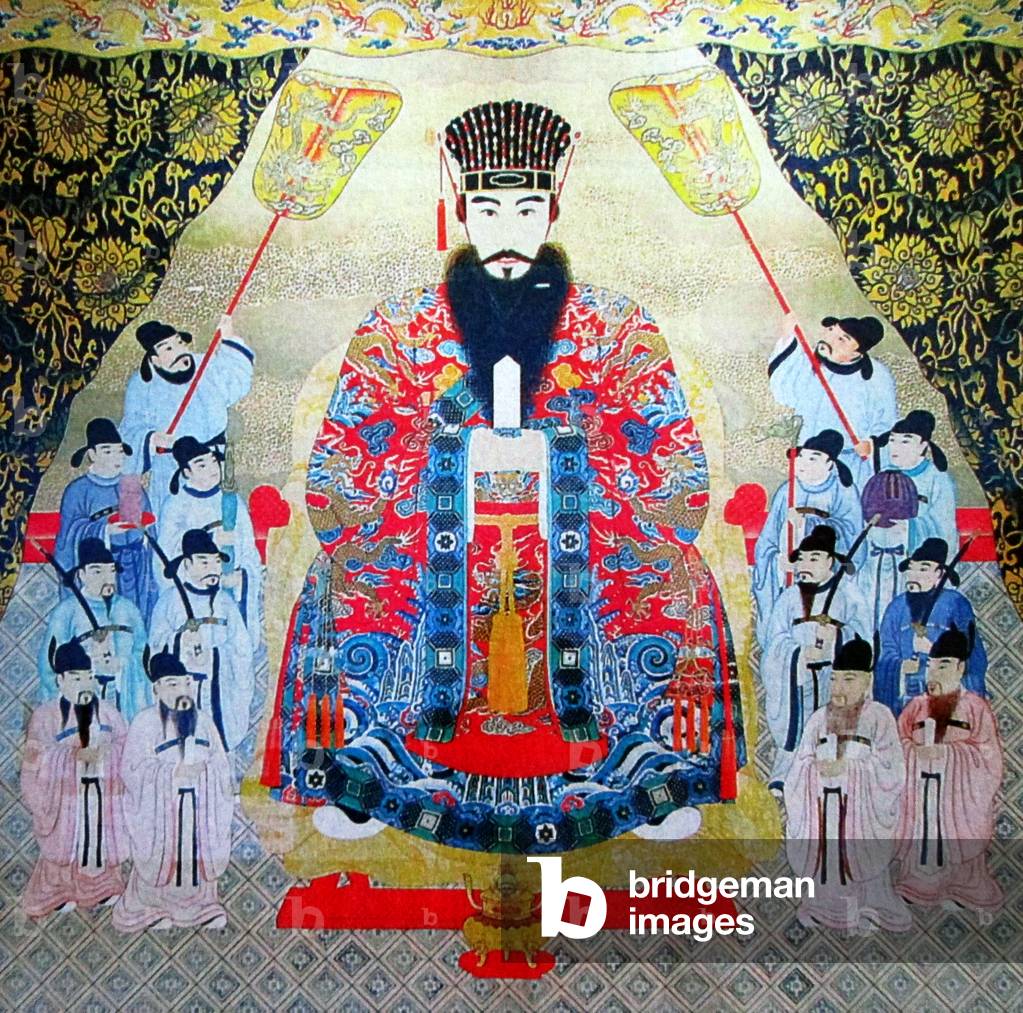
Japan / Ryukyu Islands: King Sho Iku (1829 - 1847) 18th ruler of the Ryukyu Second Sho Dynasty (1429 - 1879). Portrait by Mo Choki (1806-1865), 1852

PFH2641760: Japan / Ryukyu Islands: King Sho Iku (1829 - 1847) 18th ruler of the Ryukyu Second Sho Dynasty (1429 - 1879). Portrait by Mo Choki (1806-1865), 1852 / Bridgeman Images

Emperor Peter the Great

XLF3789946: Emperor Peter the Great / Bridgeman Images

Alexander the Great surrounded by Indian fauna during the conquete of India. 1163-1166 (Mosaic, pavement)

LRI4690419: Alexander the Great surrounded by Indian fauna during the conquete of India. 1163-1166 (Mosaic, pavement), Unknown Artist, (12th century) / Bridgeman Images

View of the Courtyard of the Isabella Stewart Gardner Museum, Boston (photo)

ISG3696796: View of the Courtyard of the Isabella Stewart Gardner Museum, Boston (photo) / Bridgeman Images

The Cloth Hall, Ypres (oil on canvas)

BRA1128407: The Cloth Hall, Ypres (oil on canvas), Rothenstein, William (1872-1945) / Bridgeman Images

Saint William of Aquitaine

USB1158655: Saint William of Aquitaine, Rosa, Salvator (1615-73) (after) / Bridgeman Images

Part of an Icelandic original manuscript known as The Flatey Book, published by the Norroena Society in 1908 (colour litho)

KWE387043: Part of an Icelandic original manuscript known as The Flatey Book, published by the Norroena Society in 1908 (colour litho), American School, (20th century) / Bridgeman Images

View of the Courtyard of the Isabella Stewart Gardner Museum, Boston (photo)

ISG3696794: View of the Courtyard of the Isabella Stewart Gardner Museum, Boston (photo) / Bridgeman Images

View of the Courtyard of the Isabella Stewart Gardner Museum, Boston (photo)

ISG3696806: View of the Courtyard of the Isabella Stewart Gardner Museum, Boston (photo) / Bridgeman Images

View of the Courtyard of the Isabella Stewart Gardner Museum, Boston (photo)

ISG3696795: View of the Courtyard of the Isabella Stewart Gardner Museum, Boston (photo) / Bridgeman Images

View of the Courtyard of the Isabella Stewart Gardner Museum, Boston (photo)

ISG3696798: View of the Courtyard of the Isabella Stewart Gardner Museum, Boston (photo) / Bridgeman Images

Rüdesheim, Eagle Tower

UTD2839839: Rüdesheim, Eagle Tower / Bridgeman Images

Syria: Courtyard within the Aleppo Citadel

PFH1172623: Syria: Courtyard within the Aleppo Citadel / Bridgeman Images

Plan of the proposed St Katharine Dock, London

HRP5245504: Plan of the proposed St Katharine Dock, London, Telford, Thomas (1757-1834) / Bridgeman Images

Armenia / Iran: Illuminated canon table from a gospel by Sembat, 13th century

PFH2561392: Armenia / Iran: Illuminated canon table from a gospel by Sembat, 13th century / Bridgeman Images

A Masked Ball in Bohemia, c.1748 (oil on canvas)

XOS3493145: A Masked Ball in Bohemia, c.1748 (oil on canvas), Austrian School, (18th century) / Bridgeman Images

Representation of the imaginary Indian fauna symbolizing the exploits of Alexander the Great. 1163-1166 (Mosaic, pavement)

LRI4690447: Representation of the imaginary Indian fauna symbolizing the exploits of Alexander the Great. 1163-1166 (Mosaic, pavement), Unknown Artist, (12th century) / Bridgeman Images

Representation of the imaginary Indian fauna symbolizing the exploits of Alexander the Great. 1163-1166 (Mosaic, pavement)

LRI4690431: Representation of the imaginary Indian fauna symbolizing the exploits of Alexander the Great. 1163-1166 (Mosaic, pavement), Unknown Artist, (12th century) / Bridgeman Images

May 05, 1953 - Famous Nuremberg Chime for Ascension Day. On Ascension Day, the world -famous Nuremberg Chime will aging be tendered to the always interested public and to many European tourists who come to see the Francois capital. Commonly Known as” Maennlein” (Literally little men), this wonderful clockwork indeed represents the finest medicinal clock - building art. The story dates back to the High Renissance (1500) when well - to -do Nuremberg merchants go ~ ~ the order the most famous English, Italian and German clock builders to” create the world's most unique chime”, thus commermorating the” glory days” when Charles IV. (1347 - 1378) a German Emperor, favored the prosperous and wealthy city, the hube ~ German trade. Each of the sewen” Maennelin” represents a medieval Elector, i.e. those who had been legally authorized by cahrles IV to elect the German Emperors. When the Chime operates, the seven” Electors” skip around the Emperor. In 1944, this priceless work was fortunately not damaged bu shells or bombs, but it took Herr Riedl, one f the many Nurremberg Chime Masters, a lot of work and all technical skill, to complete the inal repair- works.

ZUM4842960: May 05, 1953 - Famous Nuremberg Chime for Ascension Day. On Ascension Day, the world -famous Nuremberg Chime will aging be tendered to the always interested public and to many European tourists who come to see the Francois capital. Commonly Known as” Maennlein” (Literally little men), this wonderful clockwork indeed represents the finest medicinal clock - building art. The story dates back to the High Renissance (1500) when well - to -do Nuremberg merchants go ~ ~ the order the most famous English, Italian and German clock builders to” create the world's most unique chime”, thus commermorating the” glory days” when Charles IV. (1347 - 1378) a German Emperor, favored the prosperous and wealthy city, the hube ~ German trade. Each of the sewen” Maennelin” represents a medieval Elector, i.e. those who had been legally authorized by cahrles IV to elect the German Emperors. When the Chime operates, the seven” Electors” skip around the Emperor. In 1944, this priceless work was fortunately not damaged bu shells or bombs, but it took Herr Riedl, one f the many Nurremberg Chime Masters, a lot of work and all technical skill, to complete the inal repair- works. / Bridgeman Images


Back to top