Search options

Orientation
Colour

Display options

View

Print

To print search results, use print friendly version of this page.

2497525 Search Results

Dimitri Mauromichalis (1809-1879), Greek military officer and patriot - Demetrius Mavromichalis, Greek Prince, 1819, after L. Dupre. Handcoloured steel engraving by Hippolyte Pauquet from the Pauquet Brothers' “” Modes et Costumes Etrangers Anciens et Modernes” (Foreign Fashions and Costumes Ancient and Modern), Paris, 1865. Hippolyte (b. 1797) and Polydor Pauquet (b. 1799) ran a successful publishing house in Paris in the 19th century, specializing in illustrated books on costume, birds, butterflies, anatomy and natural history.

FLO4686599: Dimitri Mauromichalis (1809-1879), Greek military officer and patriot - Demetrius Mavromichalis, Greek Prince, 1819, after L. Dupre. Handcoloured steel engraving by Hippolyte Pauquet from the Pauquet Brothers' “” Modes et Costumes Etrangers Anciens et Modernes” (Foreign Fashions and Costumes Ancient and Modern), Paris, 1865. Hippolyte (b. 1797) and Polydor Pauquet (b. 1799) ran a successful publishing house in Paris in the 19th century, specializing in illustrated books on costume, birds, butterflies, anatomy and natural history. / Bridgeman Images

Centre Georges Pompidou, Place Georges Pompidou, Paris (photo)

TEC4686612: Centre Georges Pompidou, Place Georges Pompidou, Paris (photo), Rogers, Richard (b.1933) and Piano, Renzo (b.1937) / Bridgeman Images

Ring with scarab (Heracles leaning on a club), end 4th century BC (silver, chalcedony)

LRI4686615: Ring with scarab (Heracles leaning on a club), end 4th century BC (silver, chalcedony), Greek school, (4th century BC) / Bridgeman Images

1001 blue balloons, Yves Klein's aerostatic culture at the Georges Pompidou Centre in 2007 (photo)

TEC4686634: 1001 blue balloons, Yves Klein's aerostatic culture at the Georges Pompidou Centre in 2007 (photo), Rogers, Richard (b.1933) and Piano, Renzo (b.1937) / Bridgeman Images

Noble girl of Holland, after Lucas de Leiden, 1509 - Handcoloured steel engraving by Polydor Pauquet from the Pauquet Brothers' “” Foreign Fashions and Costumes Ancient and Modern”, Paris, 1865

FLO4686666: Noble girl of Holland, after Lucas de Leiden, 1509 - Handcoloured steel engraving by Polydor Pauquet from the Pauquet Brothers' “” Foreign Fashions and Costumes Ancient and Modern”, Paris, 1865 / Bridgeman Images

Le Centre Georges Pompidou, Place Georges Pompidou, Paris 75004 (photo)

MDA4686676: Le Centre Georges Pompidou, Place Georges Pompidou, Paris 75004 (photo), Rogers, Richard (b.1933) and Piano, Renzo (b.1937) / Bridgeman Images

Vase  with a representation of four men making offerings. 340 BC (painted clay)

LRI4686694: Vase with a representation of four men making offerings. 340 BC (painted clay), Greek school, (4th century BC) / Bridgeman Images

Le Centre Georges Pompidou, Place Georges Pompidou, Paris 75004 (photo)

MDA4686707: Le Centre Georges Pompidou, Place Georges Pompidou, Paris 75004 (photo), Rogers, Richard (b.1933) and Piano, Renzo (b.1937) / Bridgeman Images

Le Centre Georges Pompidou, Place Georges Pompidou, Paris 75004 (photo)

MDA4686757: Le Centre Georges Pompidou, Place Georges Pompidou, Paris 75004 (photo), Rogers, Richard (b.1933) and Piano, Renzo (b.1937) / Bridgeman Images

Le Centre Georges Pompidou, Place Georges Pompidou, Paris 75004 (photo)

MDA4686767: Le Centre Georges Pompidou, Place Georges Pompidou, Paris 75004 (photo), Rogers, Richard (b.1933) and Piano, Renzo (b.1937) / Bridgeman Images

Tourists fooling around among the skulls and skeletons in the Catacombs. Life among the Dead, or Dick Wildfire, Squire Jenkins and the Halibut Family in the Catacombs. Handcoloured copperplate engraving by George Cruikshank from David Carey's Life in Paris, the Rambles, Sprees and Amours of Dick Wildfire, Fairburn, London, 1822.

FLO4686780: Tourists fooling around among the skulls and skeletons in the Catacombs. Life among the Dead, or Dick Wildfire, Squire Jenkins and the Halibut Family in the Catacombs. Handcoloured copperplate engraving by George Cruikshank from David Carey's Life in Paris, the Rambles, Sprees and Amours of Dick Wildfire, Fairburn, London, 1822. / Bridgeman Images

Le Centre Georges Pompidou, Place Georges Pompidou, Paris 75004 (photo)

MDA4686889: Le Centre Georges Pompidou, Place Georges Pompidou, Paris 75004 (photo), Rogers, Richard (b.1933) and Piano, Renzo (b.1937) / Bridgeman Images

Le Centre Georges Pompidou, Place Georges Pompidou, Paris 75004 (photo)

MDA4686954: Le Centre Georges Pompidou, Place Georges Pompidou, Paris 75004 (photo), Rogers, Richard (b.1933) and Piano, Renzo (b.1937) / Bridgeman Images

Le Centre Georges Pompidou, Place Georges Pompidou, Paris 75004 (photo)

MDA4686993: Le Centre Georges Pompidou, Place Georges Pompidou, Paris 75004 (photo), Rogers, Richard (b.1933) and Piano, Renzo (b.1937) / Bridgeman Images

Wind god from the House of the Patrician or Centenary (Casa di Centanario), Regio IX, Insula VIII. Chromolithograph by J.G. Bach after an illustration by Geremia Discanno from Emile Presuhn (1844-1878) The Most Beautiful Paintings of Pompeii, Leipzig, 1881.

FLO4687020: Wind god from the House of the Patrician or Centenary (Casa di Centanario), Regio IX, Insula VIII. Chromolithograph by J.G. Bach after an illustration by Geremia Discanno from Emile Presuhn (1844-1878) The Most Beautiful Paintings of Pompeii, Leipzig, 1881. / Bridgeman Images

Wall painting of cupids playing, fishing, sailing from a cubiculum in the House of the Restaurant (Casa di Lupanare Piccolo) at 14, Regio IX, Insula V. Chromolithograph by J.G. Bach after an illustration by Geremia Discanno from Emile Presuhn (1844-1878) The Most Beautiful Paintings of Pompeii, Leipzig, 1881.

FLO4687046: Wall painting of cupids playing, fishing, sailing from a cubiculum in the House of the Restaurant (Casa di Lupanare Piccolo) at 14, Regio IX, Insula V. Chromolithograph by J.G. Bach after an illustration by Geremia Discanno from Emile Presuhn (1844-1878) The Most Beautiful Paintings of Pompeii, Leipzig, 1881., Discanno, Geremia (1839-1907) / Bridgeman Images

Genre painting of two young satyrs with grapes and a dog from the house complex at Regio VI, Insula XIV, 28 to 32, near the new fullonica (fuller's shop). Chromolithograph by Victor Steeger after an illustration by Geremia Discanno from Emile Presuhn (1844-1878) The Most Beautiful Paintings of Pompeii, Leipzig, 1881.

FLO4687064: Genre painting of two young satyrs with grapes and a dog from the house complex at Regio VI, Insula XIV, 28 to 32, near the new fullonica (fuller's shop). Chromolithograph by Victor Steeger after an illustration by Geremia Discanno from Emile Presuhn (1844-1878) The Most Beautiful Paintings of Pompeii, Leipzig, 1881., Discanno, Geremia (1839-1907) / Bridgeman Images

Floors with colourful marble stones from the House of the Epigrams, Regio V, Insula 1, 18. Chromolithograph by Victor Steeger after an illustration by Geremia Discanno from Emile Presuhn (1844-1878) The Most Beautiful Paintings of Pompeii, Leipzig, 1881.

FLO4687149: Floors with colourful marble stones from the House of the Epigrams, Regio V, Insula 1, 18. Chromolithograph by Victor Steeger after an illustration by Geremia Discanno from Emile Presuhn (1844-1878) The Most Beautiful Paintings of Pompeii, Leipzig, 1881. / Bridgeman Images

Pelike: a young boy tying another's sandal. 6th-5th century BC (terracotta)

LRI4687164: Pelike: a young boy tying another's sandal. 6th-5th century BC (terracotta), Euphronios, (fl.c.520-500 BC) / Bridgeman Images

Sea bream (or sea bream) (Sparus aurata) is a bone fish that feeds on shellfish. Lithographie in The Naturalist Pocket Magazine or Cabinet complete des Curiosites et Beautes de la Nature, published between 1798 and 1802, by Harrison, London, England.

FLO4687216: Sea bream (or sea bream) (Sparus aurata) is a bone fish that feeds on shellfish. Lithographie in The Naturalist Pocket Magazine or Cabinet complete des Curiosites et Beautes de la Nature, published between 1798 and 1802, by Harrison, London, England. / Bridgeman Images

The ermine (Mustela erminea), this species native to Vietnam according to Mr.Pennant, was described to him by his friend Lieutenant Colonel Davies. Lithographie in The Naturalist Pocket Magazine or Cabinet complete des Curiosites et Beautes de la Nature, published between 1798 and 1802, by Harrison, London, England.

FLO4687234: The ermine (Mustela erminea), this species native to Vietnam according to Mr.Pennant, was described to him by his friend Lieutenant Colonel Davies. Lithographie in The Naturalist Pocket Magazine or Cabinet complete des Curiosites et Beautes de la Nature, published between 1798 and 1802, by Harrison, London, England. / Bridgeman Images

Female head, beginning of the 5th century BC (Clay sculpture)

LRI4686850: Female head, beginning of the 5th century BC (Clay sculpture), Greek school, (5th century BC) / Bridgeman Images

Figures of  two menades and a satyr. About 350 BC (terracotta)

LRI4686882: Figures of two menades and a satyr. About 350 BC (terracotta), Greek school, (4th century BC) / Bridgeman Images
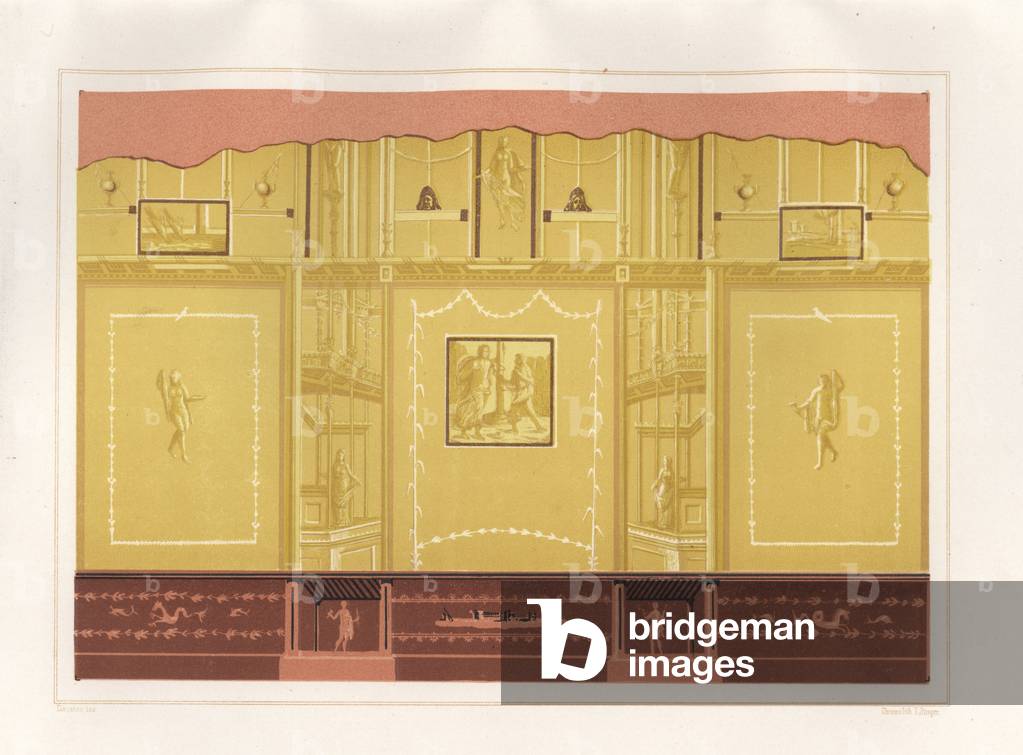
Curious wall painting in muted colours from the oecus (salon) of the Casa del Meleagro or the House of Meleager, Reg. VI, Ins. IX, No. 2. Chromolithograph by Victor Steeger after an illustration by Geremia Discanno from Emile Presuhn (1844-1878) The Most Beautiful Paintings of Pompeii, Leipzig, 1881.

FLO4686886: Curious wall painting in muted colours from the oecus (salon) of the Casa del Meleagro or the House of Meleager, Reg. VI, Ins. IX, No. 2. Chromolithograph by Victor Steeger after an illustration by Geremia Discanno from Emile Presuhn (1844-1878) The Most Beautiful Paintings of Pompeii, Leipzig, 1881. / Bridgeman Images

Ariadne watching Theseus's boat depart from the island of Naxos. Mural from a triclinium in a shop/dwelling at Regio IX.II.5, Pompeii. Chromolithograph by Victor Steeger after an illustration by Geremia Discanno from Emile Presuhn (1844-1878) The Most Beautiful Paintings of Pompeii, Leipzig, 1881.

FLO4686919: Ariadne watching Theseus's boat depart from the island of Naxos. Mural from a triclinium in a shop/dwelling at Regio IX.II.5, Pompeii. Chromolithograph by Victor Steeger after an illustration by Geremia Discanno from Emile Presuhn (1844-1878) The Most Beautiful Paintings of Pompeii, Leipzig, 1881., Discanno, Geremia (1839-1907) / Bridgeman Images

Le Centre Georges Pompidou, Place Georges Pompidou, Paris 75004 (photo)

MDA4686951: Le Centre Georges Pompidou, Place Georges Pompidou, Paris 75004 (photo), Rogers, Richard (b.1933) and Piano, Renzo (b.1937) / Bridgeman Images

Le Centre Georges Pompidou, Place Georges Pompidou, Paris 75004 (photo)

MDA4686963: Le Centre Georges Pompidou, Place Georges Pompidou, Paris 75004 (photo), Rogers, Richard (b.1933) and Piano, Renzo (b.1937) / Bridgeman Images

Wall painting of an arabesque with a mask of Oceanus found in Herculaneum, and two other ornaments of Oceanus and a lotus flower found in the Temple of Isis. All now in the Museum of Naples. Chromolithograph by Victor Steeger after an illustration by Geremia Discanno from Emile Presuhn (1844-1878) The Most Beautiful Paintings of Pompeii, Leipzig, 1881.

FLO4687005: Wall painting of an arabesque with a mask of Oceanus found in Herculaneum, and two other ornaments of Oceanus and a lotus flower found in the Temple of Isis. All now in the Museum of Naples. Chromolithograph by Victor Steeger after an illustration by Geremia Discanno from Emile Presuhn (1844-1878) The Most Beautiful Paintings of Pompeii, Leipzig, 1881., Discanno, Geremia (1839-1907) / Bridgeman Images

Portrait of a man and woman from an unidentified house in Pompeii. Chromolithograph by Victor Steeger after an illustration by Geremia Discanno from Emile Presuhn (1844-1878) The Most Beautiful Paintings of Pompeii, Leipzig, 1881.

FLO4687054: Portrait of a man and woman from an unidentified house in Pompeii. Chromolithograph by Victor Steeger after an illustration by Geremia Discanno from Emile Presuhn (1844-1878) The Most Beautiful Paintings of Pompeii, Leipzig, 1881., Discanno, Geremia (1839-1907) / Bridgeman Images

Heracles at rest. Detail. 4th century BC (Bronze sculpture)

LRI4687118: Heracles at rest. Detail. 4th century BC (Bronze sculpture), Lysippos (fl.370-310 BC) (attributed to) / Bridgeman Images

Alpine Hare (Lepus alpinus). Lithographie in The Naturalist Pocket Magazine or Cabinet complete des Curiosites et Beautes de la Nature, published between 1798 and 1802, by Harrison, London, England.

FLO4687319: Alpine Hare (Lepus alpinus). Lithographie in The Naturalist Pocket Magazine or Cabinet complete des Curiosites et Beautes de la Nature, published between 1798 and 1802, by Harrison, London, England. / Bridgeman Images

Wall painting from a room in the House of the Epigrams. V, Ins. 1, No. 18. Chromolithograph by Victor Steeger after an illustration by Geremia Discanno from Emile Presuhn (1844-1878) The Most Beautiful Paintings of Pompeii, Leipzig, 1881.

FLO4686877: Wall painting from a room in the House of the Epigrams. V, Ins. 1, No. 18. Chromolithograph by Victor Steeger after an illustration by Geremia Discanno from Emile Presuhn (1844-1878) The Most Beautiful Paintings of Pompeii, Leipzig, 1881., Discanno, Geremia (1839-1907) / Bridgeman Images

Wall paintings from rooms in the House of the Epigrams. V, Ins. 1, No. 18. On the left, a mural from an atrium, and at right, a mural from an antichamber. Chromolithograph by Victor Steeger after an illustration by Geremia Discanno from Emile Presuhn (1844-1878) The Most Beautiful Paintings of Pompeii, Leipzig, 1881.

FLO4686902: Wall paintings from rooms in the House of the Epigrams. V, Ins. 1, No. 18. On the left, a mural from an atrium, and at right, a mural from an antichamber. Chromolithograph by Victor Steeger after an illustration by Geremia Discanno from Emile Presuhn (1844-1878) The Most Beautiful Paintings of Pompeii, Leipzig, 1881., Discanno, Geremia (1839-1907) / Bridgeman Images

Wall with panel of theatrical masks from the tablinum of a house at VI.8.24.. Chromolithograph by Victor Steeger after an illustration by Geremia Discanno from Emile Presuhn (1844-1878) The Most Beautiful Paintings of Pompeii, Leipzig, 1881.

FLO4686910: Wall with panel of theatrical masks from the tablinum of a house at VI.8.24.. Chromolithograph by Victor Steeger after an illustration by Geremia Discanno from Emile Presuhn (1844-1878) The Most Beautiful Paintings of Pompeii, Leipzig, 1881., Discanno, Geremia (1839-1907) / Bridgeman Images

Wall painting from a room in the Domus M. Asellini or House of Adonis or House of Venus and Adonis or Casa di Ione or Casa con Xystus, Reg. VI.7.18. Drawn and chromolithographed by Victor Steeger from Emile Presuhn (1844-1878) The Most Beautiful Paintings of Pompeii, Leipzig, 1881.

FLO4686942: Wall painting from a room in the Domus M. Asellini or House of Adonis or House of Venus and Adonis or Casa di Ione or Casa con Xystus, Reg. VI.7.18. Drawn and chromolithographed by Victor Steeger from Emile Presuhn (1844-1878) The Most Beautiful Paintings of Pompeii, Leipzig, 1881., Discanno, Geremia (1839-1907) / Bridgeman Images

Decorative ornaments with centaurs and harpies in the oecus or living room in the house of Lucius Caecilius Iucundus. Chromolithograph by Victor Steeger after an illustration by Geremia Discanno from Emile Presuhn (1844-1878) The Most Beautiful Paintings of Pompeii, Leipzig, 1881.

FLO4686969: Decorative ornaments with centaurs and harpies in the oecus or living room in the house of Lucius Caecilius Iucundus. Chromolithograph by Victor Steeger after an illustration by Geremia Discanno from Emile Presuhn (1844-1878) The Most Beautiful Paintings of Pompeii, Leipzig, 1881., Discanno, Geremia (1839-1907) / Bridgeman Images


Back to top