Search options

Orientation
Colour

Display options

View

Print

To print search results, use print friendly version of this page.

2491708 Search Results

Portrait of Italian director Giorgio Strehler in 1980.

MME4705239: Portrait of Italian director Giorgio Strehler in 1980., Mencarini, Marcello / Bridgeman Images

Two armed knights, a horse and teams for different tests: the race with targets (right), and the race of the wheel (left). The horse of the one on the left, bears the green colors striped with white and the knight has a helm has two large wings of white feather. The one on the right is yellow striped with black, with the letter M and wears a helmet with two horns curved at the back. During the race, the knight had to touch a target point of his opponent's armor, during the game, the goal was to unarm his opponent. Hand-coloured copper engraving, in “Images historiques des costumes des principaux peuples de l'Antiquite et du Middle Ages” by Robert Von Spalart, published in 1796.

FLO4707088: Two armed knights, a horse and teams for different tests: the race with targets (right), and the race of the wheel (left). The horse of the one on the left, bears the green colors striped with white and the knight has a helm has two large wings of white feather. The one on the right is yellow striped with black, with the letter M and wears a helmet with two horns curved at the back. During the race, the knight had to touch a target point of his opponent's armor, during the game, the goal was to unarm his opponent. Hand-coloured copper engraving, in “Images historiques des costumes des principaux peuples de l'Antiquite et du Middle Ages” by Robert Von Spalart, published in 1796. / Bridgeman Images
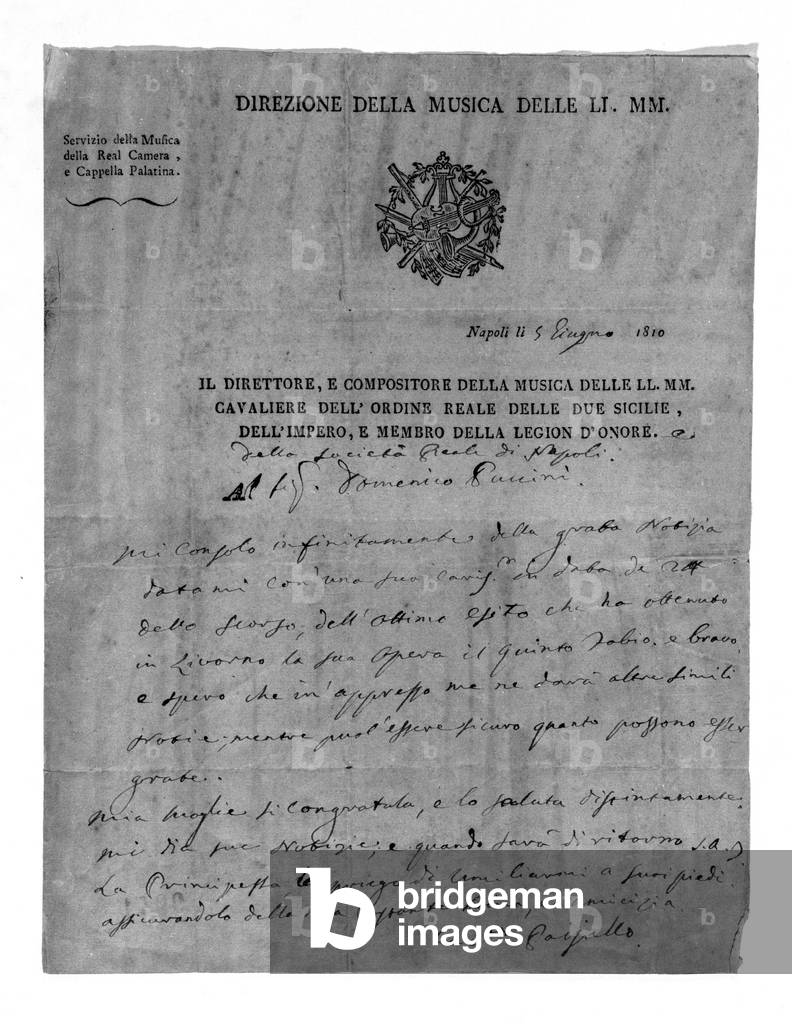
Letter from Giovanni Paisiello (or Paesiello or Paesieillo) (1740-1816), Italian composer at Domenico Puccini, grandfather of Giacomo Puccini. 1810. Milan Museo teatrale della Scala.

GIA4707250: Letter from Giovanni Paisiello (or Paesiello or Paesieillo) (1740-1816), Italian composer at Domenico Puccini, grandfather of Giacomo Puccini. 1810. Milan Museo teatrale della Scala., Unknown Artist, (19th century) / Bridgeman Images

Anglo Saxon king on the battlefield, wearing a wreath and armor, reserved for members of the kingdoms in the 8th century. He wears a yellow shield and wields his sword over his head. Behind him, his squire wears a blue hat and a white tunic and holds a white ecu bordered by scarlet. Hand-coloured copper engraving, in “Images historiques des costumes des principaux peuples de l'Antiquite et du Middle Ages” by Robert Von Spalart, published in 1796.

FLO4707366: Anglo Saxon king on the battlefield, wearing a wreath and armor, reserved for members of the kingdoms in the 8th century. He wears a yellow shield and wields his sword over his head. Behind him, his squire wears a blue hat and a white tunic and holds a white ecu bordered by scarlet. Hand-coloured copper engraving, in “Images historiques des costumes des principaux peuples de l'Antiquite et du Middle Ages” by Robert Von Spalart, published in 1796. / Bridgeman Images
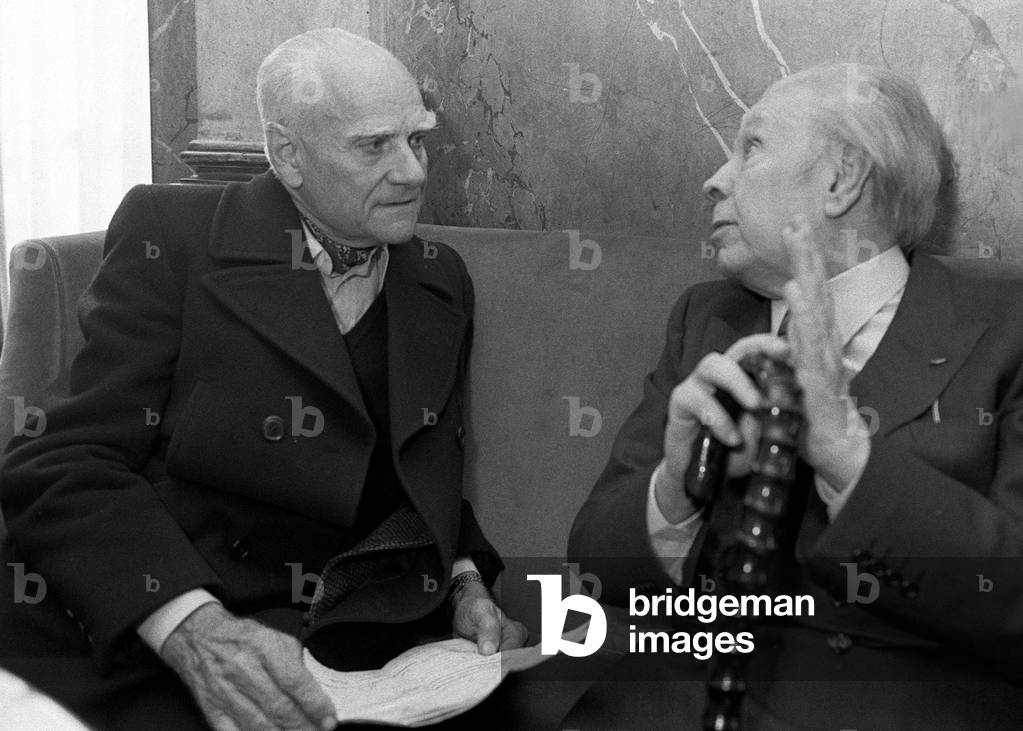
Portrait of Argentine writer Jorge Luis Borges with Italian writer Alberto Moravia in Rome, 1981.

MME4707124: Portrait of Argentine writer Jorge Luis Borges with Italian writer Alberto Moravia in Rome, 1981., Mencarini, Marcello / Bridgeman Images

Three knight mounted teams for different types of tests: the race of the arm guard with the helm, the race with round wheels and small targets and the game. In the races, the knights aimed at their spear at a specific point in their opponent's chest pto blow a metal plate, their spear ended with a sharp metal tip, the players' spear had a crown of spikes at its end.

FLO4707171: Three knight mounted teams for different types of tests: the race of the arm guard with the helm, the race with round wheels and small targets and the game. In the races, the knights aimed at their spear at a specific point in their opponent's chest pto blow a metal plate, their spear ended with a sharp metal tip, the players' spear had a crown of spikes at its end. / Bridgeman Images

Golden pheasant (Chrysolophus pictus), native to China, is sometimes called Chinese pheasant, tricolor huppe or painted pheasant, because of its bright colors. Georges Cuvier (1769-1832) believed that the description of phenix found in Pliny the Elder (23-79) was probably that of the golden pheasant. Lithographie in The Naturalist Pocket Magazine or Cabinet complete des Curiosites et Beautes de la Nature, published between 1798 and 1802, by Harrison, London, England.

FLO4687739: Golden pheasant (Chrysolophus pictus), native to China, is sometimes called Chinese pheasant, tricolor huppe or painted pheasant, because of its bright colors. Georges Cuvier (1769-1832) believed that the description of phenix found in Pliny the Elder (23-79) was probably that of the golden pheasant. Lithographie in The Naturalist Pocket Magazine or Cabinet complete des Curiosites et Beautes de la Nature, published between 1798 and 1802, by Harrison, London, England. / Bridgeman Images

Pear butter Diel (common pear tree). Lithograph after the illustration of Augusta Withers (1793-1877), published in the “Pomology Magazine” (1828-1830) by John Lindley (1795-1865). Butter Diel pear, Pyrus communis, raised by Van Mons at Leuven. Illustration by Mrs. Withers. Handcoloured copperplate engraved by S. Watts from J. Lindley's “” Pomological Magazine,” London, 1828-1930.

FLO4687854: Pear butter Diel (common pear tree). Lithograph after the illustration of Augusta Withers (1793-1877), published in the “Pomology Magazine” (1828-1830) by John Lindley (1795-1865). Butter Diel pear, Pyrus communis, raised by Van Mons at Leuven. Illustration by Mrs. Withers. Handcoloured copperplate engraved by S. Watts from J. Lindley's “” Pomological Magazine,” London, 1828-1930. / Bridgeman Images

Madame Virginie. Portrait of a corpulent woman, sitting, her cat on her knees. 1905 (Painting)

LRI4687861: Madame Virginie. Portrait of a corpulent woman, sitting, her cat on her knees. 1905 (Painting), Boccioni, Umberto (1882-1916) / Bridgeman Images

Fishing bellegarde or galade (variety of common fishing). Lithograph after the illustration of Augusta Withers (1793-1877), published in the “Pomology Magazine” (1828-1830) by John Lindley (1795-1865). Bellegarde or galande peach, Prunus persica. Illustration by Mrs. Withers. Handcoloured copperplate engraved by S. Watts from J. Lindley's “” Pomological Magazine,” London, 1828-1930.

FLO4687899: Fishing bellegarde or galade (variety of common fishing). Lithograph after the illustration of Augusta Withers (1793-1877), published in the “Pomology Magazine” (1828-1830) by John Lindley (1795-1865). Bellegarde or galande peach, Prunus persica. Illustration by Mrs. Withers. Handcoloured copperplate engraved by S. Watts from J. Lindley's “” Pomological Magazine,” London, 1828-1930. / Bridgeman Images

Morning or “” Pantheistic Poem”” Landscape of undergrowth near a body of water at dawn. Painting by Vittore Grubicy of Dragon (1851-1920) Milan, Galleria d'Arte Moderna

LRI4687584: Morning or “” Pantheistic Poem”” Landscape of undergrowth near a body of water at dawn. Painting by Vittore Grubicy of Dragon (1851-1920) Milan, Galleria d'Arte Moderna, Grubicy de Dragon, Vittore (1851-1920) / Bridgeman Images

Futurism: “” Futuristic Cypres”” Painting by Giacomo Balla (1871-1958) 1920 Dim. 75,5x59,5 cm Milan, Galleria d'Arte Moderna

LRI4687591: Futurism: “” Futuristic Cypres”” Painting by Giacomo Balla (1871-1958) 1920 Dim. 75,5x59,5 cm Milan, Galleria d'Arte Moderna, Balla, Giacomo (1871-1958) / Bridgeman Images

The Paradise Tree (or Bird of Paradise) Great Emerald (Paridisaea apoda), bird native to New Guinean and Indonesia.

FLO4687794: The Paradise Tree (or Bird of Paradise) Great Emerald (Paridisaea apoda), bird native to New Guinean and Indonesia. / Bridgeman Images

Apricot (apricot tree). Lithograph after the illustration of Augusta Withers (1793-1877), published in the “Pomology Magazine” (1828-1830) by John Lindley (1795-1865). Royal apricot, Prunus armeniaca, raised in the Royal Garden of the Luxembourg. Illustration by Mrs. Withers. Handcoloured copperplate engraved by S. Watts from J. Lindley's “” Pomological Magazine,” London, 1828.

FLO4687839: Apricot (apricot tree). Lithograph after the illustration of Augusta Withers (1793-1877), published in the “Pomology Magazine” (1828-1830) by John Lindley (1795-1865). Royal apricot, Prunus armeniaca, raised in the Royal Garden of the Luxembourg. Illustration by Mrs. Withers. Handcoloured copperplate engraved by S. Watts from J. Lindley's “” Pomological Magazine,” London, 1828. / Bridgeman Images

The Great Bird in Love designed in 1996 photo taken in 1996 (photo)

LBY4687853: The Great Bird in Love designed in 1996 photo taken in 1996 (photo), Tinguely, Jean (1925-1991) & Saint-Phalle, Niki de (1930-2002) / Bridgeman Images

Contrast Shape. 1913 (Oil on Cardboard)

LRI4687893: Contrast Shape. 1913 (Oil on Cardboard), Leger, Fernand (1881-1955) / Bridgeman Images

Apple Blenheim pippin (domestic apple variety). Lithograph after the illustration of Augusta Withers (1793-1877), published in the “Pomology Magazine” (1828-1830) by John Lindley (1795-1865). Blenheim pippin apple, Malus domestica, raised in Woodstock. Illustration by Mrs. Withers. Handcoloured copperplate engraved by S. Watts from J. Lindley's “” Pomological Magazine,” London, 1828-1930.

FLO4687915: Apple Blenheim pippin (domestic apple variety). Lithograph after the illustration of Augusta Withers (1793-1877), published in the “Pomology Magazine” (1828-1830) by John Lindley (1795-1865). Blenheim pippin apple, Malus domestica, raised in Woodstock. Illustration by Mrs. Withers. Handcoloured copperplate engraved by S. Watts from J. Lindley's “” Pomological Magazine,” London, 1828-1930. / Bridgeman Images

Strawberries (strawberry ostara). Lithograph after the illustration of Augusta Withers (1793-1877), published in the “Pomology Magazine” (1828-1830) by John Lindley (1795-1865). Grove-End scarlet strawberry, Fragaria x anananassa, raised at Grove End, London, in 1820. Illustration by Mrs. Withers. Handcoloured copperplate engraved by S. Watts from J. Lindley's “” Pomological Magazine,” London, 1828-1930.

FLO4688040: Strawberries (strawberry ostara). Lithograph after the illustration of Augusta Withers (1793-1877), published in the “Pomology Magazine” (1828-1830) by John Lindley (1795-1865). Grove-End scarlet strawberry, Fragaria x anananassa, raised at Grove End, London, in 1820. Illustration by Mrs. Withers. Handcoloured copperplate engraved by S. Watts from J. Lindley's “” Pomological Magazine,” London, 1828-1930. / Bridgeman Images

Protiro of the cathedral , end 13th-beginning 14th century

LRI4688306: Protiro of the cathedral , end 13th-beginning 14th century, Italian School, (13th century) / Bridgeman Images

Musee Guggenheim in Bilbao, Spain. End of construction 1997, architect Frank Gehry. Photography 1997.

LBY4688326: Musee Guggenheim in Bilbao, Spain. End of construction 1997, architect Frank Gehry. Photography 1997., Gehry, Frank (1929-2025) / Bridgeman Images

Musee Guggenheim in Bilbao, Spain. End of construction 1997, architect Frank Gehry. Photography 1997.

LBY4688344: Musee Guggenheim in Bilbao, Spain. End of construction 1997, architect Frank Gehry. Photography 1997., Gehry, Frank (1929-2025) / Bridgeman Images

Aboriginals of King George Sound (Albany, South West Australia). Men in cloak and loincloth. Copied from d'Urville. Handcoloured lithograph by J. Bull from James Cowles Prichard's Natural History of Man, Balliere, London, 1855.

FLO4688518: Aboriginals of King George Sound (Albany, South West Australia). Men in cloak and loincloth. Copied from d'Urville. Handcoloured lithograph by J. Bull from James Cowles Prichard's Natural History of Man, Balliere, London, 1855. / Bridgeman Images

Ram Ruttun, companion and secretary to Ram-Mohun-Roy, a Brahman of India. Handcoloured lithograph by J. Bull after an illustration by Branwhite from James Cowles Prichard's Natural History of Man, Balliere, London, 1855.

FLO4688568: Ram Ruttun, companion and secretary to Ram-Mohun-Roy, a Brahman of India. Handcoloured lithograph by J. Bull after an illustration by Branwhite from James Cowles Prichard's Natural History of Man, Balliere, London, 1855. / Bridgeman Images

Interior the Ampitheatre, Pompeii. Chromolithograph after an illustration by S. De Stefani from Antonio Niccoliniõs Pompeii: Views and Restorations (Pompeii: Essaies et Restorations), published by Fausto Niccolini, Naples, 1898. Antonio was grandson of the architect Antonio Niccolini Sr.

FLO4688201: Interior the Ampitheatre, Pompeii. Chromolithograph after an illustration by S. De Stefani from Antonio Niccoliniõs Pompeii: Views and Restorations (Pompeii: Essaies et Restorations), published by Fausto Niccolini, Naples, 1898. Antonio was grandson of the architect Antonio Niccolini Sr. / Bridgeman Images

The mandolin player, 20th century (painting)

JLJ4688271: The mandolin player, 20th century (painting), Manessier, Alfred (1911-93) / Bridgeman Images

House in Regio VIII, insula 2, Pompeii. Chromolithograph and illustration by G. Autoriello from Antonio Niccoliniõs Pompeii: Views and Restorations (Pompeii: Essaies et Restorations), published by Zucchi & De Luca, Naples, 1898. Antonio was grandson of the architect Antonio Niccolini Sr.

FLO4688286: House in Regio VIII, insula 2, Pompeii. Chromolithograph and illustration by G. Autoriello from Antonio Niccoliniõs Pompeii: Views and Restorations (Pompeii: Essaies et Restorations), published by Zucchi & De Luca, Naples, 1898. Antonio was grandson of the architect Antonio Niccolini Sr. / Bridgeman Images

Musee Guggenheim in Bilbao, Spain. End of construction 1997, architect Frank Gehry. Photography 1997.

LBY4688359: Musee Guggenheim in Bilbao, Spain. End of construction 1997, architect Frank Gehry. Photography 1997., Gehry, Frank (1929-2025) / Bridgeman Images

Native man of Anaiteum island (Aneityum, Vanuatu). He wears his long hair tied with shells, and a cloak. Taken from Captain J.E. Erskine's “Journal of a Cruise,” 1853. Handcoloured lithograph by J. Bull from James Cowles Prichard's Natural History of Man, Balliere, London, 1855.

FLO4688492: Native man of Anaiteum island (Aneityum, Vanuatu). He wears his long hair tied with shells, and a cloak. Taken from Captain J.E. Erskine's “Journal of a Cruise,” 1853. Handcoloured lithograph by J. Bull from James Cowles Prichard's Natural History of Man, Balliere, London, 1855. / Bridgeman Images

Jewish old clothesman with a bag of clothes over his shoulder, rags and hat in his hand. Handcoloured copperplate engraving from William Henry Pyne's The World in Miniature: England, Scotland and Ireland, Ackermann, 1827.

FLO4688688: Jewish old clothesman with a bag of clothes over his shoulder, rags and hat in his hand. Handcoloured copperplate engraving from William Henry Pyne's The World in Miniature: England, Scotland and Ireland, Ackermann, 1827. / Bridgeman Images

View of the Street of Tombs outside the Herculaneum Gate, Pompeii. Chromolithograph and illustration by G. Autoriello from Antonio Niccoliniõs Pompeii: Views and Restorations (Pompeii: Essaies et Restorations), published by Zucchi & De Luca, Naples, 1898. Antonio was grandson of the architect Antonio Niccolini Sr.

FLO4688136: View of the Street of Tombs outside the Herculaneum Gate, Pompeii. Chromolithograph and illustration by G. Autoriello from Antonio Niccoliniõs Pompeii: Views and Restorations (Pompeii: Essaies et Restorations), published by Zucchi & De Luca, Naples, 1898. Antonio was grandson of the architect Antonio Niccolini Sr. / Bridgeman Images

House of Ariadne or the House of the Coloured Capitals, VII.4.31/51, Pompeii. Chromolithograph after an illustration by S. De Stefano from Antonio Niccoliniõs Pompeii: Views and Restorations (Pompeii: Essaies et Restorations), published by Fausto Niccolini, Naples, 1898. Antonio was grandson of the architect Antonio Niccolini Sr.

FLO4688167: House of Ariadne or the House of the Coloured Capitals, VII.4.31/51, Pompeii. Chromolithograph after an illustration by S. De Stefano from Antonio Niccoliniõs Pompeii: Views and Restorations (Pompeii: Essaies et Restorations), published by Fausto Niccolini, Naples, 1898. Antonio was grandson of the architect Antonio Niccolini Sr. / Bridgeman Images

Apodyterium or changing room for the Tepidarium or warm bath in the Forum Thermae, Pompeii. Serving with oil vase and towel standing next to a table. The walls have figures of Thelamon and niches for personal effects. Chromolithograph by D. Capri after an illustration by G. Discanno from Antonio Niccoliniõs Pompeii: Views and Restorations (Pompeii: Essaies et Restorations), published by Zucchi & De Luca, Naples, 1898. Antonio was grandson of the architect Antonio Niccolini Sr.

FLO4688287: Apodyterium or changing room for the Tepidarium or warm bath in the Forum Thermae, Pompeii. Serving with oil vase and towel standing next to a table. The walls have figures of Thelamon and niches for personal effects. Chromolithograph by D. Capri after an illustration by G. Discanno from Antonio Niccoliniõs Pompeii: Views and Restorations (Pompeii: Essaies et Restorations), published by Zucchi & De Luca, Naples, 1898. Antonio was grandson of the architect Antonio Niccolini Sr. / Bridgeman Images

A woman of the Tuda race of the Nilagiri hills in India, wearing sari, veil, necklace and earrings. Handcoloured lithograph from James Cowles Prichard's Natural History of Man, Balliere, London, 1855.

FLO4688357: A woman of the Tuda race of the Nilagiri hills in India, wearing sari, veil, necklace and earrings. Handcoloured lithograph from James Cowles Prichard's Natural History of Man, Balliere, London, 1855. / Bridgeman Images

Woman of the Mariana Islands in top, skirt, necklace with cross. Handcoloured lithograph by J. Bull from James Cowles Prichard's Natural History of Man, Balliere, London, 1855.

FLO4688435: Woman of the Mariana Islands in top, skirt, necklace with cross. Handcoloured lithograph by J. Bull from James Cowles Prichard's Natural History of Man, Balliere, London, 1855. / Bridgeman Images

The Soup, Nah-Pope, a Sauk warrior (Bags and Fox Nation). Soup was second in command to Black Hawk during the war and brother of The Prophet. Handcoloured lithograph by J. Harris after a painting by George Catlin from James Cowles Prichard's Natural History of Man, Balliere, London, 1855.

FLO4688550: The Soup, Nah-Pope, a Sauk warrior (Bags and Fox Nation). Soup was second in command to Black Hawk during the war and brother of The Prophet. Handcoloured lithograph by J. Harris after a painting by George Catlin from James Cowles Prichard's Natural History of Man, Balliere, London, 1855., Catlin, George (1796-1872) / Bridgeman Images

The Mint, Sha-ko-ka, a Mandan or Numakiki girl. A very pretty and modest girl, 12 years of age, with grey hair peculiar to the Mandan nation. Handcoloured lithograph after a painting by George Catlin from James Cowles Prichard's Natural History of Man, Balliere, London, 1855.

FLO4688582: The Mint, Sha-ko-ka, a Mandan or Numakiki girl. A very pretty and modest girl, 12 years of age, with grey hair peculiar to the Mandan nation. Handcoloured lithograph after a painting by George Catlin from James Cowles Prichard's Natural History of Man, Balliere, London, 1855., Catlin, George (1796-1872) / Bridgeman Images


Back to top