Search options

Orientation
Colour

Display options

View

Print

To print search results, use print friendly version of this page.

2491383 Search Results

Urban signage between Boulevard Saint Michel and Boulevard Saint Germain, Paris 5e.

TEC4622464: Urban signage between Boulevard Saint Michel and Boulevard Saint Germain, Paris 5e. / Bridgeman Images

Jesus in the house of Martha and Mary of Bethany, 1620 (painting)

LRI4622483: Jesus in the house of Martha and Mary of Bethany, 1620 (painting), Steenwyk, Hendrik van (the Younger) (c.1580-1649) / Bridgeman Images

Musee national du Middle Ages et des thermal baths de Cluny, 6 place Paul Painleve in Paris in the 5th arrondissement.The thermal baths of Cluny date from the end of the 3rd century. They were the largest of the three ancient establishments in the public baths of Lutece.

TEC4622498: Musee national du Middle Ages et des thermal baths de Cluny, 6 place Paul Painleve in Paris in the 5th arrondissement.The thermal baths of Cluny date from the end of the 3rd century. They were the largest of the three ancient establishments in the public baths of Lutece. / Bridgeman Images

The descent of Jesus Christ to the  limbo, detail of an angel, 1568 (painting)

LRI4622525: The descent of Jesus Christ to the limbo, detail of an angel, 1568 (painting), Tintoretto, Domenico Robusti (1560-1635) / Bridgeman Images

Nebula IC 2177 in the Unicorn - IC 2177 The Seagull nebula - IC 2177, is a large emission nebula located at the edge of the constellations of the Unicorn and the Great Dog. Image obtained through 3 different filters that highlight oxygen (blue), hydrogen (green), and sulfur (red). IC 2177, also known as the Eagle or Seagull Nebula, is a large emission nebulosity located on the border between Monoceros and Canis Major, about 7.5 degrees northeast of Sirius. This image is in the classic “” Hubble palette”” where SII is assigned to red, H - alpha to green, and OIII to blue. RGB frames were taken for star colors

PIX4622528: Nebula IC 2177 in the Unicorn - IC 2177 The Seagull nebula - IC 2177, is a large emission nebula located at the edge of the constellations of the Unicorn and the Great Dog. Image obtained through 3 different filters that highlight oxygen (blue), hydrogen (green), and sulfur (red). IC 2177, also known as the Eagle or Seagull Nebula, is a large emission nebulosity located on the border between Monoceros and Canis Major, about 7.5 degrees northeast of Sirius. This image is in the classic “” Hubble palette”” where SII is assigned to red, H - alpha to green, and OIII to blue. RGB frames were taken for star colors / Bridgeman Images

Nebula NGC 604 in the galaxy M33 - NGC 604 star forming nebula - NGC 604, is a very large star-forming region located in the galaxy M33 of the Triangle. This image is a composite of X-ray images (blue) obtained by the Chandra Space Telescope and visible (green and red) by the Hubble Space Telescope. The study of very hot gas observed in X-ray allows us to better understand the star formation activity within this nebula. NGC 604, is one of the largest known seething cauldrons of star birth in a nearby galaxy. NGC 604 is similar to familiar star - birth regions in our Milky Way galaxy, such as the Orion Nebula, but it is vastly larger in extent and contains many more recently formed stars. This monstrous star - birth region contains more than 200 brilliant blue stars within a cloud of glowing gases some 1,300 light - years across, nearly 100 times the size of the Orion Nebula. The bright stars in NGC 604 are extremely young having formed a mere 3 million years ago. The most massive stars in NGC 604 exceed 120 times the mass of our Sun, and their surface temperatures are as hot as 72,000 degrees Fahrenheit (40,000 Kelvin). Ultraviolet radiation floods out from these hot stars, making the surrounding nebular gas fluoresce. NGC 604 lies in a spiral arm of the nearby galaxy M33, located about 2.7 million light - years away in the direction of the constellation Triangulum. The image is a composite of images taken in X - ray (in blue) by Chandra X - Ray observatory and in optical (red and green) by the Hubble space telescope. It shows a divided neighborhood where some 200 hot, young, massive stars reside. Bubbles in the cooler gas and dust have been generated by powerful stellar winds, which are then filled with hot, X - ray emitting gas. Scientists find the amount of hot gas detected in the bubbles on the right side corresponds to the amount entirely powered by winds from the 200 hot massive stars. The situation is different on th

PIX4617509: Nebula NGC 604 in the galaxy M33 - NGC 604 star forming nebula - NGC 604, is a very large star-forming region located in the galaxy M33 of the Triangle. This image is a composite of X-ray images (blue) obtained by the Chandra Space Telescope and visible (green and red) by the Hubble Space Telescope. The study of very hot gas observed in X-ray allows us to better understand the star formation activity within this nebula. NGC 604, is one of the largest known seething cauldrons of star birth in a nearby galaxy. NGC 604 is similar to familiar star - birth regions in our Milky Way galaxy, such as the Orion Nebula, but it is vastly larger in extent and contains many more recently formed stars. This monstrous star - birth region contains more than 200 brilliant blue stars within a cloud of glowing gases some 1,300 light - years across, nearly 100 times the size of the Orion Nebula. The bright stars in NGC 604 are extremely young having formed a mere 3 million years ago. The most massive stars in NGC 604 exceed 120 times the mass of our Sun, and their surface temperatures are as hot as 72,000 degrees Fahrenheit (40,000 Kelvin). Ultraviolet radiation floods out from these hot stars, making the surrounding nebular gas fluoresce. NGC 604 lies in a spiral arm of the nearby galaxy M33, located about 2.7 million light - years away in the direction of the constellation Triangulum. The image is a composite of images taken in X - ray (in blue) by Chandra X - Ray observatory and in optical (red and green) by the Hubble space telescope. It shows a divided neighborhood where some 200 hot, young, massive stars reside. Bubbles in the cooler gas and dust have been generated by powerful stellar winds, which are then filled with hot, X - ray emitting gas. Scientists find the amount of hot gas detected in the bubbles on the right side corresponds to the amount entirely powered by winds from the 200 hot massive stars. The situation is different on th / Bridgeman Images

Portrait of the elector Prince Augustus I of Saxony called the Pious, 1565 (painting)

LRI4612589: Portrait of the elector Prince Augustus I of Saxony called the Pious, 1565 (painting), Cranach, Lucas the Younger (1515-86) / Bridgeman Images

Spiral galaxy M101 in the Great Bear - Spiral galaxy M101 in Ursa Major - The galaxy M101 (NGC 5457) is located about 27 million years away from Earth. Image obtained with a 40 cm telescope, composite of several images, 2h30 pose. M101 (NGC 5457) is about 27 Mly away. Composite image obtained with a RC 16”” telescope

PIX4612662: Spiral galaxy M101 in the Great Bear - Spiral galaxy M101 in Ursa Major - The galaxy M101 (NGC 5457) is located about 27 million years away from Earth. Image obtained with a 40 cm telescope, composite of several images, 2h30 pose. M101 (NGC 5457) is about 27 Mly away. Composite image obtained with a RC 16”” telescope / Bridgeman Images

Louis XIV furniture: chest of drawers with metal inlay with acanth made, detail. 1680-1700 (metal)

JLJ4612674: Louis XIV furniture: chest of drawers with metal inlay with acanth made, detail. 1680-1700 (metal), Boulle, Andre Charles (1642-1732) / Bridgeman Images

Reverse coins: at the bottom, half franc silver coin with the effigy of Henry III (1551-1589), 1577 (silver)

JLJ4612680: Reverse coins: at the bottom, half franc silver coin with the effigy of Henry III (1551-1589), 1577 (silver), French School, (16th century) / Bridgeman Images

Spiral galaxy M101 in the Great Bear - Spiral galaxy M101 in Ursa Major - The galaxy M101 (NGC 5457) is located about 27 million years away from Earth. It spans more than 170,000 light years, almost double the size of our galaxy. We think that of the trillion stars in it, 100 billion stars could be similar to our Sun. Composite image obtained from 51 different clicks made by the Hubble space telescope from March 1994 to January 2003 and from ground photos at Kitt Peak and CFHT in Hawaii. Spiral galaxy M101 is a beautiful, large, face - on spiral galaxy located about 27 million light - years away in the constellation Ursa Major. This galaxy's portrait is actually composed of 51 individual Hubble exposures, in addition to elements from images from ground - based photos. The giant spiral disk of stars, dust, and gas is 170,000 light - years across or almost twice the diameter of our galaxy, the Milky Way. M101 is estimated to contain at least one trillion stars. Approximately 100 billion of these stars could be like our Sun in terms of temperature and lifetime. The galaxy's spiral arms are sprinkled with large regions of star - forming nebulae. These nebulae are areas of intense star formation within giant molecular hydrogen clouds. Brilliant young clusters of hot, blue, newborn stars trace out the spiral arms. The disk of M101 is so thin that Hubble easily sees many more distant galaxies lying behind the galaxy

PIX4612686: Spiral galaxy M101 in the Great Bear - Spiral galaxy M101 in Ursa Major - The galaxy M101 (NGC 5457) is located about 27 million years away from Earth. It spans more than 170,000 light years, almost double the size of our galaxy. We think that of the trillion stars in it, 100 billion stars could be similar to our Sun. Composite image obtained from 51 different clicks made by the Hubble space telescope from March 1994 to January 2003 and from ground photos at Kitt Peak and CFHT in Hawaii. Spiral galaxy M101 is a beautiful, large, face - on spiral galaxy located about 27 million light - years away in the constellation Ursa Major. This galaxy's portrait is actually composed of 51 individual Hubble exposures, in addition to elements from images from ground - based photos. The giant spiral disk of stars, dust, and gas is 170,000 light - years across or almost twice the diameter of our galaxy, the Milky Way. M101 is estimated to contain at least one trillion stars. Approximately 100 billion of these stars could be like our Sun in terms of temperature and lifetime. The galaxy's spiral arms are sprinkled with large regions of star - forming nebulae. These nebulae are areas of intense star formation within giant molecular hydrogen clouds. Brilliant young clusters of hot, blue, newborn stars trace out the spiral arms. The disk of M101 is so thin that Hubble easily sees many more distant galaxies lying behind the galaxy / Bridgeman Images

The tomb of Philippe Pot (1428-1494), 1477-1483 (limestone)

JLJ4612701: The tomb of Philippe Pot (1428-1494), 1477-1483 (limestone), Franco-Burgundian, (15th century) / Bridgeman Images

L'alsace Heureé: La ronde enfantine à Guemar (print)

JLJ4622367: L'alsace Heureé: La ronde enfantine à Guemar (print), Waltz, Jean-Jacques (Hansi) (1873-1951) / Bridgeman Images

The Chapel of the Sorbonne and Boulevard Saint Michel in Paris.

TEC4622421: The Chapel of the Sorbonne and Boulevard Saint Michel in Paris. / Bridgeman Images

The Interior of an Inn (The Broken Eggs) by Jan Steen (1625/6-1679). With self portrait, 1665-1670 (Oil on canvas)

LRI4622476: The Interior of an Inn (The Broken Eggs) by Jan Steen (1625/6-1679). With self portrait, 1665-1670 (Oil on canvas), Steen, Jan Havicksz. (1625/26-79) / Bridgeman Images

Nebula IC 2220 in the Carene - A mass - loss star in IC 2220 - This nebula is illuminated by a giant red star, the star HD 65670. Image obtained by Siding Spring's 3.9m telescope. The bright, supergiant star at the centre of this nebula is known only by its catalog designation, HD 65750. The nebulosity around the star is the result of light reflected by dust surrounding it. The dust is thought to consist mainly of particles of silica condensed from material which the star is losing from its distended surface at a fairly steady rate. The rate of mass loss is much higher than in normal stars and is sufficient to produce the reflection nebula IC 2220. The stellar nature of the central object is revealed by the four diffraction spikes extending from it. These are artifacts due to structures within the telescope. The light from the star has also produced the annular halation ring (a photographic artefact) that ornaments the nebula. These features, real or otherwise, have provoked the name 'Toby Jug' for this nebula, after the ornamental English drinking vessel or beer mug

PIX4622497: Nebula IC 2220 in the Carene - A mass - loss star in IC 2220 - This nebula is illuminated by a giant red star, the star HD 65670. Image obtained by Siding Spring's 3.9m telescope. The bright, supergiant star at the centre of this nebula is known only by its catalog designation, HD 65750. The nebulosity around the star is the result of light reflected by dust surrounding it. The dust is thought to consist mainly of particles of silica condensed from material which the star is losing from its distended surface at a fairly steady rate. The rate of mass loss is much higher than in normal stars and is sufficient to produce the reflection nebula IC 2220. The stellar nature of the central object is revealed by the four diffraction spikes extending from it. These are artifacts due to structures within the telescope. The light from the star has also produced the annular halation ring (a photographic artefact) that ornaments the nebula. These features, real or otherwise, have provoked the name 'Toby Jug' for this nebula, after the ornamental English drinking vessel or beer mug / Bridgeman Images

The story of Alsace tells the children: Louis XIV in Alsace (print)

JLJ4622521: The story of Alsace tells the children: Louis XIV in Alsace (print), Waltz, Jean-Jacques (Hansi) (1873-1951) / Bridgeman Images
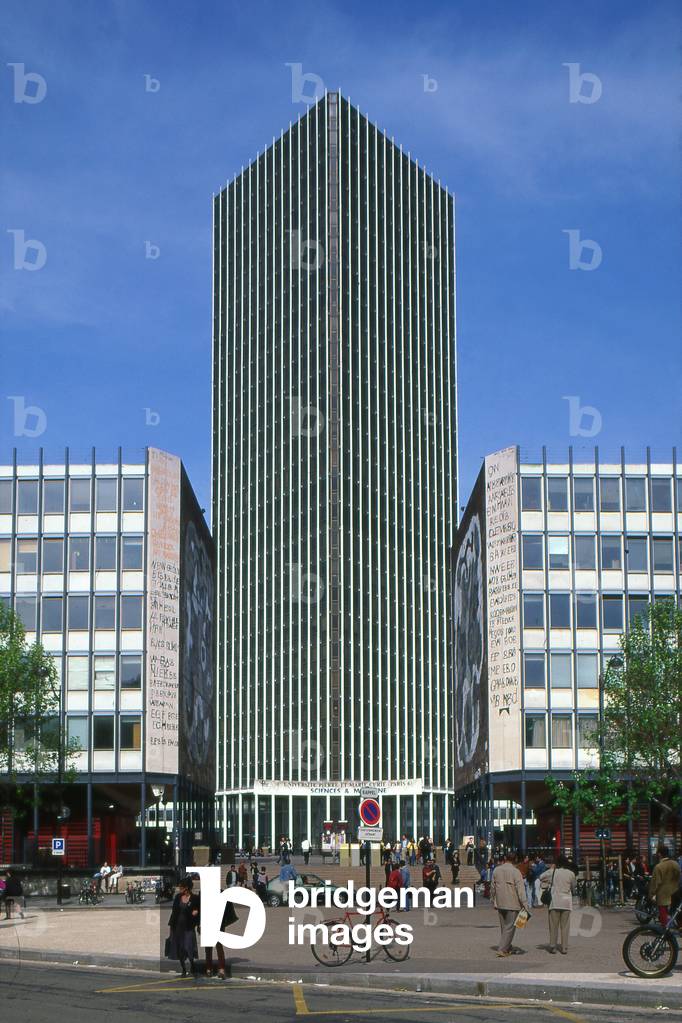
The Faculty of Sciences of Jussieu, Paris. Construction 1971, architects Edouard Alber, Urbain Cassan, Rene Coulon and Roger Seassal.

TEC4622542: The Faculty of Sciences of Jussieu, Paris. Construction 1971, architects Edouard Alber, Urbain Cassan, Rene Coulon and Roger Seassal. / Bridgeman Images

Nebulae IC 2948 and 2944 in Centaur - The Running Chicken Nebula - Nebula IC 2948 is a vast nebula located about 6000 light years from Earth in the southern constellation of Centaur. It is associated with the cluster of stars IC 2944 near which Bok's blood cells are visible. A Bok's blood cell is a dark interstellar cloud of gases and dust that absorb light. If it condenses enough, it gives birth to new stars. This image from the Wide Field Imager on the MPG/ESO 2.2 - metre telescope shows the Running Chicken Nebula, a cloud of gas and newborn stars that lies around 6500 light - years away from us in the constellation of Centaurus (The Centaur). Officially called IC 2944, or the Lambda Centauri Nebula, its strange nickname comes from the bird - like shape of its brightest region. The star Lambda Centauri itself lies just outside the field of view

PIX4622594: Nebulae IC 2948 and 2944 in Centaur - The Running Chicken Nebula - Nebula IC 2948 is a vast nebula located about 6000 light years from Earth in the southern constellation of Centaur. It is associated with the cluster of stars IC 2944 near which Bok's blood cells are visible. A Bok's blood cell is a dark interstellar cloud of gases and dust that absorb light. If it condenses enough, it gives birth to new stars. This image from the Wide Field Imager on the MPG/ESO 2.2 - metre telescope shows the Running Chicken Nebula, a cloud of gas and newborn stars that lies around 6500 light - years away from us in the constellation of Centaurus (The Centaur). Officially called IC 2944, or the Lambda Centauri Nebula, its strange nickname comes from the bird - like shape of its brightest region. The star Lambda Centauri itself lies just outside the field of view / Bridgeman Images

History: Second World War (1939-1945). Showcase protected by bands, Paris October 1939 (photo)

JLJ4617019: History: Second World War (1939-1945). Showcase protected by bands, Paris October 1939 (photo), Unknown photographer, (20th century) / Bridgeman Images

Let me look (Mixed media on canvas, 20th century)

LRI4617142: Let me look (Mixed media on canvas, 20th century), Novelli, Gastone (1925-68) / Bridgeman Images

Mercury by Mariner 10 - Mosaic of images obtained by the Mariner probe 10. Recolorated image. Missing data on top right

PIX4617145: Mercury by Mariner 10 - Mosaic of images obtained by the Mariner probe 10. Recolorated image. Missing data on top right / Bridgeman Images

Kite in the wind (Mixed media on canvas, 1965)

LRI4617154: Kite in the wind (Mixed media on canvas, 1965), Novelli, Gastone (1925-68) / Bridgeman Images

Spiral galaxy M101 in the Great Bear - Spiral galaxy M101 in Ursa Major - The galaxy M101 (NGC 5457) is located about 27 million years away from Earth. Image obtained in 1995 with an amateur instrument, a 130 mm bezel. Spiral galaxy M101 is a beautiful, large, face - on spiral galaxy located about 27 million light - years away in the constellation Ursa Major

PIX4612716: Spiral galaxy M101 in the Great Bear - Spiral galaxy M101 in Ursa Major - The galaxy M101 (NGC 5457) is located about 27 million years away from Earth. Image obtained in 1995 with an amateur instrument, a 130 mm bezel. Spiral galaxy M101 is a beautiful, large, face - on spiral galaxy located about 27 million light - years away in the constellation Ursa Major / Bridgeman Images

Furniture, 18th century (screen painting on maroufle paper)

JLJ4612722: Furniture, 18th century (screen painting on maroufle paper), Lajoue, Jacques de (1687-1761) / Bridgeman Images

Spiral galaxy NGC 5775 - NGC 5775 is located about 85 million light years away from Earth in the galaxy cluster of Our Lady. Seen from the Earth, this spiral galaxy is presented by the slice, leaving only the thickness of its disc visible. Image obtained by the Hubble Space Telescope. This NASA/ESA Hubble Space Telescope image shows the edge - on profile of the slender spiral galaxy NGC 5775. NGC 5775 is a member of the Virgo Cluster and lies at a distance of about 85 million light - years. This colour picture was created from images taken using the Wide Field Channel of Hubble's Advanced Camera for Surveys

PIX4612800: Spiral galaxy NGC 5775 - NGC 5775 is located about 85 million light years away from Earth in the galaxy cluster of Our Lady. Seen from the Earth, this spiral galaxy is presented by the slice, leaving only the thickness of its disc visible. Image obtained by the Hubble Space Telescope. This NASA/ESA Hubble Space Telescope image shows the edge - on profile of the slender spiral galaxy NGC 5775. NGC 5775 is a member of the Virgo Cluster and lies at a distance of about 85 million light - years. This colour picture was created from images taken using the Wide Field Channel of Hubble's Advanced Camera for Surveys / Bridgeman Images

Galaxies NGC 5981, NGC 5982 and NGC 5985 in the Dragon - Galaxies NGC 5981, NGC 5982 and NGC 5985 in Draco - This group of galaxies is located about 100 million years ago - light from Earth in the constellation of the Dragon. On the left, the spiral galaxy NGC 5985, in the center, the elliptical galaxy NGC 5982, on the right the spiral galaxy seen by the slice NGC 5981. This group of galaxies is located 100 million light years away. At left is the spiral galaxy NGC 5985, center is an elliptical galaxy NGC 5982, at right an edge - on spiral galaxy NGC 5981

PIX4612894: Galaxies NGC 5981, NGC 5982 and NGC 5985 in the Dragon - Galaxies NGC 5981, NGC 5982 and NGC 5985 in Draco - This group of galaxies is located about 100 million years ago - light from Earth in the constellation of the Dragon. On the left, the spiral galaxy NGC 5985, in the center, the elliptical galaxy NGC 5982, on the right the spiral galaxy seen by the slice NGC 5981. This group of galaxies is located 100 million light years away. At left is the spiral galaxy NGC 5985, center is an elliptical galaxy NGC 5982, at right an edge - on spiral galaxy NGC 5981 / Bridgeman Images

Galaxy NGC 6670 in the Peacock - Galaxy NGC 6670 in Pavo - The galaxy NGC 6670, is about 400 million light years away from Earth in the southern constellation of Peacock. This system consists of two collision galaxies seen by the slice. Their nuclei are approximately 50,000 light years away. Image obtained by the Hubble Space Telescope on 30 October 2001. NGC 6670 is a gorgeous pair of overlapping edge - on galaxies. Scientists believe that NGC 6670 has already experienced at least one close encounter and is now in the early stages of a second. The nuclei of the two galaxies are approximately 50,000 light - years apart. NGC 6670 glows in the infrared with more than a hundred billion times the luminosity of our Sun and is thought to be entering a starburst phase. The pair is located some 400 million light - years away from Earth

PIX4612954: Galaxy NGC 6670 in the Peacock - Galaxy NGC 6670 in Pavo - The galaxy NGC 6670, is about 400 million light years away from Earth in the southern constellation of Peacock. This system consists of two collision galaxies seen by the slice. Their nuclei are approximately 50,000 light years away. Image obtained by the Hubble Space Telescope on 30 October 2001. NGC 6670 is a gorgeous pair of overlapping edge - on galaxies. Scientists believe that NGC 6670 has already experienced at least one close encounter and is now in the early stages of a second. The nuclei of the two galaxies are approximately 50,000 light - years apart. NGC 6670 glows in the infrared with more than a hundred billion times the luminosity of our Sun and is thought to be entering a starburst phase. The pair is located some 400 million light - years away from Earth / Bridgeman Images

Spiral galaxy NGC 6744 in the constellation Peacock - Spiral galaxy NGC 6744 in Pavo - The galaxy NGC 6744 is about 25 million years away - light from Earth. Image obtained from the 3.9m telescope of Siding Spring, Australia. This beautiful galaxy is about 25 million light years away in the direction of Pavo, a constellation of the southern hemisphere winter. It sits in a rich starfield, and is strongly inclined to our line of sight. NGC 6744 is believed to one of the most Milky Way - like of all the nearby spirals, with fluffy (flocculent) spiral arms and a large and distinctly elongated nucleus. It also has other similarities to the Milky Way that are not visible here with at least one distorted companion galaxy superficially similar to one of the Magellanic Clouds

PIX4612996: Spiral galaxy NGC 6744 in the constellation Peacock - Spiral galaxy NGC 6744 in Pavo - The galaxy NGC 6744 is about 25 million years away - light from Earth. Image obtained from the 3.9m telescope of Siding Spring, Australia. This beautiful galaxy is about 25 million light years away in the direction of Pavo, a constellation of the southern hemisphere winter. It sits in a rich starfield, and is strongly inclined to our line of sight. NGC 6744 is believed to one of the most Milky Way - like of all the nearby spirals, with fluffy (flocculent) spiral arms and a large and distinctly elongated nucleus. It also has other similarities to the Milky Way that are not visible here with at least one distorted companion galaxy superficially similar to one of the Magellanic Clouds / Bridgeman Images

The story of Alsace tells the children: War of Revolution (print)

JLJ4622621: The story of Alsace tells the children: War of Revolution (print), Waltz, Jean-Jacques (Hansi) (1873-1951) / Bridgeman Images

Detail of the Pelican nebula (IC 5067 - 5070) in the Cygn

PIX4622642: Detail of the Pelican nebula (IC 5067 - 5070) in the Cygn / Bridgeman Images

Nebula IC 4628 in Scorpio - Nebula IC 4628 in Scorpius - Nebula has a low light emission, IC 4628 (or Gum 56) is alongside the open cluster Collinder 316, which houses many young hot stars. Image obtained through 3 different filters that highlight oxygen (blue), hydrogen (green), and sulfur (red). This beautiful, arc - like rim of nebulosity is in the far southern sky, out of sight from most of the USA and Europe. It is quite faint and has often been overlooked because of it, even by southern observers. However, it is in a rich region in Scorpius. This richness is reflected in the number of names associated with the objects in the field illustrated here. There is a large scattered star cluster, Collinder 316 which extends over most of the picture. It encloses Trumpler 24, more or less the same cluster under another name, and all of this is part of the Sco OB1 association, a much larger gathering of very hot, intrinsically luminous stars in this part of the sky. The nebula itself is also known as Gum 56, after the Australian Colin Gum who catalogued emission nebulae in the southern sky using wide field photography. This image is in the classic “” Hubble palette”” where SII is assigned to red, H - alpha to green, and OIII to blue. RGB frames were taken for star colors

PIX4622673: Nebula IC 4628 in Scorpio - Nebula IC 4628 in Scorpius - Nebula has a low light emission, IC 4628 (or Gum 56) is alongside the open cluster Collinder 316, which houses many young hot stars. Image obtained through 3 different filters that highlight oxygen (blue), hydrogen (green), and sulfur (red). This beautiful, arc - like rim of nebulosity is in the far southern sky, out of sight from most of the USA and Europe. It is quite faint and has often been overlooked because of it, even by southern observers. However, it is in a rich region in Scorpius. This richness is reflected in the number of names associated with the objects in the field illustrated here. There is a large scattered star cluster, Collinder 316 which extends over most of the picture. It encloses Trumpler 24, more or less the same cluster under another name, and all of this is part of the Sco OB1 association, a much larger gathering of very hot, intrinsically luminous stars in this part of the sky. The nebula itself is also known as Gum 56, after the Australian Colin Gum who catalogued emission nebulae in the southern sky using wide field photography. This image is in the classic “” Hubble palette”” where SII is assigned to red, H - alpha to green, and OIII to blue. RGB frames were taken for star colors / Bridgeman Images

The tricolor paradise: The Place du Marche in Thann, 1918 (print)

JLJ4622691: The tricolor paradise: The Place du Marche in Thann, 1918 (print), Waltz, Jean-Jacques (Hansi) (1873-1951) / Bridgeman Images

The tricolor paradise: At the border (print)

JLJ4622712: The tricolor paradise: At the border (print), Waltz, Jean-Jacques (Hansi) (1873-1951) / Bridgeman Images

Neptune seen by Voyager 2 - Image of Neptune obtained by the Voyager 2 probe on August 20, 1989. Neptune has an equatorial diameter of about 49,000 kilometres. Its blue color is due to the abundance of methane in its atmosphere. In this photo, in the centre, the Great Dark Spot, which is the size of the Earth where winds are blowing at 300 m/s. This spot has now disappeared but other dark spots have been detected since then. Under the Great Dark Spot, on the left, a small cloud of irregular shape moving very quickly, nicknamed the scooter

PIX4622802: Neptune seen by Voyager 2 - Image of Neptune obtained by the Voyager 2 probe on August 20, 1989. Neptune has an equatorial diameter of about 49,000 kilometres. Its blue color is due to the abundance of methane in its atmosphere. In this photo, in the centre, the Great Dark Spot, which is the size of the Earth where winds are blowing at 300 m/s. This spot has now disappeared but other dark spots have been detected since then. Under the Great Dark Spot, on the left, a small cloud of irregular shape moving very quickly, nicknamed the scooter / Bridgeman Images

Playground (Mixed media, 1965)

LRI4617229: Playground (Mixed media, 1965), Novelli, Gastone (1925-68) / Bridgeman Images


Back to top